 |
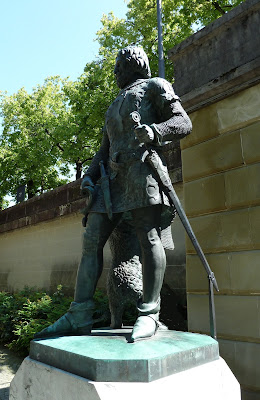
| Standard-bearer of 1542 showing the heraldic bear for Bern. |
Switzerland is known for its direct democracy, where Volkesstimme (the voice of the people) can overturn decisions of parliament and government through a referendum or an initiative.
Just 50000 signatures out of a population of 8 million are needed to launch a referendum against a newly passed law proposing at the same time a new text. Once the referendum is adopted by the majority of the people and the 23 cantons, the result will topple any decision by parliament.
An even more potent weapon is the Volksinitiative (a people's initiative) to change the Federal Constitution. It needs more than 100000 signatures, and the initiative is decided by a popular vote. So paragraphs about animal protection found their way into the Constitution. Many of these sometimes hefty initiatives - like limiting the number of foreigners seeking work and lodging in prosperous Switzerland - fail because the government hastens to make a more balanced or watered-down counter-proposal that, in most cases, is then adopted in a popular vote by the majority of the people and the Cantons.


The power of the Swiss parliament is somewhat restrained. We visited the Nationalrat, and I took the above photo. The speaker, Maya Graf (back in the middle), dressed in green, had apparently noticed me and spoken to an usherette. Thirty seconds later, another usherette approached me from behind and confiscated my camera.
However, I was happy to have taken the photo of the painting I had only seen on television up to now. It shows Lake Lucerne.
On the government bench on the right-hand side, the Minister of Environment, Transportation, and Energy, the attractive Doris Leuthard, dressed in white, is reading. The debate was about an initiative concerning further restricting the transport of goods by road. Many of the deputies were working on their laptops.
Our group got a lesson in direct democracy, and the question always arises: Why do we not have more direct democracy in Germany? The argument frequently brought up is That National referenda work for a population of 8 million but are impractical for a population 10 times as large. I instead think the reason why a more direct democratic system works in Switzerland is the art of consensus. All major parties are represented in the Swiss government, which is composed of seven Bundesräte (ministers), and much care is taken to consider and incorporate the views of minorities in its decisions. Parliament and the government find a compromise that satisfies the majority of people nearly all the time without hurting the minority too much. Happy Switzerland!
In the 1990s, the right-winger and multimillionaire Christoph Blocher, with his slogan "Switzerland for the Swiss," made the Schweizerische Volkspartei the strongest party in parliament, winning 29% of the vote. That not only gave the SVP two seats in the seven-member government but also, in 2003, led to Blocher's election to the Bundesrat. For four years, he showed his Janus face, forcing himself into a consensus with his colleagues from the other parties represented in the government, but making right-wing opposition in parliament. Christoph, the deep-rooted Swiss, clearly overstepped the line of consensus, such that in 2007 parliament did not re-elect him. He is now back in the Nationalrat as a deputy for the Canton of Zurich.
 |
| Inactive Blocher is leaving parliament after his defeat in 2007. |
*known in the US as easing
The relations between Switzerland and Germany are good. Although the Swiss tend to limit their foreign population, they import specialists, e.g., medical doctors and engineers from Germany. The brainpower that leaves my country for better pay in Switzerland amounts to a transfer of 1 billion euros per year, including the money Germany invested in the education of those leaving.
The primary issue of disagreement is Swiss banking secrecy. The black money that German tax cheaters have bunkered in Swiss banks is estimated at a couple of billion euros. A painstakingly negotiated compromise between the two governments on greater transparency in the Swiss banking sector was eventually accepted by the German Bundestag (parliament) but rejected by the German Bundesrat (senate). So we are back to square one, whereas the US seemed more successful at imposing a Lex USA on Switzerland concerning the money of American citizens in Switzerland.
**
 |
| Active Blocher with charm and rhetorical power, debating with us, the people from the big canton in the north. Dr. Michel Wehner from the Baden-Württemberg State Center for Political Education, our efficient guide, conducted the debate professionally. |
The primary issue of disagreement is Swiss banking secrecy. The black money that German tax cheaters have bunkered in Swiss banks is estimated at a couple of billion euros. A painstakingly negotiated compromise between the two governments on greater transparency in the Swiss banking sector was eventually accepted by the German Bundestag (parliament) but rejected by the German Bundesrat (senate). So we are back to square one, whereas the US seemed more successful at imposing a Lex USA on Switzerland concerning the money of American citizens in Switzerland.
 |
| The Bundesplatz (Federal Square) in front of the Bundeshaus in Bern should be called. Bank Square. All big Swiss Banks have their seats and lobbyists on this square. In the back, the UBS is flying the Bern flag. |
 |
| Bertoldo V Duci Zaeringae conditori urbis Bernae. Bertold V founded Bern in 1191, whereas Freiburg had already become a city in 1120 with his great-uncle Konrad. |
 |
| E bellua casae sit futura nomen Legend has it that the first animal sighted should give the new place its name. It was a bear. |
 |
| A lazy bear on display in Bern's bear pit. |
 |
| The old town hall, built from 1406 to 1417, is beautifully restored. |

I remember having to go through security like an airport and I think I may of checked my camera ahead of time, this was 2 years ago. I could see if it was like Washington D.C. where you might take a picture of inactivity! Here is Madison you can take all the pictures you want (maybe that's when the're not in session. Anyway sometimes it's fun to get a special shot!
ReplyDeleteThis comment has been removed by a blog administrator.
ReplyDelete