Friday, November 9, 2012

Weimar in October 2012

Remember? I started the first blog of my Weimar quadrology, telling you about Elisabeth's and my recent visit to this cultural highlight, but then I was carried away digging into my past Weimar experience. That happened in my second blog about Weimar, too. I shall no longer go back in history but move forward to the present in a third attempt.

We took an early train at Freiburg but then suffered a one-hour delay. With our train being behind schedule, we missed our connection to Erfurt in Fulda. A one-hour delay on the Deutsche Bahn is not a big problem, as direct train connections in Germany are served every hour during the daytime. So, you just wait for the next train, even though your seat reservations are lost. We filled the wait at Fulda's train station with a forced coffee and arrived in Weimar around 3 p.m.

Henry van der Velde advertising Weimar's onion market.
Instead of star architect Walter Gropius and femme fatale Alma Mahler-Gropius-Werfel, this time the founder of the Grand-Ducal School of Arts and Crafts in Weimar, the predecessor of the Bauhaus, Henry van der Velde, greeted us from the balcony of the Elephant Hotel.

View of Weimar's marketplace from our room. In the background, the Herderkirche.
HE showed us the way to a souvenir shop. 
During an afternoon walk through the streets of Weimar, we passed the National Theater.

The well-known Goethe-Schiller monument in front of the Weimar National Theater was modified.
Thomas Mann, Goethe's lifelong venerator, stands in for Friedrich Schiller. 
However, we visited the Schiller- and not the Thomas-Mann-Haus:
  
Entrance to Schiller's house
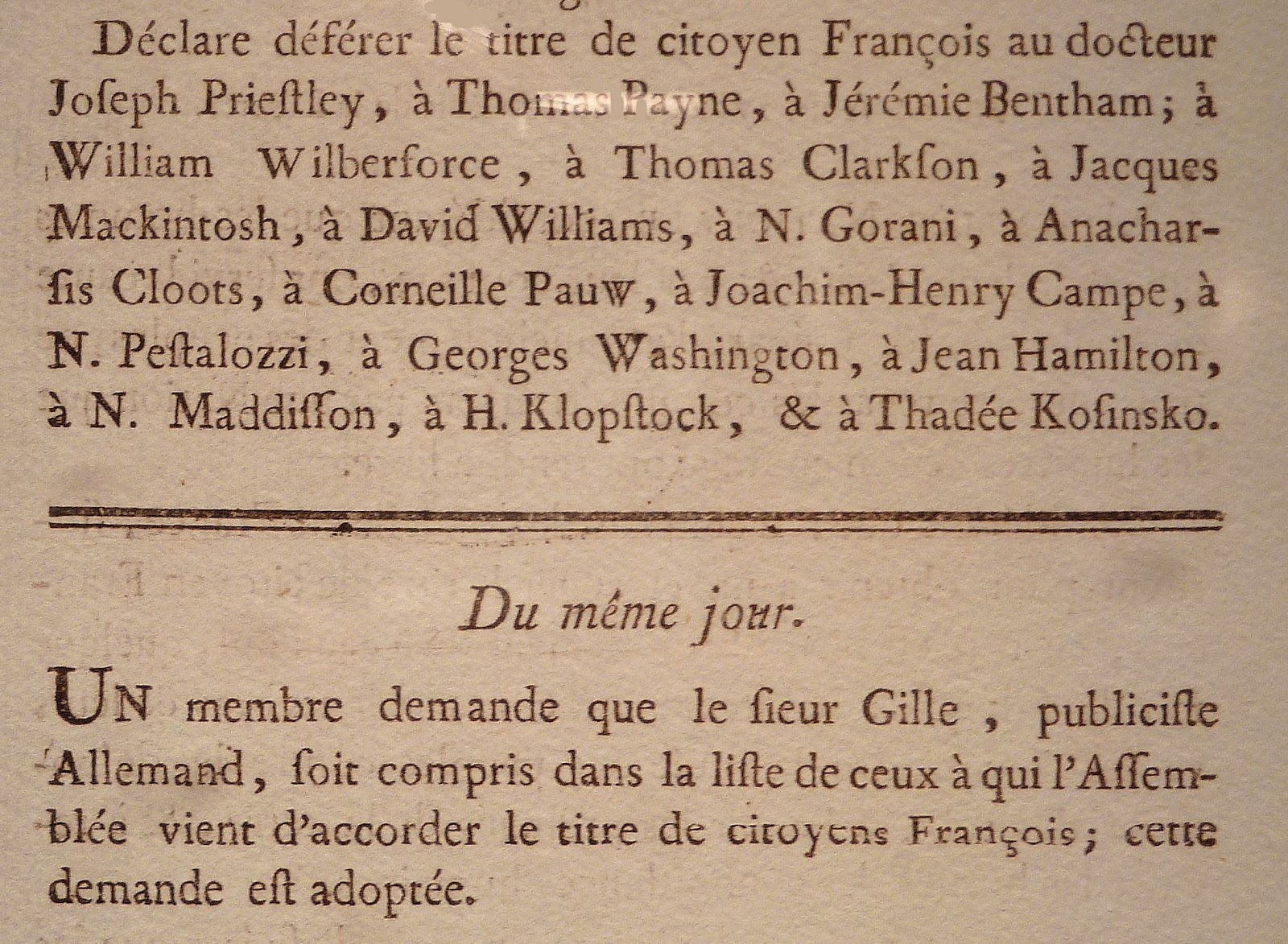
Photos were not allowed, but I took one of the Loi du 25 Août 1792, l'an quatrième de la Liberté, signed by the great Danton himself, making le sieur Gilles, publiciste Allemand, a citizen of revolutionary France.

Schiller became a citizen of revolutionary France.
Le membre proposing the publiciste Allemand may have read Schiller's Die Räuber (The Robbers), but got his name completely wrong. Note, "called-up-late" Schiller is in the company of well-known temporaries like Thomas Payne (Thomas Paine, Anglo-American political activist), Joachim-Henry Campe (Joachim Heinrich Campe, German linguist), N. Pestalozzi (Johann Heinrich Pestalozzi, Swiss pedagogue), Georges Washington (George Washington, First President of the United States), Jean Hamilton (John Hamilton, Congressman from Pennsylvania), N. Maddisson (James Madison, Fourth President of the United States) and H. Klopstock (Friedrich Gottlieb Klopstock, German poet).

Elisabeth and I closed the day by having dinner at the ElephantenkellerThe round table from 1990 was still in place, but this time, it was empty. I chose a delicious Kohlroulade (stuffed cabbage leaf) from the menu and a Pilsner beer from nearby Apolda.

Delicious stuffed cabbage leaf
The following morning, a guide showed us around Weimar. We saw Goethe's summer house (Gartenhaus) from a distance.

Goethe's summer house from a distance.
For the afternoon, we had reserved a visitor's slot for the Goethehaus and the adjacent Goethe National Museum, where an exposition of artifacts documents the genius's curriculum vitae.

In the evening, we had dinner at Weimar's Ratskeller, where I had a Rindsroulade (beef olive) that I drowned in and downed with the usual Köstritzer Schwarzbier.

Rindsroulade mit Thüringer Klößen (Thuringian dumplings)
On Saturday morning, the Herder church was open to visitors.

The Herder church in October 2012 was a building site.
Herder, in front of "his" church, initially called Stadtkirche.
November 1989: Prayers for peace not only in Leipzig: We are the people!
In and outside the church, there were building sites. The Lutheran Church is preparing its historic places for the demi-millennium of the Reformation in 1517.


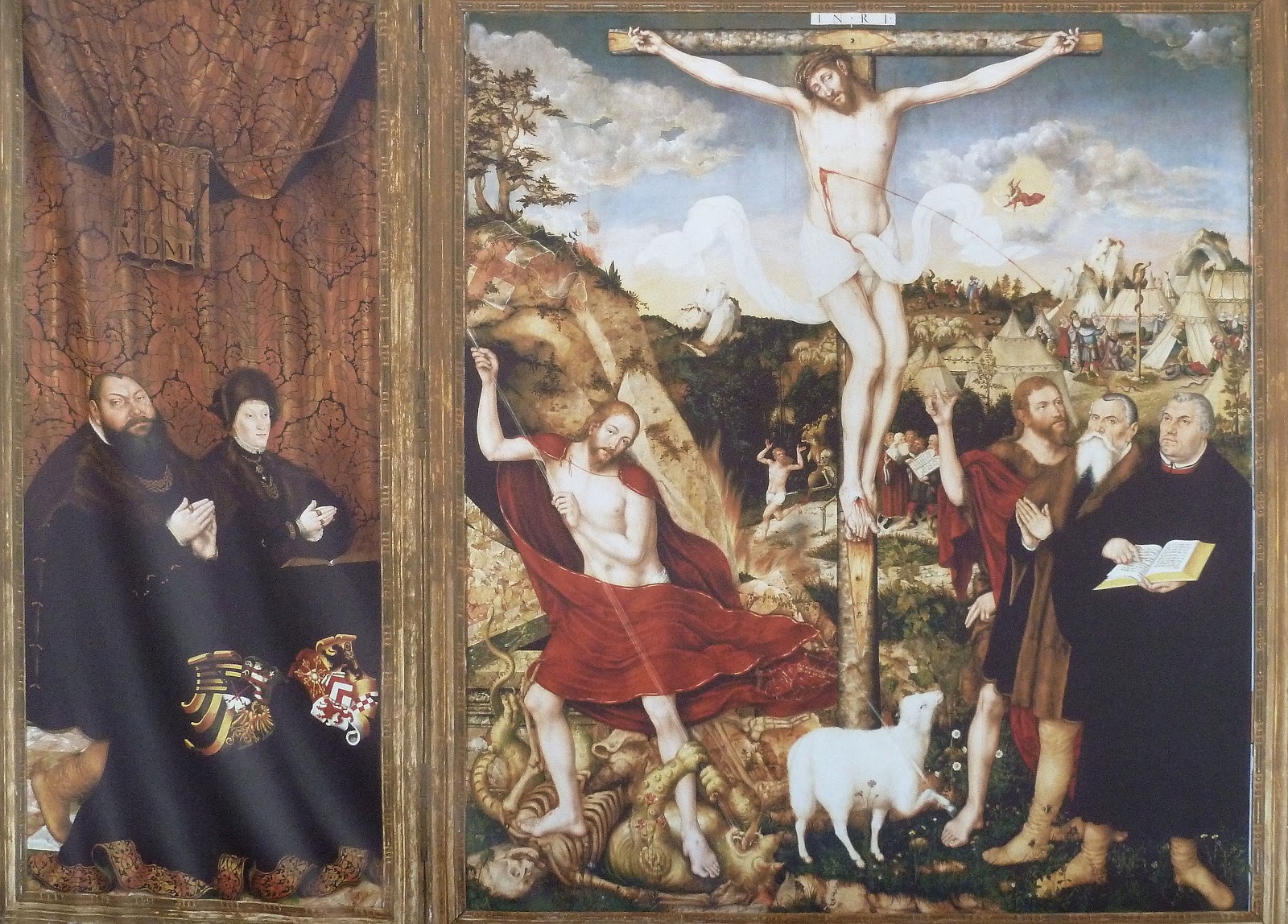
The famous altarpiece apotheosizing the Reformation was started by Lucas Cranach the Elder in 1552, one year before his death. His son, Lucas Cranach the Younger, finished it in 1555. The original painting was covered due to ongoing building activities inside the church. 

I took this photo of a photo print on canvas displayed for the benefit of the visitors. On the right, you recognize Martin Luther, and to his left, the painter Lucas Cranach.  John the Steadfast, who introduced the Reformation in Thuringia, and his wife sit on the other side.

Passing Weimar's castle ...

The castle's medieval tower is crowned by a Baroque helmet.
... we took a stroll through the park at the Ilm River toward Goethe's Gartenhaus. He had lived there from 1776 until 1782, when he moved into his townhouse at the Frauenplan.

Goethe's garden, where He grew his vegetables. 
Picking up a Thüringer Bratwurst on our way, we climbed to the Nietzsche Archive in the early afternoon.


The archive was empty, making the entrance fee not worth it, except for the building's Art Nouveau construction. Nevertheless, we enjoyed the walk to Weimar's old cemetery with Goethe's and Schiller's crypts. Recently, a DNA analysis revealed that Schiller's skull is not his.

Many people still consider Ernst von Wildenbruch's citation engraved into the monument:
Ich kämpfte nicht um anzugreifen, sondern um zu verteidigen (I did not fight to attack but to defend)
as proof that Germany was attacked by the surrounding countries in 1914.
 The problem is that von Wildenbruch had already died in 1909. 
Later, on our way back to the center, Big Goethe was watching us from a banner:
 
Lebensfluten, Tatensturm (Floods of life, storms of action)

We had a beer at a small place opposite the Goethehaus, watching carriages drive by. For a moment, forget those iron poles and the cars and live your dreams.
**

Sunday, November 4, 2012

Weimar, the Second Time Around

Following the fall of the Berlin Wall on November 9, 1989, and the opening of the border between West and East Germany, my friend and colleague working at the Nuclear Research Center near Karlsruhe invited Professor D. for Radiation Protection Physics at Dresden's Technical University.

She arrived at the beginning of December for the usual semi-annual meeting of our West German working group, "On the measurement of ionizing radiation." We had long and good conversations, feeling strange, for in previous years, when we met East German colleagues at international conferences, they were not allowed to talk to us. We all were overwhelmed by the new German-German togetherness.

So, in a follow-up, Professor D. invited three working group members to her annual International Symposium on Radiation Physics at Gaussig, a cozy castle east of Dresden used by the Technical University (TU) for meetings or on other occasions.

During the winter, I prepared my paper, Personal Neutron Monitoring in an Accelerator Environment, and was eagerly looking forward to my visit to Germany's heartland. At the end of March, I called my host in Dresden and asked her whether she needed anything I could take along. Well, the seminar participants organize at least one party, and any contribution would be welcome.

A Bocksbeutel, half full
(©Wikipedia/Mussklprozz)
An empty Bocksbeutel
 (©Wikipedia/Prince Grobhelm)
So I decided the best would be to furnish some wine they possibly had not tasted behind the Iron Curtain. The day before I crossed the now-open border into the still-existing German Democratic Republic (GDR), I stopped at Iphofen's winery. I loaded the trunk of my car with six boxes of Franconian wine bottled in Bocksbeuteln.

Then I took a night's rest at Bad Hersfeld and, heading east, reached the border in the gray of dawn. I approached a wooden shed lost in the middle of nowhere, bordering a tarred strip as an ersatz for the nonexistent road. Two sleepy border guards looking out of a window rounded up the surrealistic scene when they, utterly bored, nodded at me to pass. Border guards under the Ulbricht regime would have taken my car to pieces. Apparently shocked by the lifting of the Iron Curtain, they even refused to ask for my passport.

I am going to my first stop: Eisenach, the place of a German myth, the Wartburg. The oncoming traffic was heavy, with one two-stroke engine Trabi after the other heading west, filling the air with the typical smell of burned oil. People were suddenly free and eager to travel to capitalist enemy territory, buying goods they did not find in the GDR.

Entering Eisenach, the smell changed to the typical taste of sulfur dioxide caused by the burning of lignite, the only energy source the GDR had plenty of. I parked my car near one of the ascents to Wartburg and climbed up the hill in beautiful sunshine. It was still early in the morning, but streams of people were already flowing in both directions.

German History on Wartburg Stamps

Weimar Republic

1923: Inflation, a stamp of 5000 marks
1932: Great Depression,
a semipostal of 4+2 pfennigs
Nazi Germany

1933: Wagner's Tannhäuser or the Wartburg song contest
(Der Sängerkrieg auf der Wartburg), a semipostal of 3+2 pfennigs

Divided Germany

1966: Agnostic GDR commemorating
the 900th anniversary of the Wartburg
1967: Religious FRG commemorating the
450th anniversary of the Reformation.
Luther, concealed at the Wartburg,
translated the Bible into German
I wanted to buy some picture postcards. The vendors only accepted Western currency. How did they know I was not a Bürger der DDR (citizen of the GDR)? I rushed through the historic site: Luther's study, the Kemenate (Cabinet room) of Elizabeth of Hungary, and the hall (19th century) of the Wartburg song contest overdecorated with mosaic.

At lunchtime, I tried to be in Weimar, but potholes slowed my progress while Trabis*, ignoring them, overtook me flying by. Eventually, at noon, I parked my car near Weimar's central marketplace on an abandoned bomb site. I walked to the Elephant Hotel for lunch at its famous Elephantenkeller, the basement restaurant. Entering the place, a doorman stopped me: We are jam-packed. I asked for the second service. There is none. I handed him over a 10 DM bill. Becoming friendly, he told me to come back in twenty minutes.
*Small cars made in the GDR from plastic with two-stroke sting engines officially named Trabant

Warmed by the April sun outside, I suddenly felt hungry as the smell of Thuringian bratwurst filled the marketplace. I could not describe my feelings when I took my first bite. Still overwhelmed by the first all-German food, I approached the entrance of the Elephant in time. The doorman guided me to a single seat on an otherwise fully packed round table.

When I sat down, all conversation stopped, for the men around the table smelled the Westerner. I greeted them in a friendly manner, starting to talk about this year's early spring. Slowly, they became confident, and suddenly, I listened to an argument: who of them following the Wende (political turnaround) had first taken off his United Socialistic Party (SED) party badge? They took me into their political discussion, so I do not remember what I had for lunch.

In the evening, I reached Dresden, and the following morning, Professor D. showed her three West German invitees around her TU institute. Two facts were immediately undeniable: too many people worked on research projects, half of which would never have been funded in the West. What followed over the following years was a dramatic reduction in staff doing useless or socialistic research. Now we know that one of the reasons for the fall of the Berlin Wall was that the GDR was bankrupt. No wonder. No capitalist government would have paid relatively high salaries to so many "researchers."

The symposium in Gaussig developed into an extraordinary experience wet with tears and wine. I will spare you the scientific details but will mention two nostalgic moments:

1. For the first time, after more than twenty years of abstinence, I tasted salt potatoes (Salzkartoffeln). In contrast, Elisabeth always boils potatoes in their skins (Pellkartoffeln) to preserve their natural taste and nutrients.

Salzkartoffeln (Photo Wikipedia)
Pellkartoffeln (Photo Wikipedia)


The change in food culture was palpable. While in the East, potatoes were still regarded as Sättigungsbeilage (a staple food in GDR German), potatoes in the West had transitioned to a vegetable bought at the grocery in selected varieties and small quantities daily.

My teacher, classmates, and I peeling staple food potatoes
during a fortnightly stay at a youth hostel in 1948.
Red Baron is just in the middle (the fifth from both left and right).
I still remember those men carrying potatoes in sacks of 50 kilograms (one Zentner, i.e., hundred German pounds) into our basement in the fall, filling up aired wooden boxes. Although these potatoes were stored in a cool, dark environment, their quality deteriorated the following year, so they had to be peeled, taking off nearly half their mass in cutting deep.

2. In 1942, I spent the summer in a small place near the Elbsandsteingebirge (Elbe Sandstone Mountains) called Lichtenhain, famous for its artificial waterfall.

Lichtenhain's waterfall (Photo Wikipedia)
Bastei Panorama in the Elbsandsteingebirge
Driving my host and colleagues to the Bastei on the International Symposium's free afternoon, we made a detour to the place of my youth. We found the house where I once stayed easily:

During the summer of 1942, my friend Dieter and I lived in the house located in the photo.
 in the lower right corner
In the photo, you see Dieter and me from left to right.
You recognize our house in the distance.
Dieter was stricken with mytrophy, therefore (?) a precocious child.
I drove my parents crazy, always talking back and putting their words into question:
But Dieter said ...  
Dieter's father, a lawyer and highly decorated First World War veteran, looked like an old man to me with his white mustache - my father was just 36. He took the above photo and some more with a Leica, developed the films, and made the prints himself. During the war, I lost track of Dieter and his family. 

Entering the house where I had spent a couple of weeks of my early youth, everything seemed so small, including the room where I once slept, but nothing had changed. Even the water faucet halfway up the narrow staircase where I had my morning wash was still in place.

I knocked at a door, and from the inside, somebody said: Herein! I opened the door. There, the whole family was sitting around a table manufacturing Easter decorations. I knew people were already working on decorations for Christmas in the West. I bought some Easter bunnies, paid with Western currency, and handed the purchased souvenirs to my colleagues.

It's all history.
**

Sunday, October 28, 2012

Linguae francae

Last weekend Elisabeth and I visited my son in Zürich. On our way, we had coffee at a rest stop. The guy serving was a Yugoslavian speaking a rudimentary High German, with a client trying Swiss German on him. Since no communication was possible, the Swiss guy eventually switched to a guttural-sounding High German. While meditating on the scene, an even better example came to my mind. The other day, I overheard two charming ladies living in our housing complex—one English and the other Spanish—conversing in German, their lingua franca.

In the Middle Ages, educated Christians used Latin as a common language, particularly useful for travel. As my neighbor, a former Latin professor, pointed out, this was not Cicero's language but Küchenlatein (dog Latin). Latin was not only the language of the Church but also the language for writing treaties. Not only one but two peace treaties ended the Thirty Years' War in 1648. For the Protestants, it was the Instrumentum Pacis Caesareo-Suecicum Osnabrugense in Osnabrück; for the Catholics, it was the Instrumentum Pacis Caesareo-Gallicum Monasteriense in Münster.

This practice changed with the Rastatt Peace Treaty of 1714, which ended the Spanish Succession War, written in French. The politically dominant power in Europe, France, imposed its language and greatly influenced manners and culture in the 18th century. 

Frederic the Great spoke better French than German, though his written texts often passed Voltaire's scrutiny and required corrections. Until the beginning of the twentieth century, French was not only the diplomatic language but the lingua franca of Europe's educated circles. 

A mixture of Low German and French is the old consul's opening line in Thomas Mann's Nobel Prize-winning novel Die Buddenbrooks, set in the nineteenth century: "Je, den Düwel ook, c'est la question, ma très chére demoiselle!" Is this a reminder that the Hanseatic city of Lübeck was part of the French Empire from 1811 to 1813?

Born out of the resistance against the Napoleonic occupation, a strong aversion for the French developed in Germany that Turnvater (father of gymnastics) Jahn articulated as follows, "Deutsche, fühlt wieder mit männlichem Hochsinn den Wert eurer edlen, lebendigen Sprache, schöpft aus ihrem nie versiegenden Urborn, grabt die alten Quellen auf und lasset Lutetiens stehende Lache in Ruhe! (Germans, feel manly and high-mindedly the value of your noble, living language again, scoop from its primitive never drying up spring, dig up those old sources, and leave Lutetia's puddle alone!)."

The dominance of French in Europe gradually shifted after the First World War, when American English replaced Voltaire's idiom as the lingua franca. There was only one field in which German was a must at the time: physicsThe geniuses of New Physics, like Hans BetheMax BornWalther BotheAlbert EinsteinJames FranckPascual Jordan, young Werner Heisenberg, and even Niels Bohr, the Dane,  lectured in German. So the Americans coming to Göttingen to study quantum mechanics also trudged through Goethe's language.

In those days, transatlantic communication was by letter. A young American scientist had prepared a thick letter, but he wanted to know its weight to determine the required postage before posting it. So he went downtown Göttingen, entered a stationery shop, letter in hand, and addressed the attractive young lady on the other side of the counter, "Fraulein, haben sie eine Wiege, ich möchte etwas wagen (Young lady, do you have a cradle, I would like to dare something)." Even when she blushed, he did not notice that he had mixed up the vowels, "Fräulein, haben sie eine Waage, ich möchte etwas wiegen (Young lady, do you have a pair of scales I want to weigh something)."

Nowadays, English is the lingua franca of the world, although Professor Henry Higgins once claimed, "In America, they haven't used it for years." 

Luther saw, above all, language as a means of communication when he promoted die gemeine deutsche sprache, das mich beide, Ober- und Niderlender, verstehen mögen (the common German language such that those speaking High German and Low German may both understand me). But he also continued, "Die sprachen sind die scheyden darynn dis messer des geysts stickt (Languages are like sheaths in which stick the spiritual knives of understanding)." 

Luther's remark sometimes makes me feel sorry for the English language, used by so many for communication but spoken by so few. This is why I always admire those who master a language perfectly.

At CERN, where I worked, the two official languages were French and English, but we mainly used a mixture of the two, Franglais, for communication. During meetings, I read the lips of native speakers arguing in their mother tongues, sometimes paying more attention to their formulations than to what they actually said. 

Once, I was mistaken about one of my colleagues, let us call him Fred, whom I admired for his perfect English and his beautiful handwriting. Fred once went to England with another Englishman, Frank, and a German to discuss a delicate technical problem with a British firm. 

In the evening, after a few glasses of whiskey, the firm's boss pointed to the German and said, "You are German." Then he addressed Frank and declared, "You are British." Finally, he turned to Fred, saying, "And you nearly fooled me!" This was not gentlemanlike, for later, I learned that Fred had fled Nazi Germany as a young guy and made a particular effort to make English his mother tongue during his schooling in the UK.

Another colleague at CERN, I admired not only for his perfect French. Albert, a Grande Ecole graduate, was in charge of the authorization process for the LEP storage ring with the French authorities. The main document had been submitted, but the French administration requested clarifications, which my staff and I provided as Technical Memoranda (TMs) written in French. 

One morning, my telephone rang, "Albert here. Could you see me in my office? We should discuss your recent document." I asked, "Is something wrong technically?" He retorted, "No, it's the French." I replied, "But the French was polished by my French secretary, and I have other things to do." He became so angry that I had to give in. So I spent the whole morning going through the French text of the TM with Albert.
 
When he retired five years later, he threw a party. On that occasion, I thanked him, "Albert, avec toi j'ai bien appris le français (Albert, with you, I have learned French well)." He looked at me and sounded disappointed, "C'est tout ce que tu as appris de moi? (Is that all that you have learned from me?)."

Coming back to my original topic. Clearly, American English is today's lingua franca. Many English technical terms have been directly integrated into German. But resistance is building up. The Deutsche Bahn was particularly eager to replace German words with what they considered English terms. So they changed Fahrkartenschalter to Ticket Counter, Auskunft to Service Point, Kurzzeitparken to Kiss and Ride, and Mieträder to Call-a-Bike. Recently, Die Bahn started paddling back, applying a Teutonic face-lifting to their naming practice.
**

Wednesday, October 24, 2012

Weimar, German History in a Small Thuringian Town

When my son was in Frankfurt on a business trip in May and was stranded there for a long and lost weekend, he likely had read my blog about Weimar when he spontaneously decided to visit the town. He came back full of fascinating experiences, telling us stories and impressing Elisabeth, so she wanted to see Weimar, too.

We went there for a long weekend, staying in (where else?) the Elephant Hotel three weeks ago.

I felt happy showing my wife the Weimar that I know so well. 


Before we went, it happened that a week earlier, in a small bookshop at Kirchzarten near Freiburg, Annette Seemann, who had previously published a Weimar travel guide, gave a presentation of her latest book: Weimar, eine Kulturgeschichte. Her reading was overbooked, and I was lucky to find a seat. 

In a panel discussion, the editor of the cultural section of the Badische Zeitung attempted to have the author cover the content of the entire book. That was a problem because the amount of information in the already thick book, resulting from laborious work, presented many detailed facts. 

Still, the text occasionally lacks a deeper analysis. Nevertheless, I learned quite a lot, for example, about the Reformation and that Luther visited Weimar several times. Anette Seemann's tome will complete my collection of books on Weimar, which I shall present in a future blog.

Red Baron, then a young scientific hopeful in Munich, still remembers his first visit to Weimar in 1959. In November 1958, Nikita Khrushchev issued the Berlin ultimatum that caused Hamburg's press baron Axel Springer in January 1959 to start a campaign in the Federal Republic with the slogan Macht das Tor auf (Open the Gate), selling* pins with the Brandenburg Gate. Later, in 1987, President Reagan visited the Berlin Wall and, looking at the Gate, modulated Springer's slogan, imploring the right person: Mr. Gorbachev, open this Gate! Mr. Gorbachev, tear down this Wall!
* for 20 Pfennig a piece

In the fall of 1959, a left-wing Gesellschaft für fortschrittliche Politik (Society for progressive politics) in Munich posted an answer to Axel Springer: Wir machen das Tor auf (We open the Gate), offering a bus trip at a moderate price to Gera, a small industrial town in Thuringia, and as a lure,   a detour to Weimar. Together with a friend and a couple of other students, we seized this unique opportunity to visit Weimar, the hometown of Germany's literary quadruple stars: Goethe, Herder, Schiller, and Wieland. However, before that, our delegation had to suffer heated political discussions in Gera.

The political slogan in Gera's theater:
Germany's fate will be decided between the forces of peace and the military adventurers in the West.
Note: This and the following scanned slides are more than 50 years old.
Despite image processing, the quality is poor.
With my friend, we fought virtually back-to-back against devoted followers of the communist regime. Initially, we felt somewhat lost against their arguments, which were supported by "hard facts," until we noticed that the achievements presented were not as "hard" as they seemed. So, I started to invent "supporting numbers" myself. I became so successful in defending "Western values" that my East German counterpart, a trade union official, sought help. He frequently asked a journalist from the Neues Deutschland, the official government newspaper, "Antworte du dem doch mal" (You should answer him instead).


The following day, we were shipped to Weimar. It was in November. A pale sun illuminated the square in front of the Goethe-Haus, which was closed on Sunday morning. When we walked to the Goethe-Schiller monument, the sun disappeared. The two geniuses of German literature stood gray against the gray front of the Nationaltheater, which had been a symbol of hope in 1919 with the adoption of the democratic Weimar Constitution.
 
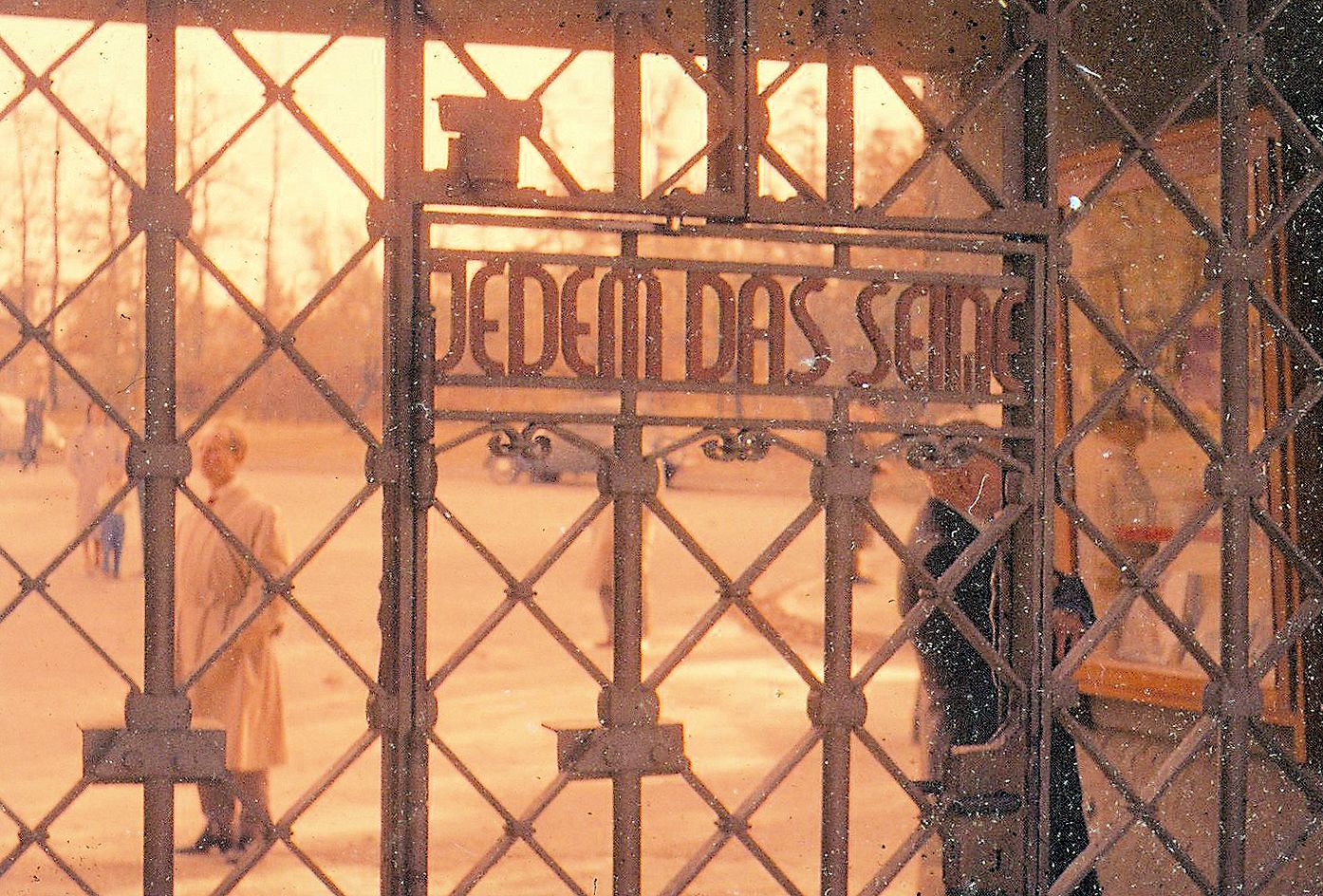
We soon had to leave the magical places to visit Weimar's other heritage, the concentration camp Buchenwald. Here, during the introduction, the East German propaganda machine went into high gear, asserting: In West Germany, new concentration camps are under construction

Luckily, we had some law students in our group who were much better at their words than the physicists. They branded the lies and cheap propaganda, resulting in an icy silence. Full of shame, our group eventually visited the horror place in silence, unmolested.

The classical suum cuique is here perverted at the entrance to the concentration camp.

Inside the camp.
Note the GDR flag and the Russian soldiers in the back on the left.
My second trip to Weimar took place 30 years later, in April 1990, but this is another story, as well as Elisabeth's and my most recent trip. Stuff for future blogs.
**

Wednesday, September 26, 2012

Euros and Non-Cents

Freiburg has an efficient streetcar system that operates until late at night. After 1 a.m. hourly buses bearing names of planets starting from Bertoldsbrunnen take over carrying night owls home into the suburbs.

Stopping point Bertoldsbrunnen. During the night instead of streetcars 3 and 5
the Merkur and Pluto busses are operating (Photo BZ)
The following story somewhat late for the Sommerloch (silly season) is presently exciting the Freiburgers. The other night a girl of seventeen partying downtown was late for the last streetcar. When she mounted the 1.11 a.m. Merkur bus she handed the driver a two euro piece, three ten cents, and ten two cent coins to make up for the total fare of 2.50 euros. The driver simply refused to take the money saying: His service regulations only allow him to take five copper coins for one ticket. He started the engine, shut the door, and left the girl behind who called home for transport. Her father was not amused and in making the story public set off an avalanche.

Euro copper coins are only copper-plated iron coins.
This likely is a German invention when in the 1960ies the value of the copper
of the pfennigs became higher than the value of the coin. So all copper coins
were little by little replaced with coins made out of a copper-iron sandwich (Photo BZ).
Since then there has not been one day with more details in the Badische Zeitung (BZ). The spokesman of the local transport company (VAG) read from the conditions of carriage: The personnel is not obliged to change bills of more than 10 euros or to accept one and two-cent coins adding up to more than 10 cents. I admire how in my country even the slightest details are regulated.

Today a law professor said: In principle, a handful of euro coins is legal tender in Germany like euro bills although article 11 of the minting law stipulates that nobody is obliged to take more than 50 coins in one financial transaction. However, the VAG has a conveyance obligation and thus cannot choose its clients. Therefore the VAG is not allowed to apply stricter rules in their conditions of carriage than in the minting law. Hence, the girl was refused transport contrary to the law.

Une querelle d’Allemand is on again. With interest, I am already looking forward to the letters to the editor in my favorite newspaper.
*

Sunday, September 16, 2012

Altersarmut

Ein Gespenst geht um in Deutschland, das Gespenst der Altersarmut (A specter haunts Germany, the specter of old-age poverty). Marx may not pardon me, but I could not find a better introduction to another chapter of German angst: Altersarmut. Admire the efficiency of the German language, which expresses all that misery in just one word, possibly best translated into poverty among the elderly in English. I am sure Altersarmut will be elected Germany's Unwort 2012, the ugliest word of the year.

Germany's age pyramid in 1911
It is obvious and well known that fewer young earners will have to support more older pensioners in the future. Just look at Germany's age pyramid. What 1911 looked like, the top of a fur tree, now resembles a mushroom.

Germany's age pyramid in 2011
Bismarck pushed for a social security system in Germany in the late 1880s, not because he pitied the misery of the working class, but tried to cut the ground from under the socialists' feet. Germany's old-age pension is based on the so-called generation treaty, i.e., the young pay into the system, financing the pensions of the retired. This works fine if the age structure shows a natural evolution, but who envisaged that people now live longer than in the past (increasing the cost for Medicare, by the way) and that young couples have fewer children than our grandparents. 

I still remember discussions in Germany during my adolescent years about how to finance future social security benefits because the people lost during the last war did not contribute to the system. Looking at today's age pyramid, you will still notice a dent for the period in question, but that is nothing compared with the distorted age structure of today.

To better balance the social security system, our government introduced two palliative measures a few years ago: lowering the level of pensions from 50% of the average income to 43% until 2030, and increasing the retirement age from 65 to 67 years during the same period. Like everybody else, my organization forced me to retire at age 65. 

I still remember my American friends shaking their heads when learning that. One of them even said that he could not afford retirement, for his institute had invested its pension fund in stocks that had lost money, so his pension had.

In Germany, in recent years, people were urged to set aside part of their earnings for private old-age insurance. Like Switzerland, our system is based on three pillars (as they call it): legally bound, occupational, and private insurance. However, with currently low interest rates, people see their financial efforts to secure decent pensions melting away due to inflation. On the other hand, many people had low earnings at times or were even unemployed during their working life. They will face mini pensions or even Altersarmut.

A few weeks ago, our Christian Democrat federal minister for social affairs forwarded an old idea to break the rule that pensions in Germany mirror your financial contributions. She proposed topping up all mini allowances so people can survive on their pensions based on the social security system. It is true that the system currently has a surplus, but what will happen (and what has happened in the past) if the social security fund runs into the red? Taxpayers' money will then fill the deficit, meaning that the working young people will again support the old. 

The head of the opposition Social Democratic Party said, "Let us not take the hidden detour proposed by the minister but use taxpayers' money right away to guarantee everybody a pension on which he/she can survive." Since the differences between the government and the opposition were only marginal, an agreement could have been found, but the trade unions did not agree. They requested to increase the level of pensions to the original 50% of the average income in combination with the retirement age being lowered again to 65. Returning to square minus one (!), they did not specify how to finance their proposal.

You can turn it around as you wish: the battle of generations over the share of wealth will become more challenging. Our grandchildren will have to work longer to make ends meet, some until they kick the bucket. Already now, more people who have retired continue to work or take up new occupations in Germany than our government is willing to admit. Why don't they just tell us the truth? Again, it is the usual Volksverdummung (brainwashing) of the voters.
**

Sunday, September 9, 2012

Basler Hof

The Basler Hof today viewed from Kaiser-Joseph-Straße.
Last week, the second guided tour organized by the Badische Zeitung concerned the Basler Hof. More than 140 people wanted to listen to the explanations of a former resident, Dr. Sven von Ungern-Sternberg, who had been the district president of southern Baden from 1998 to 2007.

Dr. Sven von Ungern-Sternberg welcomed the crowd (Photo BZ).
The Basler Hof is one of Freiburg's historical landmarks. From 1480 on, Kaiser Maximilian's chancellor Konrad Stürtzel bought seven plots of land at the Große Gaß (today's Kaiser-Joseph-Straße) and had his city residence built there in the years 1494 to 1496. These plots had the original size of 100 times 50 feet as defined by the Dukes of Zähringen and were issued to the first settlers in Freiburg against a yearly rent of 12 Pfennig due at St. Martin's (November 11). Stürzel could afford to build the palace, for he was a rich man lending money to the Habsburgs like the Fuggers in Augsburg.

Emperor Maximilian, always in quest of money, is watching the visitors.
At the end of the 16th century, the building became the home of the chapter of the Basel Cathedral. Already in 1529, the capitulars had fled the Reformation in Basel into Catholic Freiburg, but they only acquired the Basler Hof in 1587. When Louis XVI's troops occupied Freiburg in 1677 and made it a French city, they deprived the chapter of its financial resources, so the capitulars moved to Switzerland (Arlesheim). The Austrian administration used the building after Freiburg's restitution to the Habsburgs in 1697.

German double eagle with Austrian Bindenschild red-white-red
and Order of the Golden Fleece.
Stucco at the ceiling of the district president's office.
Later, when Habsburg's most western territories became the province of Further Austria (Vorderösterreich), the Vienna governors resided in the Basler Hof until 1806, when Napoleon gave the Breisgau to the Grand Duke of Baden.

Dr. Sven von Ungern-Sternberg tells the building's history (Photo BZ).
Since then, the Basler Hof has always been used by administration and services mirroring the trials and tribulations of German history:

1806 - 1918: Grand Duchy of Baden (Court House, Post Office)
March 20, 1849: Grand jury trying Gustav Struve and Karl Blind for their participation in the uprising against  the government of the Grand Duchy in September 1848
June/July 1849: During the Baden Revolution, the seat of the revolutionary Government of Baden
1919 - 1933: Weimar Republic (Tax Administration, Police Station)
1933 - 1944: Third Reich officials
From 1933 to 1941, the Gestapo had their headquarters in the Basler Hof
November 27, 1944: Air raid Operation Tigerfish destroying the building

Kaiser-Joseph-Straße and Basler Hof in 1946.
1948 - 1950: Reconstruction of the building
1950 - 1952: Departement of Interior of the State of South Baden (More details)
1953 to today: Seat of the district president (Regierungspräsident) for southern Baden of the State of Baden-Württemberg
*

Saturday, September 8, 2012

Freiburg's Central Art Depot

It is a Freiburg tradition that the BZ and Germany's two big parties, the CDU and the SPD, organize free-of-charge tours of exciting places and institutions for citizens during the summer holidays*. I had visited many a site in previous years, but this week I participated in three guided tours, two of which our local newspaper, the Badische Zeitung, had organized.
*School vacations started relatively late this year in Baden-Württemberg and will come to an end next week 

In my first blog, I would like to report on Freiburg's new Central Art Depot, built and finished in an industrial zone outside the city at the beginning of this year for a little less than 7 million euros.

I still remember the museums with waxed floors, poor lighting, and packed full glass cabinets in those olden days. In addition, these places had the same moldy smell. For modern museums, less is more; they bridge the gap by focusing on their highlights and adding a few additional items. But where did and does the rest go?

The ultimate highlight: Nofretete (Nefertiti) in the Neues Museum Berlin.
I took the photo in 2009.
Well, storing objets d'art requires space. In the past, Freiburg's museums had stored their collections in various places, even in Frankfurt, and, in most cases, not under acceptable conditions. During the visit to the new central storage place, I learned that it is not the temperature that counts but the humidity. Temperatures may range from 10 to 25 degrees centigrade, but the relative humidity must be kept constant at about 50% to preserve the stored items.

For more than 30 years, a dehumidifier has been running in my three basements to keep the relative humidity between 50 and 60%. Not that I store objets d'art, but to keep paper readable, the relative humidity must be at most 60% where it is stored.

58% relative humidity in my basement
Based on the principle of an inverted fridge, my dehumidifier is still the same old machine and working as it did on the day of its delivery, except for the indicator light, a neon bulb. There were no light diodes at the end of the 1970s.

The working horse in my basement. Note: the water collector below is filled to one-third.
Freiburg's Central Art Depot is a two-story building with a storage area of 5,500 square meters. The relative humidity inside is set to 50% to minimize energy consumption. Thick walls and insulation materials keep temperature variations minimal, while only a small amount of filtered and conditioned air is added to replace what is necessary.

Storage of ethnographic items.
Standing behind Tilmann von Stockhausen, I am listening to his explanations (©BZ).
Three groups of 25 people each were led through the building separately, and I was lucky with my guide. It was the director of Freiburg's museums, Tilmann von Stockhausen. He said that up to now, more than 100 lorries had collected and delivered the items for storage, but most were still in their boxes.

Our group is advancing in one of those big galleries
that house all the necessary tubing (©BZ).
It is more important for the people responsible to unite all items until the end of the year than to put them in order. Still, they started unpacking, and Dr. von Stockhausen proudly presented the first oil paintings in the correct order on their shifting rollers.

Tillmann von Stockhausen shows some of his treasures (©BZ).
With such well-organized storage, it will become easier to change items for exhibition in Freiburg's museums, in addition to the objets d'art permanently on display.
**

Thursday, August 30, 2012

License plates

License plates in the US follow the States, whereas towns and districts issue those in Germany. The first letters (up to three) printed on a German license plate designate the vehicle's origin.

It is easy with single letters, e.g., B stands for Berlin, M for Munich and H for Hamburg. Well, that is wrong. Although Hamburg is bigger than Hannover, the Hanseatic citizens left the H for the smaller town, preferring HH standing for Hansestadt Hamburg

Even though the Hanse has since long disappeared, the people of Hamburg are so proud that entering the city by car, you will read: Freie und Hansestadt Hamburg (The Free and the Hanseatic City of Hamburg). I really miss that road sign. During the last 30 years, I crossed the city's boundary, where I spent all my high school days only by train or plane.


In fact, three big German cities are federal states: Berlin, Hamburg, and Bremen (HB for Hansestadt Bremen). Smaller cities get two letters, and my friends in Madison know that FR stands for Freiburg. Like in the States, the administrations issuing license plates let you choose the following letter-number combination (here for an extra fee of 20 euros). Below is my Freiburg license plate:

Guess what MH and 635 stand for.
When driving along the German autobahn, you will notice that the variety of license plates is great. People like to play games with those letter combinations, So you may read BA for the city of Bamberg interpreted as blutiger Anfänger (bloody learner), GS for Goslar: genüsslich schlafend (sleeping pleasurably), WW for the district Westerwald: Wilder Westen (wild west). Three letter combinations for smaller towns are even funnier, like FFB for Fürstenfeldbruck: Fahrer fährt blöd (conductor drives stupidly), OAL for the district Ostallgäu: Ochse am Lenkrad (ox behind the wheel), and SAD for Schwandorf: sieht alles doppelt (meaning the driver is drunk).

Many letter combinations in Germany have disappeared over the last twenty years in combining small towns and districts to form larger entities. Some people are unhappy, having lost their identity like the inhabitants of Merseburg (formerly MER) now driving with new license plates QM (district of Querfurt-Merseburg). 

Two weeks ago, a German professor (doesn't he have anything else to do?) opened the theater to fill the famous journalistic summer hole, proposing reactivating those lost license plates. In addition, he advocated the introduction of new ones keeping people attached to their hometown happy. Forget about the Euro crisis and the war in Syria. Instead, think about new letter combinations like LOL?

Well, there is still one benefit to all this. In the future, guessing license plates on long car drives will keep grouching kids quiet, hopefully for extended periods.
*