As part of the Freiburg-Madison-Gesellschaft's activities, our
vice president gave an engaging and committed introduction to the exciting and
long life of
Georgia O'Keeffe as a woman and artist at our Stammtisch on April
6.
The next day, the talk was followed by a visit to an exhibition of Georgia's works at the
Fondation Beyerle (Foundation) at Riehen near Basel.
If you missed the introduction to Georgia O'Keeffe, you either look up
Wikipedia, or you may read what the Foundation wrote:
O'Keeffe was born in 1887 in Wisconsin and grew up in modest
circumstances, with several siblings, on her parents' dairy farm. Her
creative abilities were already recognized during her schooldays, and she
studied art. Her first significant works date from 1915, when she was teaching art in South Carolina and at the University of Virginia, and from the subsequent period in Canyon, Texas, where she lived from 1916 to 1918 after being hired to teach at West Texas State Normal College.
With the last long sentence, you probably noted that it is a
translation of the German text shown at the entrance to the exhibition. It
continues:
The first exhibition of the Fondation Beyeler's current anniversary
year is dedicated to Georgia O'Keeffe, one of the great painters of the
20th century and an icon of modern American art. This major retrospective, comprising works from six decades, offers a rare opportunity in Europe to encounter the art of Georgia O'Keeffe, which is found in a few collections outside the US, and its full richness and variety.
The exhibition of the Fondation Beyeler highlights O'Keeffe's
particular way of looking at her surroundings and translating what she
saw into entirely new and hitherto unseen images, at times almost
abstract, at times close to nature. "One rarely takes the time to really
see a flower. I have painted it big enough so that others would see what
I see."
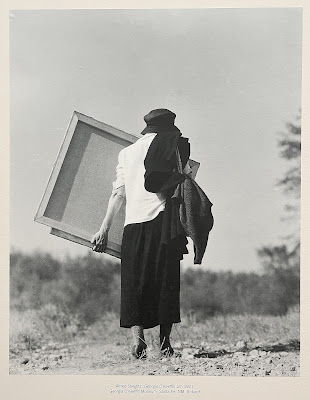
|
|
Alfred Stieglitz, Georgia O'Keeffe around 1921
|
From New Mexico in the fall of 1926, Georgia wrote in a letter to a friend, "It's a wonderful
morning - the leaves are turning – crickets singing – most summer people
gone home – there is no sun but it's warm and fine – We have been having
perfect days of perfect quiet sunshine - working lots – and I feel like
singing (…) I wish you could see the place here – there is something so
perfect about the mountains and the lake and the trees -"
These quotes from 1926 can serve as a guideline for examining
O'Keeffe's art and life. The artist's unique gaze, combined with an
approach to nature that was sensitive, respectful, and imbued with
wonder, made her the 20th century's most significant and fascinating
painter of landscape and nature.For Red Baron, it is a mystery why Georgia is not so well
known in Europe. On this side of the Atlantic, connoisseurs will
immediately recognize an Edward Munch painting; Franz Marc is a cult, and
even Max Liebermann is a sure guess. O'Keeffe, on the other hand, is
challenging to identify. In fact, she always refused to be categorized by
her painting style. She did it her way.
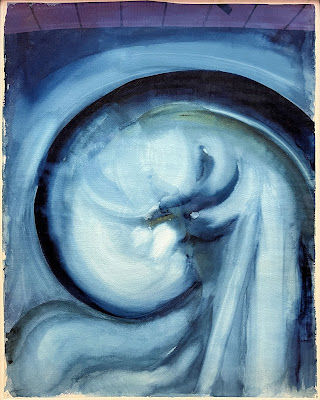
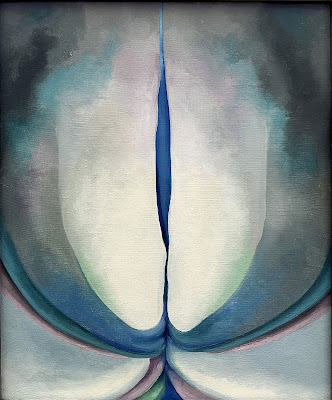
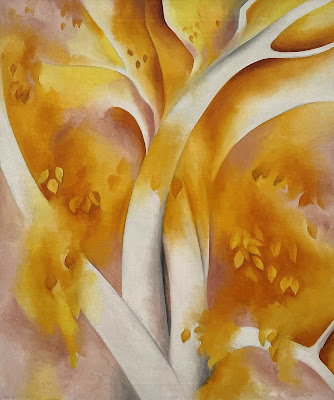
Below are some of her pictures from the Beyerle retrospective, which show how difficult it is to identify an O'Keeffe, except perhaps by her unique and most
impressive flowers. Georgia uses color and form and sometimes presents extreme detail in her paintings.
|
|
Blue II, 1916
|
|
|
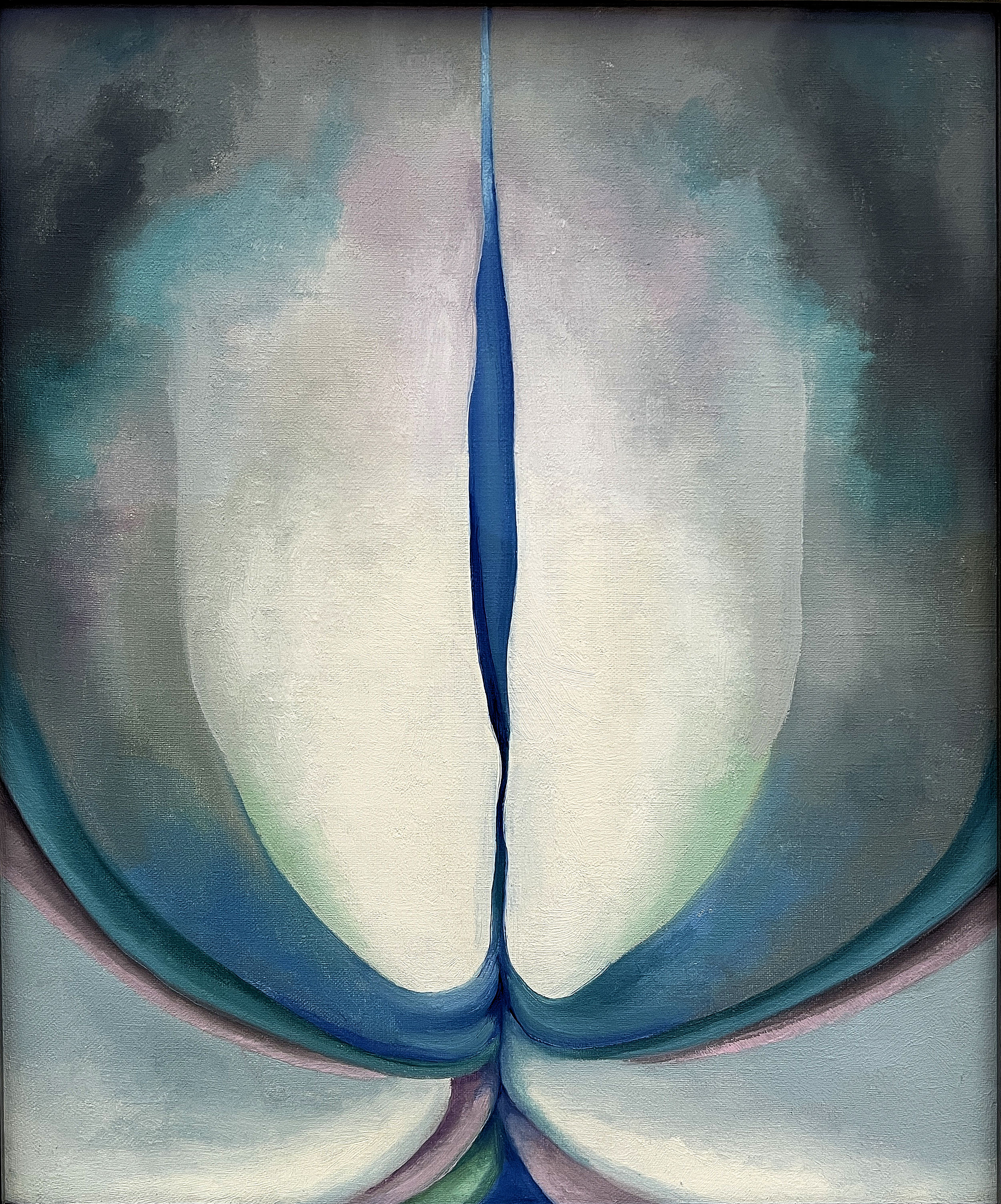
Blue Line, 1919
|
O'Keeffe stated, "When
people read erotic symbols into my paintings, they're really talking about
their own affairs." Sorry, I don't agree, for that is not my affair.
|
White Birch, 1925
Honi soit qui mal y pense.
|
|
|
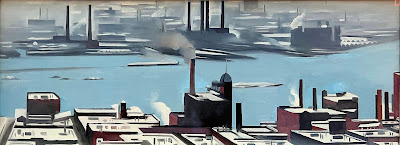
East River from the Shelton Hotel, 1928
|
|
|
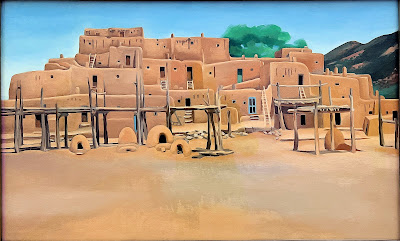
Taos Pueblo, 1929-1935
|
|
|
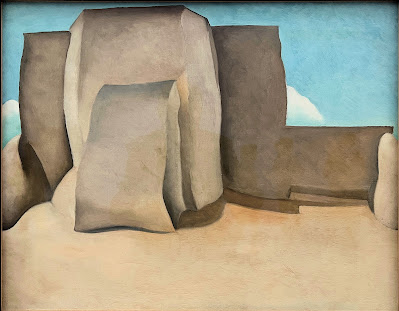
Ranchos Church No. 1, 1929
|
|
|
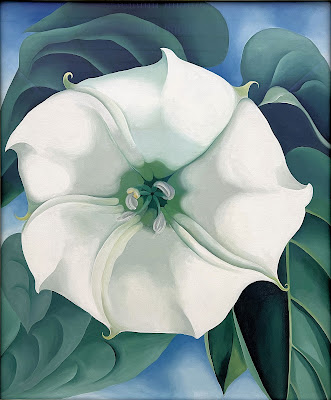
Jimson Weed, White Flower No. 1, 1932
|
|
|
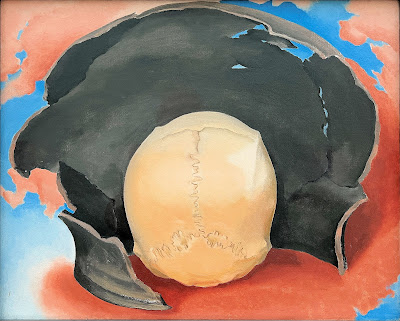
It Was a Man and a Pot, 1942
|
|
|
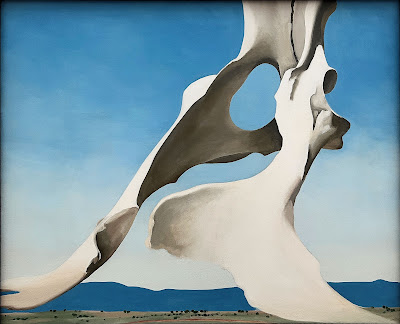
Pelvis with the Distance, 1943
|
 |
| Black Door with Red, 1954 |
 |
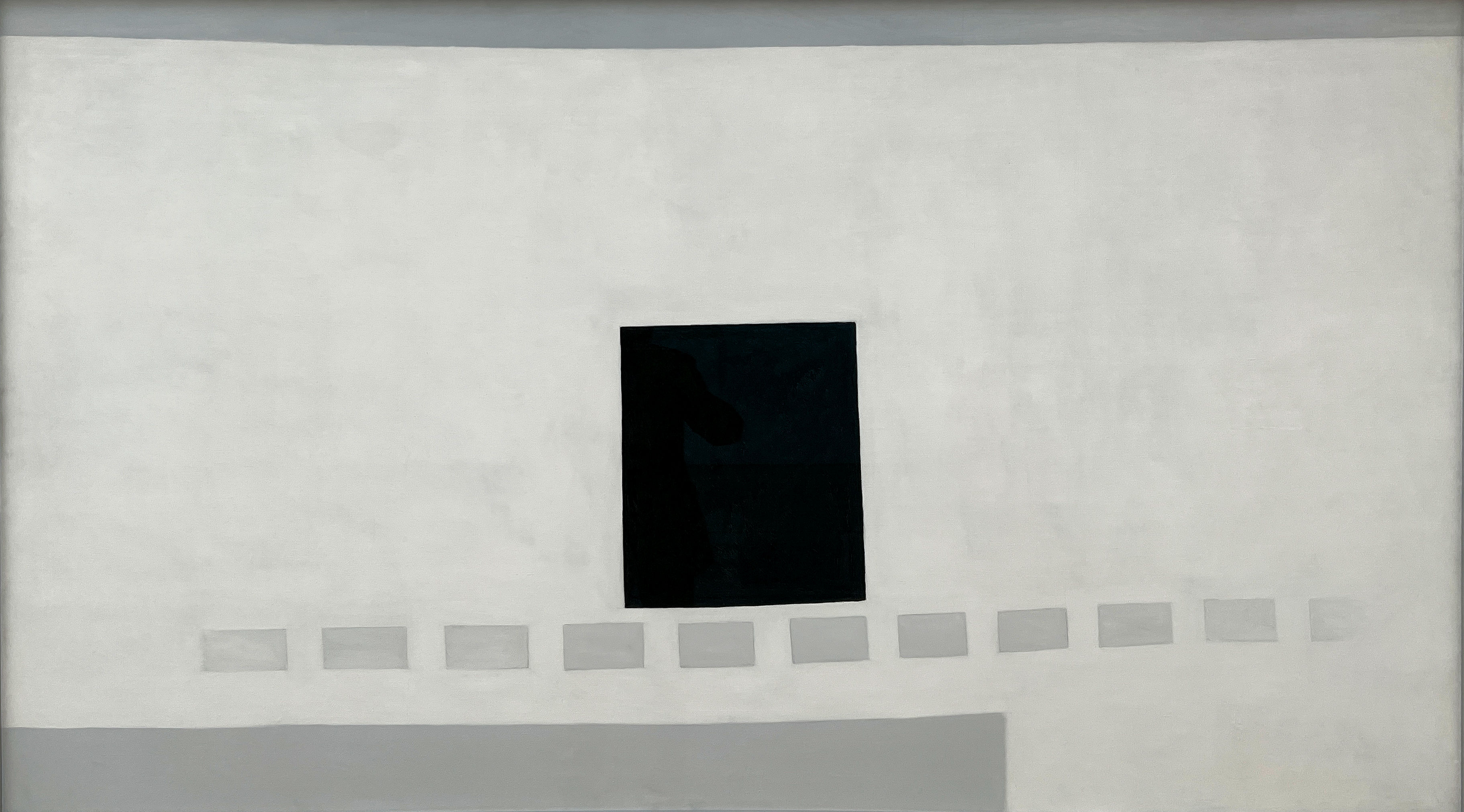
| My Last Door, 1952-1954 |
Colors lost. Georgia's last black door is surrounded by gray surfaces. At the age of 67, did she have a premonition of her death? Well, she continued to paint in color and lived to 99. Georgia O'Keeffe died on March 6, 1986.






No comments:
Post a Comment