While the United States has a House of Representatives with 435 members for a population of 340 million, the previous Bundestag had 736 members for a population of 86 million.

|
| Instead of the initially planned 598, there were 736 MPs before the recent election. |
I briefly described the German electoral law in a previous blog. The law is schizophrenic because we try to square the circle by mixing proportional representation with a majority vote system. Let's get it straight.
In its purest form, a majority vote elects the person obtaining the most votes in a constituency. The number of seats in parliament equals the number of elected deputies. This system has the advantage that the elected person is known and regarded as the representative of the people living in the constituency. With this bonding, the citizen knows whom to address when needed.
On the other hand, minority opinions and parties are ignored. So, Churchill said of the majority vote as practiced in the UK and the USA, where the winner takes it all, "It isn't one hundred percent democratic," adding, "but it works."
Proportional representation is more democratic because it allows smaller parties to be represented in parliament. However, this leads to vote fragmentation, making it challenging to secure majorities to form stable governments. In addition, the representatives in parliament do not feel responsible to a constituency and therefore remain "invisible" to the voter.
The negative example of a pure proportional voting system was the Weimar Republic. Due to the poor economic situation (mass unemployment), the share of votes for parties on the extreme right and left wings in the Reichstag increased from election to election. This made it increasingly difficult for the moderate center-left to collect the many small parties under one democratic umbrella and form viable governments. Ultimately, it was possible to govern the Republic only by Notverordnungen (executive orders). So eventually, the Nazis gave the collapsing Republic the death blow with the Ermächtigungsgesetz (Enabling Act) of 1933.
This is why the electoral law of the Federal Republic of Germany has the so-called five percent hurdle. Only parties that receive at least 5% of the votes are represented in the Bundestag, although this is not 100% democratic either.
Under Germany's initial electoral law, half of the MPs, i.e., 299, were elected by constituency using the majority system, and the other half were elected proportionally to the percentage of votes a party obtained in the election.
Additional direct mandates, beyond the percentage to which a party was entitled, gave rise to Überhangmandate (excess seats). To correct for the proportionality of the votes received, other parties were compensated with Ausgleichsmandate (leveling seats). With this praxis, Germany ended up with a bloated Bundestag.
|
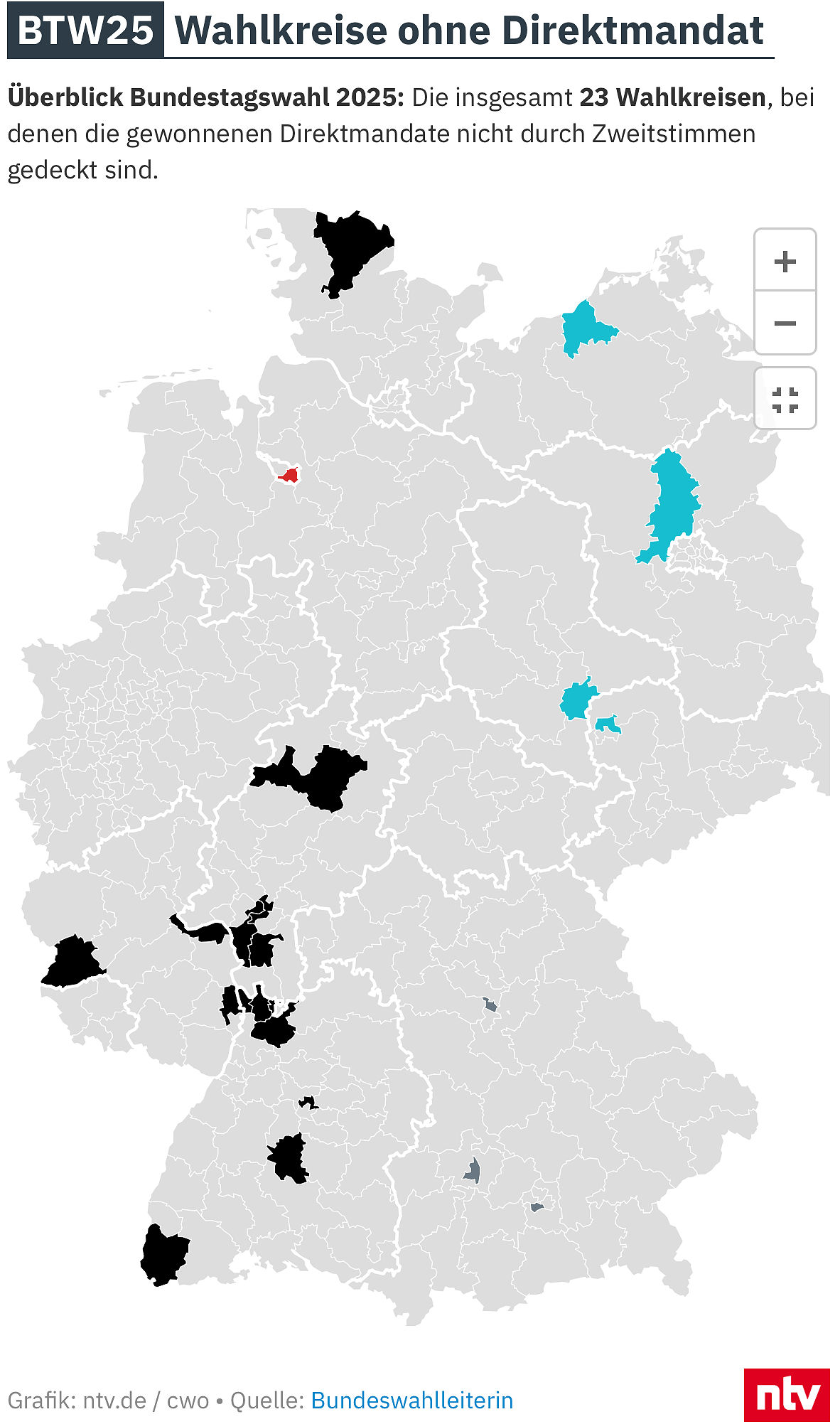
| Constituencies where directly elected candidates did not get their seats. |
Christian Democrats lost most of the direct mandates and were outraged about the "undemocratic electoral law reform." While reducing the size of the Bundestag was "necessary," it should not have been "at the expense of democracy." However, the CDU/CSU cannot yet say what a more democratic model should look like in the future.
If we decide to retain our schizophrenic election system, the only way to keep the number of MPs small would be to reduce the number of constituencies. One would end up with a variable number of deputies, but the Bundestag would be smaller than 730 MPs.
My final question is, why don't we adopt the French electoral system? In France, there are constituencies with one MP each. Whoever obtains the absolute majority of votes for his party in a constituency is elected.
If none of the candidates receives 50% of the votes in the "premier tour," there is a run-off election between the two best-placed candidates, or even a "triangulaire" with the three best. In this "second tour", the candidate with the highest relative number of votes wins the constituency.

A classic example of a "triangulaire" in Germany would have been constituency 281, Freiburg, with Chantal Kopf, Klaus Schüle, and Ludwig Striet.
The French voting system comes closest to my understanding of democratic voting, as the elected candidate represents a constituency in which he/she is known to the people. At the same time, such an election procedure still reflects the balance of votes between the parties quite well. Although the system is not 100% democratic, it would work.
**

No comments:
Post a Comment