England's farthest point out west is Land's End.
Getting a sunburn in a Mediterranean climate.
Yes, I was there, although the refreshment we took at St. Yves.
Cornwall Cream Tea, traditionally delivered with a Cornish split, a slightly sweet white bread roll, was served in St. Yves with a scone. The warm scone is spread with strawberry jam and then topped with a spoonful of clotted cream. Simply delicious!
St. Yves harbor at low tide in the mist. The only place without sun on the whole trip we visited.
Another typical Cornish food is pasties. A Cornish Pasty is made by placing the uncooked filling on a flat pastry circle and folding it to wrap the filling, crimping the edge at the side or top to form a seal. Traditionally, a pasty is filled with beef, sliced or diced potato, turnip, and onion, seasoned with salt and pepper, and baked.
British humor: This driver invited Prince Philipp as his front-seat passenger for the Queen's jubilee.
Dartmoor is known for its sheep, prison, and The Hound of the Baskervilles.
Here, the hound is following Sherlock Holmes, who is possibly late for his date with the escaped prisoner from Dartmoor, serving him as a red herring while Sir Conan Doyle is watching from the top of the staircase.
We just drove by on our way to London. However, we made a long stop in Bath ...
... and were soon ad fontes. The water is not only warm but also of a greenish color.
In the nineteenth century, the main pool was decorated with statues of famous Romans, including Julius Caesar, who looks quite grouchily.
Minerva's gold-plated head was dug out of the Roman debris.
In 973, Edgar I was crowned at Bath Abbey and anointed with his wife Ælfthryth in a ceremony that formed the basis of the present-day British coronation practice. The coronation was an important step in England's unification, as other kings of Britain came and gave their allegiance to Edgar shortly afterward at Chester and pledged their faith that they would be the king's liege men on sea and land.
A mirror to admire the fine structure of the Abbey's vault is placed in the center of the nave.
No, this is not Calvin but one of those many deans of Bath Abbey.
*
written to entertain my American friends in Freiburg's sister city, Madison, WI,
with odd stories from Freiburg, Germany, and tales about my travels.
Click pictures to enlarge.
Friday, June 15, 2012
Friday, June 8, 2012
The Swerve
Once in a while, I come across a beautifully written book. In The Swerve, Stephen Greenblatt tells us in his elegant style the story of Poggio Bracciolini, an Italian book hunter living during the first half of the 15th century. Book hunting in those days consisted of finding handwritten texts from the times of the Romans, who wrote works of their own and copied and translated some of the Greek heritage. Poggio, gifted with the knowledge of excellent Latin and known for his beautiful handwriting, was to Pope John XXIII what Georg Gänswein from Freiburg is for Pope Benedict XVI, the private secretary. He followed his master attending the Church Council of Constance in 1414, where King Sigismund wanted to end the Papal Schism. Eventually, John was formally deposed on May 29, 1515, and later even imprisoned for high treason. The Apostolic Secretary Poggio lost his job. In the following, we find Greenblatt well-informed about modern politics when he writes: the papal throne was vacant, and the council - which, like the current European Community, was riven with the tension between the English, French, German, Italian, and Spanish delegations squabbled over the conditions that would have to be met before proceeding to elect a new pope.
Poggio finding himself unemployed goes out book hunting in German monasteries. He heads for Fulda, the Imperial Abbey founded in the eighth century by the apostle of the Germans, St. Boniface. The abbey is located between the Vogelsberg and the Rhône mountains? Dr. Greenblatt, the Rhône is a river in southern France, but the German mountains are called Rhön. From their highest peak, the Wasserkuppe, traditionally gliders, start.
Apparently, in the library of the Fulda monastery, Poggio finds a copy of a poem called De rerum natura (On the nature of things) by Titus Lucretius Carus written in beautiful Latin around 60 B.C. It seems that Lucretius' primary purpose when formulating his ideas expressed in the poem was to free his friend's (Gaius Memmius's) mind of the supernatural and the fear of death — and to induct him into a state of ἀταραξία (ataraxia) that Epicureans consider synonymous with the only true happiness possible for a person.
According to Greenblatt, the content of The Nature of Things, when it became widely known, caused the medieval world to swerve into the Renaissance. On page 185, the author gives a gist of Lucretius' ideas and continues his description on page 220. The quotes are in italics, and the humble comments are mine.
On the Structure of Matter
Everything is made of invisible particles. The elementary particles of matter - the seeds of the things - are eternal. The elementary particles are infinite in shape and size. All particles are in motion in an endless void.
Taking up Democritus' ideas, Lucretius addresses some basic principles of modern particle physics. In particular, since the times of Lord Rutherford, we know that matter in atoms is concentrated in a tiny nucleus, leaving lots of empty space. New exotic particles like the Higgs boson - also called the God particle - are understood for their vacuum energy coupling with geometry in a curved space.
![]() |
| Poggio Braccioli at the age of 68. The picture was taken from The Swerve. |
Apparently, in the library of the Fulda monastery, Poggio finds a copy of a poem called De rerum natura (On the nature of things) by Titus Lucretius Carus written in beautiful Latin around 60 B.C. It seems that Lucretius' primary purpose when formulating his ideas expressed in the poem was to free his friend's (Gaius Memmius's) mind of the supernatural and the fear of death — and to induct him into a state of ἀταραξία (ataraxia) that Epicureans consider synonymous with the only true happiness possible for a person.
![]() |
| A printed copy of Titus Lucretius Carus' De Rerum Natura (Wikipedia) |
On the Structure of Matter
Everything is made of invisible particles. The elementary particles of matter - the seeds of the things - are eternal. The elementary particles are infinite in shape and size. All particles are in motion in an endless void.
Taking up Democritus' ideas, Lucretius addresses some basic principles of modern particle physics. In particular, since the times of Lord Rutherford, we know that matter in atoms is concentrated in a tiny nucleus, leaving lots of empty space. New exotic particles like the Higgs boson - also called the God particle - are understood for their vacuum energy coupling with geometry in a curved space.
For Lucretius, body and soul are only fantastically complex structures of atoms linked for a time and destined one day to come apart.
For centuries, the Church had been fighting this atomistic approach, so Galileo was regarded as a heretic for his Copernican views and atomism.
Creation and Free Will
The universe has no creator or designer. Though nature is beautiful and intricate, there is no evidence of an underlying intelligent design. Everything comes into being as a result of a swerve. The swerve is the source of free will.
As determinism appears to conflict with the concept of free will, Lucretius explains it with the random swerve of the seed of things in his atomistic approach. It is interesting to compare his idea with the discussions in the 1920ies between the advocates of quantum mechanics preaching the breakdown of determinism in the atomic world and Albert Einstein claiming that God does not throw dice. Is our free will a consequence of Heisenberg's uncertainty principle?
On Evolution
Nature ceaselessly experiments. Humans are not unique. Human society began not in a Golden Age of tranquility and plenty but in the primitive battle for survival.
Darwin, did he read On the Nature of Things before writing On the Origin of Species?
On Religion
The soul dies with the body. There is no afterlife. Death is nothing to us and no concern of ours. There is no judgment after death. The universe was not created for us by divine power, and the whole notion of the afterlife is a superstitious fantasy. All organized religions are superstitious delusions and are invariably cruel. There are no angels, demons, or ghosts. The preachers who tell us to live in fear and trembling are lying. God has no interest in our actions.
Mind you, these ideas were brought forward well before Christ was born. Already Epicurus, Lucretius's spiritual father, said: Against other things, it is possible to obtain security, but we humans all live in an unwalled city when it comes to death. Lucretius's further ideas on religion were taken up in the nineteenth century.
I found out that Thomas Jefferson owned at least five Latin editions of De Rerum nature, along with translations of the poem into English, Italian, and French. Jefferson wrote to a correspondent who wanted to know his life philosophy, "I am an Epicurean."
About Love
Lucretius' poem starts out with a hymn to Venus, the Goddess of Love:
Delight of humankind and gods above,
Parent of Rome, propitious Queen of Love,
Whose vital power, air, earth, and sea supplies,
And breeds whate'er is born beneath the rolling skies;
For every kind, by thy prolific might,
Springs and beholds the regions of the light:
Thee, Goddess, thee, the clouds and tempests fear,
And at thy pleasing presence disappear;
For thee, the land in fragrant flowers is dressed,
For thee, the ocean smiles and smooths her wavy breast,
And heaven itself, with more serene and purer light, is blessed.
For when the rising spring adorns the mead,
And a new scene of nature stands displayed,
When teeming buds and cheerful greens appear,
And western gales unlock the lazy year,
The joyous birds thy welcome first express
Whose native songs thy genial fire confess.
Then savage beasts bound o'er their slighted food,
Struck with thy darts and tempt the raging flood.
All nature is thy gift: earth, air, and sea;
Of all that breathes, the various progeny,
Stung with delight, is goaded on by thee.
O'er barren mountains, o'er the flowery plain,
The leafy forest and the liquid main
Extends thy uncontrolled and boundless reign.
Through all the living regions dost thou move
And scatterest, where thou goest, the kindly seeds of love.
For Lucretius, love means life, beauty, and proliferation. About 100 years later, Paul of Tarsus wrote another quite different Hohelied der Liebe (Song of Love). We read in chapter 13 of his first letter to the Corinthians:
If I speak in the tongues of men and angels but have no love, I am only a resounding gong or a clanging cymbal. If I have the gift of prophecy and can fathom all mysteries and knowledge, and if I have a faith that can move mountains but have no love, I am nothing. If I give all I possess to the poor and surrender my body to the flames but have no love, I gain nothing. Love is patient; love is kind. It does not envy, it does not boast, it is not proud. It is not rude, it is not self-seeking, it is not easily angered, and it keeps no record of wrongs. Love does not delight in evil but rejoices with the truth. It always protects, always trusts always hopes, and always perseveres. Love never fails. But where there are prophecies, they will cease; where there are tongues, they will be stilled; where there is knowledge, it will pass away. We know in part, and we prophesy in part, but when perfection comes, the imperfect disappears. When I was a child, I talked like a child, thought like a child, and reasoned like a child. When I became a man, I put childish ways behind me. Now we see but a poor reflection as in a mirror; then we shall see face to face. Now I know in part; then I shall know fully, even as I am fully known. And now, these three remain faith, hope, and love. But the greatest of these is love.
In his praise, St. Paul, the man who laid the foundation of Christianity, stripped love of all its sexuality! Christian history might have taken a different course if he had only referred in his letter to the Song of Songs of Solomon, a book of the Old Testament. Could it be that Paul's Hohelied der Liebe is a direct answer, an alternative model to Lucretius' vision of life? We do not know whether the apostle, an educated Roman citizen, had read Des Rerum Natura. Still, there is one trace of Paul's dispute with Epicureans documented in the Act of the Apostles 17:
While Paul waited for them (Silas and Timothy) in Athens, his spirit was provoked as he saw the city full of idols. So he reasoned in the synagogue with the Jews and the devout persons and in the marketplace every day with those who met him. Some of the Epicurean and Stoic philosophers also conversed with him. Some said, "What does this babbler want to say?" Others said, "He seems to be advocating foreign deities" because he preached Jesus and the resurrection. They took hold of him and brought him to the Areopagus, saying, "May we know what this new teaching is, which is spoken by you? For you bring certain strange things to our ears. We want to know, therefore, what these things mean." Now all the Athenians and the strangers living there spent their time in nothing but telling or hearing something new.
Smartly craving their attention in flattering them and referring to the altar of the unknown God, Paul had noticed; he stood in the middle of the Areopagus and said, "You men of Athens, I perceive that you are very religious in all things. As I passed along and observed the objects of your worship, I also found an altar with this inscription: 'TO AN UNKNOWN GOD.' What, therefore, you worship in ignorance, I announce to you. The God who made the world and all things in it, he, being Lord of heaven and earth, doesn't dwell in temples made with hands, neither is he served by men's hands, as though he needed anything, seeing he gives to all life and breath and all things. He made from one blood every nation of men to dwell on all the surface of the earth, having determined appointed seasons, and the boundaries of their dwellings, that they should seek the Lord if perhaps they might reach out for him and find him, though he is not far from each one of us. 'For in him we live, move, and have our being.' Some of your poets have said, 'For we are also his offspring.' Being then the offspring of God, we ought not to think that the Divine Nature is like gold, silver, or stone, engraved by the art and design of man. The times of ignorance, therefore, God overlooked. But now he commands that all people everywhere should repent because he has appointed a day in which he will judge the world in righteousness by the man he has ordained; of which he has given assurance to all men, in that he has raised Him from the dead."
When they heard of the resurrection of the dead, some [surely the Epicureans] mocked, but others said, "We want to hear you again concerning this."
Unfortunately, the commentator stops there.
Coming back to the Hohelied der Liebe, Paul admits that in our life on earth, we see a poor reflection of God like in a mirror but out of Paul's belief grows his hope that he will see face to face. Now I know in part; then I shall know fully, even as I am fully known. And now, these three remain faith, hope, and love. But the greatest of these is love.
Creation and Free Will
The universe has no creator or designer. Though nature is beautiful and intricate, there is no evidence of an underlying intelligent design. Everything comes into being as a result of a swerve. The swerve is the source of free will.
As determinism appears to conflict with the concept of free will, Lucretius explains it with the random swerve of the seed of things in his atomistic approach. It is interesting to compare his idea with the discussions in the 1920ies between the advocates of quantum mechanics preaching the breakdown of determinism in the atomic world and Albert Einstein claiming that God does not throw dice. Is our free will a consequence of Heisenberg's uncertainty principle?
On Evolution
Nature ceaselessly experiments. Humans are not unique. Human society began not in a Golden Age of tranquility and plenty but in the primitive battle for survival.
Darwin, did he read On the Nature of Things before writing On the Origin of Species?
On Religion
The soul dies with the body. There is no afterlife. Death is nothing to us and no concern of ours. There is no judgment after death. The universe was not created for us by divine power, and the whole notion of the afterlife is a superstitious fantasy. All organized religions are superstitious delusions and are invariably cruel. There are no angels, demons, or ghosts. The preachers who tell us to live in fear and trembling are lying. God has no interest in our actions.
Mind you, these ideas were brought forward well before Christ was born. Already Epicurus, Lucretius's spiritual father, said: Against other things, it is possible to obtain security, but we humans all live in an unwalled city when it comes to death. Lucretius's further ideas on religion were taken up in the nineteenth century.
According to Feuerbach, religion is a projection: God is nothing but the outward projection of a human's inward nature, a projection of unfulfilled human wishes and positive attributes. Marx's religion is used as opium to suppress the people.
For Nietzsche, religion is empty because God is dead, an idea that developed into Sartre's and Camus' existential nihilism: We should face the absurdity of our existence, that we will eventually die, and that religion simply is the result of the fear of death.
On the Pursuit of Happiness
The highest goal of human life is the enhancement of pleasure and the reduction of pain. What should matter to us is the pursuit of pleasure, for pleasure is the highest goal of existence. The greatest obstacle to pleasure is not pain; it is a delusion.
On the Pursuit of Happiness
The highest goal of human life is the enhancement of pleasure and the reduction of pain. What should matter to us is the pursuit of pleasure, for pleasure is the highest goal of existence. The greatest obstacle to pleasure is not pain; it is a delusion.
I found out that Thomas Jefferson owned at least five Latin editions of De Rerum nature, along with translations of the poem into English, Italian, and French. Jefferson wrote to a correspondent who wanted to know his life philosophy, "I am an Epicurean."
About Love
Lucretius' poem starts out with a hymn to Venus, the Goddess of Love:
Delight of humankind and gods above,
Parent of Rome, propitious Queen of Love,
Whose vital power, air, earth, and sea supplies,
And breeds whate'er is born beneath the rolling skies;
For every kind, by thy prolific might,
Springs and beholds the regions of the light:
Thee, Goddess, thee, the clouds and tempests fear,
And at thy pleasing presence disappear;
For thee, the land in fragrant flowers is dressed,
For thee, the ocean smiles and smooths her wavy breast,
And heaven itself, with more serene and purer light, is blessed.
For when the rising spring adorns the mead,
And a new scene of nature stands displayed,
When teeming buds and cheerful greens appear,
And western gales unlock the lazy year,
The joyous birds thy welcome first express
Whose native songs thy genial fire confess.
Then savage beasts bound o'er their slighted food,
Struck with thy darts and tempt the raging flood.
All nature is thy gift: earth, air, and sea;
Of all that breathes, the various progeny,
Stung with delight, is goaded on by thee.
O'er barren mountains, o'er the flowery plain,
The leafy forest and the liquid main
Extends thy uncontrolled and boundless reign.
Through all the living regions dost thou move
And scatterest, where thou goest, the kindly seeds of love.
For Lucretius, love means life, beauty, and proliferation. About 100 years later, Paul of Tarsus wrote another quite different Hohelied der Liebe (Song of Love). We read in chapter 13 of his first letter to the Corinthians:
If I speak in the tongues of men and angels but have no love, I am only a resounding gong or a clanging cymbal. If I have the gift of prophecy and can fathom all mysteries and knowledge, and if I have a faith that can move mountains but have no love, I am nothing. If I give all I possess to the poor and surrender my body to the flames but have no love, I gain nothing. Love is patient; love is kind. It does not envy, it does not boast, it is not proud. It is not rude, it is not self-seeking, it is not easily angered, and it keeps no record of wrongs. Love does not delight in evil but rejoices with the truth. It always protects, always trusts always hopes, and always perseveres. Love never fails. But where there are prophecies, they will cease; where there are tongues, they will be stilled; where there is knowledge, it will pass away. We know in part, and we prophesy in part, but when perfection comes, the imperfect disappears. When I was a child, I talked like a child, thought like a child, and reasoned like a child. When I became a man, I put childish ways behind me. Now we see but a poor reflection as in a mirror; then we shall see face to face. Now I know in part; then I shall know fully, even as I am fully known. And now, these three remain faith, hope, and love. But the greatest of these is love.
In his praise, St. Paul, the man who laid the foundation of Christianity, stripped love of all its sexuality! Christian history might have taken a different course if he had only referred in his letter to the Song of Songs of Solomon, a book of the Old Testament. Could it be that Paul's Hohelied der Liebe is a direct answer, an alternative model to Lucretius' vision of life? We do not know whether the apostle, an educated Roman citizen, had read Des Rerum Natura. Still, there is one trace of Paul's dispute with Epicureans documented in the Act of the Apostles 17:
While Paul waited for them (Silas and Timothy) in Athens, his spirit was provoked as he saw the city full of idols. So he reasoned in the synagogue with the Jews and the devout persons and in the marketplace every day with those who met him. Some of the Epicurean and Stoic philosophers also conversed with him. Some said, "What does this babbler want to say?" Others said, "He seems to be advocating foreign deities" because he preached Jesus and the resurrection. They took hold of him and brought him to the Areopagus, saying, "May we know what this new teaching is, which is spoken by you? For you bring certain strange things to our ears. We want to know, therefore, what these things mean." Now all the Athenians and the strangers living there spent their time in nothing but telling or hearing something new.
Smartly craving their attention in flattering them and referring to the altar of the unknown God, Paul had noticed; he stood in the middle of the Areopagus and said, "You men of Athens, I perceive that you are very religious in all things. As I passed along and observed the objects of your worship, I also found an altar with this inscription: 'TO AN UNKNOWN GOD.' What, therefore, you worship in ignorance, I announce to you. The God who made the world and all things in it, he, being Lord of heaven and earth, doesn't dwell in temples made with hands, neither is he served by men's hands, as though he needed anything, seeing he gives to all life and breath and all things. He made from one blood every nation of men to dwell on all the surface of the earth, having determined appointed seasons, and the boundaries of their dwellings, that they should seek the Lord if perhaps they might reach out for him and find him, though he is not far from each one of us. 'For in him we live, move, and have our being.' Some of your poets have said, 'For we are also his offspring.' Being then the offspring of God, we ought not to think that the Divine Nature is like gold, silver, or stone, engraved by the art and design of man. The times of ignorance, therefore, God overlooked. But now he commands that all people everywhere should repent because he has appointed a day in which he will judge the world in righteousness by the man he has ordained; of which he has given assurance to all men, in that he has raised Him from the dead."
When they heard of the resurrection of the dead, some [surely the Epicureans] mocked, but others said, "We want to hear you again concerning this."
Unfortunately, the commentator stops there.
Coming back to the Hohelied der Liebe, Paul admits that in our life on earth, we see a poor reflection of God like in a mirror but out of Paul's belief grows his hope that he will see face to face. Now I know in part; then I shall know fully, even as I am fully known. And now, these three remain faith, hope, and love. But the greatest of these is love.
*
Monday, June 4, 2012
My Cornish Diary 1
Two weeks ago, Red Baron spent a week in Devonshire and Cornwall in the south of England. One of my objectives was to have a conversation with a person from that region, remembering well Professor Higgins' complaint when he met Eliza selling flowers at the Covent Garden Opera:
Why can't the English teach their children how to speak?
This verbal class distinction, by now, should be antique ...
And he continued:
Hear a Yorkshireman, or worse,
Hear a Cornishman converse ...
The bus tour to England's southwest started from a hotel in Heathrow and took our group to historical Plymouth via Stonehenge.
We stopped at Winchester, where its famous cathedral was made known to the younger generation through a 1966 song by the New Vaudeville Band: "Winchester Cathedral, you're bringing me down." You stood, and you watched as my baby left town.
While humming the tune, a stained glass window on one side of the transept caught my attention. The man on the lower left-hand side, I had seen before. It was King George VI with his wife, Elizabeth, who is opposite him, better known as Queen Mum. A guide confirmed my guess and added that King Henry IV, with his second wife, Joan of Navarre, is depicted in the two fields above. On February 7, 1403, Henry married Joanna de Navarre, the daughter of Charles d'Évreux, King of Navarre, at Winchester.
Text on the bronze plate: Francis Drake sailed from Plymouth on December 13, 1577, to begin the "famous voyage" during which he traversed the Strait of Magellan and discovered the Drake Passage south of Cape Horn. Drake then sailed the Golden Hinde north and in June 1579 landed in California. He took possession of that region for Queen Elizabeth, naming it Nova Albion. He returned to Plymouth on September 26, 1580, having circumnavigated the globe. Drake was knighted aboard the Golden Hinde at Deptford in the presence of Queen Elizabeth on April 4, 1581. Do Californians know that they belong to the Commonwealth of Nations?
Quitting the Hoe where Sir Francis finished his game of bowls before descending to the Plymouth harbor and attacking the Spanish Armada, our group passed a monument with a memorial plate:
This obelisk is erected by Alfred Mosely to the memory of Christian Victor, Prince of Schleswig-Holstein, and to the officers, non-commissioned officers & men of the Gloucestershire, Somersetshire & Devonshire regiments who fell during the Boer War, 1899-1902. A German prince in Her Majesty's service against the Boers?
Why can't the English teach their children how to speak?
This verbal class distinction, by now, should be antique ...
And he continued:
Hear a Yorkshireman, or worse,
Hear a Cornishman converse ...
The bus tour to England's southwest started from a hotel in Heathrow and took our group to historical Plymouth via Stonehenge.
We stopped at Winchester, where its famous cathedral was made known to the younger generation through a 1966 song by the New Vaudeville Band: "Winchester Cathedral, you're bringing me down." You stood, and you watched as my baby left town.
While humming the tune, a stained glass window on one side of the transept caught my attention. The man on the lower left-hand side, I had seen before. It was King George VI with his wife, Elizabeth, who is opposite him, better known as Queen Mum. A guide confirmed my guess and added that King Henry IV, with his second wife, Joan of Navarre, is depicted in the two fields above. On February 7, 1403, Henry married Joanna de Navarre, the daughter of Charles d'Évreux, King of Navarre, at Winchester.
Plymouth, the city of Francis Drake, the Mayflower,
and Christian Victor, Prince of Schleswig-Holstein
| The famous Hoe above Plymouth harbor, with lots of people enjoying the sun |
Text on the bronze plate: Francis Drake sailed from Plymouth on December 13, 1577, to begin the "famous voyage" during which he traversed the Strait of Magellan and discovered the Drake Passage south of Cape Horn. Drake then sailed the Golden Hinde north and in June 1579 landed in California. He took possession of that region for Queen Elizabeth, naming it Nova Albion. He returned to Plymouth on September 26, 1580, having circumnavigated the globe. Drake was knighted aboard the Golden Hinde at Deptford in the presence of Queen Elizabeth on April 4, 1581. Do Californians know that they belong to the Commonwealth of Nations?
Quitting the Hoe where Sir Francis finished his game of bowls before descending to the Plymouth harbor and attacking the Spanish Armada, our group passed a monument with a memorial plate:
This obelisk is erected by Alfred Mosely to the memory of Christian Victor, Prince of Schleswig-Holstein, and to the officers, non-commissioned officers & men of the Gloucestershire, Somersetshire & Devonshire regiments who fell during the Boer War, 1899-1902. A German prince in Her Majesty's service against the Boers?
Well, yes, or somewhat no. The father of Christian Victor, Prince Christian of Schleswig-Holstein-Sonderburg-Augustenburg, fell in love with Princess Helena, daughter of Queen Victoria. She permitted marriage with the proviso that the couple live in Great Britain. Their eldest son, Christian Victor, was educated in England and became known to a broader crowd as the Royal cricketer. His Highness, Prince Christian Victor of Schleswig-Holstein, served in the British Army in Africa. He did not fall in action but died of enteric fever in Pretoria, where he was buried on British soil.
A replica of the Mayflower in Plymouth Harbor. A commemorative plate reads: On September 6, 1620, in the Mayoralty of Thomas Fownes, after being "kindly entertained and courteously used by divers friends there dwelling," the Pilgrim Fathers sailed from Plymouth in the Mayflower, in the Providence of God to settle in NEW PLYMOUTH, and to lay the foundation of the NEW ENGLAND STATES. The ancient Cawsey, where they embarked, was destroyed not many Years afterwards, but the Site of their Embarkation is marked by the Stone bearing the name of the MAYFLOWER in the pavement of the adjacent Pier. This Tablet was erected in the Mayoralty of I. T. Bond in 1891, to commemorate their Departure and the visit to Plymouth in July of that Year of several of their Descendants and Representatives.
One of the trip's highlights was visiting Lanhydrock, the most complete Victorian country house in Cornwall, with its beautiful park and gardens.
The National Trust made the house's interior most attractive for visitors by decorating it with artifacts from the good old days. Sitting around a decorated table ...
... and sipping French water:
Having already discussed the virtues of high beds, I was captivated by this really high one with a hot water bottle and those mysterious fir cones on the steps. I recalled a German myth that fir cones should help father heirs.
However, this will not work when his Lordship prefers to spend his time in the presence of his trophies from India:
The country house has the most impressive kitchen facilities ...
... with fromage et dessert prepared on the same table:
Absolute plumbing on a WC with down-piping made from lead:
The decline of English plumbing. The nation that once invented the WC and gave it to the world, such that for sanitary equipment on the continent, the imperial 7/8th of an inch has still not been replaced by a metric thread, now imports faucets from Schiltach in the Black Forest.
It seems that the English adopted the binary system for fines. It is £250 for smoking in the hotel bed at Plymouth:
Increasing by a factor of two for boozing on the sands of St. Michael's Mount:
The fine doubles again for dog poop left behind in the streets of Polperro:
I asked His Lordship about his opinion, but he did not deign to look at me.
**
A replica of the Mayflower in Plymouth Harbor. A commemorative plate reads: On September 6, 1620, in the Mayoralty of Thomas Fownes, after being "kindly entertained and courteously used by divers friends there dwelling," the Pilgrim Fathers sailed from Plymouth in the Mayflower, in the Providence of God to settle in NEW PLYMOUTH, and to lay the foundation of the NEW ENGLAND STATES. The ancient Cawsey, where they embarked, was destroyed not many Years afterwards, but the Site of their Embarkation is marked by the Stone bearing the name of the MAYFLOWER in the pavement of the adjacent Pier. This Tablet was erected in the Mayoralty of I. T. Bond in 1891, to commemorate their Departure and the visit to Plymouth in July of that Year of several of their Descendants and Representatives.
One of the trip's highlights was visiting Lanhydrock, the most complete Victorian country house in Cornwall, with its beautiful park and gardens.
The National Trust made the house's interior most attractive for visitors by decorating it with artifacts from the good old days. Sitting around a decorated table ...
... and sipping French water:
Having already discussed the virtues of high beds, I was captivated by this really high one with a hot water bottle and those mysterious fir cones on the steps. I recalled a German myth that fir cones should help father heirs.
However, this will not work when his Lordship prefers to spend his time in the presence of his trophies from India:
The country house has the most impressive kitchen facilities ...
... with fromage et dessert prepared on the same table:
Absolute plumbing on a WC with down-piping made from lead:
The decline of English plumbing. The nation that once invented the WC and gave it to the world, such that for sanitary equipment on the continent, the imperial 7/8th of an inch has still not been replaced by a metric thread, now imports faucets from Schiltach in the Black Forest.
It seems that the English adopted the binary system for fines. It is £250 for smoking in the hotel bed at Plymouth:
Increasing by a factor of two for boozing on the sands of St. Michael's Mount:
The fine doubles again for dog poop left behind in the streets of Polperro:
I asked His Lordship about his opinion, but he did not deign to look at me.
Saturday, June 2, 2012
New Drumming Authorized
Do you remember my blog about the
Freiburg Gipfel in December 2010, which told the story of some drummers who had their 13 instruments confiscated by the
police? The group called Sambastas was accused of disturbing with their noise
the meeting between former French president Nicolas Sarkozy and our chancellor
Angela Merkel.
There had been
a follow-up in June 2011
with the drummers asking for their instruments to be returned without paying
the ransom.
This latter rhyme, somewhat modified, has become a common saying in German.
|
| The Sambastas in full action (©Badische Zeitung) |
When the municipal authorities refused their request, the
Sambastas forced a court decision. One year after their complaint, a Freiburg
judge, after four hours of deliberation, decided that confiscating the drums had
been illegal. Even the argument that noise measurements showed peaks of 104.9 decibels, with 100 decibels being the threshold at which noise can be
harmful to your health (the Sambastas actually kept their ears plugged), did
not influence the judge. Since the initial argument of the authorities to
confiscate the drums had been the disturbance of the summit meeting and not
the noise - the latter had only been mentioned in retrospect - the judge did
not consider this argument. His verdict was a slap in the face of Freiburg's
administration. Wise not to make further fools of themselves, the city
officials abstained from an appeal.
However, what followed was sickening
brainwashing of the public when the winning advocates sold their triumph as a
victory for the freedom of assembly that the police had stamped down.
Disgusting!
Although I keep to the principle of Leben und leben lassen (Live and let live), I am intolerant as far as music is concerned. Here I agree with Wilhelm Busch, a German humorist. Many country fellows consider him (though incorrectly) the inventor of the comic strip. The following two pictures are copied from his strip cartoon The Mole:
|
|
Schnarräng! - Da tönt ihm in das Ohr, ein Bettelmusikantenchor (Shing, bang bang, there rings in his ears a beggar musician band) |
|
|
Musik wird oft nicht schön gefunden, weil sie stets mit Geräusch
verbunden (Music is often found not nice, since it's always linked with noise) |
Do
I really have to accept the noise of Ukrainian accordion players, South
American choirs, and North American folk singers while quietly drinking my
glass of wine at Freiburg's Münsterplatz? Good old
Sten Fredberg
was right when, in the Banana Boat Song parody, he complained, "It's too shrill, man. It's too piercing!"
I continue to protest with him, "I don't dig dilettantish amateurs, man!"
**
Thursday, May 31, 2012
Germany's Route 66
Today I read an article in my favorite newspaper about the Bundesstraße (Federal road) 500 that runs along the heights of the Black Forest. The B 500 was planned eighty years ago as Schwarzwaldhochstraße to make the high villages accessible to tourists. It runs from Waldshut in the south to Baden-Baden in the north, although with a gap that has never been closed between Triberg and the Kniebis mountain. If you take this high road passing along the Titisee instead of Loch Lomond and I take the low road through the Rhine valley, I'll be in Baden-Baden before you.
Known well for its panoramic views and breathtaking scenery, the B 500 has earned a new denomination among British motorbike tourists. They call it Germany's Route 66.
Since the days of Nat King Cole, who got his kicks on Route 66, it has always been a dream of mine and many others to drive on it from Chicago to LA. In England, motorbikers question their colleagues returning from the continent: Did you take the B 500?
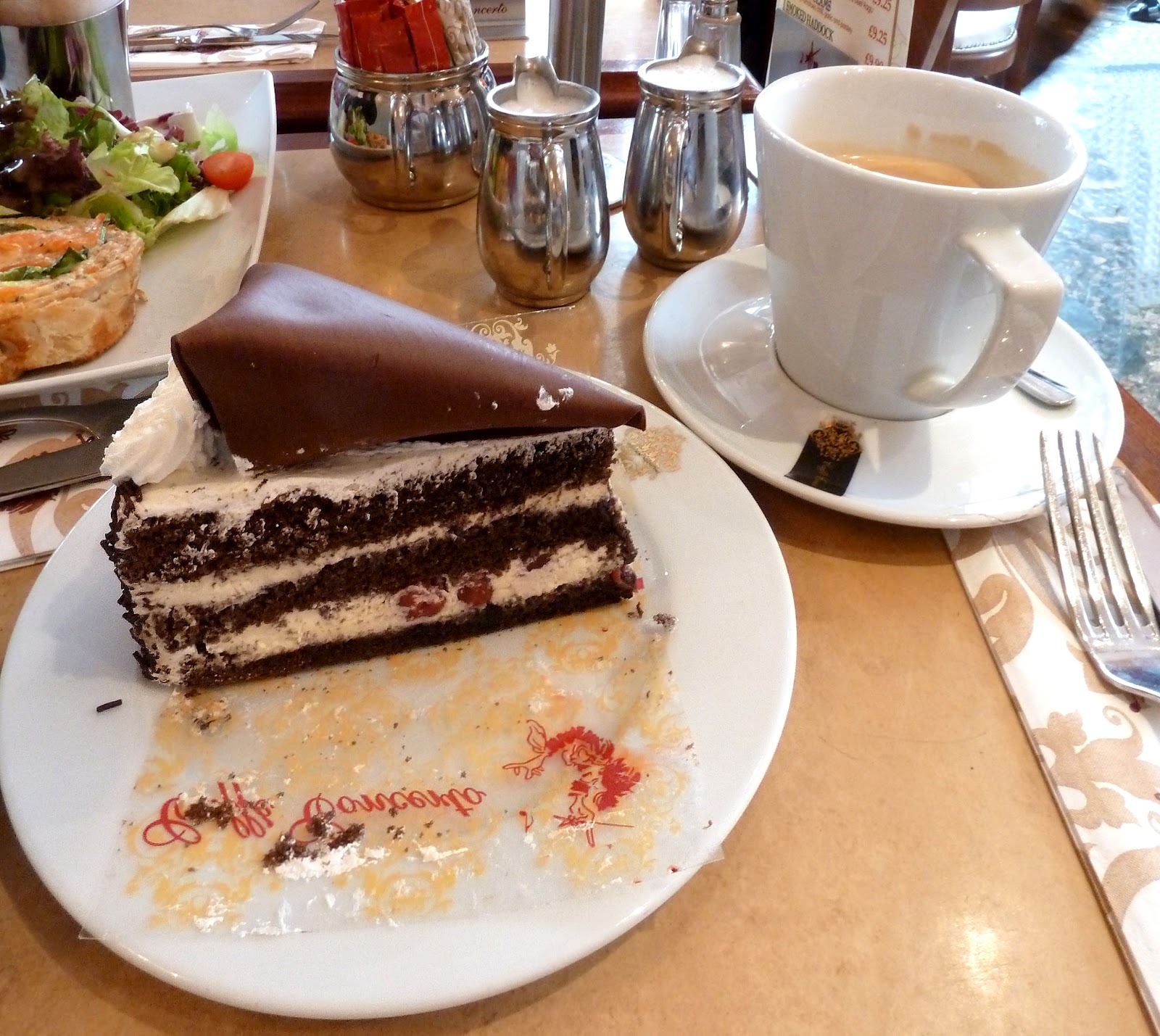
The British love the Rhine valley taking home a bottle of that sweet wine we produce for export only called Liebfrauenmilch, and they love the Black Forest. However, they do not import the cake of the same name, but they bake it in the UK with typically somewhat more chocolate than we use in Freiburg.
*
The British love the Rhine valley taking home a bottle of that sweet wine we produce for export only called Liebfrauenmilch, and they love the Black Forest. However, they do not import the cake of the same name, but they bake it in the UK with typically somewhat more chocolate than we use in Freiburg.
| Forêt Noire in Caffé Concerto on Regent Street in London during my recent trip to England. |
Friday, May 18, 2012
To bike or rather not to bike in Freiburg
Congratulations to Madison, the fifth most 'bikeable' city in the
States behind Minneapolis, Portland, Ore., San Francisco (with all those hills),
and Boston.
Freiburg is known as a bicycle city too. So I scanned the internet to learn
about its ranking. It was disappointing that Freiburg did not figure among
Germany's first ten bicycle cities. These are:
Münster, Kiel, Oberhausen, Hannover, Bremen, Leipzig, Bonn, Magdeburg,
Bielefeld, and Karlsruhe.
I must admit that I am not a keen cyclist except for my yearly bicycle tour. Freiburg's city is within walking distance (20 minutes) from my apartment, so I feel no need to use a bicycle. Still, I am mainly concerned with cycling or cyclists in Freiburg because of their bad behavior towards pedestrians who live dangerously.
|
|
A bicyclist riding along Lake Mendota near the UW-Madison campus in
Madison (©Wisconsin State Journal) |
I must admit that I am not a keen cyclist except for my yearly bicycle tour. Freiburg's city is within walking distance (20 minutes) from my apartment, so I feel no need to use a bicycle. Still, I am mainly concerned with cycling or cyclists in Freiburg because of their bad behavior towards pedestrians who live dangerously.
The other day, a Kampfradler (fighting cyclist) ran
over a friend of mine on a zebra crossing. The guy did not stop, and when the
victim stood up, she luckily only had a broken finger. In fact, in
Baden-Württemberg Freiburg has the sad reputation of having the highest bicycle
accident rate.
Last year two people died, 83 were heavily injured, and 461 had 'only'
light injuries. It does not help that Münster has a bad reputation, too, for
cyclists ignoring red traffic lights, cycling on narrow walkways in the wrong
direction, and slaloming at high speed through pedestrian zones. In addition,
only children (this is an obligation) and old people like me (my brain is the
only part of my body that still has some value) wear helmets.
To remedy the situation, Freiburg and Berlin started a two-year campaign called Rücksichtsvoll im Straßenverkehr (When participating in road traffic, be considerate).
The advertising for the campaign is strange. Green people look with disgust at the blue can. Cans had been banned in Germany for the sake of recyclable bottles and are now celebrating a merry resurrection. Will the campaign help to make life safer for Freiburg's pedestrians? I doubt.
To remedy the situation, Freiburg and Berlin started a two-year campaign called Rücksichtsvoll im Straßenverkehr (When participating in road traffic, be considerate).
The advertising for the campaign is strange. Green people look with disgust at the blue can. Cans had been banned in Germany for the sake of recyclable bottles and are now celebrating a merry resurrection. Will the campaign help to make life safer for Freiburg's pedestrians? I doubt.
*
Friday, May 11, 2012
How much Keynes we can still tolerate?
In their recent publication, the Club of Rome made an estimate of how the Earth will appear in 50 years. This, along with the results of two European elections, made me think about our future too, although I don't have much time left anymore, and I am an absolute layman in economics. For me, the world economy is running wild in an egoistic manner. Reciting the mantra that our grandchildren should not pay for our sins (debts, CO2 emissions, climate change, and the strain on natural resources) has degenerated into lip service.
Recently, I watched Paul vs. Paul, i.e., Senator Ron Paul and Nobel Prize winner Paul Krugman, on television, as they helplessly discussed how to remedy the economy. Their debate only confirmed my conviction that there is no cure for the economic situation the world is suffering from. The German economy, often regarded as a model that still works, primarily thrives on exports. This exacerbates the problem for the euro, as our European trade partners finance their trade deficits by incurring more debt. And what to think about my country that will loan 20 billion euros on the money market in these fat years of low unemployment and high tax revenues to keep this year's federal budget in balance?
That even Germany is not adhering to the strict norms of the European fiscal pact has given newly elected French President François Hollande the idea of asking for fresh, i.e., borrowed money to stimulate the European economy, just as Paul Krugman had suggested on television should be done in the United States. Printing euros is easy, but where does that fresh money go? We know that the euros Greece has received so far from the Eurozone bailout fund were used to keep the Greek banking system afloat. I suppose the money François is asking for has already been earmarked to finance the lowering of the retirement age in France from 62 to 60 years, as he has promised.
Recently, I watched Paul vs. Paul, i.e., Senator Ron Paul and Nobel Prize winner Paul Krugman, on television, as they helplessly discussed how to remedy the economy. Their debate only confirmed my conviction that there is no cure for the economic situation the world is suffering from. The German economy, often regarded as a model that still works, primarily thrives on exports. This exacerbates the problem for the euro, as our European trade partners finance their trade deficits by incurring more debt. And what to think about my country that will loan 20 billion euros on the money market in these fat years of low unemployment and high tax revenues to keep this year's federal budget in balance?
That even Germany is not adhering to the strict norms of the European fiscal pact has given newly elected French President François Hollande the idea of asking for fresh, i.e., borrowed money to stimulate the European economy, just as Paul Krugman had suggested on television should be done in the United States. Printing euros is easy, but where does that fresh money go? We know that the euros Greece has received so far from the Eurozone bailout fund were used to keep the Greek banking system afloat. I suppose the money François is asking for has already been earmarked to finance the lowering of the retirement age in France from 62 to 60 years, as he has promised.
In the United States, there is no mandatory retirement age. Contrary to me, who was forced to retire at the age of 65, many of my American friends continued working beyond that age. Let's hope that the financial stimulus Paul Krugman has requested in the United States will be used to create new jobs.
New jobs are also needed in Europe, particularly in Spain, where many young people are currently unemployed. Their 'no future' outlook is social dynamite! So again, with all the pressure building up, the end of Merkosysm is near, and public spending will heap more debts on the already unbelievable accumulated amount.
Hastily, our finance minister declared, 'It is the wrong way to take money to stimulate economic growth. Instead, he requested additional savings and reforms, both at home and in Europe. With those differing viewpoints in France and Germany, will Merkollande replace Merkozy? We shall see when François visits Angela in Berlin on May 15.
The apparent result of an increase in printed money is inflation, meaning that for the average person, the money they deposit in a savings bank will lose its value, accentuated by the currently low interest rates. What will be the best way not to lose? Do not save your money, but spend it and even incur debts.
I shall end my story with a personal anecdote. When I was young, I wanted to build a house and needed a mortgage, so I consulted several banks for offers. One was particularly advantageous. When I asked the guy why my monthly installments would be so low compared with the proposals of the other banks, he answered, "Oh, you just pay the interest rate. There is no back-payment." I said, "But then my children will inherit my debts."
![]() |
| François pouring his Hollandaise sauce over Merkel's fiscal piggy bank pact (©Haitzinger) |
I shall end my story with a personal anecdote. When I was young, I wanted to build a house and needed a mortgage, so I consulted several banks for offers. One was particularly advantageous. When I asked the guy why my monthly installments would be so low compared with the proposals of the other banks, he answered, "Oh, you just pay the interest rate. There is no back-payment." I said, "But then my children will inherit my debts."
At that time, such a situation was unacceptable to me, so I opted for the classical variant with another bank paying interest and amortization. Would I have acted the same in today's situation, knowing that inflation would erode my children's debts?
*
Subscribe to:
Posts (Atom)