The
name Halle is of Celtic origin, meaning salt. The river Saale flowing
through the town recalls the Germanic word salt too. In the Middle Ages, the
of Halle operated evaporating pans to
extract precious salt from brine, thereby becoming the town's rich people. They
proudly called themselves
. Today the
rich in calories,
reminds the visitor of those ruling pan holders.

|
|
Billions of calories in Hallorentorte
|
During that period, the center of Halle changed considerably. Following the
construction of the enormous Red Tower, home of the town's archive and treasury,
the marketplace had become too small. So the
Halloren convinced their
archbishop Albrecht, possibly with lots of money, that St. Mary's Church should
be demolished to make room for more market stands.

|
|
In 1500, from left to right: Gertraudenkirche, Marienkirche, and Roter
Turm
|
Ultimately, they kept the two church towers of St. Mary's Church, so today's
Market Church has four steeples.

|
Present view of Halle's center looking on Marktkirche and
on the Red Tower lacking its original color.
|

|
|
Luther's relief at Marktkirche
|
Here is a view of the Red
Tower as seen by my iPhone
and
Lyonel Feininger
in the 1920s.
Let us return to Reformation history and Albrecht's story, who ambitiously
wanted to surpass his older brother. In 1514, when the bishopric of Mainz became vacant, Albrecht applied for the job. Although the members of the cathedral
chapter were not averse to the noble candidate, they refused to collect the
pallia money to be paid to the Pope for a new bishop in their diocese. To
ensure his election, Albrecht himself procured the required 14,000 guilders
and sent them to Rome.
As Archbishop of Mainz, Albrecht was one of the three clerical electors. He had, as primo inter pares, the position of Archicancellarius per Germaniam, i.e., chancellor of the German-speaking parts of the Reich. In contrast, his brother Joachim only held the
symbolic function of
Archicamerarius (Erzkämmerer, i.e.,
arch-chamberlain).
All had worked out fine for Albrecht except for the problem of simony. In fact,
the Church Councils of Chalcedon in 451 and Nicaea in 787 had forbidden the
purchase of clerical posts and positions. However, money will buy anything - almost. So, after paying another 10,000 guilders to Pope
Leo X, Albrecht got a dispensation from the pontiff.
Where did Albrecht's money come from? The sums involved in 1514 were peanuts for
the Fuggers in Augsburg compared to the 851,918 guilders* they would shell out in 1519 to
Charles V, who would bribe his electors.
Jacob the Rich
lent relatively moderate sums to Albrecht against interest, making it hard for
the archbishop to pay his debts. Eventually, Pope Leo had a brilliant idea. For
the new construction of St. Peter in Rome, he needed lots of money and had
therefore issued an indulgence. Why shouldn't Albrecht sell these indulgence
papers in his bishoprics? Thanks to Gutenberg's invention, these papers
were printed en masse in the basements of the Vatican. By selling indulgences in
his dioceses, Albrecht would get part of the money he could use to pay the
Fuggers.
*equivalent to 120 million US$
When Martin Luther noticed that poor people hurried to buy these indulgence
papers with what little money they had, he blew up and wrote to Albrecht: "
Ablaß ist lauter Büberei und Trügerei, die die armen, einfältigen Christen um
Geld und Seele bringet. Darum sei E.K.F.G.* endlich und schriftlich angesagt:
wo nicht der Abgott wird abgetan, muß ich ... E.K.F.G. wie den Papst
öffentlich an[zu]tasten ... allen vorigen Greuel des Tetzel* auf den Bischof
von Mainz treiben und aller Welt anzeigen den Unterschied zwischen einem
Bischof und einem Wolfe
(Indulgence is nothing else than knavery and cheating that tricks poor,
simple-minded Christians out of their money and souls. Therefore, E.K.F.G. be finally told and here in writing: If the idol is not abjured, I must publicly finger ... E.K.F.G. as well as the Pope... and attribute all previous horrors by Tetzel to the bishop of Mainz, showing all the world the difference between a bishop and a wolf)."
*Euer kurfürstliche Gnaden (Your Grace the Electoral Prince). Tetzel was the
most (in)famous indulgence preacher of his time.
When His Grace Archbishop Albrecht failed to react to the letter of an
Augustinian monk, he was mistaken for Luther, for he did not hesitate to make his famous
95 theses public, the act that started the Reformation.

|
|
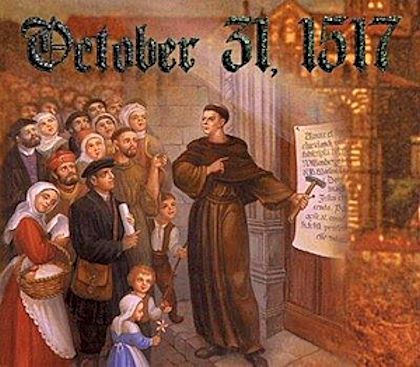
Luther posts his 95 theses as it is imagined in the States.
|
Albrecht also spent indulgences and borrowed money to construct his New Residence
in Halle.

|
|
The New Residence was started in 1531
|
He also had himself portrayed between saints on the altarpiece in
Marktkirche.

|
|
View toward the altar.
|
Here is the monument of Halle's greatest son,
Georg Friedrich Händel, at the Marketplace.
This was nearly the end of my trip to Lutherland. On our way back to
Freiburg, we passed the
Völkerschlachtdenkmal ...

|
Epitaph at the Orthodox church St. Andrej commemorating
the many Russians killed in the Battle of Nations.
Note that the Prussians had the highest death toll, with 22%.
|
...and made a stop at Jena to have
a look at Luther's epitaph.

|
|
Entrance to St. Michael, home of Luther's epitaph
|
Following the Battle of Mühldorf,
Friedrich der Großmütige lost Wittenberg and its university to his cousin
Maurice
in 1547. At Jena's marketplace, we saw that grateful students had decorated the
statue of the founder of the local university.

|
|
Elector John Frederick, the Magnanimous of Saxony, Founder of Jena's
University
|
Before I close my report about my trip to Lutherland, I would like to share
another of
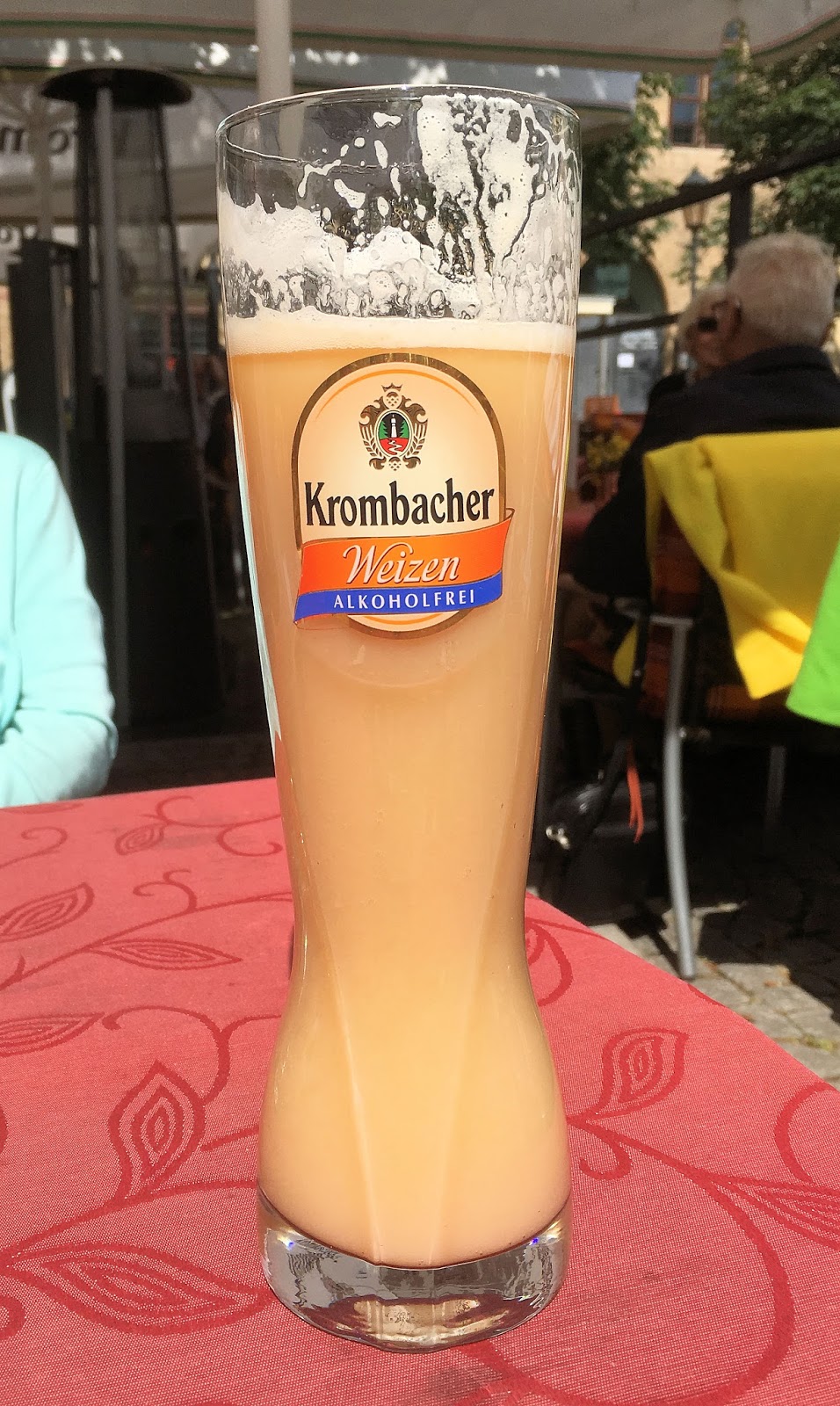
those weird drinks they serve in Germany. You see below
Bananenweizen, a white beer mixed with banana
juice.
Are those people living on the territory of the former GDR still obsessed with
bananas? Rumors have it that - following the opening of the wall in 1989 - the
first thing people visiting the West were looking for was:
A beautiful bunch o' ripe banana
Daylight come, and me wan' go home
Hide the deadly black tarantula
Daylight come, and me wan' go home.
Red Baron also wanted to go home because he feared the tarantula and was full of
indigestible Bananenweizen.
**