Monday, November 25, 2019

Civility And Justice

were the two pillars on which the education of men* was based in ancient Greece.
*My readers know already that women were just the "other" sex in homophilic Greece.

Greek settlements in the Mediterranean
In the series of lectures on "Education Today," Professor Hans-Joachim Gehrke underlined, like Professor Honerkamp earlier, the fact that Greek philosophers advanced most in their thinking in regions where they came in contact with foreign cultures.


Professor Gehrke had titled his lecture "Education and Freedom," i.e., children in ancient Greece were reared and educated freely: "For of all things the measure is man, of the things that are, or how they are, and of things that are not, or how they are not" (Protagoras of Abdera; Πρωταγόρας, c. 490 BC – c. 420 BC).


The Pnyx in Athens was the meeting place of the people. The Attic democracy meant freedom and self-determination for the free male.

So it is clear that sons must receive a specific form of education, not because it is valuable or necessary, but because it suits a free man (Plato; Πλάτων, 428/427 or 424/423 – 348/347 BC).

A newborn child is like a blank slate. Education must teach children how to live in a community where civility and justice are the basis for cohabitation.

"But who would be a benefactor if not the parents concerning their children? They have created them out of non-existence, and then again, they have given them food and later physical and spiritual education so that they may own not only life but also a good life. Through sport and wrestling lessons, they have helped the body to develop its strengths and good condition, to be agile in posture and movement, while maintaining harmonious balance and civility; but they have fostered the spirit too by teaching reading and writing, arithmetic, and geometry, music, and philosophy in its entirety, which elevates the spirit living in a mortal body and leads it up to heaven, showing it the happy, blessed beings, awakening admiration and longing for the unchanging harmonious order which these beings, obedient to their guide and leader, never abandon" (Philo of Alexandria; Φίλων, c. 20 BC – c. 50)


"If one sows genuine education into a young body, it lives and sprouts throughout his life" (Antiphon; Ἀντιφῶν, youngest brother of the philosopher Plato). However, education is insufficient, for it requires exercise and practice. "Exercise, my friends, means more than good talent" (Epicharmus of Kos; Ἐπίχαρμος ὁ Κῷος, c. 550 BC and c. 460 BC) and "By practice more are good than by nature" (Critias; Κριτίας, c. 460 – 403 BC). "Continued exercise, I tell you, my friend results in a habit; this is eventually solidified in man and becomes natural for him" (Euenus of Paros; Εὔηνος ὁ Πάριος, 5th-century BC)

Democritus (Δημόκριτος c. 460 – c. 370 BC) went so far as that "nature and education are similar. Namely, education transforms man, but this transformation creates nature."


The Greek canon determines western education in the Middle Ages and up to today. The seven liberal arts described above were taught at the first universities. They are allegorically displayed on the porch of Freiburg's Munster Church.

Like a good teacher does, Professor Gehrke summarized his lecture on education in ancient Greece at the end:

1. Education is the prerequisite for a free society.

2. Education is aimed at the ability of free citizens to judge.

3. The training of the mind is connected with the practice of the body.

4. The objects of learning are derived from orientation.

5. There are teachers and learners, care, and intellectual honesty.
*

Friday, November 15, 2019

Two Types of Logic


As part of its studium generale, Freiburg University offers many lectures to the general public. One prominent series is Saturday University, whose topic for this year's winter semester is Education Today.

The talks started with a drumbeat. A theoretical physicist elaborated on Education in the Age of Science.

Forging a bridge between Greek philosophy and high-energy physics
Professor Josef Honerkamp's lecture was one of the best I have ever heard. Being a physicist myself, I knew how the thinking of the pre-Socratic philosophers still influences modern physics. Still, in working out the difference between a logical and a dialectical deduction, Honerkamp shed new light on the influence of Greek philosophy on current thinking.


Greek philosophy and science have their origins in the Greek colonies in Asia Minor and Italy. Honerkamp stressed that, initially, in regions where Greek philosophers were in contact with alien cultures such as Phoenician, Persian, and Egyptian, their thinking advanced considerably.

Eventually, Athens became the center of cultural life in the Periclean period, and later, the specialized sciences flourished in Alexandria.


Constitutive principles of mathematics are the constituent principles of being things.

Accordingly, in modern physics, known particles can be arranged into geometric figures, allowing the prediction of missing particles, i.e., particles to be discovered.

Here, building mesons and baryons out of quarks
from the book Quarks with Color and Flavor by Nobel Prize winner Sheldon Lee Glashow©
Arranging elementary particles in geometrical structures is a favorite pastime of group theory.


How can a man/woman gain insight? Can one gain sure knowledge at all? There are observations and science. There are revelations and religion.


In their quest, men* search for and find better things to add to their understanding with time. Here Professor Honerkamp distinguished between rigorous and dialectic science.
*Let's face it. The world of the ancient Greeks was dominated by males.

When do we speak about logical and when dialectical conclusions? A conclusion is logical when derived from valid and generally accepted first principles. A conclusion is dialectical when it is derived from credible sentences.

Sentences are credible if they are recognized by all, most, or wise men.

The seven wise men in ancient Greece

On the one hand, there are nature, discovery, and the implication of experimental results; on the other hand, there are human cohabitation, norms, and continuous discourse about those norms.

In the first case, mathematics assures logical correctness. In the second case, logic is applied instinctively and analogously (That is logical, isn't it?), leading to implications that are regarded as acceptable.

Mathematical logic had a great fascination for the German philosopher Gottfried Wilhelm Leibniz when he wrote, "If one could find characters or signs capable of expressing all our thoughts just as purely and strictly as arithmetic expresses numbers or analytical geometry expresses lines, then one could obviously do what one does in arithmetic and geometry with all objects, as far as they are subject to rational thinking."

"And if someone doubted what I put forward, I would say to him, "Let us calculate, monsieur," and taking pen and ink, we would soon be out of embarrassment."

Quantum mechanics definitively killed Leibniz's dream.

Galilei experimenting at the inclined plane
Now the physicist in Professor Honerkamp broke through, giving credit to Galileo Galilei for his physics experiments and Isaac Newton for providing the theoretical foundation of mathematics.


On the way to an understanding of nature. A little history of physics


Searching for the "uniform" theory or GUT, the Grand Unification Theory. The first principles are symmetries (the Greek philosophers send their regards), a constant speed of light, and the equivalence principle.


The space of phenomena. Dimensions in meters (R) vs. complexity (N). Current scientific challenges are black holes, gravitational waves, dark matter, and energy.
**

Monday, November 11, 2019

All About Pilsner Beer


The fifth workshop in the series What's Brewing was devoted to Pilsner-type beers.


While Frank Greeraers was giving the introduction to the event, reviewing the past four workshops (Read here about #one, #three, and #four), an American in Prague and co-host, Evan Rail, was attentively watching and listening.
In Evan Rail's beer guide, you not only find Pilsner Urquell.


Evan Rail, the author of The Meaning of Craft Beer, was the star of the evening. Here is the first information we read in his book: "This sounds unbelievable today, but in 1993 you could actually operate a successful American craft brewery and not serve a hoppy American IPA - or even an IPA of any kind. You could make your bones on the great Pilsner and a delicious Dunkel, with a line out the door on weekends. In its earliest days, American craft beer really did speak with a European accent."


Why shouldn't it? As early as 1840, Bavarian brewers showed Americans that fresh lager tasted different from "warm" English-style beers.

Johann Wagner did not call his bottom-fermented beer "Pilsner," as the brewers in Pilsen only learned in 1842, two years later, how to make lager beer. Again, a Bavarian, Josef Groll from Vilshofen, taught the Pilseners how to brew a cold fermentation beer from a gently kilned and, therefore, very light malt.

Frank called 1840/1842 the years of the Big Bang in beer brewing, Urknall in German, referring to Pilsner Urquell?


In the beginning, the name was protected when, in 1896, German brewers failed to call their lager beer "Pilsner."


Evan even explained the three ways* of pouring a Pilsner Urquell:
*The explanations I found at http://www.biersekte.de/Aktuell/Neuigkeiten/Pilsner-Urquell-Waldmannskost.htm

Hladinka: the beer is tapped under an approx. 3.5 cm high head. This allows the bitter and delicate aromas and hop notes to be felt more intensely on the palate while drinking, making this beer tap a perfect match for meat and fish.

Šnyt: the glass is half-filled* with foam, and then the golden beer is tapped underneath. As the beer is drunk through the head, the malty cereal aromas are particularly intense, while the hop aromas remain in the background.
*In German, we would call the badly poured filling Schlecht eingeschenkt.

Mlíko (milk): here, a glass of beer foam is served. The beer is exceptionally creamy, and the froth makes the malt's sweet caramel aromas more intense when drunk. This tap is a perfect match for desserts.

Let us hope that this kind of fraternization will have its comeback one day
or aren't there any gentlemen anymore?
České Budějovice, called Budweis in German, is a city in Bohemia founded in 1265 by King Ottokar II. Soon after its founding, the town began brewing Budweiser. While in the States in 1876, they named one beer Budweiser, which resulted in a trademark dispute. You may like to read the long story on Wikipedia.

The short story is that in the States, you get US-brewed Budweiser, while in Germany, you can buy original Budvar Budweiser, a mass-produced beer made in Budweis.


The beers tasted


Note and taste
the difference
1. Another Civic Brewhouse was founded in Budweis in 1795 by the German-speaking burghers of the Bohemian city. Nowadays, they brew and bottle a quality lager/pilsner beer in České Budějovice, marketed as Samson. It was the first beer we tasted.

2. A Pilsner-style Benedict Pale Lager is brewed by Pivovar Břevnovský in Prague. They claim to be the oldest monastery brewery, dating from 993!

3. Bernard Dunkel Lager is brewed by the family brewery in Humpolec in the Czech Republic. This dark beer has a pleasant taste.

4. Raven Waffle Dance Stroopwafel* Ale from the pivovar Raven in Pilsen. A sweet and full-bodied Stroopwafel Ale brewed in collaboration with the Sisters Brewery, Holland. Wafel Dance is brewed with Dutch Stroopwafels and Czech dedication. This brew was simply too sweet.
*a wafer cookie made from two thin layers of baked dough joined by a caramel filling


Here is an article by Evan Rail in the NYT. He was affirmative for Berlin beer, but was it because German craft beers now speak with an American accent?

Besides, when everything fails ...


This falling in love led to increased craft beer exports and a beer-pairing dinner in Berlin.


Beer instead of ping-pong diplomacy, as, e.g., the ...

5. Bohemian Pilsner brewed by Lemke in Berlin. We brewed it with Bohemian malt and plenty of original wort, then stuffed it with Saazer and East Kent Golding hops.

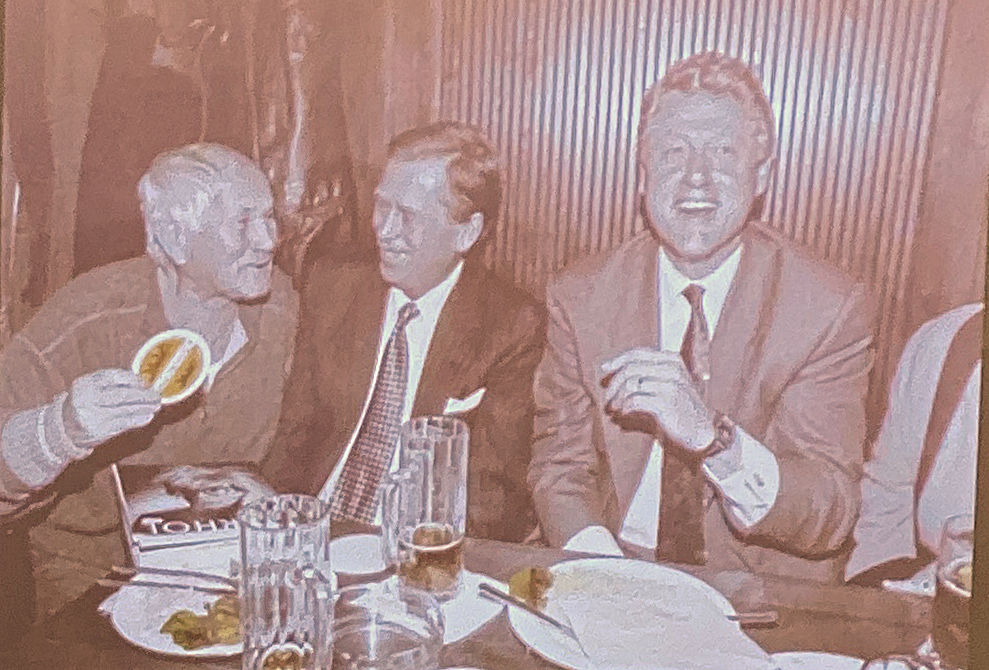
An earlier case of beer diplomacy:
Bill with Czech President Václav Havel and a nearly empty glass in Prague
6. Firestone Pivo Pilsner is inspired by the dry-hopped Tipopils from Italy and brewed by the Firestone Brewing Company in California. Pivo exhibits stylistic influences from Germany, Italy, and the Czech Republic with a West Coast dry-hopping twist. 

With all those Pilsner beers, Evan had to explain their differences.
7. A hazy & juicy New England IPA is brewed by Samuel Adams, the Boston Beer Company.

The warnings "Consumption of alcoholic beverages impairs your ability to drive a car or operate machinery and may cause health problems" were apparently not taken seriously by US comedian Conan O'Brien ...


... drinking beer the Irish way?


8. Mr. Cinnamon Bun, containing cinnamon snail and vanilla extract, is mixed by Sudden Death Brewing Company, Timmendorfer Strand, Germany. The motto for the mix is, "Hey ladies, what would you like for breakfast tomorrow?"

9. Luckily enough, the last choice was more serious. We tasted the Baltic Porter Woda Portova craft beer brewed by a German-American Czech group, Yankee & Kraut, and the team from Pivovar Raven.


Here we should not forget the craft beer brewed by the Braukollektiv Freiburg. An American-Australian-German Group has given more than 28 NEIPAs to beer connoisseurs in the region from 2014 to 2019.


Here is the final group photo of the Jagdstrecke (hunting bag) of the beers tasted at a well-organized and well-remembered workshop.
**

Wednesday, October 30, 2019

Brahe and Kepler in Prague

Tycho Brahe and Johannes Kepler at Pohorelec and in bronze
Tycho Brahe and Johannes Kepler were astronomers and astrologers at the imperial court of Rudolf II, who, in 1583, had moved his seat of government from Vienna to Prague. With this move, he had further irritated the Habsburg clan, who already regarded "their" melancholic emperor as blödhäuptig (silly-headed). As Golo Mann writes, "Rudolf possessed high intelligence when the urge of the moment did not cloud it." He was particularly interested in the science of his time, like alchemy and astrology.

As the best solution to the Rudolf problem, the Habsburgs considerably reduced his financial support. So the emperor was forced, although a fervent Catholic himself, to make a pact with the Protestant Bohemian estates. Their quid pro quo was financial support for the court in exchange for curbing religious liberties.

Rudolf's Letter of Majesty in the Czech language
So on July 9, 1609, Rudolf guaranteed in his Letter of Majesty to the followers of the Bohemian Confession, the Czech Hussites and brothers in faith, "From this day forth no one ... shall be pushed aside by [his] religion and forced to another faith by force or in any conceived way."

The document guaranteed the Ultraquists* not only freedom of religion but also the privilege of building churches and establishing schools. Prague University became Protestant.
*receiving the Holy Communion under both Species

©P. Habison
This situation culminated in a fight between two prominent brothers, Emperor Rudolf II and the younger Archduke Matthias. In the end, Rudolf was forced to abdicate.


Brahe and Kepler met for the first time on February 6, 1600, well before the fraternal quarrel, at Benatek Castle, Brahe's residence, located 50 km outside Prague.


Why do I write all this? Red Baron spent five days with a group on a guided tour of Prague and its surroundings. When I first read the announcement of "Tycho Brahe und Johannes Kepler in Prag," I was all excited. Studiosus, one of the better German tour organizers, offered this one-time specialized trip.

In what follows, I will no longer delve into the historical context on the eve of the Thirty Years' War, but rather focus on the tour. My German-speaking friends may read the full story and history here.

As usual, Studiosus had all well organized. At times, three guides looked at the overall organization, explained the implications of Brahe's and Kepler's discoveries for the development of astronomy, and showed us the beauties of Prague. The organizer was a man from Budapest speaking fluent German*, the astronomer-physicist was from Vienna, and the local guide was a Bohemian lady from Prague.
*His German was too good, clearly indicating that he was foreign (cf. My Fair Lady, the story about the Hungarian professor)

St. Norbert, in his recess, just does not get it.
In general, English was the language of conversation in shops and restaurants, but our three guides spoke German, the classical lingua franca of the bygone Danube Monarchy. I was moved.

The beautiful Elbe Valley
Coming from the Berlin wedding, I had a night-over at Dresden and took the train along the Elbe River to Prague the following morning.

Distinguish the famous Bastei bridge.
It was a pleasant ride along the Elbe Valley, passing the famous Elbe Sandstone Mountains.


The train named Berliner departed from Kiel on the Baltic Sea, passed through Berlin and Dresden, and had only a 10-minute delay when we reached Prague.

First impression: Prague's Wenceslas Square by night

The following morning started with a series of lectures by Dr. Peter Habison on Brahe and Kepler.

©P. Habison
Tycho Brahe became famous as an astronomer when he discovered and described the supernova of 1572. Its luminosity was so high that he could observe the bursting star with the naked eye.

©P. Habison
He also observed and described the 1577 comet.

A sextant
A replica of a Brahe quadrant at Benatec Castle
Brahe observed all his astronomical data, including the movement of the planets, with the naked eye, using well-adjusted sextants and quadrants.

Commemorative plaque for Smetana above the entry to Benatec Castle
Most people visit Benatec Castle not for Brahe but for Bedřich Smetana. The composer of "The Moldavia" lived here from 1844 to 1847.

Back to our protagonists. Enter Kepler. He needed Brahe's precisely measured data badly for the exact calculation of Mars's orbit. Initially, Brahe refused to part with them. You will find the full dramatic interhuman story between those two giants of science on Wikipedia.


Eventually, Kepler got the data following Brahe's death in 1601. He dedicated the publication to Emperor Rudolf.


In 1609, Kepler finally published his Astronomia Nova, in which, based on Brahe's precise observational data, he calculated the slightly elliptical orbit of Mars. In his book, Kepler also formulated two of his laws as there are:

1. Planets move in elliptical orbits with the Sun at one focus.
2. The speed of the planet changes at each moment so that the time between two positions is always proportional to the area swept over on the orbit between these positions.

Only a few contemporary "scientists" understood and
appreciated Kepler's Astronomia Nova (©P. Habison)
Only 75 years later, Isaac Newton fully understood Kepler's writings by applying to the orbiting planets in Kepler's Laws one of the basic principles in physics, the Conservation Laws, in this case, the conservation of angular momentum. In 1684, Newton published the paper De motu corporum in Hyrum.


In the following, I would like to share some of my photos from our guided tours.

A visit to the castle

Approaching St. Vitus Cathedral at the castle grounds
A look into the choir that was still finished in the Middle Ages
St. John of Nepomuk's drama in three acts is shown in one painting in the St Vitus Cathedral:
1. Nepomuk hears the Queen's confession.
2. King Wenceslaus demands that Nepomuk divulge the secrets of the Queen's confession.
3. Nepomuk refuses, is thrown from Charles Bridge, and drowns in the Moldavia River.
Crowds of tourists pass the great hall at the castle
on their way to and from the site of the 1618 defenestration.
Recovering with an Apfelstrudel (the best!) at the Castle Café
Changing of the guards at the castle
View from the castle onto the roofs of Prague.
         Note the site of the German embassy in the back of the Palais Lobkowicz.
Last view of the castle from Wallenstein's Gardens.

Downtown
An original vestige of Prague's University, founded in 1348
Today's entry to the Universitas Carolina
A traffic light at Charles Bridge channels the crowds of tourists.

Muzeum Speculum Alchemiae


Making gold
A problem everywhere: No drinks, no noise?

Library of the Strahov Monastery

"Science is difficult but fertile."
The interior is awe-inspiring...
... and the view down onto the Golden City, too.
Passing the Loreto Church ...
...discovering German street names ...
... and arriving at Tycho Brahe's house in the Castle Quarter, "The Golden Griffin."
Dr. Peter Habison gave an outdoor lecture.

The Klementinum

The National Library of the Czech Republic
Breathtaking views from the astronomical tower (see above) on
Baroque St. Nicolas Church, Tyn's Church, and the Powder Tower
The Hradčany hill with the castle and St. Vitus Church are to the west.

Pinkas Synagogue, Old-New Synagogue, and Old Cemetery

On the walls of the Pinkas Synagogue are written the names of all the Czech Jews
 who perished in the Holocaust.
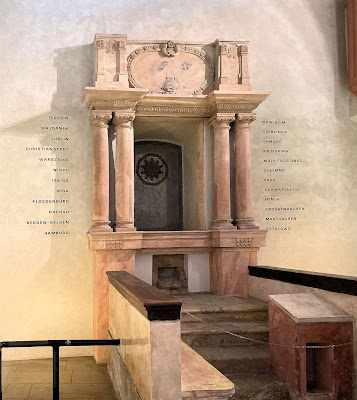
The Thora shrine at the Pinkas Synagogue is flanked
with the names of concentration camps
The Old Jewish Cemetery...
... of the 15th century.
The oldest tombstone of Avigdor Kara from 1439
Rabbi Loew's tombstone of 1609
Interior of the Old New Synagogue where Rabbi Loew taught.
Rabbi Loew's seat in front of the Torah shrine, untouched.
The Golden City is a place to visit.
**