No, I am not writing about the American politician
Joe Lieberman spelled
with one
n but about
Max Liebermann with a
double
n.
As usual, when in Berlin, I visit places with historical relevance. One place
that I had never seen before is the infamous Villa on the Wannsee, where in
1942, Himmler's right-hand-man
Heydrich held a
Konferenz (meeting) to co-ordinate the
Endlösung (final solution)
for Europe's Jews. The place is way out of the city. You first take the S-Bahn
to Wannsee Station and then ride the 155 Bus to the Villa on the Wannsee. The
bus runs every twenty minutes, and while studying the timetable, I read
Liebermann Villa marked as a stop. I spontaneously decided to visit that
place too.
The
Villa of the
Wannseekonferenz
became a memorial center only in 1992, following a long fight about financing.
It now houses an exhibition documenting how the Nazi regime, once in power, had
systematically transformed the latent anti-Semitism in Germany and elsewhere in
Europe into a campaign of annihilation. In presenting the Jews as the scapegoat
for Germany's misery (
Die Juden sind unser Unglück), six million were
hanged, shot, and gassed.
Entrance to the exhibition is free, but the main iron gate to the surrounding
park is locked and only opens after the girl at the counter has considered the
televised visitor acceptable. On this gray November morning, the visitors
comprised a few old guys, but primarily pupils. Their teacher had formed groups
of two and attributed them to the various rooms. Now she ran from team to team,
giving instructions on how the kids had to do
Vergangenheitsbewältigung. i.e., come to terms with the past of their
great-grandfathers.
What would you expect? There was shouting, running around, tussling, and even
laughing. After an hour of distraction from the kids' behavior and feeling
depressed by the exhibition, I had enough. I stepped out into the park and
walked back two bus stops to Liebermann's villa on Lake Wannsee too.
Max Liebermann (1847-1935), a Jewish-German painter born into a wealthy family,
built the house in 1909. He lived there during the summer months from 1914 to
the end of his life. Liebermann is regarded as the father of German
impressionism and, while in Berlin, became famous as the painter of
portraits.
|
What Liebermann saw from his studio on Pariser Platz in January 1933. The new US embassy is just located across
|
During his life, Liebermann always held strong opinions on art and politics.
While watching the Nazis' brown hordes torches lit celebrating their victory in
marching through the Brandenburg Gate on January 30th, 1933, Liebermann is
reported to have commented in his typical Berlin dialect:
Ick kann jar nich soville fressen, wie ick kotzen möchte (I can't eat as much as I would like to vomit). The old man is one of my
heroes!
|
|
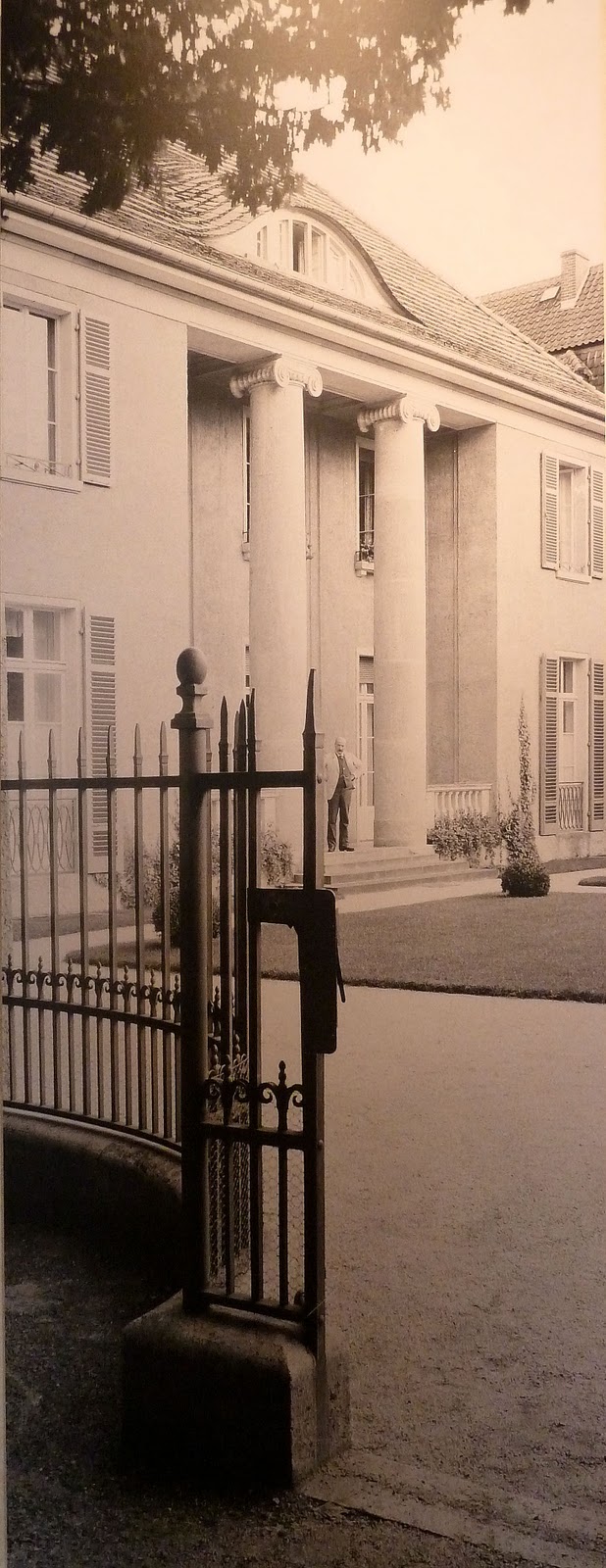
Max standing in front of his Villa.
|
Liebermann, who had become president of the Prussian Academy of Arts in 1920.
and a Berlin honorary citizen in 1927, resigned from his post in 1933, just in
time before the Nazis ousted him.
|
|
Reading in his living room.
|
|
|
Flowers in Liebermann's garden. In the back, his
Castle on the Lake
|
After he died in 1935, the new rulers forced his widow, Martha, 1940 to sell
the house to the Reichspost. Max had called the place his
Castle on the Lake, which he had loved so much, always looking for
corners with flowers for his paintings. Martha committed suicide in 1943, just
ahead of her deportation to Theresienstadt.
*