Thursday, May 31, 2012

Germany's Route 66

Today I read an article in my favorite newspaper about the Bundesstraße (Federal road) 500 that runs along the heights of the Black Forest. The B 500 was planned eighty years ago as Schwarzwaldhochstraße to make the high villages accessible to tourists. It runs from Waldshut in the south to Baden-Baden in the north, although with a gap that has never been closed between Triberg and the Kniebis mountain. If you take this high road passing along the Titisee instead of Loch Lomond and I take the low road through the Rhine valley, I'll be in Baden-Baden before you.

Known well for its panoramic views and breathtaking scenery, the B 500 has earned a new denomination among British motorbike tourists. They call it Germany's Route 66. 

Since the days of Nat King Cole, who got his kicks on Route 66, it has always been a dream of mine and many others to drive on it from Chicago to LA. In England, motorbikers question their colleagues returning from the continent: Did you take the B 500?

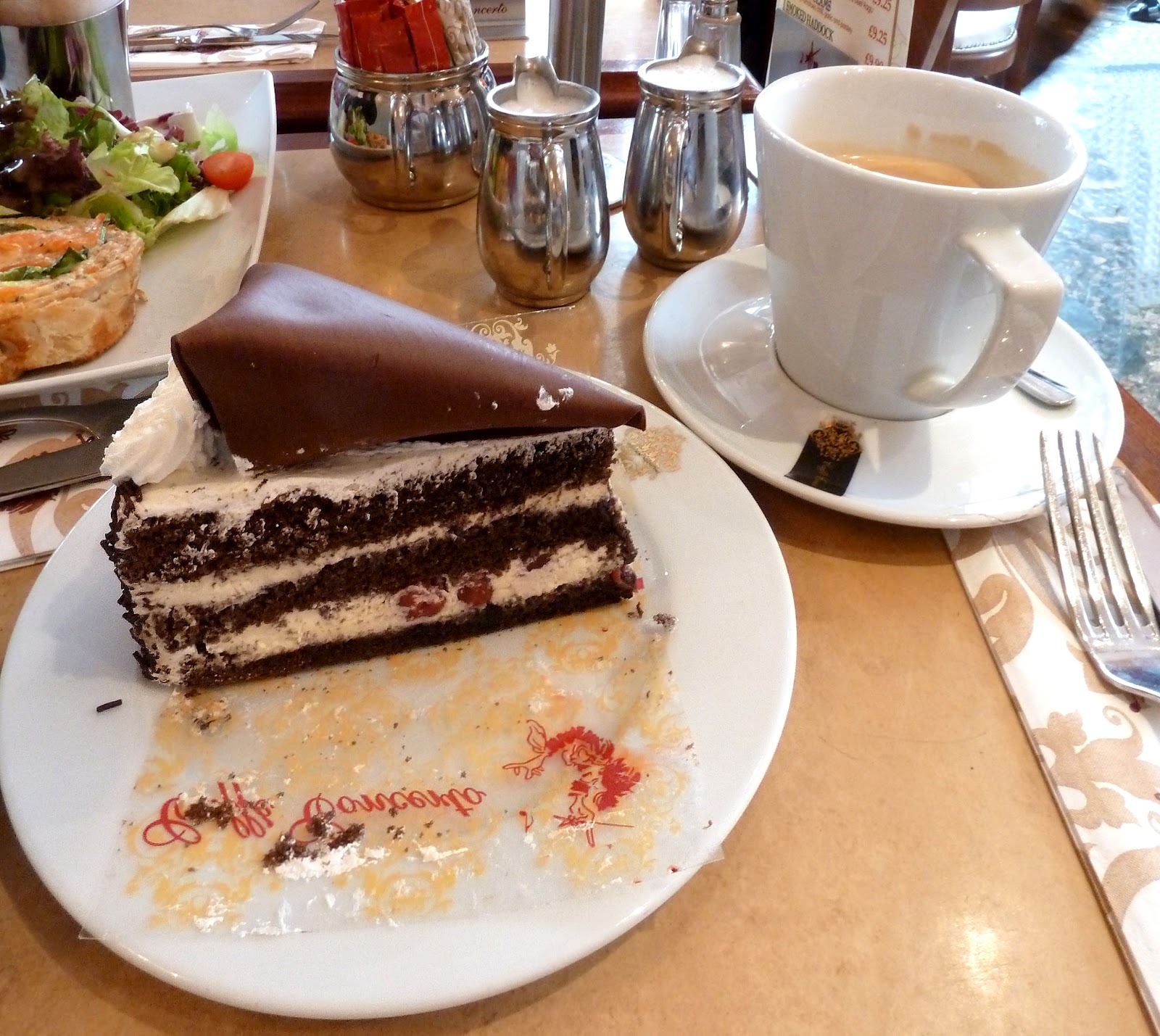
The British love the Rhine valley taking home a bottle of that sweet wine we produce for export only called Liebfrauenmilch, and they love the Black Forest. However, they do not import the cake of the same name, but they bake it in the UK with typically somewhat more chocolate than we use in Freiburg.

Forêt Noire in Caffé Concerto on Regent Street in London during my recent trip to England.
*

Friday, May 18, 2012

To bike or rather not to bike in Freiburg

Congratulations to Madison, the fifth most 'bikeable' city in the States behind Minneapolis, Portland, Ore., San Francisco (with all those hills), and Boston.

A bicyclist riding along Lake Mendota near the UW-Madison campus in Madison
(©Wisconsin State Journal)
Freiburg is known as a bicycle city too. So I scanned the internet to learn about its ranking. It was disappointing that Freiburg did not figure among Germany's first ten bicycle cities. These are: Münster, Kiel, Oberhausen, Hannover, Bremen, Leipzig, Bonn, Magdeburg, Bielefeld, and Karlsruhe.

I must admit that I am not a keen cyclist except for my yearly bicycle tour. Freiburg's city is within walking distance (20 minutes) from my apartment, so I feel no need to use a bicycle. Still, I am mainly concerned with cycling or cyclists in Freiburg because of their bad behavior towards pedestrians who live dangerously. 

The other day, a Kampfradler (fighting cyclist) ran over a friend of mine on a zebra crossing. The guy did not stop, and when the victim stood up, she luckily only had a broken finger. In fact, in Baden-Württemberg Freiburg has the sad reputation of having the highest bicycle accident rate.

Last year two people died, 83 were heavily injured, and 461 had 'only' light injuries. It does not help that Münster has a bad reputation, too, for cyclists ignoring red traffic lights, cycling on narrow walkways in the wrong direction, and slaloming at high speed through pedestrian zones. In addition, only children (this is an obligation) and old people like me (my brain is the only part of my body that still has some value) wear helmets.

To remedy the situation, Freiburg and Berlin started a two-year campaign called Rücksichtsvoll im Straßenverkehr (When participating in road traffic, be considerate).


The advertising for the campaign is strange. Green people look with disgust at the blue can. Cans had been banned in Germany for the sake of recyclable bottles and are now celebrating a merry resurrection. Will the campaign help to make life safer for Freiburg's pedestrians? I doubt. 
*

Friday, May 11, 2012

How much Keynes we can still tolerate?

In their recent publication, the Club of Rome made an estimate of how the Earth will appear in 50 years. This, along with the results of two European elections, made me think about our future too, although I don't have much time left anymore, and I am an absolute layman in economics. For me, the world economy is running wild in an egoistic manner. Reciting the mantra that our grandchildren should not pay for our sins (debts, CO2 emissions, climate change, and the strain on natural resources) has degenerated into lip service.

Recently, I watched Paul vs. Paul, i.e., Senator Ron Paul and Nobel Prize winner Paul Krugman, on television, as they helplessly discussed how to remedy the economy. Their debate only confirmed my conviction that there is no cure for the economic situation the world is suffering from. The German economy, often regarded as a model that still works, primarily thrives on exports. This exacerbates the problem for the euro, as our European trade partners finance their trade deficits by incurring more debt. And what to think about my country that will loan 20 billion euros on the money market in these fat years of low unemployment and high tax revenues to keep this year's federal budget in balance?

That even Germany is not adhering to the strict norms of the European fiscal pact has given newly elected French President François Hollande the idea of asking for fresh, i.e., borrowed money to stimulate the European economy, just as Paul Krugman had suggested on television should be done in the United States. Printing euros is easy, but where does that fresh money go? We know that the euros Greece has received so far from the Eurozone bailout fund were used to keep the Greek banking system afloat. I suppose the money François is asking for has already been earmarked to finance the lowering of the retirement age in France from 62 to 60 years, as he has promised. 

In the United States, there is no mandatory retirement age. Contrary to me, who was forced to retire at the age of 65, many of my American friends continued working beyond that age. Let's hope that the financial stimulus Paul Krugman has requested in the United States will be used to create new jobs.

New jobs are also needed in Europe, particularly in Spain, where many young people are currently unemployed. Their 'no future' outlook is social dynamite! So again, with all the pressure building up, the end of Merkosysm is near, and public spending will heap more debts on the already unbelievable accumulated amount. 

Hastily, our finance minister declared, 'It is the wrong way to take money to stimulate economic growth. Instead, he requested additional savings and reforms, both at home and in Europe. With those differing viewpoints in France and Germany, will Merkollande replace Merkozy? We shall see when François visits Angela in Berlin on May 15.

François pouring his Hollandaise sauce over Merkel's fiscal piggy bank pact (©Haitzinger)
The apparent result of an increase in printed money is inflation, meaning that for the average person, the money they deposit in a savings bank will lose its value, accentuated by the currently low interest rates. What will be the best way not to lose? Do not save your money, but spend it and even incur debts.

I shall end my story with a personal anecdote. When I was young, I wanted to build a house and needed a mortgage, so I consulted several banks for offers. One was particularly advantageous. When I asked the guy why my monthly installments would be so low compared with the proposals of the other banks, he answered,  "Oh, you just pay the interest rate. There is no back-payment." I said, "But then my children will inherit my debts." 

At that time, such a situation was unacceptable to me, so I opted for the classical variant with another bank paying interest and amortization. Would I have acted the same in today's situation, knowing that inflation would erode my children's debts?
*

Sunday, April 29, 2012

Pirates! Prepare to Board

In Germany, state elections are coming up in Schleswig-Holstein on May 6, 2012, and in North Rhine-Westphalia one week later. For two reasons, these elections are called Schicksalswahlen (Does not any election determine the fate or future of politicians or governments?):

Will Red-Green* (for the color-coding of Germany's political parties, read my earlier blog) majorities seize power in those States and thereby secure a majority in the Bundesrat (Germany's Senate), delivering a decisive blow to Angela Merkel's Black-Yellow Federal Government?

Will the (Orange) Pirates replace the Free Democrats (Yellow) as the new liberal force in those state parliaments?

Cover of  Der Spiegel No 17
The Pirates are the result of a post-democratic movement where particularly young people are fed up with the aging caste of politicians and their entanglement in financial and/or sexual affairs. In fact, the traditional liberal topics of freedom of the press, voting rights for women, and free trade are no longer anything to write about, whereas freedom of the net with urgent questions like how much YouTube, Twitter, and Facebook people need polarizes the modern world. Still learning the political trade, the Pirates were already elected into the state parliaments of Berlin and the Saar. With the wind in their sails, they boom and thrive, Avanti Dilettanti, as Der Spiegel titled a week ago. They demand free internet and free public transport for everybody. With their request, the young Pirates honor some Ur-German heritage. 

Many old people over here still expect free services, while for citizens in the States, it is natural that all services used must be paid for. The Pirates' first demand may be financially feasible, and the second is utopian.

With intentions to vote Orange at up to 10%, the established political parties are irritated, notably the Green Party, which the younger generation had been in love with up to now. Desperately but somehow maladroitly, the established political parties try to climb on the bandwagon or, rather, board the pirate ship. 

A good example is Bavaria's Ministerpräsident (governor) Horst Seehofer, an avowed Christian politician who fathered an illegitimate child in Berlin while away from his family in Munich. He wants to beat the Pirates at their own game by inviting his friends on Facebook to a party at a noble disco in Munich. Somehow, Horst must have misunderstood the Pirates' quest for liquid democracy when he offered the first drink free. Will one drink be sufficient to convince the party-goers to vote for Bavaria's Christian party?

Practicing liquid democracy in Bavaria (Photo FAZ)

Marina Weisband (Photo Wikipedia)
Presently, the Pirates hold their party convention way up north in Neumünster, Schleswig-Holstein. The party's secretary, Marina Weisband, urged the assembled deputies: "Lasst uns einen geilen Vorstand wählen" ("Let us elect an awesome party committee" or do you think her demand should be translated differently?).
**

Tuesday, April 24, 2012

Bach Forever

Johann Sebastian Bach was born in Eisenach in 1685. Following his education and stays in Lüneburg, Weimar, Arnstadt, Mühlhausen, and again Weimar, he was offered the position of Konzertmeister at the court of the Duke of Saxony-Weimar in 1714. In Weimar, his sons Friedeman and Philipp Emanuel were born.

A memorial tablet with a grammatical mistake (wurde instead of wurden)
stands at the site of Bach's first home in Weimar.
Now, the tablet decorates the wall of the Elephant's parking lot.
Later, Bach was held in custody at the duke's court for a while before he was allowed to leave for Köthen in November 1717, taking up an assignment as Kapellmeister at the court of Anhalt-Köthen. Already in May of the same year, Bach had signed the contract without the consent of his previous ruler. 

Was Bach's "imprisonment" the reason it took such a long time before Weimar, the city of writers and thinkers, erected a monument in honor of the musical genius? Forget it; nowadays, any reason is a good reason to hold a Bach festival in Thuringia, the man known to many of us as Thomaskantor in Leipzig, Saxony.


Bach's bust in Weimar was cast in 1950, but was posted at the present location
between the marketplace and Anna Amalia Bibliothek only in 1995
Three of the major opening events of the Thüringer Bachwochen concerned the Reformation and Music. Since they were scheduled in Eisenach, our group took a coach that drove us from Weimar through blooming landscapes (what former chancellor Kohl had promised in 1989 to East German voters) on newly built first-class roads - those you will only find in the east of Germany.

 We arrived at the Bachhaus in the midst of demonstrators demanding that the state government of Thuringia continue subsidizing the Eisenach theater and, in particular, spend an additional 2 million euros to fill this year's financial gap. The supporting words Luther had once said during one of his famous table talks were written on a banner: Fürsten und Herren müssen die Musik erhalten, denn großen Potentaten gebühren die guten freien Künste zu erhalten. Und da gleich einzelne Privat-Leute Lust dazu haben, können sie die nicht erhalten.

In school, my teachers taught me that when you use a citation, you must quote literally. So here we go again: Könige, Fürsten und Herrn müssen die Musicam erhalten; denn großen Potentaten und Regenten gebühret, uber guten freien Künsten und Gesetzen zu halten. Und da gleich einzelne, gemeine und Privat-Leute Lust dazu haben und sie lieben, und doch können sie die nicht erhalten.

Protest banner in front of Bach's monument in Eisenach
Only to translate its gist: Luther meant that the taxpayer should finance cultural activities since private subsidizing is not always guaranteed. Is Luther a socialist? One of Germany's richness is the variety of its cultural heritage, the legacy of those small territories formed after the Peace of Westphalia. All those wannabe rulers wanted to show off their own orchestra and theater. Nowadays, their heritage is a nightmare for all public coffers.

Kitsch as kitsch can:
Bach's head illuminated the discussion panel.


Before we were allowed to listen to music, we had to participate in a panel discussion and sing in an ecumenical service. The panel at the Bachhaus, with two specialized professors, the musical director of the Festival, and the Landesbischöfin of the Lutheran Church of Thuringia, discussed Luther's influence on Bach's music. The 500th anniversary of Luther's posting of the ninety-five theses loomed on the horizon. The region where the reformer dwelt is preparing for the 2017 commemoration: In the beginning, was the Word.

1517-2017: 500 years of Reformation: Im Anfang war das Wort
I must admit that many of the wise ideas about Luther and Bach presented in the expert discussion escaped my brain, for my mind was concentrated on an early remark the bishop had made in her introduction. 

She had claimed that the church's wheeling and dealing with the authorities had fortunately ended in 1919 with the toppling of the princes following the 2nd Reich's defeat in World War I. Sorry, but this was not just a makeshift. It had always been a two-fisted community of throne and altar wholly united in the formation of obedient subjects.

Later in the public discussion, my query concerning the bishop's remark was one of only two from the audience: I claimed that the pact between the throne and the altar did not end in 1919. It is sufficient to mention the formation of the Lutheran Reichskirche in 1932 and the Konkordat that the Reich signed with the Holy See in 1933 during the Nazi period. Even nowadays, the influence of the two Churches on German society is still significant, while the number of churchgoers is declining.

Later in the afternoon, our group participated in an ecumenical service at the St. Georgenkirche jointly celebrated by the already-known lady bishop and the Catholic (male, what else?) suffragan bishop of Erfurt. It was Palm Sunday, and I enjoyed singing old hymns familiar to both Catholics and Protestants. We also listened to Bach's Praeludium BWV 244 in h-minor, during the service to his cantata Tritt auf die Glaubensbahn (Step on the path of faith) BWV 152, and to the Fugue BWV 244 in h-minor as a postlude.

St. Georgenkirche in Eisenach
The highlight of the day, or rather the evening, was Bach's Passion, according to St. Matthew BWV 244, performed by the Scottish Dunedin Consort under the direction of John Butt again at Eisenach's St. Georgenkirche.

The orchestra was assembled, and I waited for the choir to appear. Eventually, only a dozen soloists stood before the musicians, completing the whole setup. This small company sang solo and chorus parts, thus interpreting Bach's music with an unheard dynamic. The singers seamlessly continued without the usual pause between solo and chorus. We listened for three hours with only one short interruption. Although some of my body parts started to ache, Bach's wondrous music filled our hearts to the end: Wir setzen uns mit Tränen nieder (With tears of grief, dear Lord, we leave Thee).

Many regard this final chorus to be the apotheosis of Bach's work. Yet, my particular favorite is a weeping violin in concert with an alto: Erbarme Dich mein Gott, um meiner Zähren willen! Schaue hier, Herz und Auge weint vor dir bitterlich. (Have mercy, Lord, on me, regard my bitter weeping, look at my heart and eyes both weep to Thee bitterly.)

Note: I found the pieces of music on YouTube where the final choir and the soprano aria are not interpreted by the Dunedin Consort.
**

Sunday, April 22, 2012

Thuringian Food

Those who read my blogs know I eat local food wherever I go. This, quite naturally, is lobster in Boston and Speckscholle or Labskaus in Hamburg.

Considering regional food and drink a cultural heritage, I stuck to the habit during my recent trip to Thuringia, where I attended the Thüringer Bachwochen. The evening before our group set out for Bach's birthplace, Eisenach, we had dinner at Zum Schwarzen Bären (the Black Bear), Weimar's oldest inn adjacent to the Elephant Hotel.


Our tour guide had chosen the traditional Thüringer Sauerbraten mit Rotkohl und Thüringer Kartoffelklößen (served with red cabbage and potato dumplings).


The quality of a Sauerbraten depends solely on the quality of the meat and the duration of marination. Sauerbraten is known throughout Germany, but important regional differences exist in the preparation. In the Rhineland, e.g., they add raisins to the gravy.


The next day in Eisenach, we had nearly no carnal but an overabundance of spiritual food. This meant that the following day, back in Weimar, I could tolerate a Thüringer Bratwurst on the market for lunch and a complete meal in the evening.

Traveler, whenever you come to Weimar. Do not forget to taste a Thüringer Bratwurst on Weimar's marketplace at Bianka's wurst stand. You will no longer eat a Thüringer in other parts of Germany.

The Thüringer in Weimar is prepared on a charcoal grill and


Bianka serves it on her hand in a bun: simply delicious!


In the evening, I went to the Scharfe Ecke (Sharp Corner) restaurant, where the Kloß-Marie (Dumpling-Mary) greets you at the entrance.


Two of the items on the menu caught my attention. So I opened with a local onion soup (quite different from the one they serve in France), garnished with Thuringian micro-dumplings and plum mustard ...


... and continued with a Thüringer Rostbrätel (a marinated cutlet of pig neck, grilled over charcoal) served with roasted onions and (what else?) a dumpling.


I downed the food with two glasses of Köstritzer Schwarzbier vom Fass. Köstritzer is a local lager running from the tap in most places in Weimar. You may have noticed that I stuck to it during my stay.


Above is the photo of what you get when you order a large beer in the north of Germany, i.e., above the Main river line. You can barely read on the pictured glass containing only 0.4 l of Schwarzbier: Nach dem deutschen Reinheitsgebot, Köstritzer Schwarzbier (According to the German Beer Purity Law - it was initially Bavarian – Dark [black] lager from Köstritz).

The beer of only 0.4 l served in northern Germany is what Southerners call a Preußenhalbe, for when you order a small beer in southern Germany, you already get eine Halbe, i.e., half a liter or 0.5 l.

A similar situation arises for wine. When you order a Viertele in the south, you logically get 0.25 l. However, when you order ein Viertel Wein in the north of Germany, you get only 0.2 l, a Preußen-Viertele as we call it in Baden.
**

Friday, April 6, 2012

Weimar's Elephant Hotel

The Elephant Hotel on April 1, 2012.
The rose building in the back is the famous Anna-Amalia-Bibliothek
While attending the opening concerts of Thuringia's Bachwochen 2012, my group stayed in Weimar in the Hotel Elephant, a truly historic place.

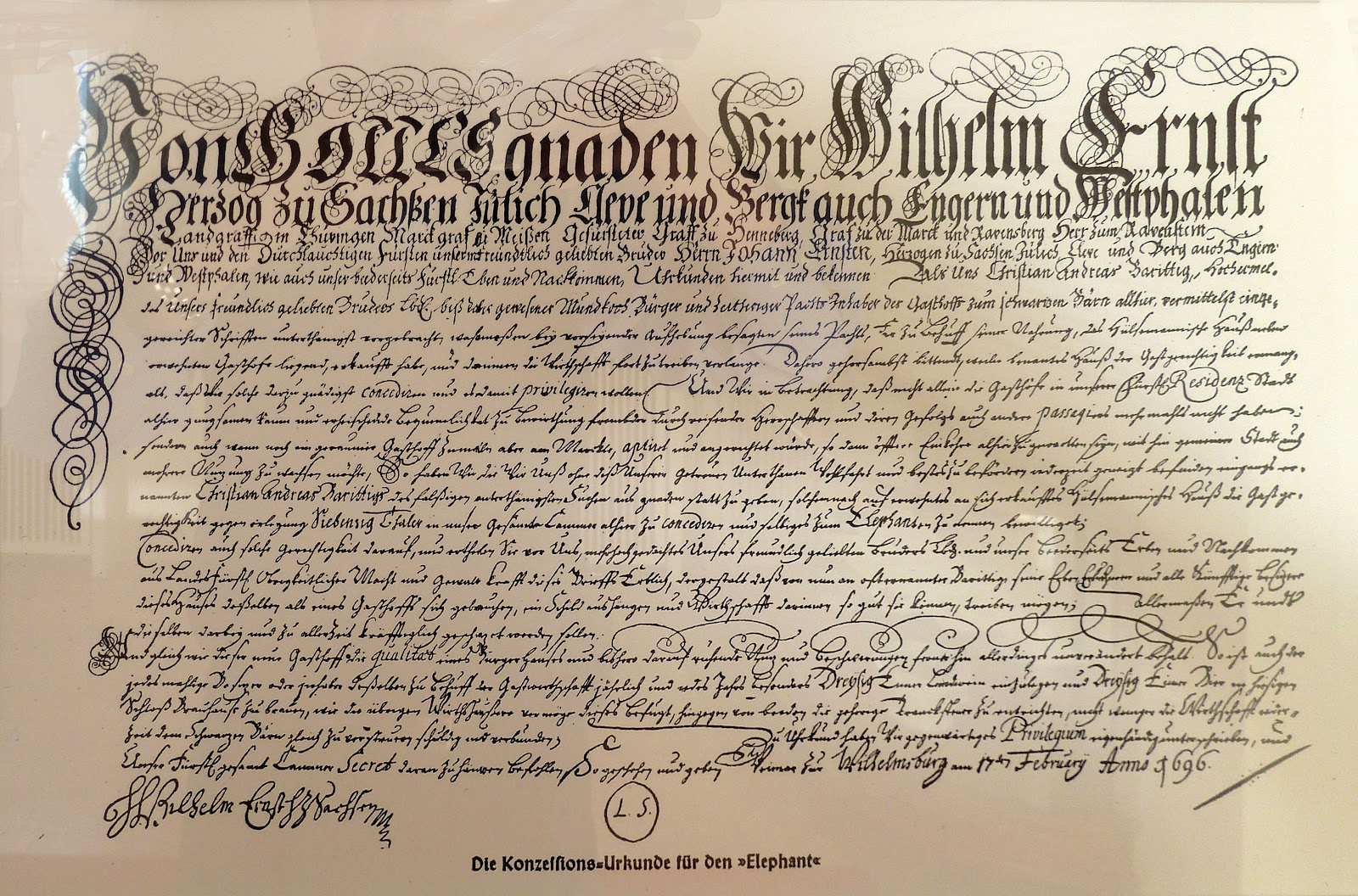
Duke Wilhelm Ernst of Saxony issued a concession to Christian Andreas Barrtig.
In 1696, the duke's cupbearer, Christian Andreas Barrtig, got a concession for an inn bordering Weimar's market square that he named The Elephant. Later, it became a stagecoach station and was enlarged to house all the merchants and visitors. When somebody asked at the city gate for Wieland, Herder, or Goethe in those days, he was directed to the Elephant because people were sure they would be found there. 

In 1938, Thomas Mann made the hotel famous when it played a central role in his novel, "Lotte in Weimar." Charlotte Buff had been one of young Goethe's sweethearts. Still, she had married another guy. Deceived, and in a dark mood, Goethe wrote his bestseller, The Sorrows of Young Werther -- a (still) famous/infamous book that brought early renown to Goethe. Mann takes Lotte's visit to Weimar and her stay in the Elephant in 1816, where she met the aging Goethe, as the starting point for his novel.

An early photo of the Elephant around 1860.
On the right, Weimar's oldest inn: Zum schwarzen Bären from 1540.
In the 1920s, the Elephant became the headquarters of the local Nazi party that, as early as 1926, had two ministers in Thuringia's state government. The same year, the NSDAP held its first national party convention in Weimar when Hitler spoke from a window to the crowd in front of the hotel.

Peeping through a window of the Haus Elephant,
the NSDAP boss is greeting the crowd in the marketplace
During the coming years, the hotel looked rundown. With the pressure of the Nazis, who had governed the state of Thuringia since 1932 and had taken power in the Reich in 1933, the old, unattractive building was torn down and replaced by the present construction in 1938.

The newly built Haus Elephant is a national-socialist shrine
The most important addition to the new building was a balcony meant for der Führer to address the people in the marketplace. In the following years, self-proclaimed Nazi dignitaries used it more than he did.

New Year's Eve dinner 1943 at the Elephant.
Note: The courses have low and rounded prices but require precious food ration card coupons.
Today's interior still breathes Nazi architecture, a strange mixture of neo-realism and cold splendor, with marble door frames and metallic, luminous elements.

Entrance to a set of rooms
Following the Wende (the end of the German division), a new splendor
with illustrious guests and their interpreter

Nowadays, the balcony is crowned by Goethe's dictum: "Here I am, Man, here I may live up to it," the final line of the poem Osterspaziergang (Easter Walk), taken from his drama Faust. The Führer's balcony now serves as a place for cultural displays. During my last visit, Thomas Mann stood up there. Star architect Walter Gropius and femme fatale Alma Mahler-Gropius-Werfel decorate the balcony this year.
**

Tuesday, April 3, 2012

Beer Tasting


During the past week, Toni's place on Freiburg's Münsterplatz celebrated its 10th anniversary. On the occasion, the Ganter brewery had revived a dark lager as the jubilee beer, and Ganter's beer sommelier organized a tasting. My loyal readers may remember my wine marathon last year. This time the stuff to be tasted and tested was beer.

We must face it: the variety of beers brewed in Germany does not correspond to the number of ways bread is baked and sold in my country. You may already have guessed why: the reason is the German Reinheitsgebot, the famous purity regulation first issued in Bavaria (where else?) in 1516, stipulating that only barley malt, hops, and water may be used in the production of beer. However, in olden times beer tasted different even when brewed at the same brewery, as the founding fathers had forgotten to codify the yeast. Only later, when beer fermentation had been fully understood, special yeasts for brewing were cultivated and added to subsequent charges assuring a similar taste. Although in Germany, adding cherry syrup or caramel as they do in Belgium is not allowed, there are still differences in the taste of beer depending on the type of yeast, the temperature, the length of fermentation, and the method and duration of storage before drinking.

The following photo shows the three beers we, as future experts, had first to describe and then identify. No, I am not, and I was not drunk: I counted four glasses too. The fourth glass, still full in the photo, was offered as a bonus after hard work and contains the jubilee dark lager beer.


Sommelier Bernd Ruth told us that beer tasting (also called beer sensory) is distinct from wine tasting. 80% of our impression of beer taste is determined by the sense of smell, whereas only 20% passes through the sense of taste. With wine, it is just the other way around. On a tasting form (Verkostungsbogen), we had to note the color, the clearness, the foam, and the smell of the brew. As for the taste when drinking, the connoisseur distinguishes between the beginning (Antrunk), the presence (Rezenz, whatever that means in German), and the past (Nachtrunk). This word in everyday German instead refers to the practice of some hit-and-run drivers. Following a collision, they rush home, open a bottle, and drink until the police arrive to prove that they had been sober when they caused the accident.


The first of the tasted beers was quickly identified as a Pils. For the second, I had difficulty recognizing it as a Weizenbier (white beer), for it had been served much too warm. The third one, showing the brown color, I got wrong, for I had marked it as the jubilee dark lager beer. It was, however, the Ganter Wodan strong beer that, contrary to Bavaria, where such a brew is served during the Lenten season, flows from the tap in Freiburg throughout the year.

The following beers were all on the house, but I did not stay on as the following morning, I had to catch an early train taking me to my next cultural event in Weimar.
*

Saturday, March 24, 2012

Mother Earth is Losing Water

The other day I found an article on the internet based on a scientific publication pointing out that Mother Earth has not just one but two water leaks. Over the last 3.8 trillion years, we have drained water at such a rate that a mass corresponding to the volume of the Atlantic Ocean has been lost. The same amount added today would increase the sea level by 800 m. Figure out what this would mean for the place you live.


Emily Pope of the University of Copenhagen and her coworkers base their findings on an analysis of Greenland's early-formed deep-lying serpentine rock layers. Those 3.8 Ga old silicates  (i.e., only slightly younger than the age of the earth of 4.5 Ga) show a remarkable difference in isotope composition compared with more recently formed minerals of the same kind.

As the article points out, one of the earth's water leaks is due to hydrogen diffusion into space. The chemical processes involved start with methane (CH4) formed by a credible biogenic source for methanogenesis, with a concentration of this gas 60 times higher in the Archaean atmosphere than today. Methane undergoes photolysis in the upper atmosphere in a reaction CH4 + 2O2 → CO2 + O2 + 4H, where some of the hydrogen formed in the process will diffuse into space. This evaporated hydrogen is lost for the formation of water. There is also deuterium, the heavier hydrogen isotope, better known in its combination with oxygen as heavy water. Deuterium, however, reacts more poorly with oxygen than hydrogen and, in addition, diffuses at a much lower rate. The net effect is that compared with the water in the Archaean oceans, today's seawater is enriched in deuterium.

There are newly formed minerals that contain hydrogen-like serpentines. In those, the amount of deuterium is higher by 2.5% compared with Archaean minerals.

The second source of Mother Earth's water loss is the formation of minerals like serpentines incorporating hydrogen when magma reacts with water. When Pope and coworkers did the mathematics, they concluded that oceans 3.8 Ga ago were more voluminous and that Mother Earth has lost 26% of its "light" water since then. 

Nowadays, however, both water leaks are less important than a trillion years ago, for the chance of water reacting with magma is significantly reduced, and methane concentration in today's upper atmosphere is much smaller than in Archaean times. 

Still, we lose 100 000 tons of hydrogen yearly diffusing into space. Does this mean that the Dutch no longer have to worry about rising oceans due to melting glaciers?

In 2009 UAF researcher Sebastian H. Mernild and colleagues from the United States, the United Kingdom, and Denmark discovered that from 1995 to 2007, overall precipitation on the Greenland ice sheet decreased while surface ablation – the combination of evaporation, melting, and calving of the ice sheet – increased. According to Mernild's new data, since 1995, the ice sheet lost an average of 265 cubic kilometers per year, contributing to about 0.7 millimeters per year in global sea level rise. Last year this prediction became obsolete because Eric Rignot and coworkers jointly of NASA's Jet Propulsion Laboratory, Pasadena, Calif., and the University of California, Irvine, reported that Polar ice sheet mass loss is speeding up, on pace for 1-foot sea level rise by 2050. The authors conclude that if current ice sheet melting rates continue for the next four decades, their cumulative loss could raise the sea level by 15 centimeters (5.9 inches) by 2050. When this is added to the predicted sea level contribution of 8 centimeters (3.1 inches) from glacial ice caps and 9 centimeters (3.5 inches) from ocean thermal expansion, total sea level rise could reach 32 centimeters (12.6 inches).

Compare this prediction, i.e., more than 5 mm rise of the ocean level per year with the loss of water by leakage. It only amounts to a fraction of a millimeter per year.
*

Friday, March 23, 2012

Are We Entering the Post PC Age?


Two years ago, I wrote about my iPad 1: For me, the iPad is the ideal machine when away from my desktop. E-mail, news, and Wikipedia via the internet are all at my fingertips. I have no time for watching films or playing games, but it seems that other people can well find their fill with the iPad.

When the iPad 2 hit the market a year ago, I considered the improvements marginal compared with what I already had. I decided two mediocre cameras didn't make much difference. Anyway, one of my habits is to skip one generation of gadgets, just as I jumped from the iPhone 3S to the 4S. 

I was among the first to get the newest iPad generation. As soon as the Apple website opened for preorders, I squeezed mine in. Like thousands of other people, I got my iPad delivered on Friday, March 16. The main reason I bought the new iPad wasn't its much-touted Retina display, but the faster processor, because some operations on my iPad 1 took pretty long.

Before giving you my impressions of the new iPad, I would like to demonstrate that even my first-generation machine fulfills most of the functions of a notebook, at least for me, and that instantaneously, without lengthy rebooting. My favorite applications are on my home screen below. They are available the moment I wake up my iPad.

For managing my appointments, tasks, and contacts, I use Pocket Informant, the application I have suffered so much over the last few years because it did not and does not easily synchronize with MS Outlook. In the meantime, the people at WebIS have included iOS calendars in Pocket Informant that also display in Outlook and stay synchronized in the Cloud. 

The next icon in the first row of applications is Mail, followed by a homemade icon named Wikipedia. Tapping it takes me directly to my Wikipedia watchlist to track changes to articles I have written or contributed to. On the other hand, my activity on Facebook (the next item) is limited to tracking my son's whereabouts.

The first application in the second row is Flipboard, that gorgeous newsreader. With Flipboard, I follow the most important national and international news. However, the app seems selective, so I switch to the slower and less shiny Pulp Reader to avoid missing specific information. 

Next come two browsers I chose from the good dozen available in the App Store in addition to the built-in Safari (last in the first row): Dolphin HD and Mercury. 

I switch to Dolphin whenever, for no apparent reason, Safari is unresponsive. Mercury is friendly, as it sports a right-hand scroll bar, making browsing longish websites a breeze. 

Last but not least, the Wikipanion app is unbeatable for looking things up. It lets you switch quickly between the German, English, and French versions of Wikipedia on the same topic.

Let us talk about text processing regarding the applications I placed in the third row. Forget about a Word-like treatment of texts on the iPad. Apple's Pages may perform wonders on a Mac but is useless for working on texts when your desktop runs Windows. Document files created in Pages on the iPad end up in obscure places like WebDIS, iDisk, and iCloud or are accessible on your desktop only via iTunes. 

There is Dropbox, the best invention for exchanging information between two machines since Microsoft's ActiveSync, which almost kept a Pocket PC in phase with a desktop PC. In Dropbox, you always work on the same file stored in the cloud from any machine that has access. No need for synchronization!. QuickOffice connects to Dropbox, and you can happily work on your MS doc or docx files on the iPad, but beware! Not all formatting done on the PC is kept when you make changes on the iPad and send your text back into the cloud. Fully justified text turns left-adjusted, which I still accept, but more serious is that all underlying information, like embedded links, is wholly lost in the transfer.

While dreaming about MS Office for the iPad (rumors circulated two months ago), I usually only need a simple text processor to jot down my ideas, load them into the cloud, and retrieve the text-only files on my desktop. 

Some text editors are available for the iPad, like iAwriter, Writeroom, Textwriter, and Plain Text; however, my favorite is Nebulous. It opens with an additional row of freely programmable keys. Here, I have direct access to umlauts, I find keys that let me move around in a text, and, last but not least, the row of keys has the sorely missed forward delete key.


The advanced Pons English dictionary is the next and most expensive item on the home screen. Although I often use LEO on the web, Pons is always available, even offline. 

PhatNotes is one of the most cherished carryovers from my Windows Mobile times. The database contains all my personal information and passwords. PhatNotes is an iPhone app optically blown up on the iPad and synchronizes data between iOS and Windows versions. In the meantime, I have transferred all my non-confidential information to Evernote (see the apps bar at the bottom), which will store anything. Evernote belongs to the ten apps everybody should have on their iPad/iPhone. 

The same is true for GoodReader. It lets you read, among other formats, PDF files in book format and annotate, cut, and paste the text. Remember my hailing of Google? On GoodReader, I read, e.g., those scanned-in books about the Baden Revolution of 1848/49 that some revolutionaries wrote and published shortly afterward in Switzerland, where they had found asylum.

The fourth row starts with my collection of weather apps. My favorite is Meteogram, but if its forecast does not please me, I switch to others. 

In Utilities, I have collected a couple of goodies like PCalc, a calculator featuring inverse Polish notation, a fast way of calculating as promoted by Hewlett-Packard in the 80s in their famous pocket calculator series. I therefore cherish an emulated nostalgic iHP41CV available for both the iPad and the iPhone. 

In addition, I placed apps for testing WLAN speed, the TapDictionary, and TextExpander in Utilities.

The last row on the home screen is completed with a self-explanatory SPORT1 app and the DB Navigator. The navigator allows me to plan German and European train trips and includes local urban transport connections to the nearest train station.

The apps bar at the bottom starts with Musik, containing most of my classical CD collection and a couple of jazz oldies and evergreens, although I prefer listening to them on my iPhone. 

Photo includes various photo apps I still have to sort out for their usefulness. I also keep a private photo collection, starting with the advent of digital picture-taking in 2000 and ordered by years. In addition, an album called nostalgia contains scanned photo souvenirs of yesteryear. I already mentioned Evernote, the database for collecting any information you want to keep and refer to later, and to synchronize with the PC. Erinnerungen (Reminders) I usually fill in on my iPhone, mainly with Siri's help. 

The last two items on the bottom bar are obvious and essential for those using Apple's iOS devices.

What are the most significant improvements of the new iPad compared with my iPad 1? The strain on my ol' blue eyes is much less when reading text on a Retina display. The increase in speed is dramatic. Launching Pocket Informant from scratch takes about 3 seconds on iPad 1; it takes less than a second on the new iPad.

The other day, I read an article that we are entering the post-PC age with the advent of the iPad. That is only partially true since the PC will remain my main workhorse for all significant office work, editing photos, creating web pages, and doing home banking. Just consider the monitor size. However, post-notebook age sounds acceptable to me.
**

Monday, March 19, 2012

March 18

In an earlier blog, I referred to November 9 being a fateful day for Germans. The Federal Assembly met in the Berlin Reichstag yesterday to elect a new German President. In welcoming the 1240 delegates, the speaker of the German parliament (Bundestagspräsident) suggested holding any future election of Germany's highest representative on March 18, and not as in the past on May 23, the Constitution Day of the Federal Republic.

In fact, on March 18, 1793, German revolutionaries supported by French revolutionary forces proclaimed the first republic on German soil, the Republic of Mainz.

Berlin March 18, 1848
On March 18, 1848, people all over Germany rose up against their princely rulers and manned barricades to underline their Märzforderungen (demands of March) for freedom of the press, jury trials, and free election of an all-German parliament.

On March 18, 1990, the first free elections in the former German Democratic Republic (GDR) were at the same time the last in East Germany as the so-called Volkskammer (the peoples' chamber) decided to join the West German Federal Republic. Following general elections in all of Germany on October 3, Unification Day became our national holiday.

This year the Federal President was elected on March 18, not May 23. This had to do with our constitution demanding that in case a president dies or steps down from office, the Federal Assembly must meet within 60 days to elect a successor. 

March 18, 2012, became a historic date because two presidents resigned before finishing their five-year terms. Hence the Federal Assembly, which usually comes together only once every five years, met three times within three years.
*

Sunday, March 11, 2012

Freiburg Call for Action

This weekend, 63 environmental prizewinners met in Freiburg for the 1st International Convention of Environmental Laureates, preparing for Rio+20. This will be the follow-up of the 1992 United Nations Conference on Environment and Development (UNCED), also called the Earth Summit, held in Rio de Janeiro, where it was stated: All States and all people shall cooperate in the essential task of eradicating poverty as an indispensable requirement for sustainable development, in order to decrease the disparities in standards of living and better meet the needs of the majority of the people of the world.

The two American participants in Freiburg's convention were Jeremy Rifkin and David Schweidenback. Rifkin, the economist, writer, public speaker, political advisor, and activist, gave the introductory talk: The Third Industrial Revolution. Schweidenback was a Peace Corps volunteer in Ecuador in the late 1970s and is president and founder of P4P (Pedals for Progress), a foundation distributing used bicycles to developing countries. Germany was represented by, among others, Ernst Ulrich von Weizsäcker*, holder of the German environmental prize. On the evening before the convention, he gave an interview to the Badische Zeitung, stating that energy must become more expensive and continuing that our world needs an increased environmental consciousness and clever engineers.
*He is the son of physicist Carl Friedrich von Weizsäcker and the nephew of former German Federal President Richard von Weizsäcker

Weizsäcker spoke from my heart, for I have always thought that energy is so cheap that people have no incentive to economize. Some of them might kill me for saying this when looking at the price of gas that had reached an all-time high of 1.68 Euros/liter (8.30 U$/gallon) last week, causing a dramatic increase in the number of fill-and-run drivers in Germany. 

Over the last twenty years, I started saving energy, replacing nearly all of my incandescent light sources with economy bulbs and, lately, some with LEDs*. Nevertheless, being an old man, I refuse to reduce the light output following Goethe, who on his deathbed is supposed to have said: More light, more light. I drive only 6000 km per year and, following my doctor's advice, walk most distances within a 3 km radius of home. Otherwise, I will take the streetcar. For longer distances in Germany, I love to take the train. When I moved to Freiburg, I lived in an apartment built in 1903 with outer walls 60 cm thick and a room height of 3.20 m. In 2007, I moved to a more modern flat with just 20 cm walls but 40 cm thermal insulation and 2.60 m room height cutting my heating costs by 50%. I don't eat strawberries from South Africa at Christmastime or grapes from Chile in March, and I prefer Kiwis from Israel to those from New Zealand.
*So far, those clever engineers have not come up with an acceptable LED replacement for the low-voltage spotlights

In his interview, Weizsäcker mentioned two developments undermining the Rio 1992 statement. One is the rebound effect, and the other is the disturbed alliance between states and capital. Since Rio, more consumption has eaten up progress in energy efficiency. During the Cold War, money had come to stabilizing arrangements with the Western countries, the latter being the bulwark against communism. With the lifting of the iron curtain and the fall of the Berlin wall, the capital eventually became loose maximizing its profits, e.g., moving production to low-wage countries and enlarging on subprime credits producing one financial bubble after the other (dot-com in 2000 and the US housing in 2007). Capital has recalled its alliance with the Western states.

Under these circumstances, is it possible to reconcile environmental problems and development programs when the fight against poverty and hunger and for fair access to energy resources and raw materials cannot be ignored? In addition, the demand of developing countries for economic growth must be weighed against global environmental objectives.

All these issues apparently found their way into the Freiburg Call for Action. When asked about the importance of this declaration Helen Caldicott from Australia, laureate of the Nuclear-Free Future award, said: We save the world. Will they?

Freiburg Call for Action with handwritten changes (Sonntagszeitung).
So far, I have yet to find the officially released version.
*

Friday, March 2, 2012

It’s Tofu Time

Following last year's Wurst War and under the new regulation for selling wurst on Freiburg's Münster market, the last of the eight authorized vendors opened his stand yesterday. This is the one and only offering vegetarian snacks based on tofu. In the back, you see the north face of the cathedral.


Today an einem Freitag in Freiburg zur fleischlosen Fastenzeit (on a Friday in Freiburg during Lenten season without meat), I decided to try a vegetarian currywurst. Here you may admire the dish:


To put it mildly, the vegetarian version of currywurst is stark gewöhnungsbedürftig (it really takes getting used to). The sausage skin is apparently made from polymerized tofu. It peels off quickly but is not easy to digest. Looking around, I noticed something in a pan that resembled döner meat that the vendor was just filling into pita bread.

Although I warned Elisabeth, she insisted on eating tofu currywurst at the Münster market tomorrow while I will try the veggie döner.


As for the price, it is higher for the vegetarian currywurst than for the real stuff.


Some of the traditional vendors at the Münster market offer hamburgers (Frikadellen). So I told the tofu people to consider selling veggie burgers for Freiburg's American guests.
*