Sunday, January 27, 2013

Drawn by the Hair*

German girls have been allowed
to fight since 2001 (©dpa)
We just learned in the press that women will be integrated into the US Armed Forces with all rights and duties. 

Three notions come to mind when thinking about American soldiers: Marines, leatherneck, and crew cut. So I wondered how the American girls would hide their superb head of hair below a mundane steel helmet?

Hair was an issue even with the boys in 1970 in the newly formed German army. The long-haired citizens in uniform regarded the old practice of putting the steel helmet on with a barber cutting off the protruding hair as incompatible with their habeas corpus. 

Our then Defense Minister Helmut Schmidt issued the now famous hair net decree (Haarnetz-Erlass) in February 1971 demanding that hair and beard be neat and that the former had to be controlled should its length hamper the tasks of the soldier by wearing a hair net. Our Federal Army (Bundeswehr) acquired 740,000 hair nets at that time. Soon the size of the hair of the drafted men was no longer an issue, so I wonder what the Bundeswehr did with all those unused hair nets.

How will the US Armed Forces deal with the hair of their female soldiers? In the photo, admire a ponytail hairstyle looking out from under a NATO steel helmet. How does the American Army helmet compare?

*Drawn by the hair is the translation of the German idiom an den Haaren herbeigezogen meaning far-fetched, but using this correct English title for the blog lockt keinen Hund hinter dem warmen Ofen hervor (does not attract a dog reposing behind a warm stove).
*

Friday, January 25, 2013

Weckle or Schrippe?

Initially, I did not want to bore you with another querelle d'Allemand. Still, when even the New York Times reported a sarcastic remark of one of our deputy speakers of parliament (Bundestagsvizepräsident), Wolfgang Thierse, the German press and I became excited.

Wolfgang Thierse (right) with Freiburg's MP Gernot Erler
on a visit in front of the Neues Rathaus in August 2002
Up until now, I have admired Wolfgang, who in 1989 lived in East Berlin and was one of the architects of the Wende in the GDR, which led to Germany's reunification. He still dwells on Käthe-Kollwitz-Platz at Prenzlauer Berg, one of the Berlin quarters that are "in." This led to gentrification, as about 90% of the people moved there after the Wende, displacing the original population. Wolfgang pointed his finger at newcomers from Swabia, "In Berlin, I want to buy Schrippen and no Weckle."

Brötchen (©Wikipedia)
In High German, a roll or a bun is called Brötchen, meaning "small bread," as in French petit pain. This word is meant to be understood across the country. Nevertheless, Elisabeth still likes to tell the story of when we lived as a young couple in Munich, and she went to a local bakery to buy a few Brötchen. The lady behind the counter taught her, "Brötchen hoamer net, wir hoam nur Semmeln (We have no Brötchen, we only have Semmeln)." You may have guessed by now that Brötchen is called Schrippe in Berlin, Weckle in Baden-Württemberg, and Semmel in Bavaria.

However, there are more regional names. You buy Rundstücke in Hamburg, Wecke in Hesse, Brüdche in Cologne, and Brötli in Switzerland. In addition, there are lots of variations carrying unique names, which I like in particular:

Röggelchen is made partly from rye flour. Served in Cologne
with a chunk of medium-aged Dutch cheese, such as Halve Hahn.
Doppel-Bürli, with its dark crust, is baked in Switzerland
and best with butter and a slice of Gruyère cheese (©Wikipedia)
Schusterjunge (cobbler's apprentice) in Berlin. A roll made from rye.
Simply delicious when spread with crackling fat (©Wikipedia).
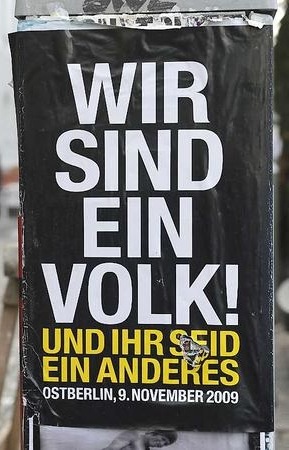
But enough of rolls and buns, as the story that by now should be over shows signs of a civil war. The slogan from November 1989 - perverted already in November 2009 against West German domination of the East - suddenly rears its head again on a poster:

We are one people; you are another (©dpa)
The highlight of the Schrippe-Weckle quarrel so far was that the head of Käthe Kollwitz's sculpture was decorated with Spätzle, i.e., Swabian pasta. The police downplayed the affair, saying it was not criminal property damage because the next rain would easily wash off the pasta.

Käthe Kollwitz sculpture on Käthe-Kollwitz-Platz (©dpa)
For this carnival season, the Swabians bestowed the golden fool's Bell upon Wolfgang Thierse. He, the first non-Swabian to be honored, regarded the honor as a Prussian-Swabian reconciliation, commenting,"Differences make Germany richer."

Wolfgang Thierse with the Golden Fool's Bell (©Der Spiegel)
On February 1, separatists announced the creation of a Swabian enclave on Prenzlauer Berg called Schwabylon, from which they would ban Thierse into exile.

A Swabian enclave on Prenzlauer Berg
Nota bene: We, the people of Baden, are not concerned. In Freiburg, the homemade pasta is called Knöpfle.
**

Monday, January 21, 2013

All Contend for Gold,

and all depend on gold (Nach Golde drängt, am Golde hängt doch alles. Goethe's Faust I, verses 2802-4).

A couple of weeks ago, the German Federal Court of Auditors (Bundesrechnungshof) complained about the sloppiness with which the German Federal Bank checks the gold reserves it has bunkered in London, Paris, and (not Rome) New York. 

And continuing with the Voice*: It would be much nicer if they came home to Frankfort, where the Bundesbank only keeps 82857 bullions or 31 percent of Germany's reserve. 
*Frank Sinatra, who liked to go traveling to London, Paris, and Rome but found it so much nicer to come home

The reason that most of Germany's gold is not in Frankfurt is due to the Cold War. At the end of the last war, Germany had no gold, but the Bundesbank started to change some of their US dollars, British pounds, and French francs into gold but kept it in those countries out of fear of a Russian invasion. 

Foreign storage was also one out of convenience for in times of exchange rate fluctuations of those currencies mentioned above, German gold in London, Paris, and New York could be used as a fast buffer for stabilizing the exchange rate of the Deutsche Mark. 

Since 2001 France and Germany have shared the euro, so the 29775 ingots kept in the Banque de France will be brought home wholly. With the British pound still being a global player, the amount of gold in the Bank of England remains. This is, in fact, nothing compared to the 122597 bullions Germany presently keeps in the vaults of the Federal Reserve Bank of New York 24 m below street level in Lower Manhattan. That 21795 ingots of this gold will be repatriated has spread rumors that Germany does not trust the Fed anymore and, even worse, as a conspiracy theory stated: What Do German Central Bankers Know That We Don't?

Well, was it not Republican Ron Paul mistrusting the Fed in the first place asking that holes be drilled in the Fed's ingots to check if they are solid gold? In Germany, Rolf Baron von Hohenau articulated the German angst saying, "We need to know if it's real gold or is it something covered with gold." Let's face it, it is not easy to fake a bullion. The density of pure gold (19.32 g/cm3) is high, so diluting it with copper (density 8.96 g/cm3) will not do the trick. You could however use gold-coated tungsten (density 19.25 g/cm3) and possibly get away with it.

The problem is that tungsten is a precious metal for industry and is relatively expensive (45 U$/kg). So why not take depleted uranium (density 18,95 g/cm3) that is in abundance, slightly cheaper (42 U$/kg), and sell the gold-plated uranium ingots as gold. Thus we transform all the DU floating around that nobody wants, but everybody wants to get rid of. If you have ever tried to drill a hole in DU, you will know that Ron Paul's suggestion will work in this case. However, there are more advanced methods to check gold ingots.

A German official testing gold ingots with ultrasound
At the end of the transaction, just 50% of Germany's gold reserve will be stored in Frankfort, idolized by many, neither growing nor diminishing except for about 5 tons annually that our Finance Minister buys to mint coins for collectors. In transforming gold into coins, Mr. Schäuble is double-gaining for not only the seignorage* but the profit of the Bundesbank will also flow back into the federal budget.
*the difference between the price of the metal and the coin's nominal value. One can overdo it by minting a few grams of platinum into a coin giving it a nominal value of one trillion US dollars.

In the meantime, the public full of German angst, demanded, "Bring all our ingots home!"
*

Tuesday, January 15, 2013

50 Years Already

50 years ago in Reims
French and Germans are supposed to be the best of friends. In fact, this year, we shall celebrate the 50th anniversary of the reconciling Elysée Treaty signed by President Charles de Gaulle and Chancellor Konrad Adenauer.

The two postal services issued a stamp showing the same motif as a visible sign. Nevertheless, you may notice two differences. The French stamp is slightly larger and costs 80 cents; the foreign postage for a letter in Germany is 5 cents cheaper. The blue color of the French flag is lighter than on the German stamp. This reminds me of a flag dispute in Germany: Which blue color is correct, and why did the two postal services not talk to each other beforehand about such an "important" detail?

So let us instead look into the question of how Germans appreciate the French and vice versa: A survey by the German Embassy in Paris revealed that although the animosity generated during two world wars had gone, the stereotypes of the hard-working German and life-loving French had survived well into the 21st century.

When asked for the first thing they thought of when considering Germany, 29 percent of the French people quizzed said Chancellor Angela "Merkel," followed by 23 percent who said "Beer." Following them were "Car" and "Strict" with 18 percent each. Then came the classics "Sausage" and "Sauerkraut," which each attracted 12 percent of first associations. Here I should add that the best Sauerkraut you will ever find is in the French Alsace and is called choucroute royale.

Choucroute royale au vin blanc.
The dish can still be improved by changing the wine to champagne.
Germans had a far more romantic image of France, with 56 percent associating it primarily with the word "Paris" (that should be the same or even higher with the Americans), 37 percent coming up with "Eiffel Tower," 32 percent going for "Wine" and a further 27 percent plumping for "Baguette."

What the survey revealed and what instead counts is that 85 percent of the French and 87 percent of the Germans like each other.
**

Friday, January 11, 2013

St. Martin on the Gate

Another querelle d'Allemand is cooking up in Freiburg this time. Controversy about a picture at St. Martin's Gate (Martinstor) looms on the horizon.

Again, a tiny historical review is necessary to appreciate what is at stake. The Porta Sancti Martini is Freiburg's oldest and most picturesque gate. It was first mentioned in a document in 1238, although the building is much older. 


The postcard shows the gate in 1905, where on the inner side, in 1851, Wilhelm Dürr the older painted the famous scene with the Roman soldier Martin cutting his cloak and handing one half to a naked beggar.


The above photo Red Baron shot in 2004. Two changes are clearly visible: the Restaurant Zum Martinsthor became a McDonald's fast food, and Dürr's painting on the gate disappeared. It became necessary to take it off in 1968, when pieces of the deteriorating picture began falling onto pedestrians. The face was plastered white and had been without decoration since then.

Simon Göser's St. Martin (©BZ)
From last Friday's Badische Zeitung, we citizens learned that a new painting will decorate the Martinstor, since Simon Göser's original oeuvre, painted around 1790, is permanently stored at Freiburg's central art depot. 

Red Baron dislikes Martin's rose-colored cloak and would prefer a more modern approach to the main message, "For I was naked, and ye clothed me" (Matthew 25,36). 

Are we already fixed when Freiburg's finance minister - although he will not contribute one cent to an operation that should be privately sponsored - stated, "Either Göser's painting or a white surface?"

Will modern painters get a chance? It will be interesting to see how they will attack the old story fulfilling at the same time the condition of Freiburg's head of Cityscape, "Any child looking at the picture will recognize, 'This is St. Martin and the beggar."

©BZ
The BZ has already published a photo online showing Göser's painting virtually mounted at the gate.
**

Sunday, January 6, 2013

Another German Flag Dispute

No, I am not writing about the flag dispute in the Weimar Republic, where right-wingers regarded Black-White-Red as the Reich's legitimate flag and insulted the Republic's colors as Black-Red-Mustard, referring to dark yellow rather than a golden shade.


I will inform you about the latest flag dispute, one of those typical querelles d'Allemand. A publisher in Karlsruhe started it, stating that Germany's correct colors are defined in Article 22 of our Basic Law (Grundgesetz) as Black-Red-Gold. However, these are not the RAL colors Jet black-Traffic red-Mellon yellow (RAL 9005, 3020, and 1028) that the Federal Government fixed as corporate design in 1999. Hence, the publisher sent a letter to our Federal President complaining and demanding that our constitution be followed.

Let us go back in history. According to most historians, the German colors date back to the liberation wars against Napoleon's occupation, during which the Freikorps Lützower Jäger, at their inception, did not wear uniforms. The easiest way to achieve uniformity was to dye all clothes black. But soldiers like decorations, so they added red-colored sleeves and collars to their black outfits. The buttons of their uniforms were made from brass, looking golden. When the guys started their studies after the Napoleonic Wars, they, being poor, continued to wear their uniforms. Naturally, the colors of their first Fraternities (Urburschenschaften) became Schwarz-Rot-Gold.

On a German stamp, people are on their way to the Hambach Castle in 1832.
Behind the German colors flies the Polish flag.
Many Germans supported the Polish fight against their Russian occupiers at that time.
This is why, following the Restoration, Johann Philipp Abresch, for the first time, carried a flag with the colors Schwarz-Rot-Gold - highly symbolically woven by virgins - in front of those people demonstrating for freedom from princely bondage at the Hambach castle in 1832. The original flag is now displayed at the Hambacher Schloss as a national shrine. The disputed band is interwoven with golden threads in that flag, whereas the red field carries the embroidered inscription Deutschlands Wiedergeburt (Germany's Rebirth). Few participants were still alive when the 2nd Reich was born 39 years later. Bismarck's Reich showed the colors Schwarz-Weiß-Rot, corresponding to a rather undemocratic rule.

The famous French historian Jules Michelet explained the origin of the German colors differently when he wrote on the occasion of the commemorative ceremony for the victims of the 1848 revolution in Paris's Madeleine Cathedral: Au bas, une chose retenait mes regards, tous les drapeaux des nations ... Jamais je n'avais vu le grand drapeau du Saint-Empire, de ma chère Allemagne noir, rouge et l'or, le sait drapeau de Luther, Kant, Fichte, Schelling et Beethoven. Je fus attendri et ravi ...

Well, except for Fichte, Luther could not have cared less about the colors of the old Reich, and it is doubtful that Kant, Schelling, and Beethoven were even aware of them.

This latest flag dispute would not have caught my attention except that a personal flag dispute started a few weeks ago. A reader of my web pages about Freiburg's history criticized me for writing that Abresch's flag codified the German colors. I did not make such a statement explicitly, but you may read it between the lines. Well, the guy is correct about the order of the colors: In 1848, the revolutionaries hoisted the colors of freedom, and they often chose an order different from that on Abresch's flag.

Invitation and direction for patriotic Freiburgers to make their flags
The flag carried by the freedom fighters at Freiburg's Predigertor (Gate of the Dominicans) on April 24, 1848, had neither been made Schwarz-Roth-Gold as mentioned in the text of a direction issued in Freiburg one month earlier, nor in the inverse sequence Gold-Roth-Schwarz as recommended according to the sketch in the Einladung above. The flag displayed shows Rot-Gold-Schwarz.

Fighting at the Predigertor in April 1848
Look at the flag carried by Hecker's men during their battle against government forces at Kandern on April 20, 1848, which is Schwarz-Gold-Rot.

Death of General Gagern (in the back) at the Kandern skirmish
The 48ers fought for the right cause but frequently under a false flag.
**

Wednesday, January 2, 2013

iPad 3 and iPad mini

In two previous blogs, I dealt with the iPad. After more than two years of use, this tablet meets all my mobile computing needs, particularly when paired with the Logitech keyboard. The keyboard is a perfect cover for the iPad 3 screen when not in use. However, reading e-books in bed on the iPad 3 becomes "heavy" over time. So why not get an iPad mini?

I received my pre-ordered iPad mini on December 7 and immediately started loving it. During its initial setup, I simply copied the content of my iPad3 to the iPad mini, but became more selective about applications. I keep on the mini onlyprograms I am likely to use. It is convenient to have two machines that are programmed alike but fulfill different purposes. The iPad 3 is the tablet I now use at home as my "notebook," whereas the iPad mini is the ideal travel companion and e-book reader. Hence, I shall choose a Wi-Fi-only model if I ever replace my iPad 3 with a newer edition.

As far as the arrangement of apps on my iPad home screens is concerned, they both look the same. However, compared to the display shown in my previous blog, there are some changes:


For managing my appointments, tasks, and contacts, I still adore the eventually matured Pocket Informant. I now use iOS calendars that perfectly synchronize in iCloud with all my devices (Desktop PC, iPad3, iPad mini, and iPhone5). Cloud services make all the difference in modern computing. There are no longer any "lost" appointments or duplicate task entries.

Contacts in Pocket Informant are also kept in an iOS database, except for group e-mails. Apple still needs to provide a decent possibility to build groups from single e-mail addresses. A third-party application is available in the Apple store, but setting up groups with more than ten people is a lengthy operation and prone to crashing, especially when I had just entered 90% of the names. So I still manage my e-mail distribution groups in MS Outlook on my desktop.

The many third-party apps for managing tasks in the Apple store that lack proper synchronization are not worth downloading. Apple offers its frugal Reminder application, so I have lately been using the task database in my favorite Pocket Informant, which I keep synchronized across my iOS devices using Toodledo. Luckily, things have moved. Two months ago, Pocket Informant incorporated iOS Reminder into their platform in a significant update. Tasks are now accessible and editable in PI and synchronized in the cloud. The only thing still needing to be added, and I would like to see, is the fusion of iOS Notes with the notes in Pocket Informant.

Mail is the following icon in the first row of applications, with, as mentioned above, the restriction of offering no group mail.

The next icon on the screen, marked Launch, hides an iPhone-only application that runs on the iPad too. A panel opens with nine programmable fields you may assign to apps and actions when you tap on it. Instead of moving to and struggling through menus and other pages to launch less frequently used apps, using Launch the following apps are just two clicks away: YouTube, my Wikipedia watch list, Google Maps, Toggle brightness, the Kindle book reader, Quickoffice that can handle MS Office files, Wikipanion (switching quickly between the German, English and French versions of Wikipedia), the iBooks reader, and PCalc, an RPN-calculator. It seems that Launch is one of those applications Apple dislikes, because the app's authors have so far hesitated to launch a dedicated iPad version.

Nothing is to be added about Apple's Safari browser. Facebook still allows me to follow my son's travels.

The first application in the second row remains Flipboard, that gorgeous newsreader. With Flipboard, I follow the most important national and international news. However, I replaced the Pulp reader with the somewhat faster Newsflash app for further reading. The next icon launches PhatNotes, the most cherished carryover from my Windows Mobile days. The database contains all my personal information and passwords. Of all the browsers available in the Apple Store, I eventually settled on Google's Chrome for its speed and stability, especially when Safari is compromised.

I still jot down my ideas with the simple text processor Nebulous (they changed their icon), synchronizing the texts into Dropbox and retrieving them with TextPad on my desktop. The additional row of freely programmable keys in Nebulous remains on the screen when the Logitech keyboard is connected via Bluetooth, but I slightly changed the disposition of these keys.

The fourth row starts with my now-favorite weather application. Meteogram is a graphical presentation of temperature, rainfall, etc., detailed for the next two days and spanning the coming week. The following icon marked Wetter contains my collection of nearly all the weather applications I accumulated when I used to look up the best available weather forecast. 

In Utilities, I keep stored useful apps, some of which I described previously. Both my iPads are delivered with a camera I never use. Don't people simply look ridiculous taking photos with the iPad? Should the need for a camera shot with my iPads arise one day, the Camera+ app features more possibilities than the native one. Notizen is what is called Notes in English.

In the last row, the SPORT1 app and the DB Navigator are known to those who have read my earlier iPad blog. New are ReaddleDocs and an alarm clock (Wecker), the latter chosen among a dozen others. ReaddleDocs is remarkable because it lets me view all my cloud files in a single application. 

Besides the old and faithful workhorse Dropbox, I am hooked on Google Drive and Microsoft SkyDrive. I am still deciding the possible use and usefulness of these various cloud services, hoping that ReaddleDocs will eventually help spark my ideas on this matter.

On the apps bar at the bottom, there is one newcomer: Bluetooth on/off again is one of those applications Apple does not like. Without getting lost in the iPad Settings submenus, just hitting the button toggles Bluetooth on and off, connecting or disconnecting my Logitech keyboard instantly.
**

Friday, December 28, 2012

And the Angel Said Unto Them ...

No angel but the smoke plume of a combined heat and power station near Freiburg
(Photo BZ)
It is a tradition that Der Spiegel, the German copy of Time Magazine, chooses for its Christmas edition as cover story a religious topic: Warum glaubt der Mensch und warum zweifelt er? (Why do men (and women)* believe, and why are they doubtful? This year, the other important German weekly, Die Zeit, also published an article about religion: Warum wir glauben müssen (Why are we fixed on belief).
*In the following, I use man in the sense of the German Mensch, which includes women

Historically, religion has evolved from polytheism to monotheism in this order: Judaism, Christianity, and Islam. Red Baron knows little about Mohamed, but the development of Christendom out of Judaism transformed the punitive God who nearly annihilated his own creation in the Flood into a God that we shall address as Father, a God who still is strict but forgiving.

The abuse of any religion as an instrument of power runs like a thread through history and is particularly true for Christianity. When persons like Wycliffe, Hus, and Luther tried to reduce the Church's mission to its spiritual roots at the end of the Middle Ages, they were treated as heretics. Declared a heretic even after his death, Wycliffe's body was exhumed and destroyed, while Hus was burnt at the stake during the Council of Constance. 

When Luther, in his anti-Roman fight, eventually stood with his back to the wall, he made the ill-fated pact with the local sovereigns. They were only too happy to transfer the Catholic cathedrals' treasures into their coffers, annex the rich monastic territories, and assume the post of a Lutheran regional bishop. In all this, the common man sometimes came out of the frying pan into the fire, like in Calvin's oppressive Geneva Republic, and frequently longed for a revival of Roman Catholic rule.

During the Thirty Years' War, atrocities were committed in the name of God both by Catholics and Protestants; ordinary men and women started to doubt God's justice and his lovingness. A villager of Gerstetten, Swabia, wrote in all his misery: Only a few houses of our hamlet still exist. We live like animals eating bark and grass. Nobody remembers that a situation like this had existed before. Many people say it is now certain that there is no God ... We, however, believe that God has not left us … It consoled the ordinary people when priests and pastors kept telling them that they would be compensated in the future life for their sufferings and miserable earthly existence that often contrasted so much with the luxurious, libertine life of their rulers.

In the middle of the 18th century, the Enlightenment produced two groups of thinkers: deists Rousseau and Voltaire), although opposed to the Church, and atheists (Diderot and von Holbach), who denied the existence of God.

The French Revolution opposed the Church, too, but did not want to hurt people's religious feelings, and erected temples to the Supreme Being that we worship. Rulers like Frederick the Great and Napoleon simply saw religion as something to be used to their benefit.

In the 19th century, philosophy took hold of religion. Feuerbach's atheism described religion as the self-reflection of man, a projection of unfulfilled human wishes and positive attributes into an individual God figure, i.e., a mirror of man. 

Marx, impregnated by the misery of the Silesian weavers who were trying in vain to compete with the spinning jenny, saw in religion a perverted political instrument of human oppression in sedating the common man. In short, religion is opium for the people.

In the 20th century, physiology and psychology took over from philosophy, trying to grapple with religion. In an earlier blog, I already referred to Nobel Prize winner Jacques Monod, who, more than 40 years ago, in his book Le hazard et la nécessité, not only denied a creator-God but attributed man's quest for God to a genetic defect we must overcome. How can this be accomplished? Should one cross-breed atheists?

Here comes the entry point to Manfred Dworschak's article in Der Spiegel: Cross-breeding atheists will not help, for they are less reproductive than firm believers or fundamentalists: Wives of ultra-orthodox Jews, on average, give birth to eight children, and also, the Amish people are productive well above average. On the other hand, atheists do not grow by birth but by the influx of apostates.


In the 21st century, the genetic cause for belief is again rearing its head: Geneticist Dean Hamer's God gene hypothesis postulates that a specific gene (VMAT2) predisposes man toward spiritual or mystic experiences, according to Hamer's book, Faith is Hardwired into our Genes, but where is our "soul" located?

Neurotheologian James Ashbrook identified the ability to experience the mystical in the superior lobe of the parietal cortex.


That would mean even the atheist believes in something, a position linguist Umberto Eco and Cardinal Carlo Maria Martini support in their dialogue: In cosa crede chi non crede? In what does somebody believe who does not believe? Unfortunately, in the English translation, the book title is poorly rendered as Belief or Nonbelief?

Accordingly, Christian Schüle writes in Die Zeit: Man's belief is something natural. Ratio, the axis of reason, does not answer the question: Is there a plan behind everything, and is my life guided?

Man is born as a pro-social being. Modern psychology sees an evolutionary advantage in religion, as living in a community inevitably reduces personal egoism. Such ego-deflation then allows people to better cope with the dangers and hardships of life. The evolutionary psychologist Lee Kirkpatrick takes up Feuerbach's ideas positively: Man strives after a positive self-perception but is aware of the abyss between wish and reality. Man tries to resolve this tension through religion, a synonym for seeking a father figure.

In Der Spiegel, Dworschak considers religion to be inherently human. He, too, points out the (evolutionary) advantage of belief, but more in the direction of Big Brother is watching you. Families and small communities may live in trust, but rules and someone to ensure their adherence are necessary for the lives of larger communities.

God's eye is watching.
Consequently, in the Old Testament, God issues the Ten Commandments. He watches, and He punishes any breach of the law. God dominates Judaism, Christendom, and Islam in demanding good social conduct. He will reward them with redemption and heaven; otherwise, He has the means to punish the spoilers with damnation and hell.

Scientists observe that people of the same faith trust each other to a high degree; therefore, Schüle calls trust the currency of religion. For example, Dworschak mentions the Indian religion Jainism. The Jains have taken over the international diamond trade in Antwerp from the Jews, and trading diamonds requires a high level of trust. And is there not a high level of mistrust between Christians and Muslims?

What did I learn from all that? Despite all the new scientific attempts to "explain" religion, the Church is still in the upper position, calling the Christian belief a great mystery. The priest celebrating Mass concludes the Eucharistic Prayer by proclaiming, "The mystery of faith," and the community answers, "We proclaim your Death, O Lord, and profess your Resurrection until you come again."

And at the end, I again have to return to Saint Paul, who writes in his first letter to the Corinthians, 13:12: Now we see but a poor reflection as in a mirror; then we shall see face to face. Now I know in part; then I shall know fully, even as I am fully known. And now, these three remain: faith, hope, and love. But the greatest of these is love.

With this in mind, Paul develops his vision of a (Christian) society without laws when he writes concerning the Ten Commandments in his letter to Romans 13, 8-10: 8 Let no debt remain outstanding, except the continuing obligation to love one another, for whoever loves others has fulfilled the law. 9 The commandments, "You shall not commit adultery," "You shall not murder," "You shall not steal," "You shall not covet," and whatever other command there may be, are summed up in this one command: "Love your neighbor as yourself." 10 Love does no harm to a neighbor. Therefore, love is the fulfillment of the law.

Love is all you need (The Beatles).
**

Thursday, December 27, 2012

On the Streets Where We Live ...

... there may not be lilac trees, but European streets carry names that are sometimes laden with history. Red Baron lives on Maria-Theresia-Straße, at the corner of Fürstenbergstraße, while a block away, a street is named Türkenlouisstraße. Some people did not like living on Turkish Pimp Street and complained to Freiburg's city council. These ignoramuses had to learn that Türkenlouis was the nickname given to Ludwig-Wilhelm of Baden-Baden, who successfully pushed back the Turks on the Balkans in the late 17th century and saved the Habsburgs.


Many Germans are obsessed with their broken history, whether on the right or the left. In renaming streets and squares, they try to stun their feeling of guilt. Presently, we are watching a new wave of re-baptizing roll in.

The other day, I read a note in the Berliner Zeitung that the residents of Treitschkestraße held a "plebiscite" against the street's renaming. Heinrich von Treitschke, a renowned Prussian historian in the 19th century, wrote right-wing history books with sentences like the following about the annexed Alsace: "These lands are ours by the right of the sword, and we shall rule them by the right of the German nation." We shall not allow those lost sons to grow apart from the Reich. We Germans know better what avails to the Alsatians ... we shall restore their self against their own will. Even worse, Treitschke coined the later-abused sentence: The Jews are our harm (Die Juden sind unser Unglück).

Going back in history: In 1945, with the fall of the Third Reich, all Nazi street names were eradicated. However, Freiburg's central axis, Adolf-Hitler-Straße, did not recover its previous name, Kaiserstraße. To avoid any allusion to the Second Reich's Kaiser Wilhelm II, the street was renamed Kaiser-Joseph-Straße, reminiscent of the Habsburg rule of Joseph II, Maria-Theresa's son.

Similarly, when the Communist regime tumbled in the east in 1989, names like Walter-Ulbricht-Platz or Wilhelm-Pieck-Straße disappeared. Opposition arose when overzealous city councils threw the baby out with the bathwater, re-baptizing streets named after Ernst Thälmann, the charismatic leader of Germany's Communist Party in the Weimar Republic, murdered by the Nazis.

The recent wave of name changes began in March 2012, when Münster's city council in Westphalia renamed Hindenburgplatz to Schlossplatz. This decision did not please everybody. A popular initiative against the decision cited the culture of remembrance (Erinnerungskultur) as a decisive argument: a square named 85 years ago after the First World War, General Paul von Hindenburg, should keep its name. Mind you, after Hindenburg appointed Hitler Reichskanzler, he became a highly controversial figure. In September 2012, a citizens' vote confirmed the city council's decision by 56,700 to 38,800.


The street renaming mania reached Freiburg two months ago when the city's Commission of Cultural Affairs decided to scrutinize all 1300 street names. Yes, there is a Hindenburgstraße in Freiburg too. Still, concerning renaming streets, Freiburgers instead think of the so-called heros' quarter (Heldenviertel), where you find names of bloody First World War battles like Langemarck und Skagerrak (Battle of Jutland) together with the Imperial admiral Graf Spee and the fighter pilots Oswald Boelcke (Dicta Boelcke), Max Immelmann (Eagle of Lille), and Manfred von Richthofen (Red Baron). Besides, nationalist poets like Hermann Löns (Der Werwolf) and Gorch Fock (Seefahrt ist Not, i.e., Going to sea is necessary) have streets named after them.

Which street names will the commission propose to change, and where will they stop? Will they regard archbishop Conrad Gröber as an adversary of the Nazi regime, although initially, he sympathized with them? Is Alban-Stolz-Straße to be renamed because this catholic poet was an anti-Semite? And what about the namesake of an important Freiburg ring street, Karl von Rotteck, a great liberal personality, but nevertheless accused of anti-Semitic quotations? I shall keep you informed.

©Andreas Höfert
The lucky United States is not "naming" its streets. However, there are exceptions to the rule. In 2004, I took a photo in New York of a street sign commemorating a jazz giant. Well, consider the German tourist reaching for his Handi (mobile phone) in quest for a toilet on W C Handy's Plaza.

**

Saturday, December 22, 2012

Merry Christmas and a Happy New Year

Dear friends,

Wishing you a

Merry Christmas and a Happy* New Year


I would like to show you a picture that indeed touches the heart of many German Christians:


Joseph Aloisius Ratzinger, alias Benedict XVI, from Bavaria, Germany's south, Pontifex Maximus of the Catholic church, head of Vatican State, and Joachim Gauck from Mecklenburg-Vorpommern, Germany's north, Lutheran pastor, Federal President, both Männer des Geistes (men of the humanities), smilingly sit opposite each other without reserve. In the back watching is Vatican's George Clooney, the pope's secretary and recently appointed Titular Archbishop of Urbs Salvia, Georg Gänswein, who, by the way, still keeps his apartment in Freiburg's Herrenstraße.
*In Germany, we instead use the adjective Healthy instead of Happy particularly when we are of an advanced age

The photo (dpa) was recently taken during Gauck's official state visit to the Vatican. The picture is one of hope for my country, nearly torn apart for centuries by religious quarrels. Although I must admit that nowadays, most Germans couldn't care less about their Christian past. As in other countries, fewer and fewer people exercise their religion. Following 45 years of atheistic rule, there are pagan regions in Germany's east. This is a country to be evangelized, as it was at the time of Saint Boniface more than a thousand years ago.

Those of you who visited the Freiburger Münster may have seen the original stained-glass windows and looked at the following scene with a smile.


Newborn Jesus is wrapped in cloths and lying in a manger with the ox eating the child's diaper. Father Joseph is not amused and hits the ox on the snout with his cane. A comic of around 1300.
**

Thursday, December 20, 2012

Radical Reactors Revisited

Although my main interest was in accelerators, one sideline topic accompanying my professional life was nuclear reactors. In my early days, experts kept telling me that governments and industry had backed the wrong horse. They said that the light-water reactor, producing enormous amounts of highly radioactive waste, had been as bad a choice as (remember) the VHS videotape system over Sony's Betamax. In those early days, the Canadian CANDU heavy-water reactor line was considered a better technical solution. One consequence of the "bad choice" is that we now face the problem of safely storing highly radioactive waste. To "incinerate" this waste, my former director-general and Nobel prize-winner Carlo Rubbia even proposed a new type of reactor, the accelerator-driven Rubbiatron.

Given the dramatic climate changes caused by burning fossil fuels, the quest for cheap and safe energy remains unbroken. In an article with the eye-catching, alliterative title "Radical Reactors," published in Nature, Mitchell Waldrop sells old ideas for new. He mentions, among others, Kirk Sorensen, who is promoting the Thorium molten-salt reactor, while an American-Japanese collaboration is working on a fast reactor. Charles Forsberg of MIT said, "Given the erratic output of both wind and solar generators, if you're going to get off fossil fuel, you have to have a serious nuclear program." For such a revival of nuclear energy, global security analyst Edwin Lyman states, "Nuclear is hard, it's expensive, it's slow. Indeed, engineers and scientists must develop better radiation-resistant materials, more efficient heat exchangers, and improved safety systems."

You see Kirk Sorensen (First row, second from the right)
with a banner advertising Thorium as reactor fuel.
This is a sketch of the molten-salt reactor with its famous frozen plug.
In case the cooling of the reactor is lost, the plug melts and opens.
The molten salt will flow out of the reactor vessel
and be caught safely in the container mentioned below.
Let me predict that all these efforts to revive nuclear energy are doomed to failure, for all projects must operate at higher pressures, temperatures, and radiation levels to increase their energy efficiency. 

Materials science still works wonders in developing new materials for specific needs, but we are already approaching limits with the metal and ceramic compounds tailored for the modern nuclear industry. Any increase in pressure, temperature, and radiation level will increase the failure rate of the materials used more than linearly, i.e., the planned new installations are accident-bound. Besides, all those efforts come too late. As a German proverb goes: "The train has left the station."

I prefer soft green to hard nuclear energy, although developments in new energy are slow. Despite enormous funding for electric mobility, the efficient electric car is still wishful thinking. Energy storage is essential due to the erratic output of both wind and solar generators, and this problem still needs to be solved. 

My favored storage medium is hydrogen produced in electrolysis during times when the surge in solar and wind generators in industry and households is low. Hydrogen is quite a "noble" energy, though it can blow up your home if mishandled. Well, there are things you want, and there are those you can do (Das eine was man will und das andere was man kann).
**

Saturday, December 15, 2012

Doha And No End?


This year winter is incumen in Freiburg early. The climate experts are back from the United Nations Climate Change Conference 2012 in Doha, Katar, disappointed and warning, but who shivering with cold, will believe in their global warning of global warming?

Mean temperatures in oC at Ebringen near Freiburg from 1983 to 2011 and trendline
Yet we experience the cumulative occurrence of heavy local rainfall followed by inundations and extended periods of extreme droughts around the globe. Perpetual ice layers are no longer permanent, and their melting is raising the water level of the oceans at an alarming rate.

In Freiburg, too, trends are visible where yearly precipitation increases due to heavy rainfalls. They are caused by more water being evaporated due to the higher temperatures in the atmosphere forming "heavier" clouds.

Yearly precipitation in liters per m2 at Ebringen from 1986 to 2011 and trendline
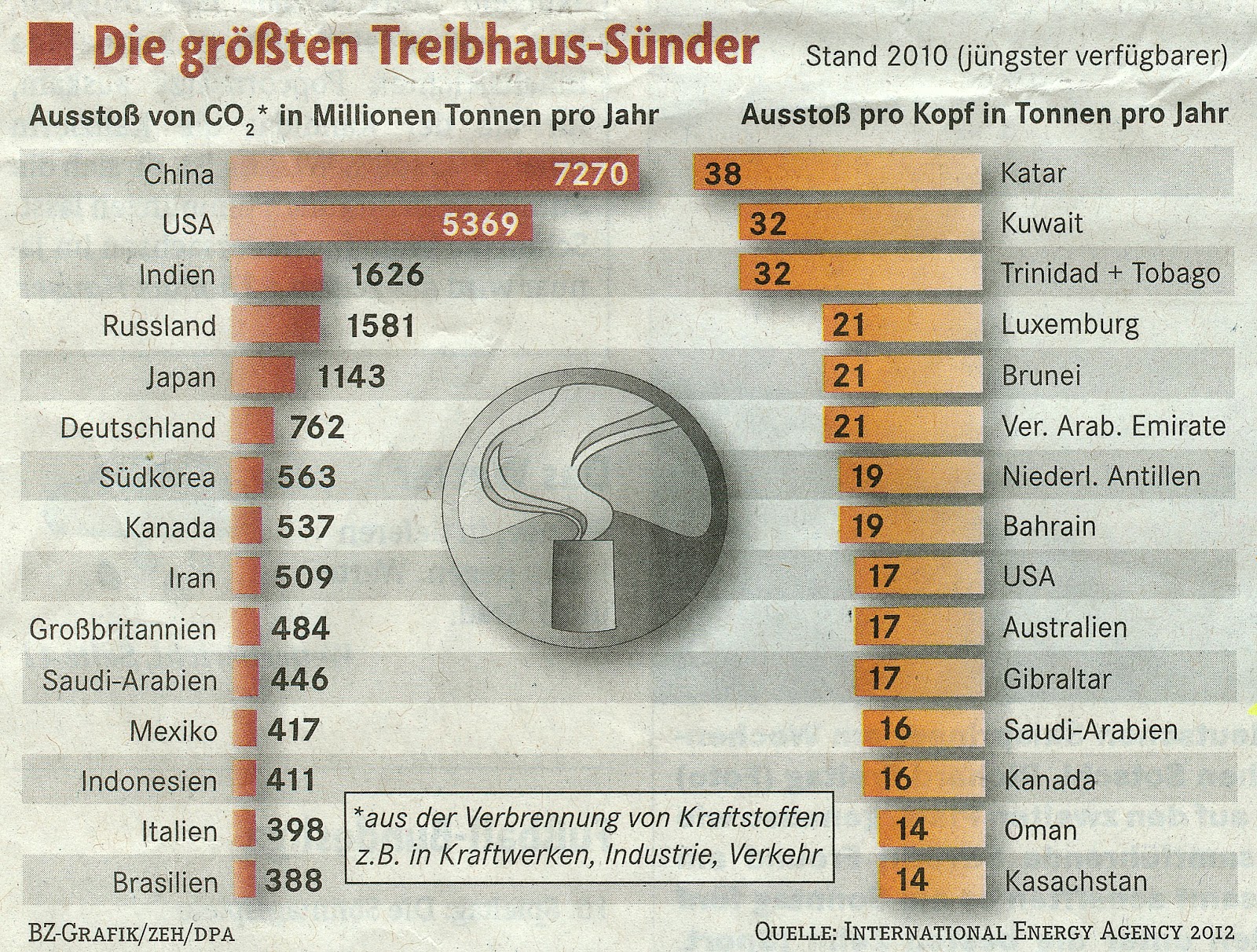
Experts keep telling us that CO2 emissions are the culprit of the greenhouse effect. The following graphic gives names and numbers in 2010.

Graphic presentation Badische Zeitung
Absolute figures in millions of tons of carbon dioxide emitted are on the left-hand side, whereas the figures of merit, i.e., the discharges per capita, are on the right. I am beginning to understand why the UN convened the Climate Change Conference in Doha's capital Katar. The winner with 38 tons simply took it all. This puts into perspective the position of the US with 17 tons per capita. With 9.9 tons of CO2 per capita, Germany does not figure on the graphic, but what the heck is so particular about tiny Luxemburg? Why did the EU not rap on their knuckles?

Trinidad and Tobago even are worse examples. With daily temperatures around 30 oC, they use much air conditioning. Unlike most of the other Caribbean islands, both Trinidad and Tobago have frequently escaped the wrath of major devastating hurricanes, including Hurricane Ivan, the most powerful storm to pass close to the islands in recent history, in September 2004 (Wikipedia). So how will the people react when one day they will experience a complete discharge of the usually laden atmosphere in the Caribbean?

Some delegates at the Doha conference implored what is known as The Common Vision of a maximum carbon dioxide emission reached in 2015. In the following years, emissions should and must decrease; otherwise, the target figure limiting the global temperature rise to 2 oC in this century will be missed.

Katar, Saudi Arabia, Bahrein, and the United Arab Emirates said they will soon announce measures protecting the climate. However, they added that this contradicts national goals, given their dependence on oil and gas production. Eventually, only the Dominican Republic, Libanon, and Monaco presented target figures for limiting their CO2 emissions, while other countries still need to move. However, in the end, the fed-up chairman Abdullah bin Hamad All-Attiya swung down his gavel, closing the conference's final session, thus forcing the participants into prolonging the Kyoto Protocol.

Germany's environmental minister Peter Altmaier (the well-built guy)
in discussion with chairman Abdullah bin Hamad Al-Attiya (dpa)
It seems that all countries are waiting for the 5th Report of the Intergovernmental Panel on Climate Change, due in 2013 or 2014, hoping scientists will have found out that the nightmare of global warming has somehow disappeared.
*

Friday, December 14, 2012

Telekom and Telecom

Whereas the mobile phone company Telecom in the States is a somewhat marginal enterprise, its mother, Deutsche Telekom is Germany's strongest player in the phone market. This has historical reasons for all telecommunication was once run by our national postal service. The Deutsche Reichs- later Bundespost was a giant running bank, mail, and telephone services - the latter two without competition - that accordingly were sometimes lousy.

However, Die Post was not always to blame. Since in the 1950s, the cable infrastructure could not keep up with the increasing demand for telephone lines, people sometimes had to wait "inline" for months before being lined up. With time this bottleneck disappeared, and our government decided to open up the telecommunication market to competitors. Still, people generally are lazy and remain true to their old provider. 

Returning to Germany following my thirty-two years in Switzerland, I had a free choice. For me, the reason to rejoin Deutsche Telekom was as follows: In 2000 it was the only company offering both telephone and internet services. In addition, even nowadays, Telekom still operates all hardware infrastructure that the new companies are exploiting too,

My relationship with Telekom was not without marital conflicts. The correspondence with my provider fills a thick ring binder. In particular, the speed of my internet connection is a permanent subject of dispute. My latest grievance was about a limitation in the number of e-mails I was allowed to send. When I tried to send messages to several groups, I sometimes got the following message: 550 5.7.1 Send quota exceeded, try again in 25436 seconds, which meant that I was OK again the next day. Still, this was annoying, so I had my contract with Telekom changed. For a modest monthly fee of 1.5 euros, they increased the size of my mailbox (which I do not need), but also raised my limit for sending e-mails to a number that I shall never even come close to.

Taken as a screenshot. You may not be able to read this.
So it came somewhat as a surprise that when I wanted to announce two new blogs to you the other day, I got the following message: 550 5.7.1 Send quota exceeded, try again in 4294967295 seconds. Since I did not want you to wait for more than a million hours, I called up Telekom's hotline.


And suddenly, I felt beamed back into the 1990s when on RTL television the comedians The Three with Their Caps (Die drei mit der [Telekom] Mütze) teased Telekom's lousy service and blunders. I spent nearly one hour in the line where they first told me that their colleagues had sold me the wrong product. That I denied, for I had read all the small print with the promise of a nearly unlimited number of e-mails to be sent. Talking to a second guy, he claimed they had simply forgotten to change my e-mail account to the new rate. A third person said that they had not done anything at all up to now.

The following morning I stepped into one of Freiburg's four Telekom local service points. It took the lady behind the counter half an hour to sort out the mess with the promise that everything would be in order in three days. And it was.
*