Sunday, November 6, 2016

Elbphilharmonie

Although many foreigners regard German technology as top-notch, we are miserable at finishing major construction projects.

The most striking example is the Hauptstadtflughafen Berlin-Brandenburg (capital airport). Groundbreaking was in September 2005, and completion was planned for 2011. Since then, many severe planning and construction mistakes have piled up, delaying work. 

Now the airport is expected to open in one year. Costs have exploded from initially 2.5 billion to 6.5 billion euros in 2016. At present, Willy Brandt, whose name is reserved for this building site that will someday be finished, is no longer turning over in his grave but instead rotating.

Another example is Stuttgart 21, the new underground central train station in Baden-Württemberg's capital. The project was started in February 2010, and the station's commissioning was initially planned for December 2019. Meanwhile, the date was moved to December 2021, while experts consider the station's opening by the end of 2022 more likely. Initially planned for 4.5 billion euros, Die Bahn (Germany's federal railway) corrected the sum to 5.987 billion in July 2013, deliberately avoiding the 6 billion mark (not marks but euros!). Independent cost estimates put the final cost at 6.8 billion euros.

So with some pride, on November 2, a minor construction project, although significant for costs and delays, finally came to an end.

Finished (©Der Spiegel)
Hamburg's Elbphilharmonie will be the new landmark of Germany's biggest port, located within the harbor.

©Der Spiegel
News people have already started comparing the Elbphilharmonie with the Sydney Opera House.

©Der Spiegel
The cornerstone-laying ceremony for the building took place in April 2007; the initial authorized costs were 241 million euros, and the Elbphilharmonie was scheduled for completion in 2010. 

Six years later, the total costs reached 789 million euros, i.e., a more than threefold increase in money for a construction period of nearly 10 years instead of four. NDR's (North German Broadcasting) satirical television show Extra Drei rightly tweaked the exultant photo above.

Expensive (©NDR)
At the inauguration ceremony, Hamburg's mayor Olaf Scholz (Social Democrat) said that the decision to build the Elbphilharmonie was correct, indirectly praising his predecessor Ole von Beust (Christian Democrat). Scholz had to swallow the high costs. The Elbphilharmonie is not only a fascinating building, he said, but one of the best concert halls in the world.

This is the true Hanseatic spirit: Forget party lines when Hamburg's interests are at stake. With both Hamburg soccer teams ranking last in their respective national leagues, they are no longer attractive to watch. Therefore, the city needs other tourist highlights. It would like to attract more people, not only those visiting Hamburg's red-light district Reeperbahn and Große Freiheit, but also cultivated music lovers.

In connection with the inauguration, Red Baron learned that the word Philharmonie is of French origin. The two components root in ancient Greek philos, meaning friend, loving, and harmonia, euphony, music. Humanistically educated Frenchmen coined the word philharmonique, from which the English philharmonic and the German philharmonisch were derived and adopted.

The official opening concert is scheduled for January 11, 2017, and on January 18, Red Baron will already listen to Haydn's Die Schöpfung (The Creation). I truly deserve it; whenever I was in Hamburg over the last ten years, I always wondered whether I would live long enough to listen to music at the Elbphilharmonie. Let us keep our fingers crossed.
**

Saturday, November 5, 2016

A Certain Smile

On the street where I live, there are two houses of student fraternities, one opposite my apartment, the other just next door. It is nice to see so many young people around, though noise levels are sometimes high when they party in their gardens on warm summer nights. As some sort of compensation and in the spirit of good neighborliness, we, the adjacent residents, are invited to most of their events. Red Baron usually finds one or two exciting topics when reading their semester program.

The Burschenschaft Teutonia started the winter semester 2016/17 on October 22 with a highlight. For two days, the Chinese ambassador was their guest of honor. His Excellency Shi Mingde wanted to learn about the activities of German fraternities. While granting just one hour for Freiburg and Mayor Salomon to sign the city's Golden Book, he lived with the fraternity students from Saturday afternoon to Sunday noon. He opened "his" program by speaking at the Teutonia fraternity house about Die Rolle Chinas in der Weltpolitik, Einblicke in die Politik, Wirtschaft und Gesellschaft Chinas (China's role in world politics, Insights into China's politics, economy, and society.

Red Baron entered the neighboring building somewhat early. He had lots of time to talk to the Teutonia Aktivitas (students active in the fraternity) and their Alte Herren (former student members). Many of the "old boys" had come to listen to Shi Mingde from far away, e.g., Delmenhorst, a small town near the port city of Bremen.

His Excellency was welcomed by the Erstchargierter der Aktivitas (head of the active fraternity) and by the chairman of the union of former fraternity students. Both speakers emphasized that Teutonians are cosmopolitan and liberal-minded.

Note Teutonia's flag behind the speaker:
Voran und beharrlich für Freiheit, Ehre, Vaterland!
(Ahead and persistent for freedom, honor, fatherland)
And so was Ambassador Shi Mingde. Rumors have it that China sent its best man to Germany in 2012. Indeed, His Excellency was excellent in his presentation and spoke excellent German. In his younger years, he served as ambassador to East Germany and witnessed the disappearance of the GDR. He said their way to socialism was doomed because the GDR lacked reforms. 

Taking this as a bad example, China sought and found its own way to integrate a market economy into communism, a combination that has led to yearly double-digit economic growth rates over the last 35 years. When China began its economic development, the average annual income per capita was US$200. It is now around US$ 9,000, while for Germany the figure is U$ 43,000. China's gross domestic product is currently 10 billion U$, while that of the United States is 18 billion, but keep in mind that one-fifth of the world's population is Chinese.

Ambassador Mingde did not want to talk about China as a world power. He said that his country had been a world power before it was subdued by colonial powers in the 19th century, but was liberated in 1949. When asked about human rights, he defined them as the right to eat and to be housed. 

While Germany has a "wealth problem," China is still a developing country with 40 million people living below the poverty line. For China, fundamental human rights include providing sufficient food and decent housing for all its citizens. The economic situation in China's inland regions must still be improved, while economic development in China's coastal regions is rapidly shifting toward quality rather than quantity.

The relations between Germany and China are excellent, for they have much in common. The two countries rely on growth through innovation, oppose protectionism, and cooperate on global economic development. There are currently 2800 German firms active in China and 2000 Chinese enterprises working in Germany.

Regarding energy, Ambassador Mingde admitted that China still relies too heavily on coal. China produces only 8% of its electricity from renewable energy, but will increase the share to 15%, while in 2015, Germany produced 32% of its electricity from wind and sun. To lower CO2 emissions by 40% and at the same time fight smog in China's cities, the country will reduce coal burning while increasing the current share of nuclear energy, which is only 2%, by building new nuclear power stations. This will certainly not please his audience in Freiburg, Ambassador Mingde said. Still, the progress in replacing coal with renewable energy alone is too slow to meet China's electricity needs. Although Germany will phase out its nuclear reactors by 2022, he added, it still produces 18% of its electricity from nuclear power compared with 70% in France.

In the discussion, Ambassador Mingde said that Chinese firms sometimes find it difficult to demand overtime from their German staff due to their well-being, while Chinese people are highly motivated. At present, 35000 ambitious Chinese students are studying in Germany.


When the much-applauded ambassador left the lecture hall, I tried to get a close-up photo. When I pressed the button on my iPhone, I noticed a red distance-measuring flash from a nearby digital camera, spoiling my shot. Here is my photo of Ambassador Mingde, in which the red color is nothing more than a technical artifact.

PS: For mutual investments and settlements of firms, it is not all roses between China and Germany, with the aforementioned difference in work ethic being only a minor problem. While China has so far used its enormous foreign exchange reserves unhampered, investing in German high-technology firms, German investors in China are facing restrictions when buying Chinese company shares. A few days ago, when our minister of economics, visiting China, touched on the subject, representatives of the Chinese government were annoyed. Nothing serious. In the era of globalization, Ambassador Mingde said in his talk that we all depend on each other. I cannot imagine how German car manufacturers would do without the Chinese market. Are we open to blackmail?
**

Thursday, November 3, 2016

Give Me Four Years

Gebt mir vier Jahre Zeit. This slogan of 1936* makes me think about Make America great again in 2016.
*Boiled down from the Verordnung zur Durchführung des Vierjahresplans dated October 18, 1936 (Order for implementing the Four-Year Plan).

Small hands but an impressive thumb (©Der Spiegel)
Yesterday night at the monthly Stammtisch of the Freiburg-Madison-Gesellschaft, the topic of discussion was the presidential election in the States. The renewed investigation into Hillary Clinton's e-mails is grist for Donald Trump's mill.

Ten hours ago. They are close (©NYT)
As masters of ceremony Jason Brown and René Freudenthal from the local Carl-Schurz-Haus guided the participants of the Stammtisch through the labyrinth of the presidential election, with René arguing for Hillary Clinton and Jason trying hard to make a case for Donald Trump. The discussion was lively, and we foreigners learned new words: Fly-over-state and striking expressions: Hillary is a wonk, and Trump speaks his mind.

But let me come back to the two slogans. On Tuesday, former Trump rival Gov. Scott Walker introduced the presidential nominee at a rally in Eau Claire, Wisconsin. Here is what I read in yesterday's Wisconsin State Journal: This is a message for any Democratic voters who have already cast their ballots for Hillary Clinton and are having a bad case of buyer's remorse. Trump said that Wisconsin is one of several states where you can change your early ballot if you think you've made a mistake. You can change your vote to Donald Trump and make America great again. She will never make America great.

I am far from comparing the two persons involved when I compare Gebt mir vier Jahre Zeit with Make America great again. However, to Germans, having lived through the rise and fall of the Third Reich, the similarity in the meaning is depressing, particularly when realizing that the period of four years is the same. In 1940, Germany was in the midst of a war it had started.

 Regarding the presidential four-year-term Pulitzer Prize-winning journalist and Trump biographer David Cay Johnston thinks that Trump would make it as president for just one year while his impeachment will drag on longer. From David's lips to God's ears!

In June 2010, Kathleen Canning, visiting professor at Freiburg's university, talked about the Tea Party Patriots and the resulting political polarization in the US at a Stammtisch of the Freiburg-Madison-Gesellschaft. She was apprehensive about the resulting hatred, comparing the threat of physical attacks against the political adversary to the situation in the Weimar Republic. I told her: Fear not! For most Europeans and me, the States were a bulwark of democracy.

I am not so sure these days, having watched television scenes where Trump supporters shouted: Kill her! David Johnston said in his Spiegel interview: I would be greatly surprised that some sort of violence wouldn't erupt after the election, mainly when the result is close. And Trump is fueling the sentiment, apparently not knowing what he is doing.

Found on Twitter: Crusader's Pastor Thomas Robb wrote:
You can see it on the shirts, buttons, posters, and ball caps
such as the one being worn here by Trump speaking at a recent rally.
... But can it happen? Can America really be great again?
This is what we will soon find out!
Red Baron heard Trump supporters on television say they are willing to take up arms in case of Donald's defeat. Are they prepared to march on Washington?

Johnston said about Trump that he is a megalomaniac without a moral core. Well, one of Trump's statements that he used loopholes in the law to avoid taxes seems to be just a venial sin compared with some of his other remarks during the election campaign. 

While well-behaved Americans pay their taxes, Trump gets away with his statement and even scores with his voters when he explains: It is Hillary's fault! Why didn't she close those holes when she was in power (?), insinuating that she was not capable then and would be incapable as president too. Red Baron is looking into a deep abyss of demagogy.
*

Tuesday, November 1, 2016

Dorotheenstädtischer Friedhof

Once in a while, Red Baron visits cemeteries. Following my encounter with Brecht one evening, the next day, I wanted to see his tomb at the Dorotheenstädtischer Friedhof. The Berlin district of Dorotheenstadt dates back to Prussia's Great Elector, Friedrich Wilhelm, who in 1670 gave the real estate to his second wife, Sophie Dorothea of Schleswig-Holstein-Sonderburg-Glücksburg. The plot was located between the city wall and Großer Tiergarten, i.e., the princely hunting ground. With Berlin growing, a new residential district was soon laid out in the area named after Princess Sophia Dorothea.

In the following, I will present the burial sites of famous people at the Dorotheenstädtischer Friedhof who rendered services to Prussia and its capital, Berlin. Their biographies are available on Wikipedia, so I will just add some personal observations and remarks. Let us start with Bertolt Brecht.


Eugen Bertolt Friedrich Brecht (February 10, 1898 – August 14, 1956) was a poet, playwright, and theater director of the Berliner Ensemble. This Ensemble was jointly run by Bertolt and his wife Helene at the Theater am Schiffbauerdamm, where Red Baron recently saw Schiller's Die Räuber. I adore Brecht's development of the German language. When he was once asked, "What book is most important to you?" Brecht, a lifelong atheist, answered: Don't laugh: It's Luther's Bible. He admired Luther for his powerful German style.

Here is Martin Luther at Dorotheenstädtischer Friedhof, pointing to "his" book.
At times, Brecht was a communist and, as such, suffered from the political takeover of the Nazis. When the Reichstag building burned on the evening of February 27, 1933, he knew that the battle for a democratic Germany was lost and impressively wrote:

Zu Berlin im Jahre neunzehnhundertdreiunddreißig stand
Dann an einem Montagabend des letzten Reichstags Haus in Brand
.
(At Berlin in the year nineteen hundred thirty-three.
Then, on a Monday evening, the building of the last Reichstag was on fire.

Bertolt's and Helene's tombstones are of touching simplicity.


Nearby, you will find the stele of Heinrich Mann (March 27, 1871 – March 11, 1950). He was a German novelist, and his life was always overshadowed by his younger brother Thomas. Whereas most people associate Heinrich only with the movie Der blaue Engel (The Blue Angel), starring Marlene Dietrich as Lola Lola, I admire Mann for his socially critical novel Der Untertan, which describes the servility of German society in the Second Reich. Based on Mann's novel, Professor Unrat, Carl Zuckmayer wrote the script for The Blue Angel, with Josef von Sternberg as the director.


Opposite those authors are the tombstones of two famous German philosophers.


Johann Gottlieb Fichte (May 19, 1762 – January 27, 1814) was a founding figure of German idealism that developed from the philosophical writings of Immanuel Kant. From Wikipedia, I learned that Fichte, not Hegel, originated the thesis–antithesis–synthesis as an intellectual tool.

Fichte was one of the fathers of German nationalism and is known for his Reden an die Deutsche Nation (Speeches to the German Nation), which he delivered in Berlin under French occupation in 1808: Germans should be Germans and have character. He also said that making Jews free German citizens would hurt the German nation.

This remark induced Freiburg's street renaming commission to place Fichte's name in their category B of "charged names," i.e., the original street sign should be supplemented with an explanatory text.


Wilhelm Friedrich Hegel (August 27, 1770 – November 14, 1831) became the philosopher of German idealism. He studied theology in Tübingen, where he planted a freedom tree together with Hölderlin and Schelling as a freshman. The three danced around, singing revolutionary songs.

When Hegel saw Napoleon the evening before the French troops crushed the Prussian army in the Battle of Jena and Auerstädt, he enthused: I saw the Emperor – this world spirit – riding out of the city on reconnaissance. It is indeed a wonderful sensation to see such an individual, concentrated here at a single point, astride a horse, reach out over the world and master it ... this extraordinary man, whom it is impossible not to admire.

In 1818, Hegel accepted Johann Gottlieb Fichte's orphaned chair of philosophy at the University of Berlin. In his lectures, Hegel called the French Revolution a glorious sunrise and continued: Ein Enthusiasmus des Geistes hat die Welt durchschauert, als sei es zur wirklichen Versöhnung des Göttlichen mit der Welt erst jetzt gekommen (Enthusiasm of the spirit has sent a shiver through the world. It seems that only now the divine is reconciled with the world).


Two of Prussia's famous sculptors are buried at the Dorotheenstädtischer Friedhof. Christian Daniel Rauch (January 2, 1777 – December 3, 1857) was one of them. Rauch created the Prussian National Monument for the Liberation Wars in Berlin's Kreuzberg and the statue of Frederick the Great on horseback, still riding Unter den Linden. My late son took a memorable photo.


Johann Gottfried Schadow (May 20, 1764 – January 27, 1850) competed directly with Rauch. Schadow's portrait statues include Crown Princess Louise, the German Jeanne d'Arc, and her sister Frederica. The latter figure is on display at the Friedrichswerder Church in Berlin, where I took my first digital photos in 2001. The quality is not too bad.


One of Berlin's famous citizens is buried here. Johann Friedrich August Borsig (June 23, 1804 – July 6, 1854) was the founder of the famous Borsig-Werke (factory). In Wikipedia, we read: Despite tremendous costs, the first locomotive, bearing factory number 1 and the name BORSIG, was finished in 1840. This locomotive had an interior frame, a two-axle front pivoted bogie, and an extra dead axle behind the only drive axle. On July 21, 1840, Borsig let it compete against a Stephenson-built locomotive on the Berlin-Jüterbog railroad. The Borsig locomotive won by 10 minutes, proving that, despite a lack of experience, Germans could build locomotives at least as good as the British models. So the import of locomotives and engineers was no longer necessary. By the way, the same happened with British cars in the second half of the 20th century.

Not all that glitters is gold. My father, a native Berliner, retained a slogan from his father highlighting the social grievances of industrial workers in the Second Reich: Wer nie bei Siemens-Schuckert war, bei AEG und Borsig, der kennt des Lebens Elend nicht, der hat es erst noch vor sich (A man who has never worked at Siemens-Schuckert, at AEG, and at Borsig does not know the misery of life, for it is still ahead of him).


The memorial stone above is dedicated to opponents of the Nazi regime who were murdered by Gestapo henchmen when the war was already lost. The inscription reads: Blessed are those who are persecuted because of righteousness, for theirs is the kingdom of heaven (Matthew 5,10). Dietrich Bonhoeffer, a Lutheran pastor, was one of them. He was a founding member of the so-called Confessing Church that strongly opposed the gleichgeschaltete Reichskirche (Lutherans forced into line with the Nazi regime).

Hans von Dohnanyi and Justus Delbrück belonged to a resistance circle created by Karl Ludwig Freiherr von und zu Guttenberg, who worked at the Foreign Ministry of the Third Reich. His nephew, Karl-Theodor von und zu Guttenberg, with his attractive wife, was once the young hopeful of the Christian Democrats until he had to resign as Minister of Defense in Chancellor Merkel's government. He obtained his doctorate by fraud.


Until November 1989, the Dorotheenstädtischer Friedhof was part of East Berlin. One of the first "West Germans" buried there was Johannes Rau (January 16, 1931 – January 27, 2006), a professing Lutheran and member of the Social Democratic Party (SPD). His party colleagues called him Bruder Johannes (Friar John).

Subsequently, we read on his tomb: "He also was with Jesus" (Matthew 26:69), a statement that Social Democrat Johannes never denied, unlike Simon Peter. Rau initially served as Ministerpräsident (governor) of North Rhine-Westphalia and was extremely popular for his attitude: reconciliation rather than division. In 1999, he was elected Germany's Federal President. Rau married in 1982 and became a father for the first time at 54. When he died in 2006, his youngest daughter was only twenty.


Egon Karl-Heinz Bahr (March 18, 1922 – August 19, 2015) was a German SPD politician. He was a journalist and became the spiritus rector of the Ostpolitik promoted by German Chancellor Willy Brandt, for whom he served as Secretary of the Chancellor's Office from 1969 until 1972.

In 1999, I met Egon Bahr personally when, on the occasion of the 10th anniversary of German unification, he gave a talk at the German School in Geneva. While he was outlining the initial processes that led to unification, I hung on to Bahr's every word, for he was a unique witness of history lived through and a master of the German language, too. He was speaking bühnenreif (ready for the stage) without manuscript or interjections (you know what I mean). He started a phrase and finished it in beauty, never turning around or correcting himself. The only other person I have met who was blessed with such a talent was a Swiss politician, Kurt Furgler.

Cemeteries are thrilling history books. This ends my trilogy of the 2016 Berlin blogs.
**

Saturday, October 29, 2016

Think Global, Drink Local

... was the motto of this year's What's Brewing, a yearly craft beer workshop at the Carl-Schurz-Haus. The CSH beer workshop was directed by Frank Geeraers (Flanders/Freiburg) and changing partners. This event is undoubtedly attaining cult status in its third edition. This year Joe Stange (Missouri/Berlin), a proven beer expert, was the second master of ceremonies who likes to drink locally but always thinks globally. The requests to attend the event were so numerous that the workshop had to be repeated the following evening.

The exchange of brewers between the two continents is flourishing. In the beginning, Americans came to Europe, learning and trying hard to overcome the lack of flavor in the beer from their large breweries. The resulting craft beer boom in the States then swept back to Europe, with brewers "pilgrimaging" to the States and, in turn, learning how to brew beers different from the European Einheitsplörre (uniform dishwater) within the limitations of the German Reinheitsgebot. In the meantime, craft beer has reached a 20% market share in the US.


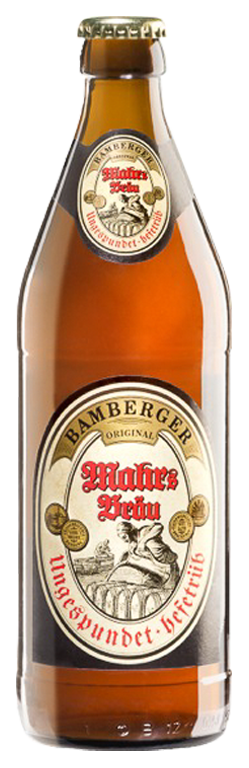
Let us start. The first beer the workshop participants tasted was Mahrs Bräu Kellerbier hefetrüb ungespundet (cellar beer, yeast-clouded, unbunged), i.e., the CO2 pressure is kept low during the brewing process. Founded in 1670, the Mahr brewery in Bamberg was initially spelled Mahr's Bräu, according to the correct German orthography of the 19th century.

Old historical label
New orthographic label

Although they could have kept the historical apostrophe (cool (!)), they did not want to be called Deppen (goofs) and slowly changed their name to the now orthographically correct Mahrs Bräu. That, however, should be no problem for the visitor drinking Mahr's beer locally in Bamberg; just ask for a "U," and the waitress will bring the right stuff. The "U" is a yeast-turbid specialty beer with a full-bodied, smooth malt character. Pleasantly tart and lightly carbonated.

It was a good start, and we were looking forward to Citrilla Maisels and Friends, an IPA wheat beer (!), or Bavaria meets California. In fact, Citrilla has flavors of fruity hops (Citra and Amarillo) and yeast, combined with pineapple, lime, citrus fruit, and ripe banana. Citrilla is likewise refreshing and a full-bodied beer.

Number three served was Berliner Berg, a lager beer in the German tradition brewed in the Neukölln borough of Berlin, looking, smelling, and tasting like a lager. You could call the beer global, brewed by an "American in Berlin" using a new German aromatic hop.


There was a short drinking pause and suspense when the door opened, and Frank and Joe entered the room with trays full of plastic cups filled with dark beer. In fact, we were served two different beers that we had to keep separate, placing them to our left and right. Were we supposed to drink beidhändig (two-handed)? Not at all; we simply were asked to compare two dark beers.

Not to be confused
Red Baron likes Schwarzbier, and we learned that there is more of it than just the Thuringian Köstritzer* served all over Germany. On our LHS, we tasted Bräunlinger Black Lion; on our RHS, we drank the New Belgium 1554 Enlightened Black Lager. Founded like Freiburg by the Zähringen dynasty, Bräunlingen is located 60 km east of Freiburg in the Black Forest. For me, the Black Lion was a local beer, while the Enlightened Black Lager from Fort Collins, Colorado, had traveled nearly halfway across the globe.
*Not to be confused with the Saxon dark beer brewed in Krostitz Red Baron drank in Leipzig

Both beers were aromatic, the Black Lion quite subtle, not sweet, and keeping with my taste. The Enlightened Black Lager was slightly sweet and had, in my opinion, too much flavor.

When I traveled in the States in the 80s and 90s, imbibing soft drinks and lite beer, I always wondered why the Americans did not jump on a drink that is sparkling, slightly sour but adjustable by adding fruity syrup, low on alcohol, and which above all goes down well, i.e., a drink in the style of Berliner Weiße?

Red Baron loves to drink Weiße mit Schuss (woodruff syrup) when in Berlin, i.e., local, but is Berliner Kindl Weiße all there is to it? Did the white beers my father, born in Berlin, once drank taste different from today's Weiße?

Doesn't it look beautiful?
My two questions were partially answered when Joe presented a graphic drawn on a coaster showing that the onset of Berliner Weisse-type beer in the States started as late as 2007. Since then, the number of breweries and white beer lovers has increased exponentially.

Not forgetting the straw in his drawing (©Joe Stange)
Is there a Weiße beyond the mass-produced stuff you are generally served in Berlin? We tasted Schneeeule Marlene (Snowy Owl Marlene Dietrich) without Schuss. According to experts, yeast is the crucial ingredient. For Snowy Owl, it was recultured using traces of yeast discovered in 40-year-old Berliner Weiße bottles from the former GDR. After the two dark beers, Schneeeule Marlene was a refreshing surprise.

The workshop continued on a sour note with Otra Vez. You will find the following text on the brewer's website: On our search for the perfect warm-weather beer, we wanted something light-bodied and thirst-quenching yet filled with complex and interesting flavors. We stumbled across the fruit of the prickly pear cactus, native to California. This tangy fruit is a great complement to the tart and refreshing traditional gose-style beer. Otra Vez combines prickly pear cactus with a hint of grapefruit for a refreshing beer that will have you calling for round after round. Otra Vez!

In my opinion, Otra Vez had too much taste. What is a great flavor for some people is sometimes obtrusive for me. It seems that some craft brewers put their pride into beers with high alcohol content because the market demands it. Red Baron likes soft notes both with drinks and food. I still remember the first workshop when Frank warned that taste buds, once saturated by intensely hopped beers, become unable to sense subtle notes in milder beers served later. The same is correct for cheese tasting: Eat your Roquefort last!

The Alaskan Smoked Porter 2013, served next, was over-flavored, too. Somehow the Berliner Weiße history was repeated when the brewers stated that German-style Rauchbier, i.e., a smoke-flavored beer, was virtually unknown in the US until Alaskan Smoked Porter was developed in 1988. The porter is produced in limited "vintages" each year around November 1 and, unlike most beers, may be aged in the bottle, much like fine wine. The beer we drank was brewed in 2013 and, as stated on the label, is best before the end of 2026, and continuing.

Finally, there was even more taste. The imperial stout Evil Twin Christmas Eve at a New York City Hotel Room, brewed by Evil Twin Brewing, Brooklyn, NY, has an intense black color topped by a very fine beige head. The nose is complex, with molasses and licorice aromas, and notes of espresso in perfect balance. On the mouth, you can taste roasted malt and licorice flavors. In the finish, you will find fine notes of chocolate! Sorry, but when even the nose is "complex," you are no longer drinking beer but a liqueur with 10% alcohol. Covered up by all those intense flavors, I did not even taste the alcohol. I could not drink more than half a liter of Evil Twin Christmas Eve at a New York City Hotel Room without asking for a "normal" beer for diluting.

The workshop's bottle parade
This flavor bomb from New York ended the official part of the workshop. Still, Frank, being homesick (?), opened a final bottle of Deux Amis (Two Friends), brewed in his home country, a product of cultural exchange between Belgium's Brasserie Dupont and America's Lost Abbey Brewery. Deux Amis is brewed in Belgium using techniques perfected over almost a hundred years and receives its decidedly stateside flavor from the addition of American Amarillo and Simcoe hops. The result of this kinship is a dry, refreshing Old World Saison* full of peppery spice, finishing with New World flavors of floral orange and earthy pine.
*Copied as such. French for season


This proprietary drink captured the workshop's think global motto well. Combining the traditional beer style of the Old World with refreshing new ideas from the other side of the Atlantic results in unique brews, as some of those served at the workshop illustrated perfectly.

Thank you, Frank and Joe, for this entertaining and informative evening.
**

Tuesday, October 25, 2016

No Bridge over Troubled Water?

The renaming of street names with a loaded past is not the only topic occupying Freiburg's citizens. As you probably already know, Freiburg was once divided into two parts separated by a traffic axis, the Karl-von-Rotteck-Ring. Following the Ring's closure to car traffic in 2014, a pedestrian zone is under construction, "unifying" the two parts. A new streetcar line will be the only traffic between the university and the theater. A campus will be shaped between the new university library and the traditional quadrangles with lecture halls.


From the artist's perspective, the Square of the Old Synagogue is a broad surface covered with granite plates that have already prompted discussion about their heat retention on hot summer days. People have also criticized the absence of vegetation. Well, a few trees will be planted.

On the right-hand side in the back, you notice a water surface (©Stadt Freiburg)
A shallow water basin will mark the layout of the "old" synagogue that the Nazis burned down during the Reichskristallnacht on November 10, 1938. Later, they removed all the stones.

The planned water basin will have the layout of the old synagogue (©Stadt Freiburg)
Until recently, a commemorative plaque reminded passersby of the barbaric act. Freiburg's Jewish Community greatly appreciates the planned integration of the bronze plaque into the new commemorative water basin.

On an old postcard
Looking at an old photo, you notice that the synagogue was built on a small hill in 1870. The planning staff of the new pedestrian zone was confident that the Nazis had removed the synagogue's rubble, the building's basement, and the surrounding soil, too. They confirmed their assumption by using an ultrasound to probe the site. 

When the construction crew eventually dug holes to house the pumping station for the water basin, they found only remnants of Freiburg's medieval fortifications. So, it was a great surprise when, during the main work, they unexpectedly unearthed stones from the old synagogue.

©BZ/Ingo Schneider
All construction activity in the area stopped. The Jewish Community signaled that under no circumstances should the stones be touched. In fact, it would have been easy to cover those stones with soil, as planned for the medieval remains, but a small wall turned out to be 40 centimeters too high, protruding into the planned water basin.

The archaeological team submitted a report to the Municipal Council and the Jewish Community proposing that the more significant stones remain in situ. Only a few stones in the way will be removed and handed over to the Jewish Community if they agree.

While visiting the scene, Irena Katz, chairwoman of Freiburg's Jewish Community, set her handbag on the relics of the old synagogue but took it away immediately after realizing what she had done. She shook her head skeptically and said, "A poll among members of the Jewish Community has shown that more than 90% of the members are against removing stones."

Klaus Neidhart shows Irina Katz the stones to be removed (©BZ)
In the meantime, more than 90% of the city council members support Mayor Dieter Salomon, who strongly endorses the position of the archeological team.

Will the two parties reach an agreement? Freiburg's city council will decide on October 29, with no plan B in place.


P.S. Abgesang (swan song): Eventually, there was no bridge. In vain, a vigil of about 30 people demanded that the old synagogue be rebuilt as a documentation center, or at least that the unearthed remains be conserved and made visible. Although the Jewish Community had initially endorsed the water basin concept and despite a constructive debate, Irena Katz called the city council's decision to stick to the original plans "rigid." Her hope now is that work at the site will not start before November 9, the 78th anniversary of the Reichspogromnacht (Kristallnacht).
**

Monday, October 24, 2016

A Podcast

While in Berlin, I saw a colleague from Wikipedia I met at the Wikimania World Conference in London in 2014, where Sebastian took a photo of me. Now, he wanted to make a podcast with me.

Our scheduled meeting was difficult because we blew the first date. I had announced my coming to Berlin early and asked Sebastian whether we could meet at the Mommseneck at Potsdamer Platz for lunch.

Why that place? Whenever I travel, I like to eat the local specialties, which means, in the case of Berlin, hearty cuisine. The dish of my desire was pea soup, like my mother used to make. In the past, the famous place for pea soup was Aschinger, which no longer exists. So I searched the Internet for Berlin and pea soup and found Mommseneck at Potsdamer Platz. In addition to traditional cooking, the place offers a good variety of beers.

Sebastian answered my e-mail: That is excellent. What time are we going to meet?

Me: At Mommseneck on September 19 at noon. Is that ok for you?

Sebastian: That is what we are going to do.

Mommseneck at Potsdamer Platz. House of 100 beers.
Theodor Mommsen, a German historian, shown inside on an original Litfaßsäule
I arrived early. It was a beautiful day, and I decided to sit outside. In studying Mommseneck's choice of beers, I read that they offer Berliner Weiße mit Schuss not only with those classical syrups of raspberry or woodruff but with cherry syrup, too. I am always up for an experiment, but the combination of wheat beer and cherry tastes odd.

As time passed and Sebastian did not show up, I still felt thirsty and ordered the classical Berlin white beer with woodruff syrup. Boy, look at the photo!

The real Berliner Weiße mit Schuss, brilliant in the sun, was served in a beaker
While contemplating the drink, my green view was suddenly disturbed by an incoming e-mail.

Sebastian: I can't find you. How do I recognize you? I am sitting at Mommseneck on Mommsenstraße. Luckily, he had added his cellphone number to his mail.

Well, there are two Mommsenecks in Berlin. I had not repeated Potsdamer Platz in my second e-mail, and he did not read my first e-mail carefully enough. The waitress told me that this mix-up happens quite frequently. Nevertheless, Sebastian and I agreed to meet at the same time at the Zur letzten Instanz. Is this name a symbol?


Eventually, my pea soup arrived and turned out to be the third disappointment of the day. There were peas alright and al dente as they should be, but the soup's taste was rather exotic with a touch of curry and green pepper. Regrettably, the dish did not live up to my memories of Aschinger.

Later, somewhat frustrated, I explored the pedestrian area around Potsdamer Platz. A place called Lutter & Wegner caught my attention.

Lutter & Wegner at Potsdamer Platz in the former Huth Building
A place of that name had been famous for its illustrious guests in the 19th century (among other celebrities, poet E. T. A. Hoffmann, actor Ludwig Devrient, author Heinrich Heine, composer Carl Maria von Weber, philosopher Friedrich Hegel, and Reichskanzler Otto von Bismarck) and in the Golden Twenties (nota bene Marlene Dietrich and Josephine Baker). For me, the place became known by a song from Eduard Künnecke's operetta Die lockende Flamme (The Tempting Flame): Im Keller bei Lutter und Wegner ... (In Lutter and Wegner's wine cellar). At the time of the good old "steam radio" in the 1950s, Red Baron had to listen to the arie frequently.

The original traditional restaurant, Lutter & Wegner, located at Gendarmenmarkt, was completely destroyed during the last war. In 1947, black market activities took place in the basement.
 
Lutter & Wegner at Gendarmenmarkt in 1947 ©Bundesarchiv
Following the Wende, Lutter & Wegner opened again at Gendarmenmarkt but at a different site. The other Lutter & Wegner location at Potsdamer Platz is famous, too, but primarily for its original name: Weinhaus Huth.

Wine House Huth was constructed in 1912. It was based on a solid steel structure to accommodate the load of the stored bottles. Therefore, it was the only building that survived the complete destruction of the area during the war and stood isolated in the landscape at the time of division into East and West Berlin. I intended to show you a picture of the Solitaire building, but all copies I found are heavily copyright-protected. Following the Wende, the Huth Building was renovated and integrated into the pedestrian zone of Potsdamer Platz.

Nearby, at Leipziger Platz, I visited the Berlin Mall. This is indeed a vast shopping center but too big.

Look into the Mall of Berlin
Constitution meets commerce.
You walk on articles of our Grundgesetz (Basic Law)
Just opposite the Mall is the building of the Bundesrat, Germany's senate
I made it to Zur letzten Instanz just in time the following day. Sebastian was already seated, and I took my usual bench. My problem is that Napoleon was short; therefore, the seating surface of the historic bench is too narrow. Concerning lunch, I followed the same procedure as last year, ordering Kohlroulade with a dark beer, Märkischer Landmann.

At Die letzte Instanz with ©Sebastian Wallroth
While we were eating, Sebastian recorded his podcast. Here is the link for those of my readers who understand mumbled German mixed with background noises. By the way, the word "penis" was not uttered by me but is, according to Sebastian, the term used most in German Wikipedia either to vandalize articles or to fill holes in texts.
*

Sunday, October 23, 2016

A Personal Note

My readers may wonder why they didn't read about two subjects exciting Freiburg's citizens so much these days. Even in today's Sunday paper, the renaming of streets and the future of the archaeological finds at the site of Freiburg's old synagogue are addressed in two articles side by side. Well, I have already blogged about the first topic describing the facts, but the blog needs more Butter bei die Fische (poking in the eye).*
*The translation I found for the grammatically wrong but colloquial German expression is Put up or shut up, which in my opinion, does not sufficiently describe the meaning in German. Let's say I would have accepted more poking in the nose too.
My friend Jim proposed, "Getting down to brass tacks." This I would instead interpret as Nägel mit Köpfen machen, literally translated as Going to make nails with heads, i.e., starting serious business. Butter bei die Fische means "Giving more substance to the matter, discussion, blogs, etc."


©Der Sonntag
Hold it! Writing a blog is a multiple-stage process:

1. Finding a subject: There are too many at the moment
2. Writing the text is fun and not always the most challenging part
3. Selecting the pictures and formatting them takes time
4. Copying text and pictures into the blog template is easy
5. Getting everything into the proper format takes even more time
6. Hitting the red Publish button

Here is my list of partially drafted blogs you may expect to read soon.

More about the remains of the old synagogue and their future
Reactions to the renaming of Freiburg streets
A report about the recent beer seminar at the Carl-Schurz-Haus
Meet the Chinese ambassador
Parts two and three of my latest Berlin trilogy
Explanation and interpretation of the word karcher and the expression postfaktisch (post-factual).

So please be patient and stay with Red Baron.
*

Saturday, October 22, 2016

On a Sunny Saturday Afternoon

Red Baron lives in a place called Wiehre. The Wiehre was first mentioned in a document dating 1008: King Heinrich II gave the hunting grounds in the area to his loyal vassal Archbishop Aldabero II of Basel as a fief. Initially located on the banks of the Dreisam River, the Wiehre  - meaning Wehr (dam, weir) - is older than Freiburg, founded in 1220.

Today, the Wiehre, Freiburg's largest district, is located solely on the left-hand side of the river. The city administration distinguishes four parts: the Oberwiehre, i.e., upstream of the Dreisam, the Mittelwiehre, the Unterwiehre, and further downstream in the south-west the Heldenviertel (heroes' district), where the streets are named after "heroes" of the First World War, e.g., Manfred von Richthofen aka the flying Red Baron.

Last Saturday, the blogging Red Baron participated in a guided tour of the Mittelwiehre, a suburb where my apartment is located. Although I know my neighborhood well, one is never too old to learn something new.

I had tried to reserve a ticket, but the people at the Volkshochschule (adult education center) informed me that the tour was fully booked. Nevertheless, I went to the meeting point and argued with guide Carola, who said, "I cannot take more than twenty people." To make a long story short, In the end, five registered persons did not show up, which made everybody happy.

We started at the corner of Günterstal-/Urachstraße where, before the First World War, there stood a hotel named Hohenzollern, its name paying tribute to the ruling imperial house. Now, the building houses lawyers' offices and doctors' clinics.

Note the original streetcars (©Carola Schark)
Here is what is left of Hotel Hohenzollern
Built 1898 by C.Hoßmann - F. Weber, restored 1997
Nearby on Urachstraße, the Freiburg transport company (VAG) built its main streetcar depot in 1901. It was used until 1994 when the VAG moved to modern premises in Freiburg's industrial zone in the west. Now, the local fire brigade occupies half of the vast halls while the Freunde der Freiburger Straßenbahn (Friends of Freiburg Streetcars) restore historical rolling stock in the other half.

Streetcar parade in front of the depot
in the years before the First World War (©Carola Schark)
On October 14, 1901, two electrical streetcar lines started operating in Freiburg: Rennweg-Lorettostraße and Rennweg-Günterstal, both passing the intersection Günterstal-/Urachstraße. We were just one day late for the 115th anniversary of the city's electrical streetcar system.

Here is Streetcar 38, one of those in the parade above. In service until 1971, it is now in poor condition but will be restored.


Streetcar number 2 was in service until 1954 and has already been rebuilt. Its electrical equipment by Siemens dates to 1901 and is still operational. The short wagons with serial numbers 1 to 71 made screeching noises when going around tight curves, and therefore, Freiburgers affectionately called them Hobl (literally, Alemannic for a wood plane).

The conservator proudly presents his baby.
Carola, waving her folder, is calling the group to order
We passed the former Anglican church built in 1894, now used by the Seventh-Day Adventists, for whom Saturday and not Sunday is the day of rest.

The Saturday afternoon service had just finished.
Red Baron had to bow his head.
The Christuskirche from 1890, the first Lutheran church in the Wiehre, is under reconstruction for next year's celebration of 500 years of Reformation.

Modeling the outside
The oldest school building in historicized style, initially exclusively for girls, is located at the corner of Turnsee-/Talstraße:

Municipal primary school
Turnsee-Schule.
Von der Stadt Freiburg als Mädchenschule erbaut 1899-1902

(Built by the City of Freiburg as a school for girls 1899-1902).
On our way to the rebuilt St. Marienhaus, now a retirement home, we passed Freiburg's Jugendzentrum (youth center), newly built in the 1950s. We just arrived when the Saturday offener Familienbereich (open family sector) from 1400 to 1600 hours had finished. Kids and even babies animated the entrance area.

Freiburg's Youth Center
In the years before 1960, the municipal sawmill occupied the site. Firewood from municipal forests was cut up and donated to the poor.

Water-driven sawmill (©Carola Schark)

The former creek is a miserable rivulet barely visible through the leaves.

A modern entrance to St. Marienhaus
St. Marienhaus on Talstraße used to be a home for Catholic girls who came to Freiburg as housemaids, protecting them from the vices of the "big" city. A vintage enamel sign serves as a reminder.

Catholic Protection of Girls, Freiburg'Br.
Catholic girls and saleswomen find advice, shelter & job placement,
 the former at Marienhaus Talstr. No 31,
the latter at St. Annastift Holzmarktplatz No. 12.
Nowadays, the building of the Saint Anna Foundation is a retirement home, too.
Another reminder of the old premises is the steeple of the former chapel. It was preserved and serves as a decoration of the courtyard of the retirement home.

A cozy courtyard
On our way back through Hildastraße, we discovered two somewhat hidden landmarks. More than 70 years after the war, the front wall of house number 28 still shows a luminescent arrow pointing to the nearest air-raid shelter in the Hof (courtyard).

Never again
A painted-over landmark
In the corner of the front wall of house number 47, a fastening hook for the catenary of Freiburg's streetcar is preserved. The line running through Hildastraße connecting the Hauptbahnhof (central station) with the old Wiehrebahnhof (Wiehre station) already stopped in 1916 during the First World War.

Our walk in the Mittelwiehre ended at the Kita, i.e., Kindertagesstätte (daycare center) opposite the old Wiehrebahnhof. In the years after the war, wooden shanties at the site served various charitable organizations (Swiss Donation, Quaker, CARE) supporting hungry Freiburg citizens. Thank you.

*