Saturday, March 24, 2012

Mother Earth is Losing Water

The other day I found an article on the internet based on a scientific publication pointing out that Mother Earth has not just one but two water leaks. Over the last 3.8 trillion years, we have drained water at such a rate that a mass corresponding to the volume of the Atlantic Ocean has been lost. The same amount added today would increase the sea level by 800 m. Figure out what this would mean for the place you live.


Emily Pope of the University of Copenhagen and her coworkers base their findings on an analysis of Greenland's early-formed deep-lying serpentine rock layers. Those 3.8 Ga old silicates  (i.e., only slightly younger than the age of the earth of 4.5 Ga) show a remarkable difference in isotope composition compared with more recently formed minerals of the same kind.

As the article points out, one of the earth's water leaks is due to hydrogen diffusion into space. The chemical processes involved start with methane (CH4) formed by a credible biogenic source for methanogenesis, with a concentration of this gas 60 times higher in the Archaean atmosphere than today. Methane undergoes photolysis in the upper atmosphere in a reaction CH4 + 2O2 → CO2 + O2 + 4H, where some of the hydrogen formed in the process will diffuse into space. This evaporated hydrogen is lost for the formation of water. There is also deuterium, the heavier hydrogen isotope, better known in its combination with oxygen as heavy water. Deuterium, however, reacts more poorly with oxygen than hydrogen and, in addition, diffuses at a much lower rate. The net effect is that compared with the water in the Archaean oceans, today's seawater is enriched in deuterium.

There are newly formed minerals that contain hydrogen-like serpentines. In those, the amount of deuterium is higher by 2.5% compared with Archaean minerals.

The second source of Mother Earth's water loss is the formation of minerals like serpentines incorporating hydrogen when magma reacts with water. When Pope and coworkers did the mathematics, they concluded that oceans 3.8 Ga ago were more voluminous and that Mother Earth has lost 26% of its "light" water since then. 

Nowadays, however, both water leaks are less important than a trillion years ago, for the chance of water reacting with magma is significantly reduced, and methane concentration in today's upper atmosphere is much smaller than in Archaean times. 

Still, we lose 100 000 tons of hydrogen yearly diffusing into space. Does this mean that the Dutch no longer have to worry about rising oceans due to melting glaciers?

In 2009 UAF researcher Sebastian H. Mernild and colleagues from the United States, the United Kingdom, and Denmark discovered that from 1995 to 2007, overall precipitation on the Greenland ice sheet decreased while surface ablation – the combination of evaporation, melting, and calving of the ice sheet – increased. According to Mernild's new data, since 1995, the ice sheet lost an average of 265 cubic kilometers per year, contributing to about 0.7 millimeters per year in global sea level rise. Last year this prediction became obsolete because Eric Rignot and coworkers jointly of NASA's Jet Propulsion Laboratory, Pasadena, Calif., and the University of California, Irvine, reported that Polar ice sheet mass loss is speeding up, on pace for 1-foot sea level rise by 2050. The authors conclude that if current ice sheet melting rates continue for the next four decades, their cumulative loss could raise the sea level by 15 centimeters (5.9 inches) by 2050. When this is added to the predicted sea level contribution of 8 centimeters (3.1 inches) from glacial ice caps and 9 centimeters (3.5 inches) from ocean thermal expansion, total sea level rise could reach 32 centimeters (12.6 inches).

Compare this prediction, i.e., more than 5 mm rise of the ocean level per year with the loss of water by leakage. It only amounts to a fraction of a millimeter per year.
*

Friday, March 23, 2012

Are We Entering the Post PC Age?


Two years ago, I wrote about my iPad 1: For me, the iPad is the ideal machine when away from my desktop. E-mail, news, and Wikipedia via the internet are all at my fingertips. I have no time for watching films or playing games, but it seems that other people can well find their fill with the iPad.

When the iPad 2 hit the market a year ago, I considered the improvements on this machine marginal compared with what I already had. I decided that two mediocre cameras did not make such a difference. Anyway, one of my habits is to skip one generation of gadgets, just as I jumped from the iPhone 3S to the 4S. This also means that I made an effort to be among the first to get the newest iPad generation. As soon as the Apple website opened for preorders, I squeezed mine in. Like thousands of other people, I got my iPad delivered on Friday, March 16. The main reason for buying the new iPad was not its much-touted retina display but rather the faster processor, for some of the operations performed on my iPad 1 took pretty long.

Before giving you my impressions of the new iPad, I would like to demonstrate that even my first-generation machine fulfills most of the functions of a notebook, at least for me, and that instantaneously without lengthy rebooting. My favorite applications you will find below on my home screen. They are available at the very moment when I wake up my iPad.

For managing my appointments, tasks, and contacts, I use Pocket Informant, the application I have suffered so much over the last few years because it did not and does not easily synchronize with MS Outlook. In the meantime, the people of WebIS have included IOS calendars in Pocket Informant that are also displayed in Outlook and stay synchronized in the Cloud. The next icon in the first row of applications is Mail, followed by a homemade icon named Wikipedia. Touching it takes me directly to my Wikipedia watch list to track all changes to articles I have written or contributed to. On the other hand, my activity on Facebook (next item) is limited to following my son's whereabouts.

The first application in the second row is Flipboard, that gorgeous newsreader. With Flipboard, I follow the most important national and international news. However, the app seems selective, so I switch to the slower and less shiny Pulp reader to avoid missing specific information. Next come two browsers I chose from the good dozen available in the Apple store in addition to the built-in Safari (last in the first row): Dolphin HD and Mercury. 

I change to Dolphin whenever, and for no apparent reason, Safari is ill- or non-responding. Mercury is friendly for it sports a right-hand scroll bar making browsing longish websites a breeze. Last but not least, the Wikipanion app is unbeatable when looking up something. It allows switching quickly between the German, English, and French versions of Wikipedia dealing with the same topic.

Let us talk about text processing regarding the applications I placed in the third row. Forget about a Word-like treatment of texts on the iPad. Apple's Pages may perform wonders on a Mac but is useless for working on texts when your desktop runs Windows. Document files created in Pages on the iPad end up in obscure places like WebDIS, iDisk, and iCloud or are accessible on your desktop only via iTunes. 

There is Dropbox, the best invention for exchanging information between two machines since Microsoft's ActiveSync, which almost kept a Pocket PC in phase with a desktop PC. In Dropbox, you always work on the same file stored in the Cloud from any machine that has access. No need for synchronization!. Quickoffice connects to Dropbox, and you can happily work on your MS doc- or docx-files on the iPad but beware! Not all formatting done on the PC is kept when you make changes on the iPad and send your text back into the Cloud. A fully justified formatted text turns to left adjusted, which I still accept, but more serious is that all underlying information, like embedded links, is wholly lost in the transfer.

While dreaming about MS Office for the iPad (rumors about it circulated two months ago), I usually only need and use a simple text processor to jot down my ideas, load them into the Cloud, and retrieve the text-only files on my desktop. 

Some text editors are available for the iPad, like iAwriter, Writeroom, Textwriter, and Plain text; however, my favorite is Nebulous. It opens with an additional row of freely programmable keys. Here I have direct access to the umlauts, I find keys that allow me to move around in a text, and last but not least, the row of keys has the sorely missed forward delete key.


The advanced Pons English dictionary is the next and most expensive item on the home screen. Although I often use LEO on the web, Pons is always available, even offline. 

PhatNotes is one of the most cherished carryovers from my Windows Mobile times. The database contains all my personal information and passwords. PhatNotes is an iPhone app optically blown up on the iPad and synchronizes data between IOS and Windows versions. In the meantime, I have transferred all my non-confidential information to Evernote (see the apps bar at the bottom), which will store anything. Evernote belongs to the ten apps everybody should have on his iPad/iPhone. The same is true for GoodReader. It lets you read, among other formats, pdf-files in book format and annotate, cut, and paste the text. Remember my hailing of Google? On GoodReader, I read, e.g., those scanned-in books about the Baden revolution of 1848/49 that some revolutionaries wrote and published shortly afterward in Switzerland, where they had found asylum.

The fourth row starts with my collection of weather apps. My favorite is Meteogram, but if its forecast does not please me, I switch to others. In Utilities, I have collected a couple of goodies like PCalc, a calculator featuring inverse Polish notation, a fast way of calculating as promoted by Hewlett-Packard in the 80s in their famous pocket calculator series. I, therefore, cherish an emulated nostalgic iHP41CV available for both the iPad and the iPhone. In addition, I placed apps for testing WLAN speed, the TapDictionary, and TextExpander in Utilities. The last row on the home screen is completed with a self-explanatory SPORT1 app and the DB Navigator. The navigator allows me to plan German and European train trips and includes local urban transport connections to the nearest train station.

The apps bar at the bottom starts with Musik containing most of my classical CD collection and a couple of jazz oldies and evergreens, although I prefer listening to them on my iPhone. Photo includes various photo apps I still have to sort out for their usefulness. I also keep a private photo collection, starting with the advent of digital picture-taking in 2000 and ordered by years. In addition, an album called nostalgia contains scanned photo souvenirs of yesteryear. I already mentioned Evernote, the database for collecting any information you would like to keep and refer to later and synchronize with the PC. Erinnerungen (Reminders) I usually fill in on my iPhone, mainly with Siri's help. The last two items on the bottom bar are evident and essential to those using Apple's IOS devices.

What are the most significant improvements of the new iPad compared with my iPad 1? The strain on my ol' blue eyes is much less when reading text on a retina display. The increase in speed is dramatic. Launching Pocket Informant from scratch takes about 3 seconds on iPad 1; it takes less than a second on the new iPad.

The other day, I read an article that we are entering the post-PC age with the advent of the iPad. That is only partially true since the PC will remain my main workhorse for all significant office work, editing photos, creating web pages, and doing home banking. Just consider the size of the monitor screen. However, post-notebook age sounds acceptable to me.
*

Monday, March 19, 2012

March 18

In an earlier blog, I referred to November 9 being a fateful day for Germans. The Federal Assembly met in the Berlin Reichstag yesterday to elect a new German President. In welcoming the 1240 delegates, the speaker of the German parliament (Bundestagspräsident) suggested holding any future election of Germany's highest representative on March 18, and not as in the past on May 23, the Constitution Day of the Federal Republic.

In fact, on March 18, 1793, German revolutionaries supported by French revolutionary forces proclaimed the first republic on German soil, the Republic of Mainz.

Berlin March 18, 1848
On March 18, 1848, people all over Germany rose up against their princely rulers and manned barricades to underline their Märzforderungen (demands of March) for freedom of the press, jury trials, and free election of an all-German parliament.

On March 18, 1990, the first free elections in the former German Democratic Republic (GDR) were at the same time the last in East Germany as the so-called Volkskammer (the peoples' chamber) decided to join the West German Federal Republic. Following general elections in all of Germany on October 3, Unification Day became our national holiday.

This year the Federal President was elected on March 18, not May 23. This had to do with our constitution demanding that in case a president dies or steps down from office, the Federal Assembly must meet within 60 days to elect a successor. 

March 18, 2012, became a historic date because two presidents resigned before finishing their five-year terms. Hence the Federal Assembly, which usually comes together only once every five years, met three times within three years.
*

Sunday, March 11, 2012

Freiburg Call for Action

This weekend, 63 environmental prizewinners met in Freiburg for the 1st International Convention of Environmental Laureates, preparing for Rio+20. This will be the follow-up of the 1992 United Nations Conference on Environment and Development (UNCED), also called the Earth Summit, held in Rio de Janeiro, where it was stated: All States and all people shall cooperate in the essential task of eradicating poverty as an indispensable requirement for sustainable development, in order to decrease the disparities in standards of living and better meet the needs of the majority of the people of the world.

The two American participants in Freiburg's convention were Jeremy Rifkin and David Schweidenback. Rifkin, the economist, writer, public speaker, political advisor, and activist, gave the introductory talk: The Third Industrial Revolution. Schweidenback was a Peace Corps volunteer in Ecuador in the late 1970s and is president and founder of P4P (Pedals for Progress), a foundation distributing used bicycles to developing countries. Germany was represented by, among others, Ernst Ulrich von Weizsäcker*, holder of the German environmental prize. On the evening before the convention, he gave an interview to the Badische Zeitung, stating that energy must become more expensive and continuing that our world needs an increased environmental consciousness and clever engineers.
*He is the son of physicist Carl Friedrich von Weizsäcker and the nephew of former German Federal President Richard von Weizsäcker

Weizsäcker spoke from my heart, for I have always thought that energy is so cheap that people have no incentive to economize. Some of them might kill me for saying this when looking at the price of gas that had reached an all-time high of 1.68 Euros/liter (8.30 U$/gallon) last week, causing a dramatic increase in the number of fill-and-run drivers in Germany. 

Over the last twenty years, I started saving energy, replacing nearly all of my incandescent light sources with economy bulbs and, lately, some with LEDs*. Nevertheless, being an old man, I refuse to reduce the light output following Goethe, who on his deathbed is supposed to have said: More light, more light. I drive only 6000 km per year and, following my doctor's advice, walk most distances within a 3 km radius of home. Otherwise, I will take the streetcar. For longer distances in Germany, I love to take the train. When I moved to Freiburg, I lived in an apartment built in 1903 with outer walls 60 cm thick and a room height of 3.20 m. In 2007, I moved to a more modern flat with just 20 cm walls but 40 cm thermal insulation and 2.60 m room height cutting my heating costs by 50%. I don't eat strawberries from South Africa at Christmastime or grapes from Chile in March, and I prefer Kiwis from Israel to those from New Zealand.
*So far, those clever engineers have not come up with an acceptable LED replacement for the low-voltage spotlights

In his interview, Weizsäcker mentioned two developments undermining the Rio 1992 statement. One is the rebound effect, and the other is the disturbed alliance between states and capital. Since Rio, more consumption has eaten up progress in energy efficiency. During the Cold War, money had come to stabilizing arrangements with the Western countries, the latter being the bulwark against communism. With the lifting of the iron curtain and the fall of the Berlin wall, the capital eventually became loose maximizing its profits, e.g., moving production to low-wage countries and enlarging on subprime credits producing one financial bubble after the other (dot-com in 2000 and the US housing in 2007). Capital has recalled its alliance with the Western states.

Under these circumstances, is it possible to reconcile environmental problems and development programs when the fight against poverty and hunger and for fair access to energy resources and raw materials cannot be ignored? In addition, the demand of developing countries for economic growth must be weighed against global environmental objectives.

All these issues apparently found their way into the Freiburg Call for Action. When asked about the importance of this declaration Helen Caldicott from Australia, laureate of the Nuclear-Free Future award, said: We save the world. Will they?

Freiburg Call for Action with handwritten changes (Sonntagszeitung).
So far, I have yet to find the officially released version.
*

Friday, March 2, 2012

It’s Tofu Time

Following last year's Wurst War and under the new regulation for selling wurst on Freiburg's Münster market, the last of the eight authorized vendors opened his stand yesterday. This is the one and only offering vegetarian snacks based on tofu. In the back, you see the north face of the cathedral.


Today an einem Freitag in Freiburg zur fleischlosen Fastenzeit (on a Friday in Freiburg during Lenten season without meat), I decided to try a vegetarian currywurst. Here you may admire the dish:


To put it mildly, the vegetarian version of currywurst is stark gewöhnungsbedürftig (it really takes getting used to). The sausage skin is apparently made from polymerized tofu. It peels off quickly but is not easy to digest. Looking around, I noticed something in a pan that resembled döner meat that the vendor was just filling into pita bread.

Although I warned Elisabeth, she insisted on eating tofu currywurst at the Münster market tomorrow while I will try the veggie döner.


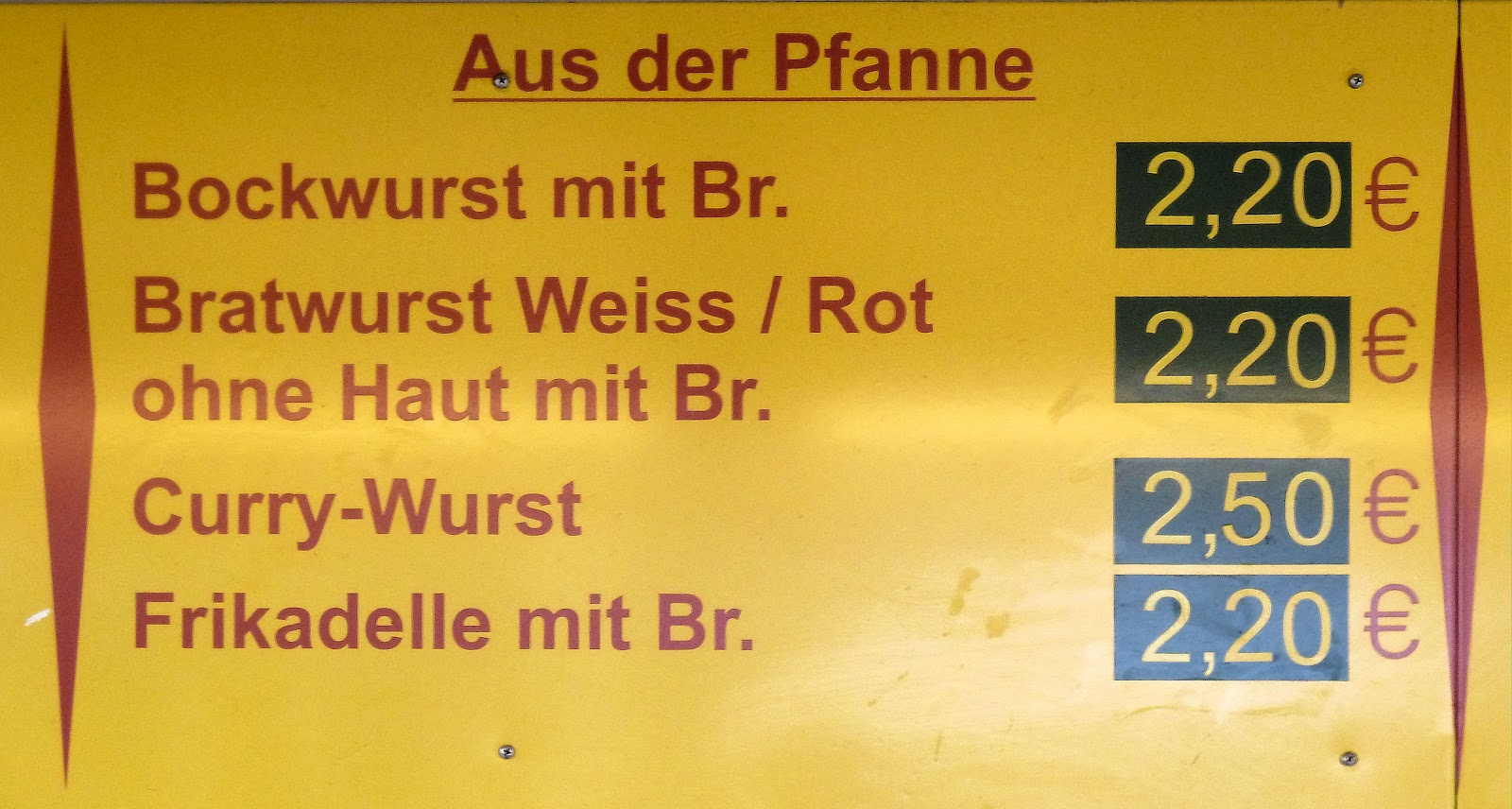
As for the price, it is higher for the vegetarian currywurst than for the real stuff.


Some of the traditional vendors at the Münster market offer hamburgers (Frikadellen). So I told the tofu people to consider selling veggie burgers for Freiburg's American guests.
*

Wednesday, February 29, 2012

Finis Germaniae

The other day, I took part in a guided tour of the German Military Archive in Freiburg, organized by my favorite local newspaper for its subscribers.


I had planned to write a blog about the visit, but delayed it because of other activities. Today, February 29, I suddenly found my photo in the newspaper. This is the reason, together with the rare date, that I must publish today.


You see me in the back, bending forward over one of the showcases, taking a picture of a historical document. Those who know me remember that, due to age and having talked my whole life mostly to people shorter than me, I keep myself somewhat bent, but not as much as in the photo. Is this because I am trying to get the document into frame and focus, or is it the document's content that makes me bow?

The document you find below is the record of the unconditional surrender of all German forces signed at Reims, France, on May 7, 1945. While the Germans had hoped for a separate agreement with the Western troops, General Eisenhower had insisted on an unconditional surrender, but agreed that the document signed at 02.41 hours (a.m.) would only become effective on May 8 at 23.01 hours, corresponding to May 9, 00.01 hours, German daylight saving time. This left about 48 hours for the German ground troops to move to territories occupied by Western forces, thus escaping Russian capture and Gulags. You note that the city of Champagne is handwritten as Rheims in the document. Were the victors thinking of the Rhine River rather than the booze?


Colonel General Alfred Jodl, Chief of the Operations Staff of the German Armed Forces High Command, signed the document. He was later tried at Nuremberg and hanged on October 16, 1946. Lieutenant General Walter "Beetle "Smith, Eisenhower's chief of staff, represented the Allied Expedition Forces. For the Soviet high command, Major General Iwan Susloparov placed his signature. French Major General François Sevez served as a witness.

At Reims, senior Allied commanders celebrate the signing of the document of unconditional German surrender, with Ike showing off some pens. His assistant Walter Bedell Smith, cap in his hand, is on his left. At the far left in front is Ivan Susloparov (Photo Wikipedia).
**

Saturday, February 11, 2012

Nuclear Coincidence

Luckily enough, it was only a coincidence and not a nuclear incident. Yesterday I read in the local newspaper Badische Zeitung that the Nuclear Regulatory Commission (NRC) has approved the construction of two new power reactors in the United States, while a few kilometers from Freiburg, just across the Rhine River, French and German anti-nuclear activists demanded the shutdown of the French nuclear power station at Fessenheim. Mind you, not all is black and white.

While Germany has decided to phase out nuclear power, the NRC approved the construction of two new light-water high-pressure atomic reactors of the Westinghouse A1000 type at the existing Vogtei site in Georgia.

Lucky cows grazing in the shadow of the cooling towers
of the existing Vogtei nuclear power station (Photo dpa)
The last approval of a reactor in the States dates back to 1978, just one year before the nuclear accident occurred at the Three Mile Island site near Harrisburg, Pennsylvania.

Three Mile Island
According to Westinghouse, the A1000 features proven technology, innovative passive safety systems, and economic competitiveness through improved and more efficient operations. Besides, the innovative A1000 offers:

Is fewer also better? 
The NRC's vote was a 4-to-1 decision. Its chairman, Gregory Jaczko, raised considerable safety concerns: "I cannot support this approval as if Fukushima did not happen." In contrast, the Obama administration is looking forward to creating 25,000 new jobs, focusing on the usual argument of reducing the US dependence on fossil energy.

Following the meltdowns at the Fukushima reactor plant and defying strong opposition within her Christian Democratic party, physicist and Chancellor Angela Merkel forced the immediate shutdown of eight of Germany's oldest nuclear power stations. The other nine will be phased out by 2022.

While Merkel and French President Sarkozy (also referred to as Merkozy) are walking and working hand in hand, suffocating the Greeks* by trying to keep them in the Eurozone, they have entirely different views on atomic energy.
*forcing the upgrade of a traditionally self-contained Greek economy that is living on olives and retsina and has a record 25% of the active population occupied in administration to central European standards

With the Siberian cold wave currently sweeping over Germany into France, 60 million freezing French suddenly use twice the electrical energy of 80 million Germans. The reason is that many houses in France have electrical heating and rely heavily on our neighbor's 58 power reactors producing nearly 80% of all electrical energy. Due to France's massive demand*, Germany exports electricity across the Rhine!
*Many homes in France are heated by electricity

This is why Sarkozy, when visiting one of the oldest nuclear sites in France, operating at Fessenheim since 1975, stated: The electricity you produce is indispensable for the people.

The President in the Control Room. Doesn't he look as if he had lost control?
In the meantime, German anti-atomic protesters tried to join their French colleagues on the other side of the Rhine River, but in vain. The French riot police blocked the bridge, arguing that they must protect their president. So the gendarmes, not the president, read black on yellow: Merkozy, sortons ensemble du nucléaire.

German protesters facing French riot police carrying banners
and the photo of a deformed child from Chernobyl (photo BZ)
When the French activists were eventually allowed to articulate their arguments against nuclear power, they were told bluntly: There are rigorous safety rules. When these are observed, the power station is safe. Sarkozy stepped up the tone: Anyone who wants to close Fessenheim is committing a political swindle, he said to the applause of Fessenheim's workforce when mentioning the hundreds of jobs depending on their nuclear power station. Sarkozy concluded: France's atomic policy is our force; we will not change it.

Referring to the demand of 400 politicians in Alsace who had asked for the immediate shutdown of the Fessenheim reactor complex, Freiburg's mayor Dieter Salomon (Green) commented: The President is turning a blind eye to reality and ignoring the worries of the people. He asked Merkel to discuss the issue with Sarkozy in their next tête-à-tête.
**

Sunday, January 8, 2012

Where is the Iranian Flag?

Last Tuesday, January 3, a city councilor of the Christian Democratic party (CDU) asked the mayor to strike the Iranian flag flown on Freiburg's Kaiserbrücke because the Mullah administration in Teheran preaches the destruction of the Israeli state and threatens the world with war.

The back story is that before the pope visited Freiburg, the city had considered the status of the flags flown on Kaiserbrücke, one of the main entries into town. The flags were all dirty, many of them torn. Looking into their provisions, the responsible persons located new national colors from Freiburg's partner cities and hoisted them.

Freiburg is the only city in Germany with a sister city in Iran. The partnership with Isfahan was criticized in the past. With political contacts not existing, the argument to keep it alive was always based on person-to-person communication.

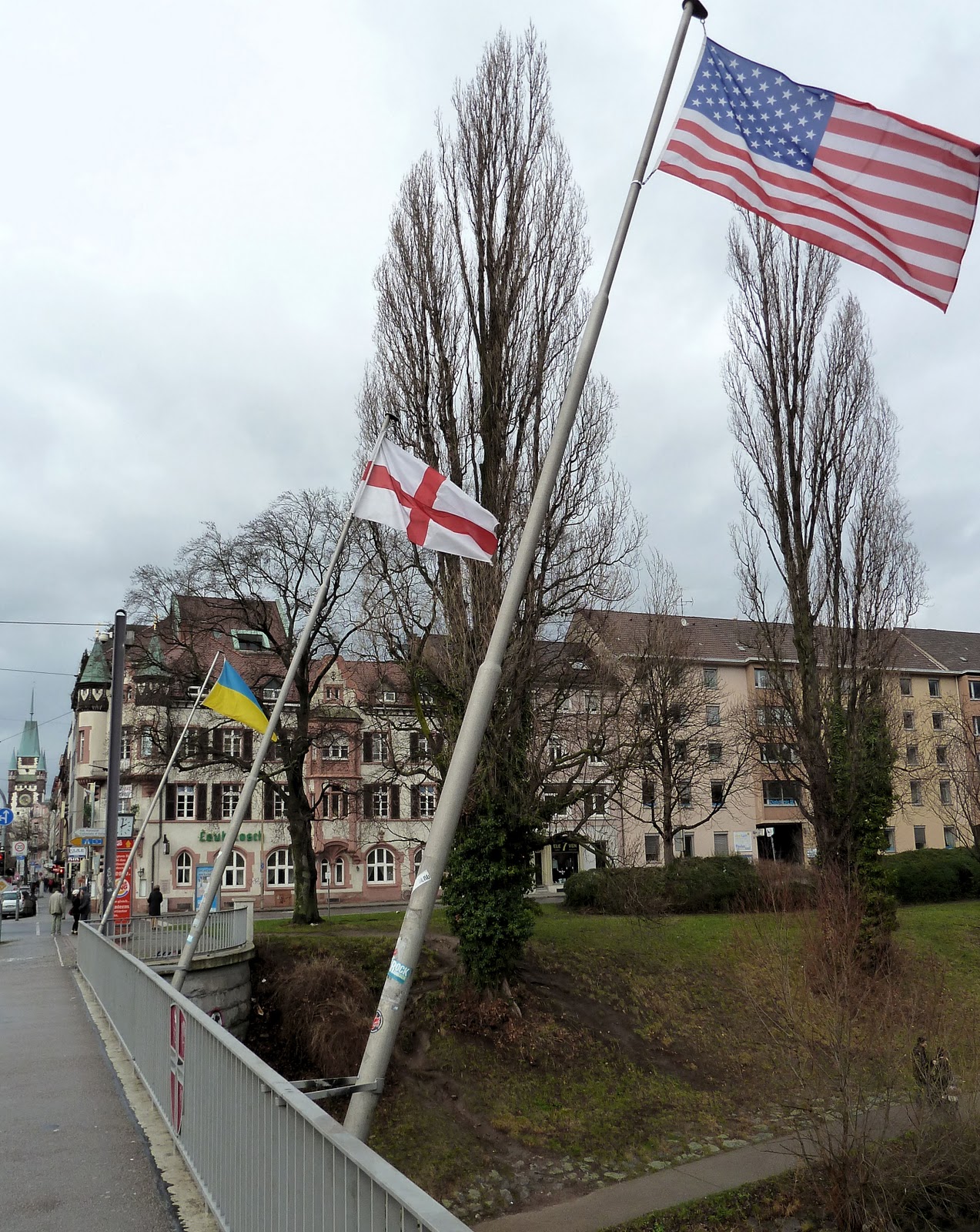
The picture from Tuesday in the Badische Zeitung (BZ) shows the Iranian flag flanked by the English (Guildford) and the Ukrainian (Lviv) colors. Note that the Iranian flag is upside down. By the way, having the same patron saint, England's and Freiburg's flags are identical, showing St. George's Cross.


On the morning of Thursday, January 5, the Iranian flag disappeared. The flag pole had been dismounted and was located below the bridge in the Dreisam River. Frustrated that he had been deprived of a media-effective striking of the Iranian flag, the city councilor was unhappy and called the action carried out under cover of darkness vandalism.

Today on Sunday, January 8, I took a photo at a wider angle.
 In front are the Stars and Stripes (Madison).
Between the English and the Ukrainian, the Iranian flag is missing.
On the left-hand side in the back is the Martinstor.
Where is the Iranian flag? The never-ending story of our fibbing president on the national scale eventually got its local counterpart. Here we go:

January 9: The Left Party (Die Linke) asked the city council to replace the Iranian flag as soon as possible, "As long as countries like the US and Germany carry war and death into the world, we should not dictate to the Iranians what to do."

January 12: Answering the request of Die Linke, the city administration said that they have no ersatz flag in stock. They will soon publish a statement concerning who in the Building and Gardening Department is responsible for choosing the countries and flags to be flown in public places.

January 14: Today, the BZ wrote: Neuer Dreh im Fahnen-Fall (New twist in the fall/case [it's a pun in German!] of the flag). The Association of the Friends of Tel Aviv (Israel) asked the mayor to replace the missing Iranian flag as soon as possible, claiming that the flag symbolizes the Iranian people and not the present administration. The CDU city councilor, a member of this association, did not understand his friends anymore and said, "The flag stands for the Mullah regime." The CDU spokesman for the city council group had initially endorsed the move but now somehow paddled backward, saying, "This issue needs to be discussed."

January 16: Today, the youth organization of Die Linke hoisted a homemade flag of the city of Isfahan as ersatz and in protest. For the left youth and the Association of the Friends of Tel Aviv, the stolen flag symbolizes the partnership with Isfahan.

An extremely poor ersatz flag
The city administration removed the poor product and didn't comment for political or aesthetic reasons.

January 18: The Christian Democrats are tired of the debate and propose to fly the flags of Freiburg's partner cities instead of the national flags. A city councilor of the Unabhängige Liste (Independent List) smirked: We note with pleasure that the CDU follows the proposal of Die Linke's youth organization. However, there are complications as the city administration had already discovered that our Partnerstadt Wiwili (Nicaragua) does not have a city flag.

January 24: The city council wanted to end the farce and decided to stick to the national flags since not all partner cities have a proper flag. The German expression Freiburg zeigt Flagge means that Freiburg will again show the Iranian colors to honor its unique partnership with Isfahan. To continue with the saga, a lady claimed from the off that the flag of Liberia must be shown, too, although the negotiations with its capital Monrovia for a partnership were put on ice in 1990.

January 27: While the Association of the Friends of Tel Aviv welcomes the city council's decision, the CDU is disappointed and commented: We must consider further steps.


February 1: As announced: An Iranian flag is back and no longer upside down.


*

Wednesday, January 4, 2012

Year of the Beer Garden

In 2012, Germany will commemorate the 300th anniversary of Frederick the Great. It started on January 2 with a commemorative stamp of 55 cents, the domestic postage for letters, i.e., the most common value. Many books were already written about the Prussian king in 2011, so they were ready for last year's Christmas Season.


What Schiller once wrote about Wallenstein: Von der Parteien Gunst und Hass verwirrt, schwankt sein Charakterbild in der Geschichte (His character sketch alternates, is perturbed by favor and hatred of opposing camps), he could have written about Frederick. Some consider the inventor of the pre-emptive war as one of the greatest warmongers in history, chasing his infantrymen into enemy fire, shouting, "You dogs, do you want to live forever?" 

For others, he
 
- is the enlightened monarch who made Prussia one of the Great Powers of his time, 
- practiced religious tolerance, 
- became in later years Alter Fritz, the first servant of his crippled people, and 
- assured his country's provisions by introducing the potato as a staple food. 

When Schiller was asked to write a hymn of praise about Frederick, he said: I cannot grow fond of this guy (Ich kann diesen Charakter nicht liebgewinnen), and neither can I.

Let us instead switch to the Year of the Beer Garden

Precisely 200 years ago, on January 4, 1812, King Max I of Bavaria (Where else?) decreed that breweries were allowed to serve their beer on top of their beer cellars. How come?

At that time, cooling equipment did not exist. During the winter, brewers would cut thick ice plates from the frozen Upper Bavarian lakes, transport them to Munich, and store them with the beer in deeply dug cellars near their breweries. To avoid the sun heating up the top of those caves, the brewers planted chestnut trees on top, providing some shade.

During the summer season, people would come to the caves and buy their cold beer in pitchers. However, some of them could not wait to drink the brew at home, but settled underneath the chestnut trees, emptying the pitcher while enjoying some food they had brought. 

This habit did not please the nearby innkeepers. Starting in 1791, a protracted legal and sometimes physical battle (Willst raufi?) between them and the breweries resulted. 

It was not until 1812 that King Max gave those breweries the right to sell their beer in their chestnut-shadowed gardens, provided guests were allowed to bring their own food.

Empty steins made from glass in the beer garden of the Münchener Hofbräu brewery after 11 p.m. (drink up time).
Note the two soft drink bottles being tolerated in Bavaria.
(Photo dpa)
I shall also test whether the latter rule is valid in Baden-Württemberg during the coming summer holidays at Toni's beautiful chestnut garden*, taking along my homemade Brotzeit.
*Also, on Facebook
**

Wednesday, December 21, 2011

Merry Christmas

Many of you know that I keep my eyes open throughout the year, looking for original depictions of the Christmas scene to use at the end of the year. This season, instead of one, I have chosen two, an old and a modern presentation of the birth of Christ.

The first is a photo I took during my "homage to Kleist trip" at St. Mary in Frankfurt on the river Oder, a church located near Heinrich's birthplace. The church windows remained under Russian custody until they returned in 2008. Three impressive strips of colored glass in Gothic arches show the story of salvation. In the middle window is the story of Christ, and on the left-hand side run in parallel, the usual precursor scenes taken from the Old Testament, alluding to the coming Messiah. In contrast, on the right-hand side, medieval legends about the Antichrist are woven in a texture of images.

Middle window (Photo Wikipedia)
Jesus had announced the Antichrist according to St. Mark 13:

21 And then if anyone says to you, "Behold, here is the Christ" or "Behold, He is there," do not believe him; 22 for false Christs and false prophets will arise and will show signs and wonders to lead astray, if possible, the elect. 23 But take heed; behold, I have told you everything in advance.

In the Middle Ages, pious storytellers spread legends about the Antichrist, generally depicted as looking like a teaching Jesus guided by the devil.

The Antichrist guided by the devil (Photo Wikipedia)
Back to Christ's birth scenes. The following picture is an impossible freehand photo I took as close as I could get, standing legs wide apart in the transept, using the ten-power zoom of my Panasonic LUMIX DMC-TZ10. As it should be: newborn Jesus is in the center of the picture, closely watched by an ox and donkey, while Maria strangely turns her head away from the scene. Joseph, as usual in old illustrations, is a somewhat uninvolved bystander.


The following picture, scanned from a poster and displayed in the left church window, depicts the birth of the Antichrist.


For Luther, the Antichrist was personified in the pope. According to the Apocalypse, the Antichrist at the See of St. Peter signals that the world's end is near. In fact, Luther, during the last years of his life, developed strong eschatology ideas and murmured on his deathbed: Mundus ... mox mutandus, Amen (The world will soon vanish, Amen)

The pope is the Antichrist. Woodcut from the time of Luther
Enough of medieval theology. Let us go back to our times.

The second Christmas photo I took in Baden-Baden was taken after the Kiefer exhibition, when I visited the local Weihnachtsmarkt. It was not just jingle bells and those booths selling Christmas decorations or seasonal food and drinks. Some lanes were lined with paintings by Baden-Baden school classes imagining the Christmas scene. One of those pictures, in the form of a Gothic church window, is in jolly contrast to what I saw at Frankfurt's St. Mary. While Joseph is sketched in the old tradition as the somewhat absent-minded old man, Mary hugs little Jesus. He likes it and thanks her with his most charming smile.


Keeping this comforting and touching scene in my mind, I wish you all a

Merry Christmas and a Happy New Year
**

Tuesday, December 20, 2011

Kiefer meets Kleist

On December 10, I visited an art exhibition at the Frieder Burda Museum in Baden-Baden devoted to Anselm Kiefer. On December 13, the Central Council of Jews in Germany (Zentralrat der Juden in Deutschland) awarded the artist the Leo Baeck Medal, which honored his efforts toward reconciliation between Jews and Germans. Gay Guido, our foreign minister, handed the medal to Kiefer during a ceremony at the Waldorf Astoria in New York.

The exhibition at Burda's is already impressive because of the sheer size of the paintings. In fact, painting is probably not the right word, as the large canvases exhibited are mostly covered with thin lead sheets on which paint is distributed. One wonders how these monumental collages hold together.


Most impressive from the year 2010. is Kiefer's picture of the Tower of Babel, measuring 7.6 x 4.6 m, which he titled The Fertile Crescent, since his interpretation of the tower in shambles differs from the classical Bible story. 

Looking at Kiefer's picture, Pieter Breugel's painting came to mind, depicting the unfinished tower as a symbol of mankind's hubris, subsequently divided by their different languages. Kiefer, however, said, "forget about languages," for the tower's base is still intact, such that Occident and Orient meet in fertile Mesopotamia and fructify their cultures mutually.


Walking up a staircase, I read one of Kiefer's statements on the wall: "Ich denke vertikal, und eine der Ebenen ist der Faschismus. Doch ich sehe alle diese Schichten. Ich erzähle in meinen Bildern Geschichten, um zu zeigen, was hinter der Geschichte ist. Ich mache ein Loch und gehe hindurch (I think vertically, and one of the layers is fascism, but I see all those layers. I tell stories in my pictures to show what is behind history. I make a hole and walk through)."

Although taking photos in the exhibition was not allowed, I took a shot at the wording, trying hard to digest its meaning on the spot. Advancing further, I discovered another monumental collage 7.2 x 4.35 m signed Wege der Weltweisheit, Die Hermannsschlacht, a theme perfectly fitting to this year's Kleist anniversary. Suddenly, I had my light bulb moment: Kleist is a progenitor of fascism.


Kleist wrote his drama in five acts in 1808 when Napoleon occupied all German-speaking territories. Die Hermannschlacht (The Battle of the Teutoburg Forest) features battle-winning Arminius. The chief of the Germanic Cherusci tribe fights against the Roman invasion of Germania. No fantasy is needed to read in those fiery speeches that hero Hermann appeals to an uprising against the French occupants. Napoleon had just defeated Prussia. 

Needless to say, the theater piece could not be staged then. During the subsequent restoration, the liberal ideas presented in the drama did not fit the Biedermeier period. 

Only after the Franco-Prussian War, as late as 1875, when the "Hermannsschlacht" against the Erbfeind (hereditary enemy) was won, did the play see performances on German stages.

Kiefer, in his collage, tells the story behind the story. He shows portraits of those Franzosenhasser (French haters) during Napoleon I's reign. The next layer of hate fixed to the reign of Napoleon III was transported during the Weimar Republic into the upper Nazi layer. The brown shirts never forgot the dishonor of the Versailles peace treaty, the French diktat.

Advancing through history, I have chosen some key persons from those 36 portraits I cannot show you because of copyright:

Johann Gottlieb Fichte (1762-1814) wrote his famous anti-Napoleonic Addresses to the German Nation (Reden an die Deutsche Nation).

Luise von Mecklenburg-Strelitz (1776-1810), the Prussian queen, was regarded by many as the German Jeanne d'Arc for standing up to Napoleon, calling him a monster.

Gebhard Leberecht von Blücher (1742-1819) was somewhat late* at the Battle of Waterloo but is still considered in Germany as the co-winner.
*Wellington ought to have moaned: I want night or Blucher! (Ich wollte, es wäre Nacht, oder die Preußen kämen.)

Christian Dietrich Grabbe (1801-1836) not only wrote a drama about Napoleon's last one hundred days but also a remake of the Herrmannsschlacht.

Georg Herwegh (1817-1875) implored the French to stop intervening in German affairs when he conducted his German Legion from Paris into Baden to help Friedrich Hecker in the 1848 uprising.

Hoffmann von Fallersleben (1798-1874), author of the Deutschlandlied with its pan-Germanic first stanza.

Albrecht von Roon (1803-1879) was one of the key generals in the Franco-Prussian War of 1870/71.

Alfred von Schlieffen (1833-1913) developed a military plan for a pre-emptive attack on France.

Walter Flex (1887-1917) was a nationalistic poet and soldier during the First World War.

Albert Leo Schlageter (1894-1923), the man from Wiesental near Freiburg sabotaging the French during their occupation of the Ruhr district, was shot for that.
 
Martin Heidegger (1889-1976) perceived Schlageter as a martyr of the German cause.

Horst Wessel (1907-1930), the author of the Horst-Wessel song, shot by the communists, was an early martyr for the Nazis.

Thank God that there was no further layer.
**

Tuesday, December 6, 2011

Incense and Gunsmoke

When the building of the Badische Kommunale Landesbank (Bakola), constructed in 1954, was torn down in 2007 to make room for a modern shopping center, scientists began searching for traces of earlier settlements at a site that had always been within the inner-city boundaries. 

Yesterday, Dr. Jenisch, the director of the Bakola excavation, guided a group from the Breisgau Geschichtsverein (historical society) through an exhibition of charts documenting the archaeological findings and presented the artifacts he and his team had unearthed at the former site of Freiburg's Dominican monastery.

The exhibition titled Weihrauch und Pulverdampf (Incense and gun-smoke) is devoted to the former Dominican monastery and to the times when Freiburg was besieged in the 17th and 18th centuries by Swedish and French troops. The building within and close to the city walls was located near a vital access gate called Predigertor (preacher's gate). The monastery became famous when, from 1236 to 1238, the great Albertus Magnus served as Lesemeister (lecturer).

Albertus Magnus' monument at the site of the Dominican monastery (Photo Wikipedia)
Hand grenades made from glass were among the most interesting artifacts found at the monastery site. The word grenade comes from pomegranate (Granatapfel) because the original grenades had that shape.

French hand grenades made from glass around 1740
For me, the term hand grenade evokes the 1970s, when we were building the Intersecting Storage Rings for protons at CERN. It became necessary to erect an old-fashioned water tower to ensure the water pressure required for the magnet cooling circuits of the ISR. Soon, my Anglo-American colleagues nicknamed the building the German hand grenade. For a long time, the stick hand grenade competed with the pineapple design called Eierhandgranate (egg hand grenade) in German.

Aerial view of the ISR ring structure with the German hand grenade in the back
close to the CERN fence (Photo CERN)
The glass hand grenades found in Freiburg are from 1745 and of French origin. They were used as explosives during the dismantling of Vauban's fortifications, but not all detonated as planned. 

In battle, a grenadier (sic!), i.e., infantryman throwing a glass hand grenade, lived dangerously for the time between ignition and detonation was ill-defined, and many a man lost his life before he could fling the grenade at the enemy.

A "grenadier" - his shoulder bag full of hand grenades - ignites one.
**

Thursday, December 1, 2011

No Ticket For The Pope And Finis Kommando Rhino

On page 21 today, my favorite newspaper Badische Zeitung published two additional pieces of news about topics I dealt with in earlier blogs.


One informed the reader that Pope Benedict would not get a ticket in Freiburg for driving in his papamobile without a seat belt. The charge was dismissed because he had used the papamobile on a street closed for public traffic where the German road traffic act does not hold. Will the man from Dortmund be satisfied with the argument and give up? To be continued.

On the other hand, the Wagenburgler story is definitely over. The Kommando Rhino disbanded following internal quarrels about the question of violence against police actions in the past. Some group members moved together with other Wagenburglers to the point that the city officials counted more vehicles on the agreed site Eselwinkel than the authorized 45. Since the city is interested in de-escalating the situation, the police did not take any action so far.
*

Monday, November 28, 2011

Benedict Bashing

Those who follow my blogs may remember the one I wrote about Pope Benedict's visit to Freiburg. The other day, I commented on what is typically German concerning seeking justice in court.

Now, here comes a surprising association: A guy from Dortmund had his lawyer in Unna file a suit against the Pope for not having put on a seat belt while touring Freiburg: Mr. Joseph Ratzinger born in Marktl/Landkreis Altötting on 16 April 1927, drove on 24 and 25 September 2011 for more than an hour without a seat belt in his papamobile. Witnesses are the Archbishop of Freiburg Robert Zollitsch and Baden-Württemberg's Ministerpräsident (governor) Winfried Kretschmann. Freiburg's district court confirmed the receipt of a fax in this respect.

Pope Benedict XVI in his papamobile without a seat belt on Kaiser-Joseph-Straße (Wikipedia)
The Dortmund guy said he does not seek publicity, but justice must be done. There is a 30 euro fine for driving without a seat belt in Germany, increasing up to 2500 in case of recurrence, which the Pope indeed was guilty of. Do you still feel that my earlier allusion to Shylock standing for his bond was far-fetched? If not satisfied by the district court's decision, I am convinced the man from Dortmund will drag the case to our highest court in Karlsruhe.

What will happen? Freiburg's district court will declare not competent in the case as the Pope being head of state, enjoys diplomatic immunity. And indeed, taking the fact that diplomatic staff serving in Berlin gets away unpunished with drunken driving and car crashing, so not wearing seat belts is just a petty offense. However, Freiburg's district court's declared incompetence will open the way for an appeal to the next higher instance, and if all goes bad, the Pope's case will end up in Karlsruhe.
*

Sunday, November 27, 2011

My First Referendum

Today I cast my vote in my first referendum in a typically German affair, what the French call une querelle Allemande.

Over more than ten years, discussions and plans had been going on to replace Stuttgart's 19th-century terminus station with a modern underground through-station. This win-win solution will accelerate train traffic and, at the same time, liberate precious ground within the city for green spaces and urban development. The project, named Stuttgart 21, was discussed in all aspects by experts, presented in public hearings, and quickly passed the state parliament in its final version since the Federal Railway will bear the lion's share concerning financing. Only the Green party always was against the project. All seemed clear and had been democratically approved, but when the construction eventually began, citizens opposing the project started public protests at the building site, hindering the work's progress. A mediator failed in his attempt to arbitrate.


The situation became delicate for Baden-Württemberg's green-red state government, with the Social Democrats in favor and the Greens against Stuttgart 21. The only possibility to keep their coalition intact was to ask the people and have them decide in a referendum. Such a procedure is complicated to launch. Eventually, we were asked whether we agreed that the government would bail out of negotiations with the Federal Railway. 

Estimated costs for abandoning Stuttgart 21, the state of Baden-Württemberg would have to shoulder range from only 350 million believing the adversaries to 1.5 billion, according to the project's supporters.


You know from my previous blogs that I am a railway aficionado preferring a six-hour train ride to a ninety-minute flight like the other day from Freiburg to Berlin. I hate the stress of going to Basel airport by bus and having to be there too early. I detest the checks after the check-in and don't like landing far out of the city by taking a bus downtown Berlin. On the other hand, I step on the train in Freiburg and step off at Berlin central station enjoying a good book, and you guessed it, the pot of coffee and the Butterkuchen now 5.70 euro compared to 5 euro last fall.

Coming back to our topic: A couple of weeks ago, the state government issued a booklet containing the pros and cons of Stuttgart 21. This didn't change my mind, but not because I am biased. I was open to any good argument, but those of the adversaries were just aggressive statements.

What made the referendum really weird was that those who want Stuttgart 21 to be built must vote no, and those who are against it have to vote yes. As I wrote above, the people only decide about a law authorizing the government to negotiate with the Federal Railway to abandon the project.

Although the nays will undoubtedly have it, the protests against Stuttgart 21 will continue. Crazy!

November 28, 2011:
Note added in proof: As expected, the referendum ended with 58.8% nays in Baden-Württemberg. Thus Stuttgart 21 will be built. The participation was only 48.3%. Even in primarily concerned Stuttgart, 52.9% voted with no. Freiburg, however, was the great exception and had only 33.5%, the lowest figure of naysayers in our Ländle. Should I now feel like a loser or a winner?

In today's Badische Zeitung
Even before the final result of the referendum was known, adversaries brandished panels in front of Stuttgart's central station: You won't get rid of us.
*

Monday, November 21, 2011

In Memoriam Heinrich von Kleist

 Two hundred years ago today, Heinrich von Kleist, a giant of German literature, committed suicide at the Kleiner Wannsee near Berlin at the age of 34. For me, he is one of the grandmasters of the German language, together with Georg BüchnerHeinrich Heine, and Bertolt Brecht. Goethe and Schiller are great, but did not write with such density. One critic said that the masterpiece is spoiled if you take just one word away or try to add a word to one of Kleist's texts.


I want to avoid developing Kleist's biography. Many books were written on the sad anniversary. Red Baron read: Peter Michalzik, Kleist, Dichter, Krieger, Seelensucher, Propyläen Verlag, Berlin, 2011.


The book cover shows the only confirmed portrait of this disturbing personality. Heinrich was a soldier, student, dropout, traveler, letter artist, farmer, soul seeker, playwright, civil servant on probation, hater of Napoleon, war correspondent, short novel writer, publisher of a literary magazine, newspaper editor, and rebel who, during his whole short life, was always attracted by suicide. His "problem" was that he did not want to go alone. All of his friends, although sometimes depressed like him, refused. Eventually, he found a 31-year-old married woman, a friend, cancer-stricken Henriette Vogel, who was ready to accompany him on his last journey.

I want to show some pictures I took from 12 to 15 November while attending the Kleist Festival in and around Berlin. This included a theater marathon with three pieces on three evenings: Der Prinz von HomburgPenthesilea, and Der zerbrochene Krug (The Broken Jug), followed by nightly discussions with the director and actors.


The Maxim Gorki Theater in Berlin Unter den Linden. 
On its front face is Kleist's Das Erdbeben in Chili (The Earthquake in Chile).


The Kleisthaus, where Kleist lived during his last years in Berlin
 is not the original building.


The relief at the front shows a scene from Penthelisea and Kleist's profile.


The Kleistmuseum in Frankfurt an der Oder is housed in an old manor house.
The house where Kleist was born was destroyed during the war.


A modern Kleist portrait I like most shows him as a rebel.

We experienced a sunny November morning at the Wannsee 
like Heinrich and Henriette lived through before their deaths.


Kleist's memorial stone at the place where he shot Henriette first
and later killed himself.

Nun, o Unsterblichkeit, bist du ganz mein! (Prinz von Homburg) 
O immortality, now you are all mine!
**