Tuesday, October 31, 2017

Fight Fake News

Fake news has become a German word. Our Zeitungsente (newspaper hoax) is just false news, sometimes with a funny touch. In contrast, fake news carries the connotation of being deliberately made up. 
In German, fake news would be called, quite clumsily, a vorsätzliche Falschmeldung. The shorter word Lügenpresse (lying press) is burdened with a Nazi past, so the American term fake news came in handy and has been adopted.


Local newspapers in Germany's southwest have started a campaign with the strange slogan "Jedes Wort wert," translated as "My newspaper is worth every word." 

Strange indeed, for German readers generally have confidence in black-on-white print media along the lines of the statement of Faust's famulus in Goethe's theater play:

Denn was man schwarz auf weiß besitzt,
kann man getrost nach Hause tragen.
What we possess in black on white,
We can take it home in confidence.

Fake news pollutes the political climate, and so many a man accuses the media as the source of all evil. Long-gone civilizations killed the messenger bearing bad news. Would a silencing of the sources be a remedy against fake news? Was there not a statement regarding the revoking of TV licenses?

While visiting the former GDR (German Democratic Republic) as a student, Red Baron witnessed the fabrication of "facts" by communist trade union officials during a political discussion. Suddenly, I found myself in a situation where I was producing fake news, too. There is no excuse, but as a young man, helpless as a kitten on the roof, I tried to beat my adversaries with their own weapons.


It is honorable that my local newspaper claims it is worth every word. Although I spend some time reading the Badische Zeitung after breakfast, the significance of its printed information* varies widely. Browsing the NYT and Der Spiegel online makes the BZ's printed national and international news generally outdated. So I start with the arts and culture section, followed by local news, although reports on traffic accidents do not interest me since they are interchangeable.
*My subscription includes the electronic version too. So, when away from home, I am informed about what is happening in Freiburg.

While up to now, fake news in the German press has rarely been an issue, our media are instead accused of manipulating the news. Well, this is no news; haven't the media always done this? In particular, their biased reporting is said to have strengthened the new right-wing AfD* in the run-up to our recent general election. 

By spreading the story that members of the party were mistreated, the media pushed them into the role of victims. Through their provocative right-wing statements and actions, members of the AfD deliberately place themselves into the position of martyrs seeking the pity bonus. Dealing with the AfD is a no-win situation, for ignoring them will make them pitiable, and attacking them politically will lead to endless debates and situations similar to what I experienced in the GDR.
*Alternative for Germany

The first showdown with the AfD at our newly elected Bundestag ended in a stalemate. Each parliamentary group, i.e., the party represented in the federal parliament, has the right to propose a house speaker who will be deputy to the speaker presented by the party with the most seats. The "main" speaker, second-in-line to our federal president, is generally endorsed by most other members of parliament.

At the opening session of the new Bundestag, most deputies from other parties refused to grant accreditation to the AfD's candidate for deputy speaker on three consecutive ballots, pushing the guy into the role of martyr. His stigma? He had violated Article 4 of our constitution (Grundgesetz) about religious freedom by denying people the right to practice their Muslim faith in Germany. Sadly, this is not fake news.

Frederick the Great living in the 18th century was more tolerant, writing in his rudimentary German: Alle Religionen sind gleich und guth, wan nuhr die leüte, so sie professieren, ehrliche leüte seindt, und wenn Türken und Heiden kähmen und Wolten das Landt pöplieren, so wollen Wir sie Mosqeen und Kirchen baun, Fr. (All religions are equal and good as long as the people adhering to them are honest people. And if Turks and heathens came to populate the land, we will build them mosques and churches, Frederick).
**

Thursday, October 19, 2017

Socialism for Pedestrians

and communism ad nauseam. Here is the blog I announced earlier, which contains what I learned on the bus ride to Zürich about socialism and communism.

Karl Marx did not invent socialism, a word that most Americans abhor. Socialist ideas were articulated much earlier by the 1848/49 revolutionaries, among others. Here is the translation of the decisive paragraph of an article published in Der Festungs-Bote No 10. It was the last newspaper printed in besieged Fort Rastatt towards the end of the Baden Revolution, crushed by Prussian troops on July 18, 1849:

What is a social democracy, and what is its aim?

Democracy alone will give us neither jobs nor bread. It will not pay the interest on our debts. It will not liberate us from sorrows and sufferings, for when trying to bring the people to power, it consistently stumbles against the disproportion of property possession. Socialism seeks to address this disproportion by creating equality ... According to socialists, the distribution of goods shall depend on work. Thereby, the best possible equality among people shall be achieved. Each hardworking, decent, industrious man shall have the opportunity to acquire sufficient property to assure him a reasonable enjoyment of life...

This is the gist of modern socialism, whereas Karl Marx, in his main work, Das Kapital, sought to provide a scientific basis for communism. While in socialism, people should have the opportunity to acquire sufficient property to ensure a reasonable enjoyment of life, in communism, private property is limited to a few personal belongings.

Marx among his books (©Andreas Höfert)
According to Marx's theory, man* is a working social being. A man should find his personal fulfillment in his work, but he becomes alienated because the product of his labor does not belong to him. So he regards work as a burden. Although man is the brother of his fellow men, he becomes estranged from them primarily because of his private property.
* For political correctness, replace man with woman, he with she, himself with herself, etc.

In communism, private property does not exist, and all people are supposed to be equal. So man will eventually recognize himself as a human being. While in capitalism, a minority dominates a majority, in communism, a dictatorship of the proletariat will rule, a situation that Lenin called full democracy*. Communism will give peace, work, freedom, equality, and happiness to the world.
*In countries of the communist bloc after 1945, the term Volksdemokratie (people's democracy) was coined.

During the revolutionary uprisings in Europe in March 1848, Marx lived in Vienna as a correspondent for the Cologne-based radical newspaper Rheinische Zeitung (Rhineland News). The working class residing in the suburbs of the Austrian capital was the driving force of the uprising, in contrast to the revolution led by the bourgeoisie in other German regions and cities. Marx, who, with his sponsor Friedrich Engels, had published the Communist Manifesto in February 1848, was excited, imagining that the predicted proletarian revolution had come. However, it turned out that in Vienna, the national guard and militia were fighting side by side against the enraged workers, protecting the bourgeoisie's private property.

Marx was disappointed. Living in exile in London near the end of his life, he had high hopes that Britain's industrial workers would try the proletarian uprising. Marx, however, had not reckoned with reforming governments and clever factory owners. They appeased social tensions by agreeing with trade unions to wage increases and reductions in working hours, which, in Marx's opinion, were only peanuts. A good example is Bismarck's social legislation in the 1880s.

While in exile in Zürich, Lenin was well aware of this and concluded that the proletariat would not initiate a revolution. Is the working class sluggish, lulled by their trade unions, or are workers even dumb?

When Lenin arrived in Petrograd in April 1917, he used his Bolshevik party to point the way for the working class, i.e., to force them toward their happiness. Note that the Russian population at that time counted only 5% industrial workers but 80% peasants, so the proletariat was the serfs, not the workers. Without hesitation, Lenin used the oppressed peasantry as auxiliaries of the revolution, pushing his April Theses:

All power to the Soviets,
Immediate peace with Austria and Germany
All land belongs to the peasants
The workers control all factories
Banks are nationalized
Creation of a Soviet Republic
Foundation of a revolutionary Internationale
Agitation and enlightenment of the masses and the winning of a Bolshevik majority

The slogan was peace, freedom, land, and bread from now on.

Lenin usurped the bourgeois revolution of February 1917 and organized the October putsch against the provisional Russian government, which later became glorified as the October Revolution. The resulting war between the Bolshevik Red Army and the opposing White Army lasted until October 1922, when the Union of Soviet Socialist Republics was eventually formed.

During the Russian Civil War, no side took prisoners. In the end, more than eight million people were dead. Lenin did not live to see his dream realized, as he died in 1924, when Stalin took over.

So far, all attempts at communist rule have suffered from the discrepancy between promises and "really existing socialism." Human nature will always result in a nomenklatura in which some are more equal than others.
**
Tuesday, October 17, 2017

Atdorf at Rest

Solar and wind energy require storage facilities to bridge periods when non-fossil energy sources are unavailable. The most elegant solution is to use existing water reservoirs already producing electricity and upgrade them with water pumps. The latter will be turned on when there is surplus electrical energy from renewable sources, pumping water uphill back into the reservoir.

Local storage facilities are welcome with the need for electricity in Germany's south, which is produced by off-shore wind parks in Germany's north. To this end, an artificial water reservoir near Atdorf in the south of the Black Forest is in the planning stage. Red Baron has reported about the compromised Atdorf project, which has now been put to rest. One Green deputy in Baden Württemberg's state parliament called the Atdorf exitus "extremely regrettable. The decision is economically comprehensible but unwise in terms of energy policy".

Artist's view of the upper and lower water reservoir near Atdorf (©Der Sonntag)
In fact, the decisive arguments for stopping the project were economic. With the cost of electricity way down in Europe, the 1.6 billion euros for constructing the Atdorf facility are just too high. Its capacity, on the other hand, is too small. A fully filled Atdorf reservoir would produce electricity at full power for a mere nine hours. In the meantime, many small gas-fired power plants ensure Germany's continuous electricity supply. A final argument is that surplus renewable energy is increasingly stored economically in second-generation batteries or by producing hydrogen or methane electrochemically.

R.I.P. Atdorf and the Black Forest stays green.
*

Friday, October 13, 2017

Peeing Like in the Wild West

was the title of an article in Freiburg's Official Journal. As an illustration, the Amtsblatt printed the following photo:

©Amtsblatt/ A.J. Schmidt
I blogged about the prairie project at the Mundenhof animal park before. Here are some more details. Next year, Freiburg's partnership with Madison, Wisconsin, will celebrate its 30th anniversary. On this behalf, the two sister city committees intend to import some prairie feeling to the Mundenhof.

At present, only 270 square meters (0.07 acres) of European prairie land are growing on water-permeable gravel soil. European grasses and shrubs generally bloom in summer, while American prairie species are proud of the Indian summer. Short- and high-grass indigenous American plants will be seeded on an adjacent surface of an additional 700 square meters (0.17 acres).

In a somewhat funny remark, the article in the Amtsblatt referred to the bison at the Mundenhof as country-specific fertilizers. First, the calf does not seem to appreciate his/her mother peeing before him/her. Secondly, given the small land area involved, overfertilization may already be a problem.
**

Tuesday, October 3, 2017

Marillenknödel


When Red Baron read the above announcements, he was all excited. Marillenknödel are not simply apricot dumplings. I had them once made in Geneva 25 years ago by an Austrian lady as the main course and still remember the taste of this juicy delight (Marcel Proust sends his regards). Already, the name Marillenknödel sounds like the k. and k. Monarchy (Austro-Hungarian Empire) for Marillen harvested in Austria differ from Aprikosen in Germany.

Afraid of being late with my inscription to the event, I immediately chose October 1 as my date but soon felt frustrated being informed that my date had to be advanced due to the lack of participants. When I went to the Augustinermuseum to buy my voucher, I was told that to achieve a quorum of six participants, they had finally moved me back to square one, i.e., October 1.

When the museum closed at 5 p.m., our group of only five started the scheduled guided tour of the exhibition Greiffenegg und Ramberg. Having seen the collection twice, I was the only person not having regrets when, precisely at 5.15 p.m., all the lights went off in the exhibition hall. Following a long wait, the lighting could only be partly re-established. While you can admire the graphic highlights in my earlier blog, our guide used the light of his smartphone to illuminate the most interesting drawings for us.

Later, we walked up to the Greiffenegg-Schlössle and read on a sign that the restaurant was closed. However, when we opened the door, we were well received, being the only guests of the evening.

An improvised Greiffenegg drink instead of Ramberg aperitif.
As an aperitif, the house offered the newly created Ramberg drink with gin, tonic water, and peppermint leaves on the occasion of the exhibition. However, our charming service lady soon returned and announced that the tonic water was off. Instead of Ramberg, the chef had prepared a drink that he baptized Greiffenegg based on Gewürztraminer wine on the rocks plus peppermint leaves. Again, I had no regrets about having tasted the Ramberg drink on another occasion. Both drinks need getting used to.

I wanted to order an Austrian wine for the k. and k. three-course dinner, but in its absence, I finally opted for a white Burgundy from the vineyards on Freiburg's Schlossberg we were looking at while dining.

Salad of chanterelles, walnuts, and pears
The first course was so excellent that we asked ourselves whether there would be further escalation.

Fillet of beef Esterhàzy-style and potato galettes
And there was. Red Baron had the best beef fillet for years and could have used the double quantity of an incredible sauce.

I was overwhelmed and thinking: Why are only so few of my countrymen/women embracing the idea of a combined cultural-gastronomical event? The Greiffenegg-Ramberg exhibition closed today but will be followed by one devoted to Rembrandt's graphics. Will the Augustinermuseum give the concept of a joint event another try?

Enter the Marillenknödel. I was in such a high mood that I forgot to take a photo of the dish. It was a nice dessert, but regrettably, it did not revive my souvenirs. 

Ultimately, the chef and service united at our table, and we were full of praise. What a memorable afternoon and evening!

Applause, applause
*

Friday, September 29, 2017

Lenin in Zürich

The Badische Zeitung, in collaboration with the Landeszentrale für politische Bildung, organized a bus day trip to Zürich, where Lenin lived from February 1916 to April 1917.

Leaving Freiburg, we saw a Lenin greeting from an election poster
 for the Marxist Leninist Party of Germany.
In the September 24 federal election, the party gained 0.1% of the vote.
Good morning, Zürich. We expected some rain.
Sexist segregation. For ladies only:
What is named Damenbad in Freiburg is called Frauenbad in Zürich
Another revolutionary:
Ulrich Zwingli brought his Protestant religion to Zürich.
Our group visited the site of the house on Spiegelgasse, where Lenin had rented an apartment, and one of the three libraries, the Library of the Swiss Social Archive, where he spent most of his time reading and writing.

Entrance to Spiegelgasse
with the Cabaret Voltaire, the birthplace of Dadaism.
Lenin's apartment at Spiegelgasse 14,
a nondescript new building.
More celebrities worthy of a blog lived in Zürich's Spiegelgasse.

A house built in 1740 and named Zum Waldris at Spiegelgasse 11:
Johann Caspar Lavater lived here from 1741 (in a new building!) to 1778.
Traveling in Switzerland, Goethe visited Lavater in 1775.
At Spiegelgasse 13, Georg Büchner, a revolutionary doctor of medicine,
and master of the German language,
died of typhoid fever at the age of 24 on February 19, 1837.
Table decoration at the Turm restaurant:
Advent wreath with candles and apples on September 19.
Red Baron loves Swiss wine and abhors Swiss beer made by large breweries.
The restaurant only offered Spanish wine. I overcame the dilemma by ordering a Spanish beer.
Zürcher Geschnetzeltes (Zurich-style veal stew) with Rösti (fried grated potatoes).
The meat was a turkey instead of veal, the rösti was not crusty, but the melon was an extra.
Overall, it was an excellent three-course meal for a reasonable price.
Satisfied fellow travelers leaving the Turm restaurant
Before lunch, we listened to lectures on Marxism-Leninism, and after lunch, on Lenin's influence on Swiss and European socialism during his time in Switzerland.

Professor Koller talked about the Swiss Social Archive and Lenin in Switzerland.

Eventually, Lenin moved from Bern to Zürich because the libraries there were better.
There is no Lenin without Marx, but I describe our trip in this blog and explain what I learned about Marxism-Leninism. In a future blog, I'll write about what may interest my American readers.

Lenin's April Theses
Before he traveled by train through Germany, Sweden, and Finland to Petrograd (later Leningrad, now St. Petersburg) to lead the Bolshevik Revolution, Lenin formulated his April Theses while still in Zürich: Peace, Land, and Bread. All power to the Soviets and to the working class.


Lenin's arrival in Petrograd by train from Finland
Lenin was successful with the Bolshevik Revolution, for his Russians, having been slaughtered by thousands in the war, wanted peace above all.

Goodbye, Zürich, goodbye, Großmünster 
**

Tuesday, September 26, 2017

National Anarchism

Yesterday's general elections saw support for the two big German parties dwindle and the rise of the Alternative for Germany (AfD), a right-wing populist party.

©BZ
In the meantime, intelligent commentators have written brilliant articles on the election's outcome and its consequences. I will not dig into those. One guy wrote that the winner is national cynicism, which I would instead call national anarchism.

Voter turnout was 75.9 percent, up from 71.5 percent in 2013, but a long way from the 90 percent turnout figures of the 1980s. Twelve years of Merkel's rule have created both disenchantment with politics and rage against the establishment in Berlin that is apparently pouring billions of euros into refugees. At the same time, millions of German citizens live at or below the poverty threshold. So far, nobody in the AfD has said "Germany First," but it shows through all their statements.

Savoring their election victory. The right-wing Glorious Four, from the left (?):
Jörg Meuthen, Alexander Gauland, Alice Weidel, and Frauke Petry.
Twenty-four hours later, there were only three (©Der Spiegel).
While the populist wing of the AfD led by Frauke Petry is copying the current political trend in many democracies worldwide, its nationalist fraction, the majority guided by Alexander Gauland, is the dangerous part considering my country's past. 

There is hope that the two wings will fight each other. In fact, in all German state parliaments, the AfD, which is unconditionally opposed to the established system and parties, has so far done no practical work but has instead spent its energy on debates over points of order and internal quarrels.

And they were up to no good when, yesterday, AfD spokeswoman Frauke Petry declared that she would not join the AfD parliamentary group but would instead sit as an independent deputy in the newly elected Bundestag. Today, she even announced her withdrawal from the AfD.

While Merkel's Christian Democrats remain the strongest party and will undoubtedly form a coalition government, Germany's Social Democrats experienced their lowest vote share since 1949. Consequently, they will return to their roots and seek renewal in opposition to the future government. 

In fact, four more years as a junior partner in a grand coalition with Merkel would have meant the end of Germany's grand old party that, in 1933 alone, stood up in the Reichstag (parliament) against the combination of Nazis and bourgeois parties by not voting for the Ermächtigungsgesetz (the infamous Enabling Act).

In the 2017 elections, Germany moved to the right. It is time for the democratic parties to fight back.
**

Saturday, September 23, 2017

Wading Pool News

On several occasions, Red Baron reported about the new Square of the Old Synagogue. The alleged abuse of the commemorative water basin patterned on the ground plan of the destroyed synagogue still excites the mind of many a citizen. For them, the water surface has degenerated into a Planschbecken (wading pool) for preschool children, dogs, and even adults.

Hand-written information in German and English.
Note the boy standing on the submerged commemorative plate (©BZ/Michael Bamberger)
There is a consensus that the commemorative plate submerged in the water is barely visible and that its text is rather general. Passers-by will need concise information about the site's history and significance.

©SPDFraktion
Freiburg's Social Democrats have already rushed forward, proposing a giant banner partly covering the front of Collegiate Building II that will undergo renovation during the next two years. In the meantime, the municipal council has set up a working group, including the Jewish community, to work out an explanatory text.

Coming back to the abuse of the water basin. Many citizens, including moderate Jews, regard splashing children as a way to fill the square with new life. With the parents' consent, a friend took the following photo.

©ES
Two splashing children, yes, but naked? Is this a new dimension?

The scene reminds me of a song made famous by Paul McCartney and Stevie Wonder:

Ebony and ivory live together in perfect harmony,
Side by side on my piano keyboard, oh Lord, why don't we?

Yes, why don't we?
*

Thursday, September 21, 2017

Schwarzbrot

For black bread, a German specialty, many of my compatriots and I will walk the additional kilometer to get it. Some Germans living abroad even have it flown in in large quantities.

Sliced Vollkornbrot by Lieken called Kraftklotz (power log)
 without preservatives, juicy, and extra grainy.
While France is the land of cheese, we are the land of bread. Among those many kinds of bread, the black variety is of particular significance but must not be confused with Pumpernickel*. German Schwarzbrot is a bread made from whole grain rye, sometimes called Vollkornbrot, although wholemeal bread may also be made from wheat or spelt.
*I shall come back to Pumpernickel Bread in a future blog.

Elisabeth likes wholemeal toast bread, and so do many others. Of the three kinds of toast bread sold at the local grocery store, the wholemeal variant is frequently sold out.

On the other hand, Red Baron already prefers thinly sliced whole-grain rye bread for breakfast. There are many kinds of Schwarzbrot, some available only regionally, although others, like Lieken, are produced by bakery chains and are offered throughout Germany. 

Support local bakers! So, for a change, I often buy a loaf of whole-grain rye bread at a local bakery, cutting my thin slices by hand.

My favorite packed bread in Freiburg is the Kraftklotz, but whenever I was in Cologne, I bought at least two packages of Rheinisches Vollkornbrot produced by the local bakery Merzenich. Their bread was very dark and tasty due to the addition of sugar beet syrup. Recently, they changed their baking recipe. Now, Merzenich's bread tastes like any everyday Rhenish whole-grain rye bread. 

So when I wept in the presence of my sister-in-law during my recent visit to Cologne, she, being an insider, recommended Zimmermann's Rheinisches Vollkornbrot instead, donating me two packages.

Zimmermann's bakery, founded in 1875, produces Rheinisches Vollkornbrot
 without preservatives and the addition of syrup.
On the left is a thin slice of Kraftklotz,
and on the right is an even thinner slice of Zimmermann's Rhenish whole-grain rye bread.
Recently, Kraftklotz changed its baking recipe, offering 20% more bread per package. I taste the difference. The new kind is tastier than the previous version.

**

Sunday, September 3, 2017

Hitler in Freiburg

We are in the midst of our federal election campaign, but Red Baron has never experienced a more boring one. Angela Merkel (Christian Democrat with a projected 38% of the vote) is hovering as the mother of Western democracy over the lowlands of German party politics, whereas Martin Schulz (Social Democrat at a meager 24%) is struggling like the famous frog in liquid cream, hoping that part of it may eventually transform into butter to give him at least some ground.

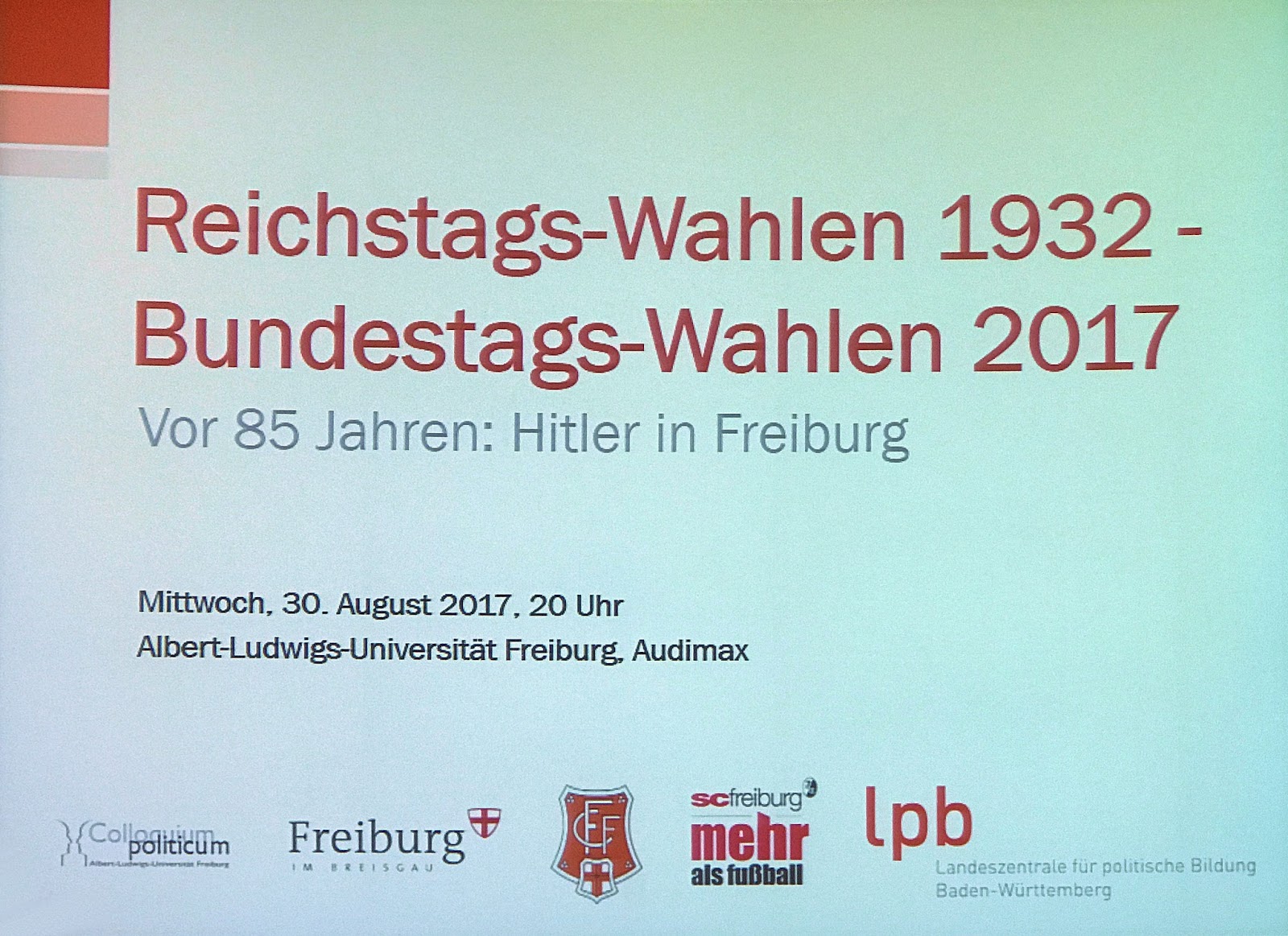
In light of such boredom, the Landeszentrale für politische Bildung (lpd, State central for political education) scheduled a panel discussion at the university's Audimax (main auditorium).

General elections 1932 and 2017: Hitler in Freiburg 85 years ago
Unbelievable:
People had to pay an entrance fee at campaign rallies in the Weimar Republic.
Visitors came from Switzerland and neighboring Alsace to listen to Hitler.
Red Baron was early at the Audimax and got a seat near the stage, but only in row four. The other seats in front were reserved for dignitaries, including members of the local soccer teams Sportclub Freiburg (SCF) and the Freiburger Fußballclub (FFC). I got a free ticket issued for counting purposes at the entrance since seating more than 800 persons at the Audimax is illegal. Nevertheless, as the starting time approached, the auditorium became overcrowded.

©lpb
During the filling and waiting phase, we were entertained by video material. A documentary about Hitler's arrival and stay at Freiburg on July 29, 1932, was the "top seller." Here are some frames.

Most impressive. In July 1932, Hitler campaigned using an airplane,
allowing him to give four speeches in four distant
cities in one day. At Freiburg, he arrived one hour late.

Removing his earplugs after arrival at Freiburg (Cabins were not pressurized in 1932).

Saluting children and flowers as usual.

Hitler liked powerful and fast cars.
Rumors have it that the autobahn between Prussia and Bavaria was built
with priority so that he could quickly move between Berlin, the German capital,
and the Hauptstadt der Bewegung (Capital of the Movement), Munich.

As Hitler passed, young female voters were screaming
 like today's teenage girls idolizing Justin Bieber.

Looking determined and surrounded by his Brownshirts
he is marching to the FFC's Mösle stadium.

Hitler is giving his third and same speech during the day.

Already in 1932, there was fake news about the number of attendees:
30,000, according to the Freiburger Sport Club,
50,000, as estimated by the Freiburg newspapers,
70,000, as claimed by Nazi propaganda.

Hitler, with a flying cap, ready to head for Radolfzell on Lake Constance
to attend his fourth and last rally of the day.

Können diese Augen lügen? (Would I lie to you?) Yes, you did.

Super election year 1932. Rektor Schiewer during his introduction
in front of a poster of the presidential election of April 10.
The evening was opened by the host, Prof. Dr. Dr. h.c. Hans-Jochen Schiewer, Rektor (head) of Freiburg's university. The purport of his introductory talk was: Although there have been dark times in the past, the motto of Freiburg's university is equality and freedom of speech and research.

In front of a historical photo
 showing Nazi Mayor Franz Kerber and Gauleiter (governor) Robert Wagner,
here are the panel members from left to right:
Dr. Thomas Schnabel, Leiter Haus der Geschichte Baden-Württemberg, Stuttgart
Dr. Dieter Salomon, Oberbürgermeister der Stadt Freiburg
Dr. Michael Wehner, Landeszentrale für politische Bildung Baden-Württemberg,
Außenstelle Freiburg leading the discussion
Christian Streich, Trainer, Sport-Club Freiburg
Dr. Heinrich Schwendemann, Historisches Seminar
der Albert-Ludwigs-Universität Freiburg
The panel discussion proper started with two noteworthy statements by Freiburg's mayor, Dr. Dieter Salomon: Jeder Mensch hat seinen Wert (Every human being is valuable) and Populismus ist geschichtsvergessen (Populism ignores history).

According to Dr. Thomas Schnabel, director of the House of History in Stuttgart, a comparison between 1932 and 2017 is nearly ridiculous. In 1932, Germany suffered from the world economic depression and a high unemployment rate of 18% (today 5,7%). This meant more welfare recipients and increased social spending, compensated by reducing salaries in the public sector. Streets were dominated by politically motivated brawls and murder. This was an excellent climate for populism. Most important, however, was that more than 50% of voters, whether right or left, rejected the Weimar Republic, whereas today more than 85% fully support the democratic system of our Federal Republic.

Hitler and the National Socialists had their breakthrough in 1930 with 18.3% of the vote, reached their peak with 37.3% in the July 1932 poll, and declined to 33.1% in the November 1932 elections, reflecting a noticeable improvement in Germany's economic situation. Schnabel insisted that Hitler's rise to power on January 31, 1933, was not imperative. The elites helped him, and not the working class.

Schnabel is right, for the chancellor-makers and members of Hitler's initial government were industry (Alfred Hugenberg), military (Werner von Blomberg), and aristocracy (Franz von Papen), where the latter commented: In zwei Monaten haben wir Hitler in die Ecke gedrückt, dass er quietscht (Within two months we shall have pushed Hitler into a corner so he will squeak). All underestimated Hitler's will to power. Within only eight months, the Nazi chancellor had brought Germany into line.

Why were two of Freiburg's soccer teams invited, and Christian Streich, SCF coach, sitting on the panel? As Dr. Heinrich Schwendemann of the Historical Seminar of the university explained, at the beginning of the 20th century, soccer was an integrating factor as Catholics, Protestants, and Jews placed team spirit above religious and ideological differences. The Mösle Stadium, home of the FFC, was sponsored by Jews. So it is one of history's ironies that Hitler gave his speech in a "Jewish" stadium.

The integrating power of soccer today involves Muslim and native African rather than Jewish players. This multicultural mix sometimes leads to racist outbursts during matches in the Bundesliga (Federal soccer league). Contrary to other coaches, Christian Streich has frequently spoken out against racist remarks and hate speech and, in particular, has recently taken on the populist AfD (Alternative for Germany). To great applause, he explained that he had agreed to sit on the panel because I am surrounded by educated people who are occupied the whole day with history and politics. In contrast, I constantly reflect on how to prevent goals against my team.

Later in the discussion, Dr. Salomon distinguished between a political movement and a political party. The Greens started in 1980 as a movement, with Joschka Fischer being their charismatic leader. Together with the Free Democrats and the Linke (left socialists), the Greens now belong to the spectrum of the smaller established parties in Germany, each with the prospect of around 10% of the votes. The populist AfD is still in the movement stage, just missing the one and only charismatic leader. They may get 12% of the votes in the upcoming general election.

Dr. Salomon said: Concerning Germany's past, present generations are not guilty, but we must ensure that such an inhumane period never recurs. Concerning our uneasy relationship with our nationality, Dr. Schnabel added: Nationalism, yes, but never against others inside or outside Germany.

Except for some interesting historical details and a few bon mots, the panel discussion did not knock my socks off. Contrary to my habit, this time, for fear of lengthy comments from people in the auditorium and verbose answers from the panel members, I left the Audimax with most of the audience before the general discussion started.
**