Saturday, February 24, 2018

On the Stones of the Synagogue

There is one iconic photo of Freiburg's burned-down synagogue taken on November 10, 1938, that not only is part of my web page Freiburgs Geschichte in Zitaten (Freiburg's history represented in quotations) but also serves as historical evidence on the newly installed municipal information panels at the Platz der Alten Synagoge.

Middenhoff's famous photo (©Staatsarchiv Freiburg)
Although it was strictly forbidden to take pictures of the smoldering ruins of the Jewish house of prayer, the student of law Wolf Middendorff took a risk and shot the only known photo, becoming a sort of hero after the war. He was honored not only for his audacity but became a law professor serving at the renowned Max Planck Institute of International Law one block away from my apartment.

Tall Middendorff in HJ uniform
(©Staatsarchiv Freiburg)
This morning an article in the Badische Zeitung changed Middendorff's image dramatically. Markus Wolter, a historian and librarian has unveiled the Nazi past of this "hero," who, in fact, was not just a Mitläufer (nominal follower) of the regime but an active member of the Nationalsozialistischer Schülerbund (Nazi Schoolchildren's League). Later he rose through the ranks of the Hitler Youth (HJ) to become Unterbannführer (Local leader of HJ) in Freiburg. Having reached the age of 19 in 1935, Middendorff became member number 3,594,133 of the NSDAP (Nazi Party). During the war, he served in the Luftwaffe (air force). In the winter semester of 1945/46, he was one of the first law students in Freiburg. By keeping his Nazi past secret, he obtained the famous Persil-Schein* (denazification certificate) by fraud, opening a public service career in court. He later boasted of having "whitewashed" many old Nazis in this capacity.
*Brand name of a famous washing powder: "Persil, nothing washes whiter."

What makes the Middendorff Affair unbearable is his anti-Semitic notes found after his death when, e. g., he welcomes the fact that Freiburg's university was in the winter semester of 1938/39 judenfrei (free of Jews). To cap it all off, he wrote a "poem" modifying the text of an old ballad: Wetzt die langen Messer am Synagogenstein, daß sie besser flutschen in den Judenbauch hinein (Sharpen your long knives on the stones of the synagogue, so they may more smoothly glide into the Jews' bellies). Nauseating!

Knowing Middenhoff's story, his famous photo reproduced on municipal information panels derides the Jewish victims. Unfortunately, this is just another chapter in the unfinished saga of the Platz der Alten Synagoge. Markus Wolter rightly demands that the photo be commented on extensively in the final version of those information panels.
*

Thursday, February 22, 2018

Original Sin

Yesterday, Elisabeth and I attended a lecture about Erbsünde, ein irreführender Begriff (Original sin, a misleading term) by Professor Ludwig Wenzler, former director of Freiburg's Catholic Academy. While "original sin" may be understood in English, Erbsünde (inherited sin) in German is frequently misinterpreted.

Are we all born with the personal sin (peccatum originale originans) Adam once committed when in paradise he ate an apple (?) of the tree of knowledge, and why is a newborn child already fraught with Adam's sin (peccatum originale originatum)?

Do you see this big black spot? That is the original sin. (©Cosmiq)
Let us start at the beginning. Not taking the "literal" interpretation of the Book of Genesis by creationists seriously, science now explains that the world came into being following the Big Bang, with life developing on Earth later. Out of primitive forms of DNA have evolved viruses, bacteria, protozoans, plants, animals, and eventually man/woman or better men/women, for it is hard to believe that mankind is the result of only one common ancestor.

Bible stories are great at explaining the mystery of creation to Jews and Christians before science, inspired by Darwin, revealed the development and selection of species and, later, the transfer of our DNA to our offspring.

In his time, although he proclaimed the Freiheit eines Christenmenschen (On the Freedom of a Christian), Martin Luther remained deeply rooted in the Middle Ages. For him, freedom meant freedom from paternalism, the tutelage of the Catholic Church, i.e., freedom for any man/woman to find his/her particular way to God, guided by reading the Bible. 

Nothing was more important to Luther than fighting illiteracy, even for women (!), so that everybody may study the Bible in his German tongue and find his way to Christ.

According to Luther, man/woman has no free will, for although the spiritual human being is free, the flesh is weak and bound to sin, so he read in St. Paul's letter to Romans 7:19, "For I do not do the good I want to do, but the evil I do not want to do--this I keep on doing."

As Luther writes in his scripture De servo arbitrio (On the Bondage of the Will), human beings are slaves and bound by their will. They are either "ridden" by the devil or by God. This was his rude answer to Erasmus of Rotterdam's scripture De libero arbitrio diatribe sive collatio (On Free Choice of the Will, Discourses or Comparisons), in which the latter explains that God does not interfere with man's/woman's free will. Let them decide between good and evil.

Back to the original sin: It is widely acknowledged that Augustinus forwarded the concept. Augustinus's story of Adam and Eve losing paradise by disobeying God's order and eating from the Tree of Knowledge explained the evil in this world and the misery of medieval life. Is there not a more modern interpretation of the "original sin"?

Man/woman is indeed in the bondage of his/her origin. Although the genetic code has evolved, the original evolutionary principle that the fittest will survive and proliferate is common to all species. Being essential for their survival, animals have no scruples about eating other animals, and strong males will fight for females to pass on their genetic material. 

We, however, intelligent beings, became conscious that it is wrong to kill neighbors, take or destroy their possessions, and impose genes on raping their women. Professor Wenzler called the inclination of man/woman towards evil an Erbmangel (hereditary defect) but interpreted it as a "genetic defect" rather than in a religious context. The insight of our ancestors that there is evil apparently came in pair with their queries about the meaning of existence.

Here, I dare to claim that paradise never existed, although such a condition is the starting point of many other non-Jewish mythologies. Paradise Lost serves as an auxiliary construction to explain how good and evil came into this world and how man/woman acquired the "knowledge," i.e., became conscious of choosing between them.

Although Professor Wenzler tried hard to eliminate the German word Erbsünde, replacing it with Ursünde and even introducing the concept of Erbgnade (hereditary grace), the element Erbe gets a whole new significance for me. We carry the basic information of egoistic life-preserving and life proliferation in our genes, as the lyrics of the song "As Time Goes By" describe:

It's still the same old story
A fight for love and glory
A case of do or die ...

Or with respect to our heritage, as Mephistopheles in Goethe’s Faust states in his defeatist way:

Es erben sich Gesetz und Rechte
wie eine ew’ge Krankheit fort;
sie schleppen von Geschlecht sich zum Geschlechte
und rücken sacht von Ort zu Ort.
Vernunft wird Unsinn, Wohltat Plage:
Weh dir, daß du ein Enkel bist!
Like a disease, an heirloom dread,
Still trail their curse from race to race,
And furtively abroad, they spread.
To nonsense, reason's self they turn;
Beneficence becomes a pest.
Woe unto thee, that thou'rt a grandson born!
**

Sunday, February 18, 2018

In God's Own Country

Yesterday, the Freiburg University winter lecture series "500 years Reformation, Luther and the Consequences" ended with a talk by Professor Michael Hochgeschwender, University of Munich: "Radical Reformation and Reform of Society in the States in the 19th Century". As on all previous Saturday mornings, the auditorium was fully packed.

In his first sentence, Professor Hochgeschwender clarified that America's society was and still is influenced by Calvinism, not by Lutheranism. The Pilgrim Fathers looking for new frontiers were Puritans. Later Anglo-Saxon Protestants continued to mark the spiritual development in the States, to the detriment of Irish immigrants being fervent Catholics. Settlers arriving on the American continent took along the Puritan Anglosaxon slogan "Thy mercy on thy people Lord," regarding themselves as the newly chosen people.

Professor Hochgeschwender's lecture was a bit too detailed, referring to the religious situation that led to the War of Independence and that developed into revival movements in the 19th century. These were soon teaming with liberal groups to form the capitalistic system in the northern states.

For Protestants, the King James Bible was the measure of all things, sometimes the only book at home. Reading was an essential skill. The message is that all men can be saved; they only have to meet God individually.

God alone will choose his people, although the idea that those selected by the Lord are already successful here on earth does not sound very biblical. But did not St. Paul clearly write in his second letter to the Thessalonians 3:10, "For even when we were with you, this we commanded you, that if any would not work, neither should he eat." This led to the distinction between the undeserving and deserving poor.

In the States, the spiritual development in the north clashed with the more traditional living style in the south, a democracy of free white men. Eventually, tensions over the justification of slavery culminated in the Civil War that, given the endured carnage, left religious groups speechless and in trouble explaining.

Not for long. In the second half of the 19th century, the ministering zeal revived to give the American way of life to the world. Herman Melville carried this sense of mission even further, "And we Americans are the peculiar, chosen people - the Israel of our time; we bear the ark of liberties of the world," and he continues, "Long enough have we doubted whether, indeed, the political Messiah had come. But he has come in us."

Religious affiliation in the U.S.
Although the number of atheists is on the rise, the spectrum of Protestant religious movements in the States still is broad, e.g., Evangelicals, Presbyterians, Baptists, and Mormons. This Church of Jesus Christ of Latter-day Saints perfected the view of the last days being near and taking place in new Israel, the United States. Christ will eventually exult in God's own country.

As Professor Hochgeschwender explained, all this is far more complex, but he showed that some religious attitudes still influence a significant part of today's American society.
*

Friday, February 16, 2018

For a Big Fee, a Map of America

This morning, reading the Badische Zeitung, Red Baron shook his head when he read a copy of the famous map of “America” by Martin Waldseemüller held at the Bayerische Staatsbibliothek (Bavarian State Library) is a fake. Yes, the BSB proudly bought a fake copy of Waldseemüller’s map for 2 million Deutsche Mark (1 million euro) in 1990. The report immediately brought the lyrics of  “I want to be in America” from the musical West Side Story to my mind.

When Christie’s London put up another map for auction last December, experts became suspicious by comparing their specimen with the copy in Munich. Subsequently, material science tests revealed that around 1960, both maps were drawn from an original kept at the University of Minnesota in the States; where else? At least we know that the specimen preserved at the Library of Congress in Washington, DC, is an original.

There is another copy in Freiburg near where once Waldseemüller’s parents’ house, the Haus zum Hechtkopf (pike head), stood.


Visiting the place this morning, I learned that it was not Martinus Ilacomilus who had invented the name but Philesius Vogesigena (Matthias Ringmann).

Note the reflection of the Haus zur lieben Hand (House of the Kind Hand)
Then Waldseemüller wrongly (?) wrote America on the map.


Coming back to the two fake copies in Munich and at Christie’s. Why had they not found out earlier? Oh, those experts!
*

Thursday, February 15, 2018

Churches to Beer Halls

People well-versed in the Bible know the famous lines in the Book of Isaiah, "They shall beat their swords into plowshares." This is the snow of yesteryear, for you read in the Book of Gambrinus, "They will transform their churches into beer halls." It is a fact: while the number of churchgoers is declining, gesoffen wird immer (people will always booze).

Initially, Red Baron was shocked when he read in the Badische Zeitung that churches are transformed into large beer bars in the States. In Freiburg, the Luther Church, situated near the university's clinical buildings, was recently deconsecrated too ... to become a lecture hall for the medical faculty. The future multi-functional auditorium will have 460 seats.

Luther Church in Freiburg (©Joergens.mi/Wikipedia)
Back to the beer churches. Instead of an altar, you will find a brewing kettle, and beer will be served instead of wine. Names for the beers have been easy to find since the Middle Ages; the best beers are brewed by monks. Subsequently, you will find the Pious Monk dark lager, Organ Pipe pale ale, and Celestial Gold on tap or in bottles at those booming Beer and Bible Bars. Note the quadruple alliteration.

In Pittsburg, Pennsylvania, the Church Brew Works in Pittsburgh are housed in a former church building. While we read in Genesis 2:2, "And on the seventh day God came to the end of all his work, and on the seventh day he took his rest from all the work which he had done," the Pittsburg brewers completed, "On the eighth-day man created beer."

Church naves with large stained glass windows
are hard to make into condominiums (©Dake Kang/AP)
In Cincinnati, Ohio, the Taft's Ale House opened in the 167-year-old St. Paul's Evangelical Protestant Church with a "blessing of the beers" by a Catholic priest, Rev. John Kroeger. Eyes cast upward, he said, "God of all creation, you gift us with friends, food, and drink. Bless these kegs and every keg that will be brewed here. Bless all those freshened here and all those gathered in the days, months, and years to come! Amen." 

It proves that Beer is ecumenical.
*

Friday, February 9, 2018

Fire and Fury

At the beginning of the year, Red Baron learned about a whistleblowing book by Michael Wolff reporting from inside the White House. The book Fire and Fury was to be published on January 7, but when I looked on Amazon, it was available in Germany only on January 9.

Somewhat angry, I browsed the Apple store on January 5, and there it was, Fire and Fury, ready for download. What had happened? The Little Brown publishing house had advanced the delivery by two days, fearing an injunction that President Trump's lawyers were preparing forbidding publishing the book.

Some people hate e-books, but they have several advantages. They do not need precious space on your bookshelf, let you read the book in parallel, synchronized on multiple devices, and allow the marking and annotation of text and the looking up of unknown expressions in online dictionaries. Wolff writes a demanding style, using a vocabulary sometimes strange to me.

In the States, Michael Wolff writes for a few newspapers and published a 2008 biography about the Australian media mogul Rupert Murdoch titled: The Man Who Owns the News. In the U.S., Murdoch owns the 20th Century Fox studios, the television network Fox, and the influential Wall Street Journal.

Michael Wolff had already accompanied Donald Trump during the election campaign and writes, "Shortly after January 20, I took something like a semi-permanent seat on a couch in the West Wing of the White House. Since then, I have conducted more than 200 interviews. "


The first Freiburg-Madison-Gesellschaft Stammtisch of 2018 was on Wednesday this week, and I presented Wolff's book to a considerable audience.

The Transition
Almost no one in the Republican camp had counted on Trump's victory. When they moved into the White House, the electoral team was stunned and inexperienced. So Kellyanne Conway, Trump's election campaign manager, coined the term "alternative facts." At the same time, she had intended to say, "The president has other information," which is also a peculiar way of describing Trump's fixation on the size of the crowd present at his inauguration on the Mall in Washington.

Wolff's book then reveals that it had been Trump's chief strategist Steve Bannon who was behind those hasty Executive Orders restricting the entry of citizens from some Arab states.

The ultra-right, all-right activist and Breitbart TV maker Steve Bannon tried, until his dismissal in July 2017, to turn America morally and politically back into the good old 1960s. As the chief strategist, he often had the president's ear if the latter had not listened to Jarvanka — an artificial word formed from the names of Trump's son-in-law Jared Kushner and daughter Ivanka.

Trumpism
It turned out that the president had no long-term strategy except to "Make America great again." Often the last person to see Trump influenced his opinion. As Wolff knows: "It was one of the key elements of Bannon's understanding of Trump: the last person Trump spoke to ended up with enormous influence." So the chief strategist was permanently present in the White House; sometimes, he slept a few hours on a couch.

There are the long nocturnal phone calls, the evening cheeseburger, the three television screens, and the morning tweets in the bedroom that determine POTUS's daily routine, "If he was not having his six-thirty dinner with Steve Bannon, then, more to his liking, he was in bed by that time with a cheeseburger, watching his three screens and making phone calls — the phone was his actual contact point with the world — to a small group of friends. "And so, "Trump would brag that Murdoch was always calling him; Murdoch, for his part, would complain that he couldn't get Trump off the phone. "

And then there was Reince Priebus, the chief of staff, rather than being a personnel manager, playing the role of a prime minister in the White House, taking care of the president's day.

As in any organization, there are power struggles and intrigues in the White House too. Here the main front line ran between the right-wing Bannon/Priebus and the liberal Jarvanka. It would need an intelligent boss smoothing the waves and knowing the game of divide et impera.

The Media
Wolff writes that Trump is not interested in politics. In a televised expert meeting of Republicans and Democrats on new bipartite immigration law, Potus said, when it came to the legalization of the Dreamers illegally residing in the States, "I'll sign anything you guys will come up with," but later rejected a hastily elaborated draft bill submitted to him.

It was unique that such a special meeting in the White House took place in front of live television cameras, but "The president's most pressing concern was his media reputation. "As Wolff knows, "The media treat him like no other president had ever been treated."

"His enemies were out to get him. Worse, the system was rigged against him. The bureaucratic swamp, intelligence agencies, unfair courts, and lying media lined up against him. This was, for his senior staff, a reliable topic of conversation with him: the possible martyrdom of Donald Trump,"

Here Trump is paranoid as Wolff describes the president's feelings, "The media were sore losers and hated him for winning, they spread total lies, 100 percent made-up things, totally untrue, for instance, the cover of Time magazine — which, Trump reminded his listeners, he had been on more than anyone in history. "

"The cover showed Steve Bannon, a good guy, saying he was the real president. ‚How much influence do you think Steve Bannon has over me? 'Trump demanded and repeated the question, and then repeated the answer, ‚Zero! Zero!'"

More Challenges
The president's collaborators had more challenges; as Wolff reports, "Everyone was translating a set of Trump's desires and urges into a program, a process that required a lot of guesswork. It was, said Deputy Chief of Staff Katie Walsh, 'like trying to figure out what a child wants.' But making suggestions was deeply complicated. Here was, arguably, the central issue of the Trump presidency ... he didn't process information in any conventional sense — or, in a way, he didn't process it at all."

"Trump didn't read. He didn't really even skim. If it was printed, it might as well not exist. Some believed that, for all practical purposes, he was no more than semiliterate ... Some thought him dyslexic; certainly, his comprehension was limited. Others concluded that he didn't read because he just didn't have to and that this was one of his key attributes as a populist. He was postliterate — total television."

"But not only didn't he read, but he also didn't listen. He preferred to be the person talking. And he trusted his own expertise — no matter how paltry or irrelevant — more than anyone else's. What's more, he had an extremely short attention span, even when he thought you were worthy of attention."

Obamacare
And then there was the failure in the appeal of Obamacare, "Trump wanted to break things, he wanted a Republican Congress to give him bills to sign, and he wanted the love and respect of New York machers and socialites."

Obamacare was the acid test for the Trump administration, "It was Bannon who held the line, insisting, sternly, that Obamacare was a litmus Republican issue, and that holding a majority in Congress, they could not face Republican voters without having made good on the Republican catechism of repeal. Repeal, in Bannon's view, what the pledge and repeal would be the most satisfying, even cathartic, result."

On the other hand, the Republican speaker of the House, Paul Ryan, knew that he would succeed with his majority only sticking to a "repeal and replace" approach. In fact, Trump, now indifferent to everything, had, during the election campaign, offered voters better health insurance than Obamacare.

Then, as the various attempts in Congress failed to abolish and replace Obamacare, "Bannon was careful to take a back seat in the debate. Later, he just said, 'I hung back on health care because it's not my thing.'"

Foreign policy
Steve Bannon behaved differently when the Trump government was challenged in the field of foreign policy: "At the beginning of April, Bashar al-Assad's government, once again defying international law, had used chemical weapons at Khan Sheikhoun. There was a video documenting the attack and substantial agreement among intelligence agencies about Assad's responsibility. Barack Obama had failed to act when confronted with a Syrian chemical attack, and now Trump could. The downside was small; it would be a contained response. And it had the added advantage of seeming to stand up to the Russians, Assad's effective partners in Syria, which would score a political point at home."

"Chief Strategist Bannon's approach was very much it was not our mess, and judging by all recent evidence, no good would come of trying to help clean it up. That effort would cost military lives with no military reward. Bannon believed in the need for a radical shift in foreign policy and proposed a new doctrine: Fuck 'em. This iron-fisted isolationism appealed to the president's transactional self: What was in it for us (or for him)? "

"To son-in-law Kushner, it seemed obvious that the president was more annoyed about having to think about the attack than by the attack itself."

Checks and Balances
Let us have confidence. "At the heart of the U.S. Constitution is a system of checks and balances that was established primarily to guard against the concentration of power in an executive branch that might tend toward royalism. The founders of the American experiment wanted to prevent a repeat of the monarchical abuses of King George III, against which their constituents had risen in the revolution." To this day, these checks and balances have prevented Trump did not get out of hand.

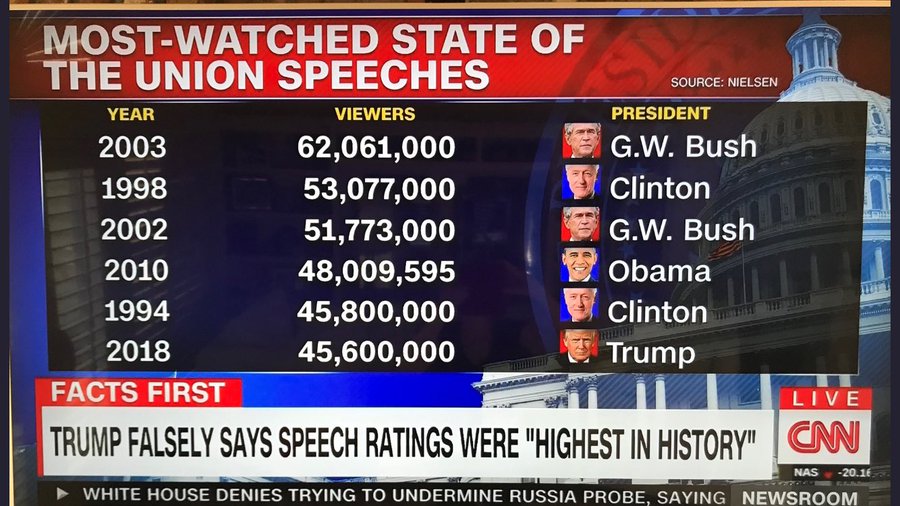
Trump's narcissism, however, continues. About his State of the Union speech, he twittered, "Thank you for all the nice compliments and reviews on the State of the Union speech. 45.6 million people watched, the highest number in history ... "

©CNN
Fake news! Obama had 48 million viewers in 2010, G. W. Bush holds the record with 62 million in 2003, while POTUS came in only in seventh place.

Last week in Ohio, while stock prices fell through the floor, Potus said, "I am not braggadocios," although two days before, he had bragged that he was the cause of the booming stock market.

My presentation stimulated an exciting discussion that, however, diverged into present German politics. While I was partly listening to the arguments thrown around, I became possessed by the idea: Will Donald Trump permanently damage the position of the U. S. presidency through his behavior? Will this result in the fact that future American presidents will have less authority? We shall see.
*

Monday, February 5, 2018

First Collisions


Red Baron is an alumnus now. I reached the status last weekend, not at the University of Munich, from which I graduated, but at CERN, where I spent 32 years of my professional life until my retirement. I participated in the First Collisions jamboree, which was held at CERN. So it was natural that, when I arrived, my former office was the first place to visit.


The isotope chart behind the desk was still there, as well as the pinboard. Instead of the one clumsy tube monitor I had, there are now two (!) flat screens on the desktop. I also noticed that the small wooden bookshelf behind my chair, where I kept my reference books, is still in use.

Later, I met my last Division Leader from Austria and three of my former collaborators from Germany, Italy, and France, all of whom were smiling. With all the other long-retired Belgians, British, Danish, Dutch, Norwegians, Swedish, Swiss, and one of the first physicists from Slovakia (not retired) I recruited at CERN, my group was truly European not forgetting those many visiting colleagues from China, Japan, Russia, and the United States.


I hurried to the Main Auditorium and arrived just in time to listen to CERN’s Director-General Fabiola Gianotti welcoming the assembled alumni. She started with a slide showing the Large Hadron Collider and the location of the four underground experiments in the Canton of Geneva and the Pays de Gex of France. Note the snow-covered Alps beyond Lake Geneva in the background.


The age structure at CERN presented by the DG really astonished me, for I was retired, i.e., I had to leave at age 65. Today, the official retirement age is 67. So it was comforting to see that, beyond the age of 82, professional life at CERN finally seems to end.


Back to high-energy particle physics.


The lab still lives on the discovery of the Higgs boson, with its mass now precisely determined at 125 GeV, plus or minus 0.25 GeV, but many questions in physics remain unanswered, and some problems still need to be solved. Why is there more matter than antimatter in the universe, and what did the plasma look like in the time slot before 10 µsec after the Big Bang?


To investigate those questions further, particle physicists ask for more powerful accelerators. The quest for higher particle energies leads to new R&D (research and development) at CERN.


Note the plans for a Compact Linear Collider in the Pays de Gex. But above all, the Future Circular Collider should fit into the given landscape. Why? The official reason is that the LHC will serve as an injector to the FCC, or is the region around the Lake, between the Jura Mountains and the Alps, so beautiful and attractive?

The DG showed her last slide:


And thanks to the CERN management for sponsoring the successful event, the first of its kind and likely to be followed by others.

The weekend's activity was so dense; there is more to report. Stay tuned for some nostalgic notes (what else?) in a future blog.
**

Wednesday, January 31, 2018

Inside Fry's Triple Combination

On Monday evening Professor Earl E. Fry of Brigham Young University in Utah spoke about "Trans-Atlantic Drift and Global Shift; Can the United States and Europe compete in a Rapidly Changing World." At the beginning of his talk, Professor Fry appealed to the audience's sympathy by mentioning his German ancestors, who possibly had been Swiss instead. There is a known Frey Chocolate in Switzerland, albeit with an "e."

Here are some of the slides Professor Fry showed and discussed:


The content of his slide on "The Challenges Facing the Trans-Atlantic Region" confirms the global shift. However, the high economic growth in Asia and other emerging markets is due to the backlog of demand in developing countries. Professor Fry's worries about the non-proliferation of western values like human rights, democracy, the rule of law, and capitalism are justified, although capitalism may not be the best export article. This is hard to accept for the devoted capitalist Fry.


On his slide "Lament for America Thesis," Professor Fry harped on his triple combination of globalization and rapid technology going in parallel with creative destruction. Indeed globalization lowered the percentage of the U. S. in terms of Purchasing Power Parity (PPP) on a global scale from 40% in 1967 to only 15,5% in 2015, i.e., to the value of the year 1900.

Creative destruction brings down once-thriving crafts and industries, replacing them with the outcome of new technologies. Digital photography brought to its knees once mighty "analog" Kodak, and coal miners were jobless with cleaner energy sources taking over. It does not help that POTUS, in yesterday's State of the Union message, touted, "We have ended the war on American energy, and we have ended the war on beautiful, clean coal." Yes, I know the slogan "Black is beautiful," but clean coal is fake coal.


The slide "America's 15 Domestic Fault Lines" lists problem areas in the States, most of which are also valid in the European Union (EU). So the explosion of entitlements and benefits is a severe problem in Germany, where state governments and the federal government kick down the road financing of acquired pension rights for their civil servants.

That the costs for health care will have only one direction: Going up, Red Baron wrote before. Although I knew that health care in the States is expensive, I did not realize that costs are more than twice as high in the US, i.e., 17% versus 8%, as in the EU.

Lacking education, a deteriorating infrastructure, and growing separatism are common problems. Whereas in Germany, federalism is considered an achievement, European countries with relatively strong central governments face separatist movements, i.e., North and South in Italy, Corsica in France, Catalonia in Spain, and Scotland in the United Kingdom.


The slide on "U. S. Government Debt" is frightening for me, but Professor Fry is optimistic about the US economy going strong.


Indeed, on the slide "If US States Were Nations 2016," the fact that the State of California alone has the economic strength of the UK is astonishing.


Professor Fry's last two slides, "America's Economic Strengths," are optimistically summarizing the solid economic positions of the United States.

At the end of the talk, I had many questions but held back, asking only, "Recently, the US has lowered the corporate tax considerably. Consequently, President Trump invited European firms to invest in America at the recent Economic Forum in Davos, Switzerland. Where will they find a skilled workforce when the present unemployment rate is as low as 4% in the States?"

Professor Fry corrected, "It is not only the low corporate tax but also the cheap energy that will attract investors," and continued, "The problem of the missing workforce can be solved by immigration." Mhm, I had many more questions, but others in the audience wanted to get their queries in too.
*

Monday, January 15, 2018

New Year‘s Reception 2018


Last year, Red Baron was one of the 1300 lucky citizens invited to Freiburg's official New Year's Reception 2017. This year, I attended the reception of my local Lower- and Middle-Wiehre Civic Association.

Citizens attending the reception are listening to the speeches. Note the eerie light effect.
This is not the Holy Grail, but the sun focused on a wine glass.
Following a lengthy speech by the chairman of the Bürgerverein - harping on perennial issues like the traffic situation in our quarter Wiehre, a veritable squaring of the circle - Mayor Dr. Dieter Salomon answered at equal length, emphasizing the achievements of his administration in the past years, albeit enhanced by full employment and bubbly tax revenues.

Mayor Dr. Dieter Salomon in action
Martin Horn's flyer:
Together let us shape Freiburg


We Freiburgers will elect our mayor on April 22, so the meeting turned out to be a sort of early election rally with all five contenders present. We have a left-wing woman of Die Linke, a right-wing AfD candidate, and an independent Green Party male challenging his colleague, incumbent Mayor Dr. Dieter Salomon, who is seeking a third eight-year term as mayor. The Christian Democrats (CDU) did not find a suitable candidate, while last week, the Social Democrats (SPD) pulled a hitherto unknown young man out of the hat.

This handsome non-party guy, Martin Horn, is Dieter's only serious contender and attracted all the attention. Here are some photos:

Later, the two top contenders were discussing back-to-back with the people.

I captured this picture from a Facebook video.
The scene was taken during Freiburg's official New Year's Reception in 2018.
The longtime SPD MP for Freiburg, Gernot Erler, is the person in the back, observing Martin Horn.
**

Sunday, January 14, 2018

Plumpsklo

When Red Baron learned of Michael Wolff's book Fire and Fury on January 4, he immediately checked Amazon and discovered that the American edition would not be available in Germany until the 9th. However, when I searched the Apple Store the next day, I was prompted to download a copy to my iPad. The reason for this earlier release was, as you all may know, an impending injunction that President Trump's lawyers were preparing to forbid the publication of the book.

I wanted to read the book not so much for the sometimes juicy details (yes!) but to better understand the American political system of checks and balances. On the first pages, I read that, like most of us, nobody in Trump's entourage had reckoned with his victory, but I was stunned that he was not prepared for the presidency, for he did not want it himself. The Freiburg-Madison-Gesellschaft will dedicate its February Stammtisch to Fire and Fury with Red Baron reporting.

Last Friday, January 12, halfway through the book, I checked the news, and I was shocked that reality had surpassed any possible fiction: On Thursday, Trump reportedly grew angry during a meeting about protections for immigrants from several countries and asked, "Why are we having all these people from shithole countries come here?" He then reportedly added, "Why do we need more Haitians?" and suggested the US bring in more people from Norway.

Subsequently, the NYT reported that foreign correspondents had problems translating shithole into their languages. As a child, I remember a shithole being an essential part of the Plumpsklo (pit latrine) at my grandparents' farm. It was a plank with a hole to sit down on that was in use until the building got a proper toilet connected to the sewer system in the 1950s. By the way, some people now claim that POTUS instead said "shithouse," which does not change the explanation in this paragraph. Comedian Stephen Colbert commented, "He does not belong in the White House."

POTUS's remarks are inhumane and racist (although positive for Norwegians). He is on the same line as leading figures of Germany's right-wing AfD (Alternative for Germany).

Father and son Becker (©dpa)
Jens Maier, MP and judge, after having babbled about the creation of mixed race populations, called tennis legend Boris Becker's son Noah a Halbneger (half-nigger), and AfD deputy chairwoman Beatrix von Storch twittered after the police in Cologne had sent out an appeal for a peaceful New Year's night in various languages: Was zur Hölle ist in diesem Land los? Wieso twittert eine offizielle Polizeiseite aus NRW auf Arabisch? Meinen Sie, die barbarischen, muslimischen, gruppenvergewaltigenden Männerhorden so zu besänftigen? (What the hell is happening in this country? Why does the North Rhine-Westphalia police twitter in Arabic? Do they think this will calm down those barbaric, Muslim, and gangbanging hordes of men?) referring to # MeToo events in Cologne on New Year's Eve two years ago.

I just learned that today the French are celebrating the medieval Christian Festum Asinorum (fête de l'âne or Feast of the Ass), commemorating the Holy Family's flight into Egypt. Honi soit qui mal y pense.

©Store norske leksikon


Apropos people from Norway: 75 years ago, the Nazis deported young Johan*, belonging to the blond Germanic race, from Norway to Germany to teach him German Physics. He died last year on July 15, peacefully at the age of 96, in Oslo; he was a vital man indeed.
*later, my boss at CERN until 1980

Requiescat in pace.

**

Friday, January 12, 2018

Fish & Friends

Elisabeth and I like to eat fish, although finding a good choice in Freiburg is tough. The city is too far from Germany's coasts, where it's traditional to eat seafood often. 

In the States, I always found a good selection of fish, even in places like Knoxville and, particularly, lobster in Oak Ridge.

English still is the preferred language in Germany.
The only chance to eat fresh fish in Freiburg is a German restaurant chain called Nordsee, where we quite often eat grilled fillets of plaice caught in the Pacific, even though it tastes entirely different from plaice found in the North Sea. This is why whenever I am in Hamburg, I try to eat Speckscholle, a plaice caught by men on fishing cutters harbored in Finkenwerder, a village on the left bank of the Elbe River. Remember my blog from last January? I nearly missed the boat.

Coupons: this is just the first page
The local Nordsee restaurant tries hard to convince Freiburgers that fish is healthier than their traditional Schäufele (pork shoulder). It issues coupons that will cut your bill in half. Sometimes it is hard to find those coupons, so Red Baron joined their customer club, Fish & Friends, not to be confused with either the craft beer Fox & Friends or the early morning show on Fox Television.

Note: the restaurant is open, not geöffnet.

Yesterday I had a strange encounter. With some difficulty, I created a QR code on my iPhone using the Nordsee app, giving me a price reduction on our favorite dish. When I proudly presented the above image to the man behind the checkout counter, he panicked: "I don't need that," and handed me not one but two sheets of coupons, avoiding the electronic gadget like the plague. He nearly fainted when a young man waiting in line behind me showed him his mobile phone with a barcode too.

So much for digital competence in Germany.
**

Wednesday, January 3, 2018

Stolz

I do not mean the German word for pride; instead, I am referring to Alban Stolz, a theology professor at Freiburg's Alberto-Ludwigia, born in 1808, and a professing anti-Semite.

Since 1913, Alban Stolz's bronze bust
has stood in front of the Konviktkirche (Seminary Church) (©BZ)
He belongs to the Freiburg dozen, i.e., those street names identified by a naming commission as unacceptable according to present moral standards.

©BZ/Ingo Schneider
An article in yesterday's Badische Zeitung titled "Alban Stolz in the Snow and the Rain" showed an old photo of his bronze head in the snow. These days, with temperatures much too warm for the season, his bust is left out in the rain. For how long? The Archbishop's Ordinariate announced already last February that the physical memory of Alban Stolz would be removed.

View from the Konviktkirche (Seminary Church)
 to the Münster (Minster Church) (©Hans Sigmund)
There are other places in Freiburg's suburbs named after Alban Stolz: a children's daycare center in Zähringen and a Catholic dormitory in Littenweiler. The building was renamed in 2017 and is now dedicated to Saint Alban of Mainz, so residents may continue to call it Alban-Haus.

Stolz was a representative of Catholic anti-Semitism, and as such, he wrote countless articles in his popular calendars, stirring up hate against Jews using animal, plant, and plague metaphors. He was on to Presse- and Schacherjuden (press and bargaining Jews). To these traditional clichés of anti-Judaism, Stolz added the alleged genetic determination of Jewish shortcomings, bringing him close to racist ideas.

In Wikipedia, I read: After the revolutionary turbulence of 1848, he alleged a Jewish-Masonic conspiracy. This is directly linked to the Third Reich, where the menace was the Jewish-Bolshevik plot.

A sinister anti-Semitism runs like a red thread through history, from the time of the Romans to the 21st century. In this context, renaming a street is nothing but a symbolic act.
**

Sunday, December 31, 2017

The Theater-Maker

Last Wednesday, Red Baron saw Der Theatermacher by Austrian playwright Thomas Bernhard at Freiburg's City Theater. This comedy, written in 1984, belongs to the Theater of the Absurd category.

Bruscon arguing with the innkeeper (©Theater Freiburg)
Staatsschauspieler* Bruscon has collated a comedy, The Wheel of History, comprising all other comedies according to him. The premiere shall take place at the depraved dance hall of "The Black Stag," an inn in a small Austrian village called Utzbach. Bruscon's wife, son, and daughter are serving as co-actors.
*a title the government awards to deserved actors

The guy is a creep tyrannizing both the innkeeper and his family. The first one is because he wants to eat Frittatensuppe, a bouillon with strips of pancake, in the early afternoon while the innkeeper and his family are busy making blutwurst (blood sausage). When Bruscon asks him, "Do you have your blutwurst day once a week?" the answer is, "No, but always on Tuesdays."

Frittatensuppe (©Wikipedia/RobertK)
Bruscon complains to the innkeeper about the room's sultriness, fears that the floor will break through, and finds the village of Utzbach far too small for his "outstanding" work. He then starts a fuss about the emergency lighting. He requires total darkness for the last scene of his concoction, a condition conflicting with fire protection regulations. Here he is categorical, "Without complete darkness, there will be no performance." So Bruscon sends the busy innkeeper to fire chief Atwenger asking for a derogation.

During rehearsals of the play with his children, he drives out their love of acting. In recurring phrases, he alternately cleans up their acting talent, whereas he always highlights himself as a great "state actor" and demands his children's servant behavior. He often gets entangled in contradictory statements without realizing it, saying to his son, "You are my greatest disappointment, you know that, but you never disappointed me; you are my most useful."

The eerie scene where Lady Churchill meets Klemens von Metternich, the Austrian foreign minister at the time of Napoleon, takes half an hour to rehearse, "Naturally, her hat pin must get loose before the hat falls to the ground."

Bruscon eating Frittatensuppe in the presence of his family (©Theater Freiburg)
Bruscon's wife, an apparently cold woman ("your mother invests all her talent in her illnesses"), enters the scene for the first time while he is eating the previously ordered Frittatensuppe keeping him quiet for a moment. Later he continuously attacks his wife, but she never speaks a word.

In the end, with Atwenger's derogation granting a maximum of ten minutes of darkness, the theater group is in costumes peeping through the curtain, daring covert glances as the spectators arrive. A heavy thunderstorm passes, and the audience leaves the dance hall following a great crash of thunder. A flash of lightning has set the parish house on fire. Good for them, for the roof above starts to drip, leaving Bruscon disappointed on stage in the rain.

I wish you all a Happy* New Year.
*my German friends will read "Healthy."
*

Saturday, December 30, 2017

Maryam and Īsā ibn Maryam

 i.e., Mary and the son of Mary, key figures in the New Testament, are also important in the Quran. The title page of Der Spiegel even goes so far as to propose: Jesus, the Muslim, although the religious topic in the last edition of 2017 is not at all controversial, contrary to articles in previous years. The title story, instead, is a narrative of shared beliefs and differences between Christians and Muslims.

©Der Spiegel
In Islam, too, Jesus, called Īsā, is born of a virgin as announced by Archangel Gabriel, but leaving out the cuckolded Joseph: And she who guarded her virginity. We breathed into her of Our spirit and made her and her son a sign to the world (Sura 21:91). Maryam is all alone in the desert giving birth to Īsā. When she presents her newborn boy at the Jewish temple, he begins his prophecies, convincing the elderly Zechariah and other attending scribes that he was conceived without a mortal man.

Maryam and her adult baby son (©Der Spiegel)
In contrast, according to the oldest known text of the New Testament written in ancient Greek*, we read in Luke 2:46 how Joseph and Mary were searching for twelve-year-old Jesus in Jerusalem: And it came to pass after three days they found him in the temple, sitting among the teachers, both hearing them and asking them questions.
*Called Codex Sinaiticus. It dates back to the 4th century and was discovered at the St. Catherine monastery located on the Sinai peninsula only in 1859

These differences between the stories in the Quran and the Bible are apparent but not decisive.

At the end of his life, Īsā ascends to heaven from Jerusalem’s Temple Mount. No mention in the Quran of Jesus’s crucifixion and resurrection. For Muslims, Īsā is just a prophet precursor of Muhammad, the latter outshining all previous prophets. How to explain the crucifixion? God told one of Jesus’s disciples that he would make him look like Īsā and have him crucified? Were both Romans and Jews fooled? The gospel, no glad tidings but fake news?

The article in Der Spiegel continues to describe at length the bloody disputes between Christians and Muslims, the Crusades and the Jihads, the fall of Constantinople, the Reconquista of Granada, the transformation of the Hagia Sophia into a mosque, and of the Alhambra into a cathedral. How many lives were lost, and how many art objects were destroyed.

In the end, Andrew Thomson, pastor of the Anglican church in Abu Dhabi, formulates an allegory: “It is the same God, but there are different entrance doors.”
**

Sunday, December 24, 2017

Body and Soul

It is a tradition for Germany's weekly magazines to cover religious topics around Christmas. So Die Zeit titled, "Where does the soul reside ?" We are searching for it.

©Die Zeit
Greek philosophers located the soul, which only humans are supposed to possess, in the heart, the brain, or even in our blood. That is what Mephistopheles meant when he said in Goethe's Faust, "Blut is ein ganz besonderer Saft" (Blood is a pretty peculiar juice).

For the monotheistic religions, the human soul is God's Odem (breath of life) that we receive when we are born, and that will leave our bodies at the moment of our deaths. More poetically said, "the soul is a droplet of a divine nature," a definition acceptable for those with problems with a personal, fatherly god. In nearly all cultures, the individual soul will stay beyond death.

The soul is where we experience love, perceive happiness, discover beauty, and have hope, pity, and desire for another person. We suffer together with others, donate on Christmas or for victims of an earthquake, and love our pets. May robots be more intelligent in solving problems or perfect in producing goods; they do it mechanically and are only wise electronically; they are without a soul.

Maybe we should consult Goethe on the meaning of the soul. He wrote the following poem in 1779 while contemplating the Staubbach Falls at Lauterbrunnen in Switzerland:

Gesang der Geister über den Wassern

Des Menschen Seele
Gleicht dem Wasser:
Vom Himmel kommt es,
Zum Himmel steigt es,
Und wieder nieder
Zur Erde muß es, ewig wechselnd.

Und Goethe lässt sein Gedicht enden:

Seele des Menschen,
Wie gleichst du dem Wasser!
Schicksal des Menschen,
Wie gleichst du dem Wind!

Song of the Spirits Over the Waters

The soul of man
It is like water;
From Heaven it cometh,
To Heaven it riseth,
And then returneth
To earth, forever alternating.

And Goethe ends his poem:

Soul of man mortal,
How art thou like water!
The fate of man mortal,
How art thou like the wind!

Did our national poet believe in transmigration?

On the lighter side, here are some pictures of this year's Christmas Market. Due to the poor light conditions, I employed the HDMI technique for the first time.

The Market is seen from my dentist's practice on a late and somewhat foggy morning.
Veterans of the Parnerschaftsmarkt know the site well.
In the back, from right to left: St. Martin's church and the two town halls,
built in Renaissance and historicist styles, respectively.
In the background: St. Martin's church
Mulled wine in a simple and a fancier cup
Santa and I wish you a Merry Christmas.

See also this.
**