Sunday, April 17, 2011

Of High and of Low Beds

The other day I stepped into a furniture store. A salesperson (a man) walked up to me. After the usual preliminaries, he eyeballed me and said firmly, "You need a high bed. How did the guy know my bed was only 45 cm (18") high?

Although I get older, between going to bed and waking up the following morning, I've still managed to climb out of it so far, and until further notice.

Nevertheless, when visiting the States two months ago, I savored the high beds of at least 60 cm (24"). They reminded me of those at my grandparents' farm in Westphalia. As a child, I visited them and sat on the beds; my legs were too short to reach the ground.

Admire the medieval student struggling with his high bed in the early days of Freiburg's university:


Looking at the picture, I understand the expression to climb into bed because there is even a footstep. In the States, they hung on to the tradition of high beds and the traditions of the medieval university too.

In the early days of Freiburg's university, students (freshmen, no women) had to study the seven free arts in the philosophical faculty for two years (college years?). The Greek philosopher Boethius (480-524) divided ancient knowledge into grammar, rhetoric (elocution), dialectic, arithmetic, geometry, astronomy, and music. Students graduated in philosophy, earning the title baccalaureus artium (bachelor). Only then were they allowed to study theology, law, medicine, or continue in philosophy to complete those four faculties with a magister (master) degree.

In a manuscript from the second half of the XII century called Hortos deliciarium (Garden of Pleasance), the seven arts are depicted as women. Lady Grammar claims: From me, you can learn what the words, syllables, and letters are.


Complicated stuff not only yesteryear, such that the lady typically is shown with a birch in her right hand, ready to punish her pupils (naked). One sitting at her feet pretends to read his grammar book. I took this photo on the front porch of Freiburg's Münster, where statues of all seven arts are displayed.

Following a European directive but with lots of resistance, universities in Germany are now obliged to return to their roots in replacing the usual university degrees of diploma or state examination with bachelor's and master's degrees.

Coming back to the height of beds: How is it that, contrary to the beds, toilet seats in the States are so low, i.e., much lower than those in Europe? Kohler, was he a dwarf? 

 Well, this is another and completely different story.
**

Sunday, April 10, 2011

Was-a-Belle

When I visited Brookhaven National Laboratory (BNL) on Long Island, NY, late in 1983, the US government had just stopped the construction of a 200+200 GeV superconducting proton collider called ISABELLE (the Intersecting Storage Accelerator + "belle") after having already spent 200 Mio U$ on infrastructure and superconducting magnets. Frustrated, my American colleagues renamed the killed project Was-a-belle.

The most beautiful machine: A similar situation occurred in Germany when, in 1989, the State government of North-Rhine-Westphalia, after spending 2 billion Euros, stopped the operation of a pebble-bed reactor (Kugelhaufenreaktor), which was then called the most beautiful machine. The high-temperature reactor THTR 300 in Hamm-Uentrop has become a was-a-belle from today to tomorrow. The Chernobyl radioactive cloud that had passed over Europe in 1986 was the main reason for shutting down this is-a-belle machine.

What makes the high-temperature pebble-bed reactor so beautiful? Like any other reactor, the THTR operates on nuclear fission, but the primary fuel is Thorium-232, with 20% Uranium-235 needed to create a critical assembly that sustains the chain reaction. The moderator is graphite instead of light water, and the coolant is helium gas. 

Elegantly, the nuclear fuel is mixed with the neutron-moderating graphite (carbon) and formed into spheres the size of a tennis ball. Such an assembly has a negative temperature coefficient: as the temperature increases, the fissionable material-carbon mixture eventually becomes subcritical, giving the THTR an inherent safety feature.

How the THTR operates: When the THTR runs, thermal neutrons breed Uranium-233 from Thorium-232, where the former is fissioned "online." Instead of uranium, the THTR burns thorium - more abundant on earth than uranium - with only a tiny amount of plutonium produced. The theoretical energy efficiency of boiling water reactors (like those at Fukushima) is 47%; that of the helium-cooled pebble bed reactor is 71%, because the beautiful machine not only generates electricity but also high-temperature heat. This heat was intended to hydrogenate the abundant coal on the Ruhr, producing methane and other hydrocarbons.

Fresh carbon-thorium balls are fed into the reactor vessel from above during operation, while burned-out spheres are removed from the bottom and reprocessed. Although the THTR produces a small amount of plutonium, the radioactive waste from burning thorium, due to the shorter half-lives of the fission products, is less of a problem than the waste from light-water reactors.

The Rubbiatron: Carlo Rubbia's energy amplifier may allay concerns about the small amount of plutonium produced. In coupling a thorium assembly with a proton accelerator, nuclear fission is sustained by neutrons from spallation reactions. No Uranium-235 is needed, and no plutonium is produced. 

Why is the machine called an energy amplifier? One has to input a certain amount of energy to get the more energy-producing chain reaction going. This also means nuclear fission stops immediately when the accelerator is switched off. Such a proton accelerator could likewise be used to "incinerate" the nuclear waste produced.

When we discussed the Rubbiatron at CERN, one technological issue was insurmountable. As an accelerator operates in a vacuum, there must be a separation (a thin window) between the thorium assembly and the proton machine. Such a metallic membrane will be hit by enormous amounts of radiation and thus be damaged quickly.

Epilogue: With all the present-day nuclear hysteria in Germany, the State government of North Rhine-Westphalia suddenly claimed that 2000 of the 675,000 radioactive thorium-graphite balls used in the THTR had gone astray. Luckily, this turned out to be a hoax!

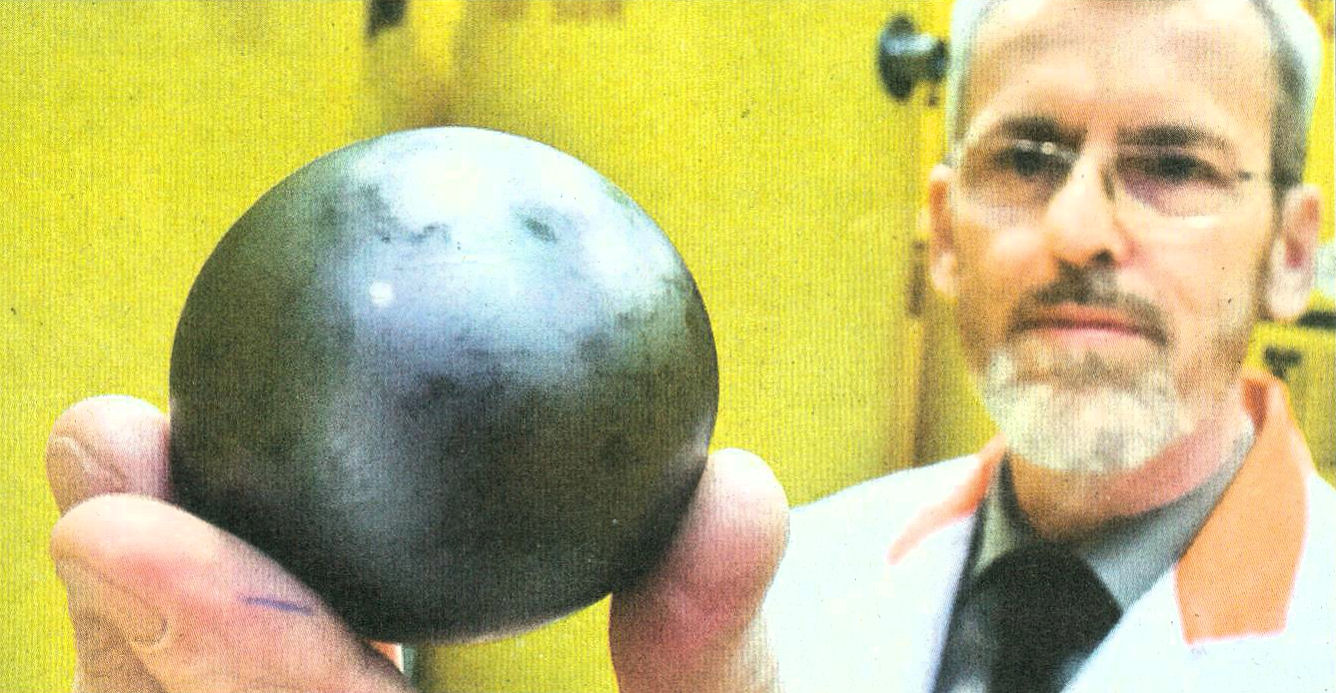
Dr. Printz of the Jülich Research Laboratory proudly presents
one of the "missing" graphite-thorium balls (DPA)
**

Saturday, April 9, 2011

Anything Goes

Nothing is impossible: Der Spiegel online used this Toyota slogan: Nichts ist unmöglich as a title of an article referring to newly possible color combinations in German politics. Remember the color coding of our political parties?

Nothing is impossible? Instead, the lyrics of an Ella Fitzgerald song come to my mind:

In olden days a glimpse of stocking
Was looked on as something shocking
Now heaven knows, anything goes.


With the Greens flying high in the sky (like Ol' Blue Eyes with his gal or chick), the other colors become pale or nearly vanish like the yellow-colored Liberals. Following their crushing defeat in the latest State elections, they choose as a first remedy a new party chairman, a doctor by profession, to cure them of anorexia.

At present, all political parties in Germany would like to get a bit of the anti-nuclear bonus the Green Party is profiting from. All in vain; if there were federal elections today, the Christian Democrats (black) would remain the strongest party, but they would be unable to form a government for the Liberals (yellow) would fall below 5% and thus no longer be presented in the Bundestag (parliament). 

And as the Greens will have more votes than the Social Democrats (red), Germany would likely have a green chancellor provided the Reds accept the rôle of a junior coalition partner for the Greens like in the State of Baden-Württemberg.

This may not happen, and with the yellows falling out of parliament, the blacks are looking for a "new" coalition junior partner, and suddenly anything goes. For them, the Greens have become honorable.

However, all this is just a snapshot, for the tide will change once Fukushima doesn't make it to the front page anymore and the Green-Red coalition in Stuttgart is showing symptoms of wear and tear.
*

Friday, April 1, 2011

Cold Fusion

The recent electoral success of the Greens will accelerate the phasing out of nuclear power in Germany. The search for new energy sources is being intensified. I should admit that Freiburg's population is stuck between a rock and a hard place. So far, opposition to wind energy plants is considerable, with one convincing argument being that the rotating blades may kill bats during their night flights. However, this is a trumped-up assertion, for the real reason is that nobody likes the technical asparagus on top of the Black Forest and certainly not in his/her backyard.

I read the other day that Dane County's manure digester is ready to provide electricity. This certainly works if there are enough cows or pigs to deliver the raw material. 


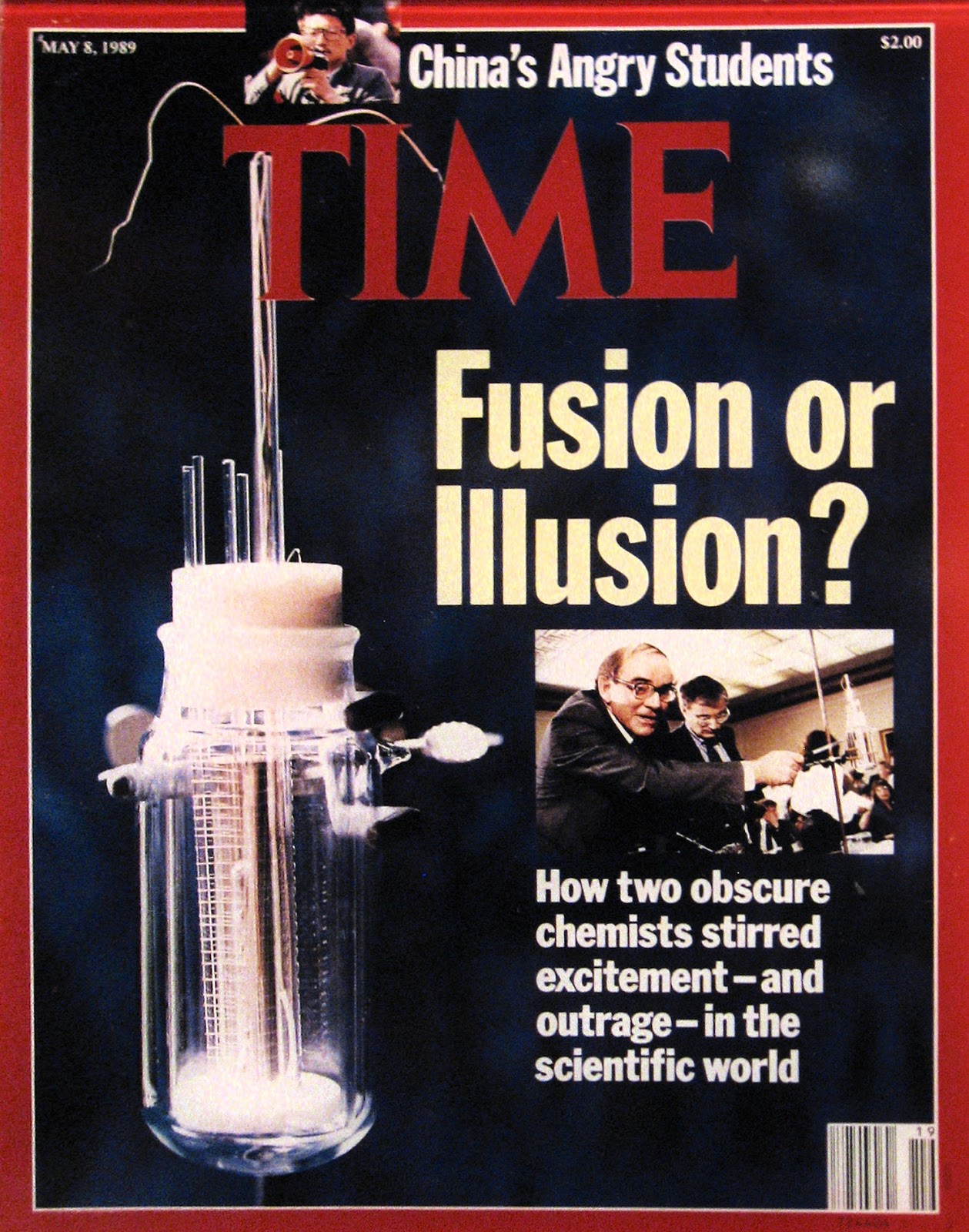
What does not work is Cold Fusion, a flaw that Dogbert has lately re-invented as an energy source.

TIME, the cover of May 8, 1989
I still remember. In the spring of '89, Carlo Rubbia (later Nobel Prize winner and my Director-General) caught me in a hallway at CERN, saying: "Look what Fleischman and Pons do in the States, and we are all sleeping here." I gulped and later provided him and other teams at CERN with neutron counters, so that my Group could hardly fulfill its radiation protection tasks at the Lab. 

Yes, even Cold Fusion, if it works, will create radiation! To make a long story short, a CERN spokesman said that "essentially all" attempts in Western Europe to reproduce the results had failed (Wikipedia). This means that Cold Fusion did not, and I add will not work.
**

Thursday, March 31, 2011

The Follow-up

Smudged election poster
Ministerpräsident (governor) Mappus got the nuke issue right in his face. Last Sunday, Fukushima in distant Japan decided the state elections in Baden-Württemberg with the Greens more than doubling their votes.

Distribution of seats in the state assembly. In percentage: Christian Democrats 39.0%,
Greens 24.2%, Social Democrats 23.1%, and Liberals 5.3%
Look at the new distribution of seats in Baden-Württemberg's state assembly. Not only did many base voters switch to green, but people who had never cast their votes in the past put their ballot paper into the box. The turnout of voters in 2011 was 66.2% compared to 53.4% in 2006. Note that the Liberals, with 5.3%, had nearly missed their entry into the legislature, a fate that happened to the right and left-wing parties, for they missed the minimum quorum of 5% of the votes necessary to be presented in the state assembly.

The intention of the Social Democrats had been to form a coalition with the Greens to oust the present black-yellow government. However, the Greens having more than doubled their seats and gained one more than the Reds, will form a green-red government with their leader becoming the new Ministerpräsident.

Suddenly the existing schedule for phasing out nuclear power in Germany in the coming years without jeopardizing our electrical supply is questioned. Even the past pro-nuke Liberals now try to jump on the "Abandon Nuclear" bandwagon. And there are those for whom Angst transforms into a panic when they demand: Stop all nuclear power stations now!

Will they still be satisfied when Germany has to import "nuclear" electricity from France with prices per kilowatt-hour going up? As long as the Japanese do not come to grips with their reactor disaster, the issue of nuclear power in Germany will overshadow all other problems.
*

Friday, March 25, 2011

Abwählen = recall?

If I understood correctly: it is possible to recall senators in Wisconsin before the end of their term by public vote. When you look at an election poster for next Sunday's state elections in Baden-Württemberg, you read the words: Jetzt abwählen (recall now), and you wonder. 

You can vote alright, but how to recall the Christian Democrats (Conservatives or black) + the Free Democrats (Liberals or yellow)?

What actually is meant is do not vote in Sunday's election for nuclear power. The issue is represented by the present coalition government of black and yellow here in the Ländle, but since Fukushima loaded with German Angst. 

While it is impossible to recall deputies in Germany, it is possible to refrain from voting for them in the upcoming election.
*

Sunday, March 20, 2011

Color Coding

During my recent visit to Madison, when speaking with protesters around the Capitol, some inquired about coalitions between various political parties in the Old World and how they function. Even the motherland of the one-party majority rule, the UK, is now governed by a coalition of Conservatives and Liberals in Parliament, with the Labor Party in opposition.

The situation is even more colorful in Germany since we have a whole "spectrum" of parties. The Christian Democrats (CDU with the usual 30 to 40% of the votes in elections) are our conservatives. However, people have recently become uneasy about the adjective Christian as some great leaders are divorced, and one has fathered an illegitimate child. 

The other Volkspartei, our GOP*, is the Social Democrats (SPD with 25 to 35% of the votes). They traditionally are the party of the working class. Recently, however, they renewed their pact with the industry that had worked so well under the Schröder administration. The SPD eventually understood that elections are won only when the party appeals to the middle class and follows the rule: thou shalt not kill the cow (industry) that gives the milk (jobs). Such an attitude, however, never pleased the traditional left-wingers. 
*Not ideologically but just what it literally means: the Sozialdemokratische Partei Deutschlands is our Great Old Party, founded in the 19th century and still exists. Due to Germany's industrialization in the 2nd Reich, the number of SPD voters increased steadily. Bismarck attempted to take the wind out of their sails by introducing old-age and health insurance for the working class. When, contrary to his plans, the rollback did not work, Bismarck had the Reichstag (parliament) pass the Socialist Act, which outlawed the Social Democrats. Later, the SPD was admitted again because Emperor Wilhelm II needed the Socialists' votes to pass the war budget in 1914. Following the lost war, the Social Democrats were the party whole-heartily supporting the Weimar Republic. It was the only political formation that voted in parliament against Hitler's Ermächtigungsgesetz (Enabling Act) that eventually assured absolute power to the Nazi regime. Additionally, today, the Social Democrats are one of the pillars of German democracy.

When the German Democratic Republic (GDR) was integrated into the Federal Republic of Germany in 1990, nostalgic Marxists in the East founded the Party of Democratic Socialism (PDS). The PDS, suffering great labor pains, eventually amalgamated with the extreme left of the Social Democrats in the West to form the Left Party (Die Linke), which garnered 5% of the votes in the West and 20% of the votes in the Eastern parts of Germany.

Returning to the party spectrum, the Christian Democrats are traditionally associated with the color black, as they originated from the Zentrum, the Catholic Party in the Weimar Republic. You guessed it: the Social Democrats wear red. Since there is no redder than red, the post-communist PDS is presented by magenta in pie charts. 

Green for the Green Party (10 to 20% of the votes) is obvious, and the Liberals (5 to 10%) are painted yellow. New parties have to take what is left over in the spectrum. The recently formed Pirate Party, which demanded free internet access for everyone in its program, chose orange.

Now, let us form coalitions. The hard part is to find a compromised common governmental platform allowing the survival of a whole legislature with a usual small majority in a coalition government against solid opposition. The easy part is the colors. In the past, traffic light (Ampel) coalitions of Red, Yellow, and Green were quite popular. 

When in some of our State governments (Länder), the Social Democrats are replaced by the Christian Democrats, a Jamaica coalition may form, which is my favorite only in terms of the combination of colors: Green, Yellow, and Black.

More common than three-party coalitions, two parties form a government, as seen in the Black-Yellow coalition, which is our present Federal Government in Berlin. The other proven working combination is Red-Green. There have been successful cases of Red-Black coalitions, too. These are called grand coalitions because of their large and comfortable parliamentary majorities for the two parties concerned. In such a combination, the Social Democrat Party generally is the junior partner and usually suffers a setback in the next election. On the other hand, an experiment of a Black-Green coalition in the State of Hamburg ended in an electoral disaster for the Christian Democrats.

If you have been wondering about some recent erratic reactions and decisions by our Federal government*, you should know that there are upcoming elections in three of our Federal States. Since their outcome is vital for the majority in our Senate (Bundesrat), the government avoids any unpopular decisions that could deter voters from choosing Black-Yellow.
*The hectic dealings with the minister of defense, Guttenberg's copy-and-paste thesis, the sudden about-face in support of nuclear power following the Fukushima disaster, and the negative vote in the UN Security Council about the Libyan no-fly zone

Today is Election Day in the State of Thuringia. Will there be a new edition of a grand coalition, or will we see the formation of a Red-Magenta government?

Next weekend, Germany is looking forward to a Super Sunday. I shall vote in the election for the State Parliament of Baden-Württemberg. At the same time, people elect their State parliament in the Land of Hessen. For the latter, it is practically sure that Hessen will be governed by a Red-Green coalition.

However, for my Ländle, the election result is a thriller: will the incumbent Black-Yellow government survive, or will a Green-Red coalition take over? You read correctly: Green-Red means that a green Ministerpräsident (Governor) would form a coalition State government for the first time in German history. Stay tuned for a possible political earthquake in Germany's South-West. 
**

Monday, March 14, 2011

Nuclear Power And No End?

In writing this, I do not mean electrical power from nuclear fission that will surely come to an end. Given the present catastrophe in Japan, I mean the renewed discussion in Germany on nuclear power. The apocalyptic scenario we watch with great sympathy for the Japanese people, in fact, furnishes no new arguments in the debate about the safety of nuclear power reactors.

The explosion (©AP)
Let me say this clearly: Present power reactors are safe as long as a team of incompetent technicians does not mess around with the cooling system (Three Mile Island), an overambitious engineer does not play with the control rods (Tchernobyl), or a magnitude 8.9 earthquake followed by a tsunami wave of 10 meters height does not hit a nuclear power plant. 

While the last scenario can be excluded in Germany, nobody is safe against human foolishness. This and the unresolved nuclear waste storage are the main reasons Germany has an established timetable for phasing out its nuclear power reactors. Let us face it: Presently, there is no alternative to "cheap" energy, as nuclear fusion is still only in the stars (in both senses).

The industry is propagating a new generation of power reactors that will be more compact and work at higher temperatures, hence being more efficient than those we presently operate. Do not believe the people telling you this new line of power reactors is safer than the old one. 

Due to the higher energy density and the higher neutron flux density inside the nuclear core, the materials used for the reactor vessels will rapidly become brittle and fail much earlier than in present-day reactors. Mother Nature presents us with marvelous elements that we melt into alloys, showing properties our ancestors only dreamt of. We have, however, approached the technological limit of stability of metal alloys as far as the combined influence of neutron bombardment and temperature is concerned.

So please, we want no new nuclear fission reactors and let the old existing ones eventually come to their well-deserved rest. 

What makes me nervous is that most people today are unaware that energy is too cheap. They moan if prices for petrol, gas, and electricity steadily increase. However, the increasing stress on their purses and wallets will hopefully trigger their consciousness of an economical use of our limited resources.
*

Monday, March 7, 2011

Fabulous Fred

With Wisconsin's 14 Democrat Senators having fled their State, Republican Governor Scott Walker's contested budget repair bill cannot be passed. The Republicans have a majority in Wisconsin's upper house alright, but the quorum is needed to pass a bill touching on financial matters. With the Democrat Senators absent, the upper chamber falls short of the number required by just one vote.

Among those 14 expatriated Democrats, Fred Risser is an outstanding person. Senator Risser has served Wisconsin for 55 years in the legislature and is the longest-serving state legislator in American political history. When in 2009, the Freiburg-Madison Gesellschaft had organized a trip to Madison, Senator Risser - then 81 years old - showed us his workplace place in the Capitol and explained the working of the two-chamber legislature on the State and Federal level. Nobody could foresee that this personality now "hides" in Illinois out of the range of Wisconsin troopers who received an order to "escort" at least one Democrat Senator back into Wisconsin's Senate Chamber.

State Senator Fred Risser, primary democratic rock, addresses us, visitors, at Madison's Capitol in 2009,
ending a tour of the building arranged by the Mayor's wife, Dianne, right to him.

This picture from a local newspaper shows Risser at the end of February 2011, together with State Senator Robert Rauch changing hotels in Illinois (frequently) to avoid harassment by Tea Party activists. Fred wears a red cap, but my American friends keep telling me this has no political significance.
*

Friday, February 25, 2011

Bannmeile

I follow with great interest the heated altercation in the State of Wisconsin over budget cuts that have led to a showdown between the governor and state employees. The day before yesterday, even Freiburg's local newspaper Badische Zeitung published an article about the social unrest in Madison.


Without judging the situation or commenting on the Wisconsin affair, two side issues have occupied my thoughts. There are subtle differences in how democracy is understood in the States and in Germany. 

I saw masses of protesters holding up panels with various slogans inside Madison's Capitol Building. It must have been physically challenging for senators to reach their chamber, not to mention the psychological effect such protesters certainly have on legislators.

Protesting crowds invading the building of a state parliament or the Bundestag in Berlin is unthinkable in Germany. While parliaments are in session, protesters are not allowed within a defined perimeter around the building so deputies can debate and vote undisturbed. 

The map taken from the German Wikipedia shows the perimeter around the Reichstag building in Berlin called Bannmeile. It is not called a kilometer but a mile, based on the distance measure used in various German territories before Germany's unification in 1871. 

The Second Reich adopted the (French) metric system so everyone would use the same measure for distance and weight, and introduced a common currency, the Reichsmark. 

The Bannmeile around the Reichstag is just a few hundred meters wide, not even a mile. Inside the perimeter, you find buildings that also house committee meeting rooms. The Bannmeile is valid only during scheduled sessions of the Bundestag.

In Germany, protests are frequent and taken seriously. In principle, authorities must be informed before and authorize the protest. Nevertheless, you find authorized and unauthorized protesters everywhere. Sometimes I think some participants are professionals traveling from protest to protest all over Germany. Official protests are even protected by the police against anti-protesters. 

There is a continuous protest in Freiburg each first Monday of the month against Hartz IV, a bundle of social laws that the Schröder government passed long ago. It is heart-warming to watch the lonely policeman walking along the marching half-dozen people until they settle on Freiburg's Rathausplatz, again only allowed when our city parliament is not in session.

The other minor difference between our democracies is that, apparently, in the States, deputies can be forced to be present for voting. In Germany, deputies simply walk out of their respective parliaments unhindered until the quorum is no longer reached. 

In the States, Wisconsin senators unwilling to vote on the budget crossed the State boundary to be safe against intervention by whom? Does the governor (?) call in the State troopers (?) to take senators who have left the chamber back to their workplace, hand-cuffed? That is what I would call a forced democracy. I would like to learn more about these procedures when I am in Madison next week.
**

Saturday, February 19, 2011

A Monument for Apo


When reading the other day in my favorite newspaper the headline: A monument for "Apo," I was somewhat disturbed. Apo, this is what my grandchildren call me, not Opa, being the standard form for grandpa in German. When my oldest grandson started to speak, he used Apo instead of Opa, so the younger grandchildren adopted Apo as well. Elisabeth is called in an even kinder way Ami (French for a friend) instead of Omi or Oma. Our odd names help to distinguish us from the other grandparents.

What about the monument? Reading the article, it turned out that people from a community outside Freiburg had erected a statue for their defunct pharmacist (in German Apotheker) called Apo, who had rendered outstanding services to local clubs and societies.

Just to tell you, I am still alive!
*

Sunday, February 13, 2011

Baden's Blessed Bernhard

Beautiful statue of Bernhard,
the Christian warrior.


Today in the Sunday Newspaper, I read an article about the blessed Bernhard of Baden and how all attempts to canonize him have so far failed. Having studied regional history for nearly a decade, I was shocked that I had not read about him earlier.

Margrave Bernhard lived from 1428 until 1458, when he died from the plague in Moncalieri, Italy. Little is known about Bernhard, and is this scanty information worthy of a saint? Like all rulers of earlier and later times, he sought glory through war. So, in 1453, Bernhard led a group of mercenaries to Italy to conquer Naples for his uncle René of Anjou.

But mind you, there are just and unjust wars depending on which side you are looking at. What makes Bernhard worthy in the eyes of the Church is his call for a crusade against the Turks, who had taken Constantinople in 1453. They called the city Istanbul, which, according to a 70s song, is nobody's business but the Turks'. 

What helps in Bernhard's canonization process is that this crusade, with all its atrocities, never took place, so the Battle of Varna in 1444 is considered the last crusade.

Now, Freiburg's archbishop Robert Zollitsch is making another attempt to convince the Congregation for the Causes of Saints of Bernhard's holiness. 

**

Friday, February 11, 2011

Manfred


The other day I visited the Hohenstaufen Exhibition at Mannheim. Time was too short to see all the exciting exhibits, but one name, my own, fascinated me.


King Manfred's coat of arms
Manfred, King of Sicily and son of Emperor Frederick II. What a consolation! Although he never became German Emperor, I finally found a decent man carrying my name. What else do we have?

I don't have a Saint, just the Blessed Manfred of Rive commemorated on January 28.

Then there is the famous physicist Manfred von Ardenne who changed his socks from brown to red and still managed to lead a luxurious and happy life.

Manfred, the Symphony in B minor, Op. 58, composed by Pyotr Ilyich Tchaikovsky, treats Manfred's incest with his step-sister, which is irrelevant since I do not have a sister.

Remains Manfred von Richthofen, the Prussian junker, racist, arrogant, flying an airplane in the First World War painted in red, daredevil par excellence. This guy, at least, was so prominent that he carried several nicknames: The Red Baron, The Red Battle Flyer, Red Devil, Le Diable Rouge, Le petit Rouge, and the Red Knight. As the title of his memoirs of 1917, von Richthofen used the name The Red Fighter Pilot.
*

Tuesday, February 1, 2011

Groundhog Day in Freiburg?

This morning on the title page of the Badische Zeitung, I read the word Murmeltiertag and wondered if, in addition to Halloween, we had imported Groundhog Day from the States.

Here in Freiburg, we have no proper zoo, but a farm transformed into a vivarium where children and adults can observe domestic and some exotic animals in a natural environment. No groundhogs live there. So what can we do? The chief keeper was interviewed and answered that Freiburg’s groundhogs are water turtles. If they come out and stay for a week, then the frosty period is over. Presently, their pond is frozen; spring is still far away.


In Geneva, it is not an animal but the chestnut tree de la Treille that, with its first leaf, will announce: Spring is icumen in.

Let us agree: any sign will be good. We are all waiting for Spring!
**

Friday, January 14, 2011

10 Years Wikipedia

Tomorrow, on 15 January 2011, the internet encyclopedia Wikipedia celebrates its 10th anniversary. Time goes fast.
  
Unique Freiburg Logo (source Badische Zeitung)
Looking back, I discovered that I wrote my first article about Karl von Rotteck, the liberal Professor from Freiburg, as early as 6 March 2004. Since then, I have documented my major activities on Wikipedia on my personal Wiki page without mentioning my work of correcting mistakes or improving the stylistic nightmares of fellow authors.

Here in Freiburg, we cultivate a monthly Stammtisch. For me, the old guy, it is refreshing to learn all the tricks they know by heart from those younger colleagues. As an added bonus, the discussions at the Stammtisch keep me abreast of new developments in the computer world.

We had invited the local press earlier. Today, the relatively generous article about 10 years of Wikipedia, written by local correspondent Gerhard M. Kirk, appeared in the Badische Zeitung: To be fast, you must take your time. Tomorrow, a more general article will remind the Wikipedia user community about the anniversary.
**
Tuesday, December 28, 2010

Wurst War

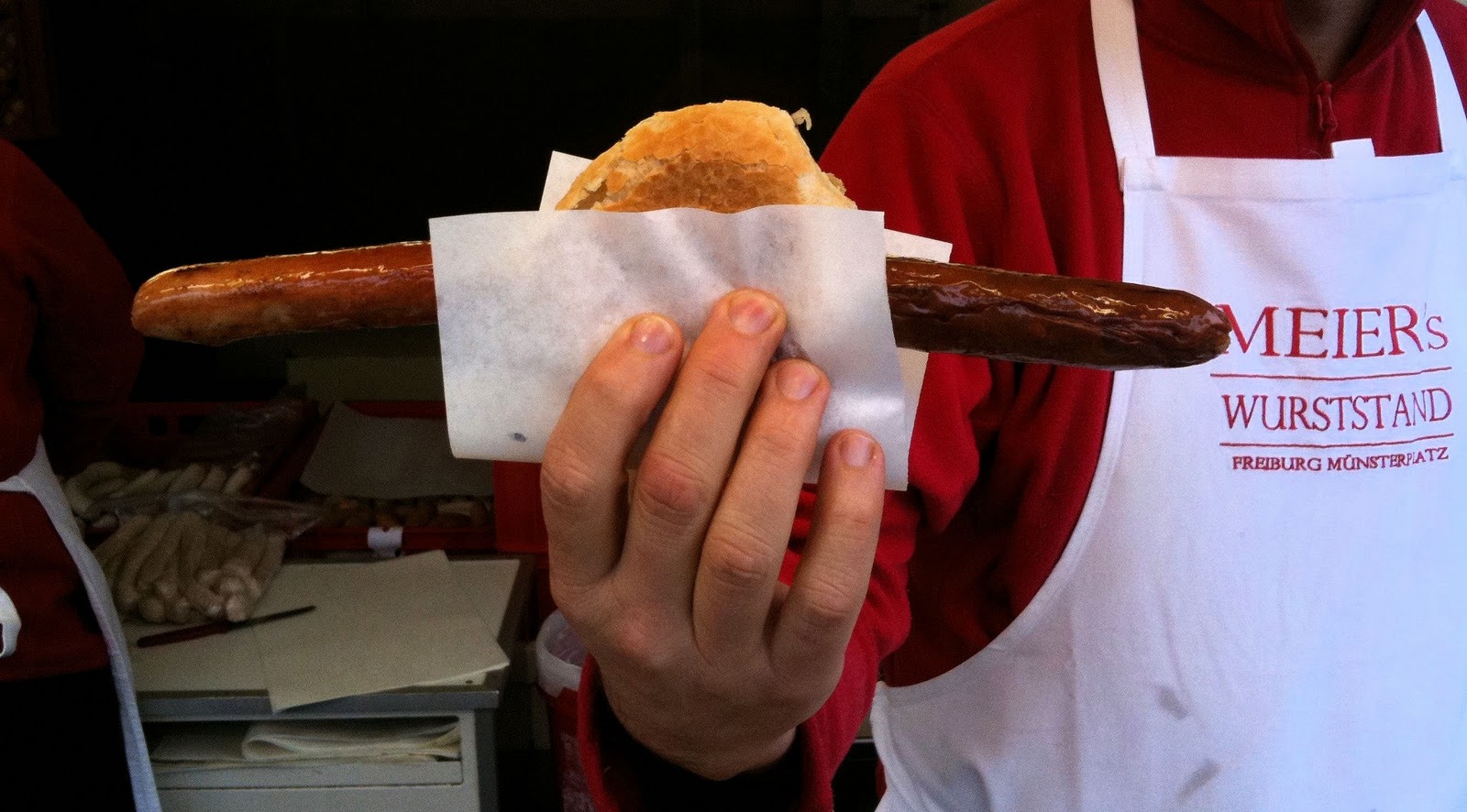
In Freiburg's Münster market, six licensed vendors traditionally sell grilled bratwurst to natives and tourists alike at their stands. The Freiburger Long Red (wurst), served with slightly stewed onions in a bun, is my favorite, but you can also opt for a Polnische (is this the same as a Krakauer?), a Krainer with or without cheese, and a Thüringer. There is a wurst made from veal and cholesterol-poor turkey. An orderly market order dictates that the order of the stands in the Münster market rotates daily such that each vendor, in turn, is first in line.

Mr. Meier, at his Wurststand, proudly holds up Freiburg's Rote in a Brötchen for an iPhone photo shoot. Note the brin of an onion looking out on top of the bun. 
Presently, there is some agitation among those traditional vendors as - l'Union Européenne oblige - the precious licenses must be newly tendered Europe-wide! Imagine some Turks disguised as Greeks selling döner wurst! A scandal? But if it's good, why not? But do not be afraid: the inventive German talent does not sleep, wenn es um die Wurst geht (when dealing with wurst). In a letter to the editor, a tofu producer from Freiburg is seeking to establish a tofu business, with the condition that one of the future six licensees must also sell veggie wurst.

Mind you. The idea of vegetarian meat ersatz has been introduced previously. In the Vegetarian Journal, you can already read as early as 2000: Veggie burgers and dogs are generally lower in calories and fat than hamburgers and hot dogs. Even extra-lean ground beef gets more than half its calories from fat; most veggie burgers have less than 20% of calories from fat. Meat has no fiber; most veggie burgers have at least 3 or 4 grams of dietary fiber per serving. While veggie burgers have little or no cholesterol, a 3.5-ounce hamburger with extra-lean ground beef has 90 milligrams of cholesterol. Veggie burgers, especially those made with soy, contain generous amounts of protein and iron. Vitamin B-12 is added to some veggie burgers. The only negative for veggie burgers is that most are higher in sodium than ground beef.

I don't know about the quality of veggie burgers in the States, but the ones I've tasted in Germany were awful. Perhaps, unlike in the States, the ones sold here contain less salt. That indeed makes them 120% healthy food, but uneatable too.

Veggie dogs are also lower in calories, fat, and cholesterol than hot dogs. Some veggie dogs have more protein and iron and less sodium than hot dogs. Both hot dogs and veggie dogs contain little or no fiber. So what will a roasted tofu wurst served at a vegetarian booth here in Freiburg contain?

In the States, they already sell the Veggie or the somewhat speedier Leaner Wiener, the Meatless Frank (the poor guy), the VegiDog, and the slightly hotter Veggie Chili Dog. Take a Tofu Pup when you don't like adults served (a Wiener and Frank). There is a SoyBoy Not Dog on the market for all those cat lovers. 

Since none of this is roasted, what happens when you grill a tofu wurst? We may find out on World Veggie Day, October 1st, 2011.


I wish you all a Happy New Year!
**

Tuesday, December 21, 2010

Winter is icumen in

Winter is icumen in,
Lhude sing Goddamm,
Raineth drop and staineth slop,
And how the wind doth ram!
Sing Goddamm.

... wrote poet Ezra Pound once in a persiflage of the well-known poem from the middle of the 13th century:

Sumer is icumen in,
Lhude sing cuccu!

Pound's appreciation is too rough. Also, winter has its charms. My friend and English mentor Jim took this amazing photo on December 1st, 2010. Fresh snow had just powdered streets, roofs, and trees.

The photo shows Oberlinden, a square in Freiburg you cross when you enter
the city through the Schwabentor (the gate opening to Swabia).
Note the linden tree in the middle decorated with Herrnhut Stars.
In the back, you sense the steeple of Freiburg's Münster Church
Herrnhut Stars became fashionable in Freiburg last year. I bought one for my balcony and took a photo last year. For those who haven't yet seen one up close, here is my photo:

It's twilight time. You can make out the Black Forest trees in the background.
 The illuminated windows mark study rooms
for the students of the Max-Planck Institute of International Law. 
Meanwhile, last week's snow has completely disappeared. Freiburg is likely to be the only major city in Germany without a white Christmas.

I wish you all a peaceful Christmas!
**

Monday, December 20, 2010

The Lost Cause

Today, the Thema des Tages (The Topic of the Day) in the Badische Zeitung commemorated the 150th anniversary of South Carolina's secession from the Union. When the resulting Civil War between the Yankees and the Rebels ended, bemoaning more than 600.000 dead, many a man in the South instead moaned about the Lost Cause. So far, so bad, but then the author, in his article about the Civil War, managed to smuggle in the German "Dolchstoßlegende" (stab-in-the-back legend) and the claim that "Not all was bad (in the Third Reich).

Eventually, the author regarded the feelings of those Americans in the Deep South as something in between.

Propaganda drawing from 1860? Black Union army men under the command
of a white officer are attacking the Confederates.
Notice the couple below on the left-hand side fighting to the finish:
Is this a stab in the back?
I shake my head! The Dolchstoßlegende, born after the lost First World War, claimed that it was the home front and socialist Jews who had not supported the German fighting men in those trenches in Flanders. They virtually stabbed them in their backs. It was one of those brainwashings of the people by the right-wingers and later by the Nazis.

However, during the Civil War, the conspiracy theory accused Southern generals of treason.


Germans remember it well! Philipp Scheidemann, who had proclaimed the German Republic, has a dagger in his hand, while Matthias Erzberger, a catholic Jew of the Zentrum Party, is watching. In the background, wealthy Jews sit on their gold and count their paper money.

Whether in the South it was not all bad before the Confederate States were forced back into the Union, I cannot judge, but all was bad as far as the Nazi regime is concerned! The Nazis started with total domination of the people, changed to a total war, and ended in total defeat.

Here's a lesson: Be cautious when comparing historical processes and events.
**

Friday, December 17, 2010

Mark or Franc that is no question

My son found the following cartoon on the internet:

This only reinforces my remark made in the blog below. Don't bail out of the Euro to reintroduce the Deutsche Mark, but don't buy Swiss Francs either.

Our chancellor has the perspective: If you can't beat them, join them.
**

Sunday, December 12, 2010

The Freiburg Gipfel

Ouff, the Franco-German Gipfel (summit) in Freiburg between Nicolas Sarkozy and Angela Merkel is history. Last Friday, the town came to a standstill. From 8h30 to 17h30, no streetcars in the city. Backpack-loving Freiburgers passing through had their Rucksacks checked several times by security forces.
  

Without comment
A hundred-strong police unit kept some demonstrators disguised as clowns encircled. As they polluted the air with terrible sounds, one officer confiscated a small drum, but, being a perfect German official, handed the drummer a receipt.

When a bystander criticized the expense of such summits, I answered, One day in Afghanistan costs more than ten Gipfels."

Let Angela and Nicolas be guided by the Archbishop in person, visit the Münster church, sign Freiburg's Golden Book - with our Lord Mayor watching from behind -, and let them eat a free lunch (?) specially composed by the one-star cook in town; all this doesn't disturb me if it helps French-German friendship.

However, it annoys me when those two leaders pretend to protect the euro.

Spraying Sarkozy. A French guy splashes his President with a water gun.
The clustered security force reacted much too late but arrested the man.
Addressing the demand from Luxembourg, Italy, Spain, and Greece to issue euro bonds, Merkel said, "We cannot allow mutualizing the (financial) risks." Nicolas paid her lip service by adding, "I don't see how far Germany would be selfish. Germany is the biggest (financial) contributor to the European Union."

Greece and Ireland, for years indeed, lived on credit, striving beyond their financial possibilities. They now must pay more for bonds on the international market than Germany to refinance their debts. But since we have a common currency, the old German proverb holds: Mitgefangen, mitgehangen (Captured together, hung together).

In fact, Euro bonds will be only a small remedy to cure the imbalance between rich and poor European countries. These bonds present a lesser evil for Germany than a Länderfinanzausgleich (balancing budgets between different countries). The latter is practiced in the Federal Republic between various States. From time to time, this compensation creates fury in those Länder that always have to pay to the States that, according to the givers, don't do their financial homework correctly. I agree that such a European system will require a more united community than countries bound together by a common currency.

By stirring up public opinion in Germany against euro bonds, opponents deprive the man in the street of higher interest rates on his money. With those, he could compensate for inflation. Meanwhile, people who lack confidence in either the euro or the dollar buy gold, although it has become so expensive that some have started converting their money into Swiss francs.
**

Monday, November 29, 2010

Baubürgermeister

Yesterday a friend from Madison sent me an article by Barry Gore: Madison needs a professional City Council, asking me at the same time whether the Freiburg model of city government may not serve Madison.

I understood that Madison is run from the Mayor’s Office by experts and twenty aldermen/elderwomen on a city council, paid US$ 7,545 per annum to cover their expenses.

In a first approximation, Freiburg’s administration structure is similar. The city has a Lord Mayor and a city council with 48 members elected by the people representing the usual German party spectrum. All council members are working on an honorary basis with their expenses covered.

Madison and Freiburg differ in that we have four additional mayors, each heading a Dezernat (department). The city council elects these mayors, so they mirror the party composition of the latter but are expected to be experts in their departments. Like the Lord Mayor, the four mayors are fully paid.

The Lord Mayor’s office handles general organization, administration, personnel matters, law, and public relations (partner cities). One of the mayors deals with the economy, finance, housing, sports, and public order (police). Another cares about the environment, forests, schools, and waste. The third is responsible for social affairs, culture, youth, and integration. The fourth mayor runs the building departments and annexed activities.

These four mayors and their departments cost a lot of money. So a few years ago, the city council decided that Freiburg could do with only three additional mayors. Without going into detail, the decision to oust the mayor responsible for building and to dissolve the Baudezernat was based on the issue of competence and economy.

This year the city council eventually came back on its decision. Despite city finances running low, the council reinstalled the fourth mayor, the Baubürgermeister. The official reason was the excess work for the previous three mayors and their departments.

Freiburg's new Baubürgermeister Professor Dr. Martin Haag (©Thomas Kunz/BZ)
In the northern part of Germany, we say: Rut us de Kartüveln, rin in de Kartüveln, or if you understand what I mean, is it better to say: Out of the cotton field, back into the cotton field?

Considering the outcome of the recent elections in the States, how do Americans feel about more administration, even on a level as modest as a city?
**

Wednesday, November 24, 2010

Functional Illiterates?

The other day I read an article in the Washington Post on the issue of the ever-increasing public expense. A Republican-minded citizen complained in a letter to the editor: Not just the armed forces, every Federal agency and appropriation is handled in this way. Even schools. They can whine and complain all they want about "cuts," but school budgets increase every year, and they turn out functional illiterates. We are a land where failure is richly rewarded, and productivity is criminally penalized. Is it no wonder that we're in a fix we're in?

Far from judging the issue of public spending in the States and the resulting consequences, the last part about schools producing functional illiterates electrified me.

Sprachkompetenz? (©yirsh)
In Germany, we are not better off. The magic word here is mangelnde Sprachkompetenz (insufficient command of spoken and written German). The young generation clearly lacks competence in two of the three Rs (reading, writing, and arithmetic). 

So school bashing is typical but aren't we beating the wrong donkey? I see kids, including my oldest grandson, spending time with audiovisual gadgets instead of books. As we say: Von nichts kommt nichts (Nothing will come out of nothing).

In the long run, the saddest aspect of this development is the loss of Sprachreichtum. Who can express his ideas clearly and with the subtlety of a rich vocabulary? Even more so, who will understand all those funny words and expressions grandparents still use in future years?

Old man = pessimist? Perhaps, but this topic unsettles me and is always on my mind.
*

Sunday, November 21, 2010

Liebermann

No, I am not writing about the American politician Joe Lieberman spelled with one n but about Max Liebermann with a double n.

As usual, when in Berlin, I visit places with historical relevance. One place that I had never seen before is the infamous Villa on the Wannsee, where in 1942, Himmler's right-hand-man Heydrich held a Konferenz (meeting) to co-ordinate the Endlösung (final solution) for Europe's Jews. The place is way out of the city. You first take the S-Bahn to Wannsee Station and then ride the 155 Bus to the Villa on the Wannsee. The bus runs every twenty minutes, and while studying the timetable, I read Liebermann Villa marked as a stop. I spontaneously decided to visit that place too.

The Villa of the Wannseekonferenz became a memorial center only in 1992, following a long fight about financing. It now houses an exhibition documenting how the Nazi regime, once in power, had systematically transformed the latent anti-Semitism in Germany and elsewhere in Europe into a campaign of annihilation. In presenting the Jews as the scapegoat for Germany's misery (Die Juden sind unser Unglück), six million were hanged, shot, and gassed.

Entrance to the exhibition is free, but the main iron gate to the surrounding park is locked and only opens after the girl at the counter has considered the televised visitor acceptable. On this gray November morning, the visitors comprised a few old guys, but primarily pupils. Their teacher had formed groups of two and attributed them to the various rooms. Now she ran from team to team, giving instructions on how the kids had to do Vergangenheitsbewältigung. i.e., come to terms with the past of their great-grandfathers.

What would you expect? There was shouting, running around, tussling, and even laughing. After an hour of distraction from the kids' behavior and feeling depressed by the exhibition, I had enough. I stepped out into the park and walked back two bus stops to Liebermann's villa on Lake Wannsee too.


Max Liebermann (1847-1935), a Jewish-German painter born into a wealthy family, built the house in 1909. He lived there during the summer months from 1914 to the end of his life. Liebermann is regarded as the father of German impressionism and, while in Berlin, became famous as the painter of portraits.

What Liebermann saw from his studio on Pariser Platz in January 1933. 
The new US embassy is just located across
During his life, Liebermann always held strong opinions on art and politics. While watching the Nazis' brown hordes torches lit celebrating their victory in marching through the Brandenburg Gate on January 30th, 1933, Liebermann is reported to have commented in his typical Berlin dialect: Ick kann jar nich soville fressen, wie ick kotzen möchte (I can't eat as much as I would like to vomit). The old man is one of my heroes!

Max standing in front of his Villa.
Liebermann, who had become president of the Prussian Academy of Arts in 1920. and a Berlin honorary citizen in 1927, resigned from his post in 1933, just in time before the Nazis ousted him.

Reading in his living room.
Flowers in Liebermann's garden. In the back, his Castle on the Lake
After he died in 1935, the new rulers forced his widow, Martha, 1940 to sell the house to the Reichspost. Max had called the place his Castle on the Lake, which he had loved so much, always looking for corners with flowers for his paintings. Martha committed suicide in 1943, just ahead of her deportation to Theresienstadt.
*

Saturday, November 20, 2010

Pounds into Dollars

On my way to Berlin, riding the ICE again, digesting the previously described pot of coffee and Butterkuchen, and reading the freely offered newspaper Frankfurter Allgemeine I came across an article about early stereotypy. In this process, pictures are transferred to metal plates that are subsequently used for printing.

Already in 1729, Benjamin Franklin had pleaded to increase the amount of money circulating in the colonies to fight consumer abstinence. Today the reason obviously is the consumer's indebtedness; in those days, the Brits apparently were the culprits prohibiting silver export from their colonies. Printing paper money: Franklin an early Bernanke?

©FAZ
In fact, Benjamin started printing pound notes together with D. Hall as early as 1760. To avoid counterfeiting, the paper money had to be forgery-proof. Technically minded, Franklin used stereotypy. Note the fine structures of those leaves on the 5-pound/100-shilling denomination. Printed in red: To Counterfeit is DEATH. Those good old times!

©FAZ
In 1776 one year after the War of Independence had broken out, the dollar had replaced the pound in the thirteen colonies and - note the intertwined rings - bound together in Olympic competition? The dollar was then divided into six parts. British heritage?

©FAZ
Already in 1778, Hall & Sellers printed a 50-dollar note as an early sign of inflation? Again the fine structure of stereotypy made forgery of the paper money difficult.
*

Sunday, November 14, 2010

Thank you, Google, thanks!

Presently Google is under attack in Germany because many people don't like to see their houses in street view. Public pressure was so high that Google agreed to pixel those protested pictures on request. 

Some house owners probably were ashamed and possibly feared fellow citizens, eventually becoming aware of how badly front gardens and faces were kept when zooming their objects more closely on the web.

But here I have come not to bury Google but to praise them. I was preparing a talk about the Revolution in Baden in 1848/49 to be given here in Freiburg, and I was browsing the web for original information on Friedrich Hecker and Gustav Struve. Both are among those who had actively fought in Baden for the German Republic as early as the middle of the 19th century. And there I suddenly found two books written by these very persons while they were in Switzerland, the country just across the border where they had initially fled to before emigrating to the States. The two books published in Switzerland are:

Dr. Fr. Hecker: Die Erhebung des Volkes in Baden für die deutsche Republik im Frühjahr 1848, Druck von J. C. Schadelitz, Basel 1849 (Bayerische Staatsbibliothek München) and

Gustav Struve: Geschichte der drei Volkserhebungen in Baden, Verlag von Jenni, Sohn, Bern 1849 (Bayerische Staatsbibliothek München).

These publications are available on Google books in facsimile as PDF files and as text in the epub format. The originals scanned were taken from the Bavarian State Library in Munich. I enjoy reading their Gothic print on my iPad and admire all the graffiti readers have left over the years on those pages as an extra bonus. In the app GoodReader, I can mark paragraphs for future reference, but I take refuge in the processed text for copy and paste. It is not easy to recognize Gothic printed characters correctly, but the people at Google did a marvelous job, although you get the rough text without any corrections. 

Wikipedia has a similar project making old texts publicly available on the web called Wikisource. All texts must have been proofread three times before they are accepted.

The web is full of treasures. Let us find and use them.
*

Monday, November 1, 2010

Chilling Schill

Ferdinand Batista von Schill
The other day, I read that blond, blue-eyed, and naïf Siegfried is the last German hero. Indeed, these spoilers are depriving us of all the others.

What about Arminius, the guy who, in beating the invading Romans, deprived the German people of civilization? As historians found out, Herman, the Cheruscian, was a traitor and troublemaker within his own family.

Barbarossa was a power-hungry ruler without scruples. He lost a war against the pope and died a silly death, drowning on a crusade in a brooklet in Asia Minor (today Turkey), as Umberto Eco writes in his novel Baudolino.

Already, Heine had knocked Martin Luther from his pedestal, describing him as the typical German, a tag sufficient to drag a person down.

And now, in his book: Die Zeit der schweren Not Günter de Bruyn demounts Ferdinand Baptista von Schill, the man the people of his time hailed as a freedom fighter against Napoleon's tyranny. They mentioned him in the same breath as Ludwig Adolf Wilhelm von Lützow and Theodor Körner. For de Bruyn Schill, the 2nd Brandenburg Hussar Regiment commander is an uneducated, silly imposter. However, as a guerrilla, he had such success against the occupying forces that his picture, frosted in red on cakes, was admired in Berlin coffee houses.

Aristocratic ladies considered it a grace to touch his saber. Mind you, Emmanuel Geibel, in his poem Schill, had already described the hero as a man who rode faster than his time, i.e., seeking glory at a time when the resistance of small military units against Napoleon's main forces was simply madness.

On April 28, 1808, Schill left Berlin with his regiment without authorization. Once outside the city boundaries, he talked to his men, leaving the impression that he had an order from the all-admired and beloved Queen Luise, Prussia's Jeanne d'Arc. Later, Schill simply ignored the King's order to return to his home base. Instead, he marched to Dessau on the river Elbe, took the city on May 2, and published his proclamation: An die Deutschen (to all Germans).

Schill's Memorial Stone in the pavement on Fährstraße
Napoleon's youngest brother, Jérôme, King of Westphalia, put 10,000 francs on Schill's head and sent Danish and Dutch reserve troops, commanded by Generals Ewald and Gratien, respectively, to pursue the resistance fighter. Schill escaped to the north and entered the city of Stralsund, hailed by its Mecklenburg-Polish garrison. 

By then, Schill's troops, reinforced by recruiting, comprised up to 3000 men, but the fight for Stralsund against an overwhelming enemy approaching the city was lost from the beginning. Against all warnings, Schill was determined to hold out and said: Better an end with terror than terror without an end, an idea drawn from Psalm 73,19: How they are destroyed in a moment, swept away utterly by terrors!

Stalingrad anticipated: On May 31,  Napoleon's troops assaulted the city. Schill fell unnoticed and died his heroic death on Fährstraße. With him, he took many a man. It is a crazy and sad story.
**