Friday, July 22, 2011

Göthe

While Dante Alighieri is Italy's national poet and William Shakespeare is England'sJohann Wolfgang von Goethe is recognized as such in my country. He was not only a poet but one of the last universally educated geniuses of the German tongue. 

There is not one place in Germany without a street or square named after him. In Freiburg, many regard Goethestraße as the most beautiful alley in town, dating back to the early 20th century. Beautifully decorated houses built in a variety of historical styles line the street.

 This is not true for Munich's Goethestraße, which runs off the central train station, where red-light premises compete with cheap electronics stores. It was there that it happened. Road construction work around the station called for a detour signaled by panels showing Göthestraße instead of Goethestraße, which was an obvious mistake. A mistake? Hey, not so fast.

Our national poet was born in Frankfurt on 28 August 1749 as the son of Johann Caspar Göthe. As a young man, Johann Wolfgang changed his name to Goethe, in his father's eyes a misdeed; his father never pardoned his son. 

The reason for Goethe's change has yet to be discovered. As a young man, did he already think of his international renown? Mind you, umlauts are rarely found in other languages, unless it's Turkish or Hungarian. By the way, the Turks are called Törökök in Hungarian. Those Hungarians not only overdo it concerning the frequency of their "ös." In addition to the short "ö" carrying two dots, they also know the long "ő" taking two strokes.

The American keyboards I used during work and later on the Internet forced me to change my name from Höfert to Hoefert. 

Working in the UK, my brother was so annoyed with the umlaut that he dropped the "tüttels" altogether. Maybe he did the right thing because when changing from "ö" to "oe," I suffered from my Dutch colleagues' pronunciation of my name. In their language, the "oe" stands for the phoneme "u." 

Did Goethe consider this fact when he changed from "ö" to "oe"? Did he want the Dutch to call him de oude Goede, i.e., the old Good one?
**

Wednesday, July 13, 2011

Uta of Naumburg

Two sculptures in two German cathedrals are regarded as being very Teutonic: the Bamberg Horseman and Uta of Naumburg. In my reader, in primary school, their two pictures were shown together and described as the epitome of the German man and the German woman.


After the war, Bamberg was situated in the West, whereas Naumburg was in the East. The two pieces of sculpture were separated, becoming one of the many reminders that Germans were divided politically but not in their hearts.

With Germany's reunification in 1990, the Rider and Uta have united again. I last visited Uta, regarded as one of the most important works of German Gothic art, in 2003. On that occasion, I read a text written in 1928 by Gertrud Bäumer, a well-known German feminist and not considered to display an excessive Germanness: Uta derives from a relationship with the German woods, with long brutal winters full of loneliness and horror in the dark, long waiting and longing, spring tempest over melting snow, hard and harsh but soaked with inner balminess. Don't worry; the German text is as incomprehensible as my English translation.


The other day, I read in the German weekly Die Zeit about an exhibition called The Naumburg Master - Sculptor and Architect in the Europe of Cathedrals. The article showing Uta's picture was headed Très Deutsch, and indeed, I expected the old story that this woman is very German. The French "très" should, however, have warned me, for the article revealed the crushing news that the creator of this German Gothic masterpiece was possibly French!

The whole story I found on the Naumburg Exhibition website: The sculptors and stonemasons associated with the name "Naumburg Master "had an outstanding reputation throughout medieval Europe. From the 1220s on, German masters trained in the sculpture workshops of the Northern French cathedrals situated in Île de France, Champagne, and Picardie. Their journey to Germany took them across the borders of the French kingdom via Mainz to Naumburg and Meissen. Their legacy is a body of work that is of outstanding quality and worldwide importance. The sculptures of the west rood screen in Mainz Cathedral, the relief depicting the sharing of St. Martin's coat in Bassenheim, the tomb slab of the Ritter von Hagen in Merseburg Cathedral, the statues in the choir and the octagon chapel of Meissen Cathedral and above all the unique west choir of Naumburg Cathedral with the Passion reliefs of the rood screen and the statues of the founders (Uta!) are impressive examples of the outstanding quality of workmanship from these medieval masters.

When looking at the Strasburg Cathedral, Goethe once admired the Gothic style as native German, but he was severely mistaken. Gothic architecture was born in France; it spread across the Rhine River and subsequently throughout Europe. In the beginning, German stonemasons educated in the Romanesque style tried to imitate the new French style. The result is still evident at Freiburg's Münster church. Not until they called in the masters from the other side of the Rhine did the construction of the windows get the lightness of style so admired at the Reims cathedral.

The stonemasons at Freiburg's Münster worked from right to left,
starting with heavy German Gothic for their windows.
When the French specialists took over,  the tracery in their windows became more refined.
That Gothic means France is emphasized in the continued text on the exhibition's website: During the first half of the 13th century, Reims Cathedral, which hosted the coronation of many French kings, became the focus of German building work increasingly, until it was eclipsed, in the middle of the century, by architectural activities in generating the metropolis of Paris. The adoption of designs and sculptural ideas from France was certainly not only due to a general fascination with the French cathedral creation, which eclipsed all previous architecture, but also to the high esteem in which the sacrally distinguished French royalty was held.

So eventually, it's European. The Naumburg Exhibition, in fact, is under the joint patronage of our Chancellor and France's President.

©Wikipedia/Berthold Wener
What about the Bamberg Horseman? I am sure that next year some experts will come up with the story that the guy and his horse were sculptured by an Italian.
**

Saturday, July 9, 2011

Wagenburglers

The name Vauban melts in the mouths of many of my friends in Madison. When they arrive in Freiburg these days on an ICE (LOL) from Frankfurt Airport soaked because the air conditioning on the train is broken* they cannot wait to visit the greenest quarter of our Green City. It is easy to get there. 
*This is the contribution of our Federal Railway to fight climatic change

Just walk south on the platform, avoid taking the escalator to the bridge's deck spanning the central station's track field - since you are already soaked anyway - but rather climb those 40 steps at a temperature of 30 degrees centigrade (86 Fahrenheit). Then mount a red (!), not green (!) marked streetcar named Vauban. It will take you to the entry of Vauban in just 15 minutes.

Stepping off streetcar number 3 at Paula-Modersohn-Platz.
When stepping off the streetcar at Paula-Modersohn-Platz, you may suffer a cultural shock: the gate to Vauban looks like a fort protecting a couple of wagons. This is the home of the Wagenburglers (people living in a wagon fort?). They live in their densely parked or instead packed camping cars and old buses on a lot that eventually will be covered with a multipurpose Green-Business-Center, including a hotel and shops. 

The construction plans date back a few years but often have changed with changing investors. When until May 2009, nothing happened, the empty lot started to attract people looking for a place suited to live their alternative lifestyles.

The Wagenburglers claim their right to a self-determined life
and oppose the Green Party's policy of expulsion
When the construction plans for the Green Business Center were finalized at the beginning of this year, it was clear that the Wagenburglers had to leave the place. A hectic search went on (and still is on) for a site where these people could move. 

The city immediately said that they had already set aside three lots carrying such poetic names as Eselwinkel (donkey's corner), Biohum (bio humus), and Schattenparker (shadow parker). These places, however, are already filled with fellow Wagenburglers. Private people who were asked for some land to lease wearily signaled their refusal.

Although Vauban remains green, the Wagenburglers are mocking the Christian Democrats and the Green Party, accusing them of a zero-tolerance for space to place their wagons.
Their mocking cumulates in the phrase: Gypsies back to Africa

The last deadline for the removal of Fort Wagon is July 31. So the pressure is building up at the Rathaus: They must leave and, if necessary, be forced by law countered by the Wagenburglers: We shall fight to stay. They have already announced a demonstration in the city center for July 23. It is to be feared that more actions will follow, particularly when the Wagenburglers will call in professional demonstrators from all over Germany who like nothing better than bashing the police.

Please stay tuned for any future development.
*

Tuesday, July 5, 2011

The Last Habsburg


When strolling through Freiburg this morning, I noticed a strange flag with a mourning band flying from a bookshop. When I came nearer, I recognized the Austrian Imperial banner and had my light bulb moment (mir ging ein Licht auf): The bookseller wanted to remind the passers-by that the last of the Habsburgs, Otto, grandchild of Austrian Emperor Franz Joseph I, had passed away on the 4th of July at a biblical age of 99.

Polyglot Otto von Habsburg had lived through the last days of the Austrian Empire, survived the Nazi rule, had nearly become the president of Hungary, and was elected as a German (!) Deputy into the European parliament, where he fought against communism and for a strong united Europe.

My friend Jim took both photos,
particularly one of the shop windows displaying Otto von Habsburg's portrait.
Freiburg had been under Habsburg rule for 438 years when, in 1806, Napoleon ordered the Anschluss of the Breisgau to the Duchy of Baden. The Catholic population accustomed to the "mild" Austrian hand (Vienna was far away!) suddenly felt dominated by Protestant Badeners. It is reported that many a man wasn't ashamed of his tears.

One of the means of integrating the Breisgau into the Duchy was the creation of a reading society (Lesegesellschaft) to marry the Protestant North with the Catholic South as the poet Johann Georg Jacobi then wrote. In those days, the Lesegesellschaft, nowadays named Museumsgesellschaft, united the civil servants from Karlsruhe with the local intellectuals. It still exists and now is Freiburg's oldest civic society.

The Habsburg rule is still felt in Freiburg, with historical buildings sometimes showing the Austrian colors red-white-red, the Vienna cuisine, and the fine bakery.
*

Sunday, July 3, 2011

National Holidays

That the US community in Freiburg celebrated their 4th of July holiday this year already on the 2nd certainly had to do with the fact that a sunny Saturday afternoon is better suited than an even brighter Monday. Nevertheless, moving a festivity forward disturbs me somewhat, although it is customary in Germany to celebrate birthdays conveniently after the due date.

The ongoing "crazy hazy days of summer full of pretzels and beer" (Brezel und Bier) remind me that past German national holidays were never sunny.

As you may recall, Germany became a rather late nation to create the 2nd Reich in 1871, but without a national holiday. Eventually, on September 2, the Sedantag was accepted as the day of the decisive victory over Germany's Erbfeind, France. 

However, the people of Freiburg preferred February 18, when the fortress of Belfort eventually surrendered to the German coalition army in 1871. Belfort is nearer to Freiburg than Sedan in terms of distance and was closer to their hearts.

Philipp Scheidemann standing in a window of the Reichstag
 on November 9, 1918, proclaiming a German republic
On November 9, 1918, when Germany had lost the First World War, Philipp Scheidemann proclaimed a German republic. This was a date many country fellows considered appropriate as the day on which Robert Blum, deputy of the Frankfurt National Assembly and a strong advocate of a German Republic, had died in front of a firing squad in Vienna in the aftermath of the 1848/49 revolutionary uprisings.

The Nazis, however, always regarded November 9 as the date of surrender and national shame. They attempted a Putsch in Munich on this same date in 1923 that broke down in the machinegun fire of troops loyal to the republic. However, when Hitler came to power in 1933, November 9 didn't change as a national holiday since it became the day of the martyrs who had died in Munich for the Nazi cause. 

It became a day of bad emotion and infamous in 1938 when, in the so-called Reichskristallnacht - the night from November 8 to 9 - not only the windows of Jewish shops were smashed, but most of the synagogues were burned to the ground.

With the war and the nightmare over, the Federal Republic of Germany, after designating the day of the adoption of our constitution (Grundgesetz) as the new national holiday, spontaneously switched to June 17, 1953. 

On that date, a general strike in East Germany against the communist regime - they hadn't been as lucky as we in the West with a teacher telling us how a federal state should work - was brutally crushed in the fire of Russian tanks. For years, West Germans used the date of June as a day of recreation rather than commemoration, as it offered the advantage of the summer season over November.

But November 9 remained the day of German fate when in 1989, after twenty-eight years of separation, the wall between the East and the West came down. Germany became unified again. In my opinion, and that of many others, it would have been most appropriate to switch back to November 9, a date that illustrates German history's highs and lows.

When on October 3, 1990, the first freely elected parliament of the GDR voted that East Germany shall adhere to the Federal Republic of Germany, the Kohl administration decided to make that date our national holiday. This was a wise, politically and seasonally correct decision to give the last democratic vote of the East German parliament the importance it deserves. For people, the date offers a chance to visit a chestnut-shaded beer garden on a day of the Golden October (Germany's Indian summer).

Wikipedia tells me the only country still celebrating November 9 as a national holiday is Cambodia, which has a much warmer climate than Europe.
**

Wednesday, June 29, 2011

Much Ado About Drums or German Justice at Its Best

Remember my blog about the French-German Gipfel in Freiburg, where Nicolas S. and Angela M. were sprayed with water and bystanders with the sound of drums. The police found the noise the left-wing alternative (linksalternativen) Sambastas produced with their drums too loud to be healthy and confiscated not one, as I had wrongly reported but 13 instruments. The official reasons were that communication between policemen had become impossible and that the sound level had exceeded the 100-decibel limit in Germany's Immission Protection Act. In fact, the highest level the police had recorded was 110 decibels, as loud as a compressed air hammer at a one-meter distance.
The giant of physics Richard Feynman
 with his famous bongo drums

According to the public prosecutor, such noise poses a health risk. However, he concluded, the Sambastas hadn't done it on purpose and didn't assent damage to a third person. Nobody had been hurt, and without tinnitus or a burst tympanum, there had been no bodily injury by negligence. And he added: There are realms where noise must be accepted as a socially adequate burden (sozialadäquate Belastung).

Following this statement, the Sambastas had high hopes to recuperate their drums without paying the fee of 50 Euros each the city of Freiburg had asked for. However, the city officials remain obstinate since the 650 Euros for the 13 drums had been fixed in court, and there is no reason to deviate from this decision. Let's face it, the actual reason is that Freiburg needs the money; even small sums will help the city's budget.

At present, the Sambastas are preparing a lawsuit against the city to force them to return the instruments without paying the ransom. The case is now entirely in the hands of lawyers, who will surely keep it alive. It's promised: I shall keep you abreast of the progress in the drum affair.
*

Thursday, June 16, 2011

Permanent Storage

Whenever a government cannot solve a problem by making a decision, it calls in experts. These wise women and men then sit together and eventually come up with one or a bunch of proposals that the government either will choose from or simply ignore. 

This happened lately when the Merkel administration called an Ethics Commission to recommend abandoning nuclear energy in Germany. For me, this was once more all about stupefying the people (Volksverdummung) as the government had previously decided to shut down our nuclear power stations. They just wanted to cover their ... with a recommendation of the Ethics Commission to be used when our electric lights become low in later years. 

Strangely enough, a shortage in kilowatts may happen not so much in winter but in summer. When all the rivers are low on water, the nuclear reactors in France must work on reduced power and are not willing to export electricity.

The Ethics Commission also dealt with permanently disposing of radioactive waste, demanding that the problem be solved. What a lucid statement! No wonder the Federal Office of Radioprotection, responsible for permanent disposal, commented immediately. No phrase-mongering this time when they state: The unsolved global problem of the permanent disposal of radioactive waste must be solved. However, they are somehow ducking the national issue, heaving the radioactive waste to the world level.

What follows are just matters of course and déjà vus: German waste remains in Germany. All technical options for storage should be discussed, i.e., we will continue talking in the coming years. The safety of storage has the highest priority. With the possibility of storage in abandoned salt mines significantly compromised, the Federal Office recommends a comparative search for other sites: Permanent storage can only be solved with public participation in a way where the outcome is not known in advance (to say it short in German: ist ergebnisoffen).

To make the long story short, with the technical problem not solved and a storage site not found, we either turn in circles or are back to square one each time with more insight but fewer options. The statement that the permanent disposal of radioactive waste must not be left to future generations remains just a statement.
*

Wednesday, June 15, 2011

All Metric?

Strolling through the exhibition on Bad Mergentheim's history, I suddenly was thunderstruck. Behind an old cupboard only half visible, I read the word "Maaß" on a poster and rapidly figured out that it didn't mean a Maß of beer but an information panel introducing metric measures and weights as recommended by the authorities on 29 March 1870 for use in Baden's primary schools. 

Up to now, I always assumed that the metric system had been introduced in Germany with its unification in 1871. Looking up Wikipedia, I read that the 2nd Reich had adopted the metric system indeed on 1 January 1872, but how to explain its earlier introduction in Baden on the eve of the start of the French-Prussian war in 1870?


The poster illustrates how up to 1870, technical exchange and trade between German territories were hampered by using various lengths of feet. In fact, the foot varied from a meager 0.25 m in the Duchy of Hesse-Darmstadt to an enormous 0.3161 m in the Austrian Empire, with the English foot of 0.3048 m in between. 

The foot in the Great Duchy of Baden measured exactly 0.3 m. Both Hesse's and Baden's feet are a clear deference to Napoleon's Rheinbund, making the lengths easily convertible into the meter France had introduced as early as 1799.

Other European countries adopted the metric system well before Germany, like the Benelux (Belgium, Luxemburg) in 1820, Switzerland in 1835, and Italy in 1861 following its unification. The UK is still in the changeover to the metric system, and the US Congress passed a Metric Conversion Act as late as 1975 with apparently no changes so far as the daily life of the US citizen is concerned. The Wikipedia page gives a lot of anecdotal information about the history of the metric system.

The metric system is not without flaws. I do not mean that the statement on the poster, one meter being the 1/40 000 000 part of the earth's circumference, was wrong from the start* but that the basic unit of weight is the kilogram, i.e., a metric quantity with a prefix. This is because the initial French system retained specific and sometimes traditional names for the new metric quantities. The basic unit for the weight (today, it is defined as mass) was called the grave, and one-thousandth of it was the gram. Since grave sounded too aristocratic, the name was abandoned during the French Revolution.
*since 1983, one meter is defined as the distance light will travel in a vacuum during 1/299 792 458 seconds 

A similar use of traditional names for the new lengths in German is found on the poster. One centimeter is called Neuzoll (new inch), ten meters are a decameter, or a Kette (chain), and one kilometer is named Wegstrecke (length of way or path). These names never made it into everyday use.
*

Wednesday, June 8, 2011

Strange Borders

Bad Mergentheim train station.
In the old days traveling from Karlsruhe to Stuttgart,
you had to change (wechseln) from a Baden to a Württemberg train.
Strolling through Bad Mergentheim, the second stop on this year's bicycle tour, I happened to look into the window of an abandoned shop at Market Place. Some local history nerds had used the "empty" opportunity to place an original drawing of Bad Mergentheim's train station there. The information said that the station was inaugurated in 1870 jointly by the Great Duchy of Baden and the Kingdom of Württemberg: Two identical side buildings were connected by a middle part that used to house a shared waiting room. On top of the central part, a tower with two clocks showed the two different times valid in the two states.

An old map showing the region of Bad Mergentheim.
Famous Rothenburg ob der Tauber is shown in the right corner below.
Click to enlarge.
I logically assumed that the border between the Baden and Württemberg States before Germany's unification in 1871 had run across the station with Bad Mergentheim, a city built on the border. Nope! The following day visiting the exhibition on the city's history, I learned that the old border ran slightly out of Mergentheim in the West. 

The historical map where I followed and marked the relevant borders in red shows the Grand Duchy of Baden to the left with the Württemberg enclave of Deubach in Baden territory. In the upper left, the Kingdom of Bavaria is eating into Württemberg with the latter's micro enclave of Bowiesen situated on the border between Baden and Bavaria. Notice the classical case of a Dreiländereck nearby (a region where the borders of three countries meet) in the middle of Old Germany.

With the creation of the federal state Baden-Württemberg in 1951, the border between Baden and Württemberg disappeared. However, a consensually artificial animosity is cultivated between the Swabians and the Badeners, thus keeping alive the former border in their heads.

Nowadays, Bad Mergentheim's train station looks down and out.
This impression is enforced when looking at the following photo.

Platform 1:  Historical and hence beautiful.
Old mechanical signals protect the three remaining tracks.
*

Monday, June 6, 2011

Röntgen

This year's bicycle tour with some of my former classmates took me to the banks of the Main and Tauber rivers. One of the highlights of our trip was the city of Würzburg, mainly known for its Residence Castle (UN heritage) and its two old hospitals, Julius- and Bürgerspital, where nowadays Franconian wine is served in special Bocksbeutel bottles.

Würzburg is also the city where, in 1895, Wilhelm Conrad Röntgen discovered the roentgen rays, better known in the US as X-rays. Röntgen modestly used to call them X-Strahlen in German or, in French, the scientific language of the 19th century, rayons X

Röntgen's manuscript
The laboratory room where Röntgen made his discovery can, in principle, be visited, but when I went there with two friends, I found the door locked. Luckily enough, an excellent booklet about the history of the new kind of radiation (Über eine neue Art von Strahlen) was on sale at the secretariat of the now-material research institute for a ridiculous price of € 2.50.

Here I used the occasion to convince the two ladies present that I should be privileged to show my two buddies Röntgen's lab since I had written way back in 1960 my diploma thesis about: Applying the contrast transfer function to X-ray picturing. Oh, miracle, one of the girls left and returned with the key. 
The room we visited was filled with Ruhmkorff induction coils, Crookes tubes, and Hittorf vacuum glass vessels. The picture below may give you an impression.

The room where Wilhelm Conrad Röntgen made his discovery
Röntgen was lucky that the vacuum he could achieve in his time was relatively poor, so when he applied high tension between two electrodes melted into a glass vessel, the remaining positively charged gas ions hitting the metal cathode generated free electrons. These electrons, in turn, are accelerated by the high tension towards the anode, producing x-ray bremsstrahlung. This term, like eigenvalue, is one of the few remaining German words or half-words in today's scientific language.


By the way, applying the contrast transfer function to the picture Röntgen took of a hand would have considerably improved the photo's quality. Please compare the left hand to the left hand on the right.
**


Wednesday, May 18, 2011

Grass Art

No, I am not writing about Günter Grass, a Nobel Prize winner in literature and known as a skilled sculptor and fine graphic artist too.


I would like to present a grass work of art made by Ralf Witthaus, an artist from Cologne, on the Stühlinger Church Square, in mowing stripes into the lawn. My first reaction was that he had cut too deep, but his answer was that Nature is taking my work of art back. Art that does exist only for two or three weeks must communicate well. 

People living around the Stühlinger Church - situated just across the train station and often mistaken by passing travelers as Freiburg’s Minster Church - look at this piece of art differently in branding a panel: This is no art, this is a noise nuisance! Indeed, Ralf had used a rather noisy lawnmower.
*

Saturday, May 14, 2011

Heisenberg Re-read

You should absolutely reread some books you got acquainted with during school days when you are old and gray. The Bible and Goethe's Faust belong in this category, among many others. 

Up to now, I didn't count Werner Heisenberg's The Part and the Whole*, a book I read as a young physicist, but admittedly, I was mistaken.
*Titled relatively commonplace: Physics and Beyond in the English translation

This year my annual bicycle tour will take me to Franconia. Wulf, a former classmate and retired College teacher for German and biology, organizes these yearly trips. He does a marvelous job on these tours. While cycling during the day, we learn about birds and plants along the way. Wulf also prepares a reading for the evenings, always choosing an author and topic relevant to the region we are cycling.

Apparently, no famous regional authors were connected with Würzburg, but Werner Heisenberg, Nobel Prize winner in physics, was born in this town in 1901. Since I had contributed to the evening entertainment on past bicycle tours too - although with mixed success - Wulf asked me whether I would be willing to read something Heisenberg wrote. 

To this end, I took his autobiography from the shelf and noticed it had been published in 1969, making it more than 40 years since I first read it.

What is comprehension in physics? Are we satisfied with understanding a phenomenon when it is possible to describe it by a mathematical formalism? Although such an understanding will allow us to do calculations and make predictions, the situation remains unsatisfactory. It turns out that terms and definitions of our daily experience will break down when we try to describe phenomena in the atomic world.

A cartoon by N. Harding shows Erwin Schrödinger clueless.
The equation named after him allows for calculating
discrete quantum states using wave mechanics.
One famous example is the physical description of light. In the 17th Century, Christiaan Huygens' wave theory of light beat Isaac Newton's corpuscular theory, but modern physics eventually encompassed both ideas and speaks about particle-wave duality. 

This is not a fight between scientists but an attempt to explain the physics of light with pictures taken from our everyday experiences. In subatomic physics, we need this complementary description. 

One of Heisenberg's leitmotifs is the problem of comprehension: our language cannot describe the phenomena in atomic physics in an inherently consistent way. 

After 40 years of working in the subatomic world, it was fascinating to reread his book.
**

Monday, May 9, 2011

Opalinus Clay

With Osama bin, the German news is again Laden with the nuclear issue. No more energy from fission in the future, that is decided, but what to do with all that highly radioactive waste already present and still being produced until the last power reactor shuts down in Germany?

So far, our government has put all its money, or more, into an abandoned salt mine in Gorleben, in the State of Lower Saxony, to serve as the permanent radioactive waste disposal site. 

Citing the Anglo-American Wikipedia: The name "Gorleben" has become infamous both nationally and internationally because of plans to build a national deep geological repository for radioactive waste there, along with interim storage units. The waste comes from Germany's nuclear power plants, was reprocessed in France at La Hague, and the unusable remains are then sent back to Germany in spent nuclear fuel shipping casks for final storage.
 
Abandoned salt mine Gorleben
A strong opponent to the Gorleben storage site is Anna Countess of Bernstorff, who was honored in Freiburg last week with the Kant-World-Citizen-Prize 2011. She is an admirer of our designated green Governor (Ministerpräsident), for he had agreed to start a search for a high-level radioactive waste disposal site in Baden-Württemberg. 

The past Black-Yellow government had consistently refused such action, arguing that one must first show that Gorleben is not good. In fact, it had never been good for the Countess, as part of the land on top of the Gorleben site belongs to her. No wonder she is vehemently opposed to any radioactivity in her - although deep-lying - basement. Slightly more objectively than this "not in my basement" attitude, Greenpeace has declared a risk of water infiltration into the salt mine. Lately, news that natural gas has diffused into the cavern has created an "explosive mixture" for further discussion.

When our designated governor considered the possibility of radioactive storage in Germany's South-West, he certainly had the Opalinus clay in mind. This geological formation has been under investigation in Switzerland for many years because of its potential as a long-term safe haven for waste from its power reactors. Mighty layers of this particular clay are found in northern Switzerland but extend somewhat delicately into Germany. Opalinus clay may, in fact, be better suited than salt as a geological storage medium since the stuff is waterproof and, due to its elasticity, will heal any developing geological faults, thus keeping the storage cavern tight for generations.

Generally hailed as a courageous step, the consent to search for the storage site in our "Ländle" is worth what it is: another brainwashing of the people. The investigation of the Opalinus clay formation will only cost taxpayers' money and, as in Switzerland, will continue for years well beyond the responsibility of any present government. 

Anyway, the answer to all the searching and research is already clear from the start: storing radioactivity in Opalinus clay will entail a residual risk (Restrisiko) just significant enough to justify the statement of those living nearby: Not in my basement.

Let's face it: we simply don't know how to protect future generations against the radiological risk and consequences of all that artificial radioactivity we have produced and are still producing.
**

Wednesday, April 27, 2011

55 U$ per gallon?

Like we in Europe, you in the States experience increasing petrol prices but have you ever heard about a gasoline price of 55 U$ per gallon? The story goes like this:

About two months ago, the German Government decreed in an act of ecological force an increase of the percentage of ethanol in premium (Super) gasoline from 5 to 10%. Immediately a big tug of war started between the Federal Government and those car-loving Germans fearing for the well-being of their Audi, BMW, and Mercedes engines. 

In addition, some Green came up with calculations that alcohol made from corn is less ecological than burning fossil fuel. Above all, food prices would necessarily increase as fertile land is instead used to produce ethanol than cereals. The fact is that in Germany, Super E10 (Eurosuper) presently is a dead article, whereas, as far as I know, Americans don't give a hoot what they fill into their tanks as long as it keeps their robust engines running and is affordable.

Note the price tags at the filling station. Diesel: 7.6 U$ per gallon,
Super E10: 8.4 U$ per gallon and Super (premium gas): 55.4 U$ per gallon.
To promote sales of the biosprit (Would this be called organic gasoline in the States?), oil companies urged the Government to tax Super E10 less than the traditional Super, but the Ministry of Finance turned out to be as pigheaded as the German driver. Now tanks at the filling stations are full of Super E10 while supplies of the classical Super are dwindling. Some pessimists even predicted a shortage of the favorite brew despite gasoline prices constantly climbing and, as usual, soaring before the Easter holidays.

In fact, with the content of its reservoir approaching zero, fearing that the pumps might run dry and be damaged, a filling station in Filderstadt near Stuttgart displayed a price of 9.99 Euros per liter for Super just to block drivers from filling up. However, it happened that one guy refueled 3 and a girl 6 gallons winding up with bills of 100 and 200 Euros, respectively. A gasoline price of 55 U$ per gallon, is this worth an entry into the Guinness book?

I actually don't care. On those rare occasions when I use my car, it is either to go to France or Switzerland, where Super is readily available and sold at a lower price than in Germany.

Note added in proof: In the meantime, Exxon has re-embursed the two persons from Filderstadt.
*

Sunday, April 17, 2011

Of High And of Low Beds

The other day I stepped into a furniture store. A salesperson (a man) walked up to me. Following the usual preliminaries, he eyeballed me and firmly stated: You need a high bed. How did the guy know my bed was only 45 cm (18") high?

Although I get older, between going to bed and waking up the following morning so far and until further notice, I still managed to climb out of it.

Nevertheless, when visiting the States two months ago, I savored the high beds of at least 60 cm (24"). They reminded me of those at my grandparents' farm in Westphalia. As a child, I visited them and sat on the beds, my legs were not long enough to touch the ground.

Admire the medieval student struggling with his high bed in the early days of Freiburg's university:


Looking at the picture, I understand the expression to climb into bed because there is even a footstep. In the States, they hung on to the tradition of high beds and the traditions of the medieval university too.

In the early days of Freiburg's university, students (freshmen, no women) had to learn for two years (college years?) the seven free arts in the philosophical faculty. The Greek philosopher Boethius (480-524) divided ancient knowledge into grammar, rhetoric (elocution), dialectic, arithmetic, geometry, astronomy, and music. The students graduated in philosophy, obtaining the title of a baccalaureus artium (bachelor). Only then were they allowed to study theology, law, medicine, or continue with philosophy to finish those four faculties with a degree of magister (master).

In a manuscript from the second half of the XII century called Hortos deliciarium (Garden of pleasance), the seven arts are depicted as women. Lady Grammar claims: From me, you can learn what the words, syllables, and letters are.

Complicated stuff not only yesteryear such that the lady typically is shown with birch in her right hand, ready to punish her pupils (naked). One sitting at her feet feigns reading his grammar book. This photo I took on the front porch of Freiburg's Münster, where statues of all seven arts are displayed.

Following a European directive but with lots of resistance, universities in Germany are now obliged to return to their roots in replacing the usual university degrees of diploma or state examination with bachelor's and master's degrees.

Coming back to the height of beds: How is it that contrary to the beds, toilet seats in the States are so low, i.e., much lower than those in Europe? Kohler, was he a dwarf? 

 Well, this is another and completely different story.
*

Sunday, April 10, 2011

Was-a-Belle

When I visited Brookhaven National Laboratory (BNL) on Long Island, NY, late in 1983, the US government had just stopped the construction of a 200+200 GeV superconducting proton collider called ISABELLE (the Intersecting Storage Accelerator + "belle") after having already spent 200 Mio U$ on infrastructure and superconducting magnets. Frustrated, my American colleagues renamed the killed project Was-a-belle.

The most beautiful machine: A similar situation occurred in Germany when, in 1989, the State government of North-Rhine-Westphalia, after spending 2 billion Euros, stopped the operation of a pebble-bed reactor (Kugelhaufenreaktor), which was then called the most beautiful machineThe high-temperature reactor THTR 300 in Hamm-Uentrop has become a was-a-belle from today to tomorrow. The Chernobyl radioactive cloud that had passed over Europe in 1986 was the main reason for shutting down this is-a-belle machine.

What makes the high-temperature pebble-bed reactor so beautiful? Like any other reactor, the THTR operates on nuclear fission, but the primary fuel is Thorium-232, with 20% Uranium-235 needed to create a critical assembly that sustains the chain reaction. The moderator is graphite instead of light water, and the coolant is helium gas. 

Elegantly, the nuclear fuel is mixed with the neutron-moderating graphite (carbon) and formed into spheres the size of a tennis ball. Such an assembly has a negative temperature coefficient: as the temperature increases, the fissionable material-carbon mixture eventually becomes subcritical, giving the THTR an inherent safety feature.

How the THTR operates: When the THTR runs, thermal neutrons breed Uranium-233 from Thorium-232, where the former is fissioned "online." Instead of uranium, the THTR burns thorium - more abundant on earth than uranium - with only a tiny amount of plutonium produced. The theoretical energy efficiency of boiling water reactors (like those at Fukushima) is 47%; that of the helium-cooled pebble bed reactor is 71%, because the beautiful machine not only generates electricity but also high-temperature heat. This heat was intended to hydrogenate the abundant coal on the Ruhr, producing methane and other hydrocarbons.

Fresh carbon-thorium balls are fed into the reactor vessel from above during operation, while burned-out spheres are removed from the bottom and reprocessed. Although the THTR produces a small amount of plutonium, the radioactive waste from burning thorium, due to the shorter half-lives of the fission products, is less of a problem than the waste from light-water reactors.

The Rubbiatron: Carlo Rubbia's energy amplifier may allay concerns about the small amount of plutonium produced. In coupling a thorium assembly with a proton accelerator, nuclear fission is sustained by neutrons from spallation reactions. No Uranium-235 is needed, and no plutonium is produced. 

Why is the machine called an energy amplifier? One has to input a certain amount of energy to get the more energy-producing chain reaction going. This also means nuclear fission stops immediately when the accelerator is switched off. Such a proton accelerator could likewise be used to "incinerate" the nuclear waste produced.

When we discussed the Rubbiatron at CERN, one technological issue was insurmountable. As an accelerator operates in a vacuum, there must be a separation (a thin window) between the thorium assembly and the proton machine. Such a metallic membrane will be hit by enormous amounts of radiation and thus be damaged quickly.

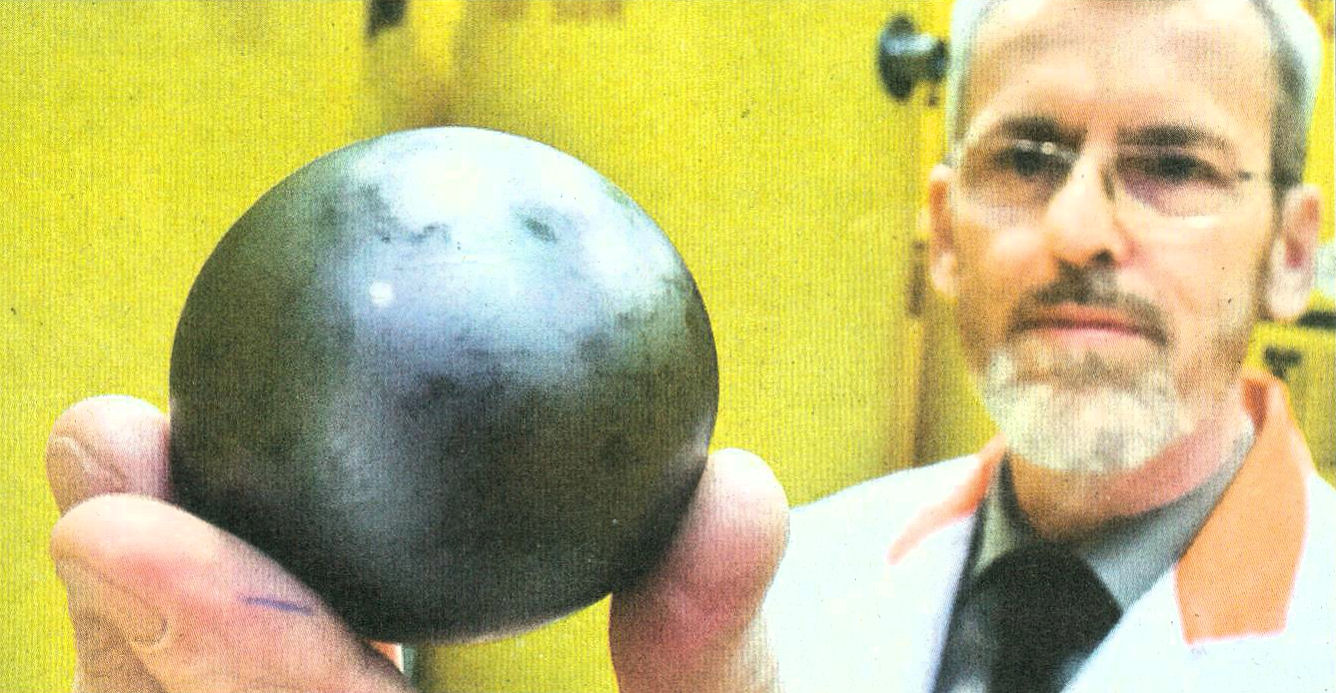
Epilogue: With all the present-day nuclear hysteria in Germany, the State government of North Rhine-Westphalia suddenly claimed that 2000 of the 675,000 radioactive thorium-graphite balls used in the THTR had gone astray. Luckily, this turned out to be a hoax!

Dr. Printz of the Jülich Research Laboratory proudly presents
one of the "missing" graphite-thorium balls (DPA)
**

Saturday, April 9, 2011

Anything Goes

Nothing is impossible: Der Spiegel online used this Toyota slogan: Nichts ist unmöglich as a title of an article referring to newly possible color combinations in German politics. Remember the color coding of our political parties?

Nothing is impossible? Instead, the lyrics of an Ella Fitzgerald song come to my mind:

In olden days a glimpse of stocking
Was looked on as something shocking
Now heaven knows, anything goes.


With the Greens flying high in the sky (like Ol' Blue Eyes with his gal or chick), the other colors become pale or nearly vanish like the yellow-colored Liberals. Following their crushing defeat in the latest State elections, they choose as a first remedy a new party chairman, a doctor by profession, to cure them of anorexia.

At present, all political parties in Germany would like to get a bit of the anti-nuclear bonus the Green Party is profiting from. All in vain; if there were federal elections today, the Christian Democrats (black) would remain the strongest party, but they would be unable to form a government for the Liberals (yellow) would fall below 5% and thus no longer be presented in the Bundestag (parliament). 

And as the Greens will have more votes than the Social Democrats (red), Germany would likely have a green chancellor provided the Reds accept the rôle of a junior coalition partner for the Greens like in the State of Baden-Württemberg.

This may not happen, and with the yellows falling out of parliament, the blacks are looking for a "new" coalition junior partner, and suddenly anything goes. For them, the Greens have become honorable.

However, all this is just a snapshot, for the tide will change once Fukushima doesn't make it to the front page anymore and the Green-Red coalition in Stuttgart is showing symptoms of wear and tear.
*

Friday, April 1, 2011

Cold Fusion

The recent electoral success of the Greens will accelerate the phasing out of nuclear power in Germany. The search for new energy sources is being intensified. I should admit that Freiburg's population is stuck between a rock and a hard place. So far, opposition to wind energy plants is considerable, with one convincing argument being that the rotating blades may kill bats during their night flights. However, this is a trumped-up assertion, for the real reason is that nobody likes the technical asparagus on top of the Black Forest and certainly not in his/her backyard.

I read the other day that Dane County's manure digester is ready to provide electricity. This certainly works if there are enough cows or pigs to deliver the raw material. 


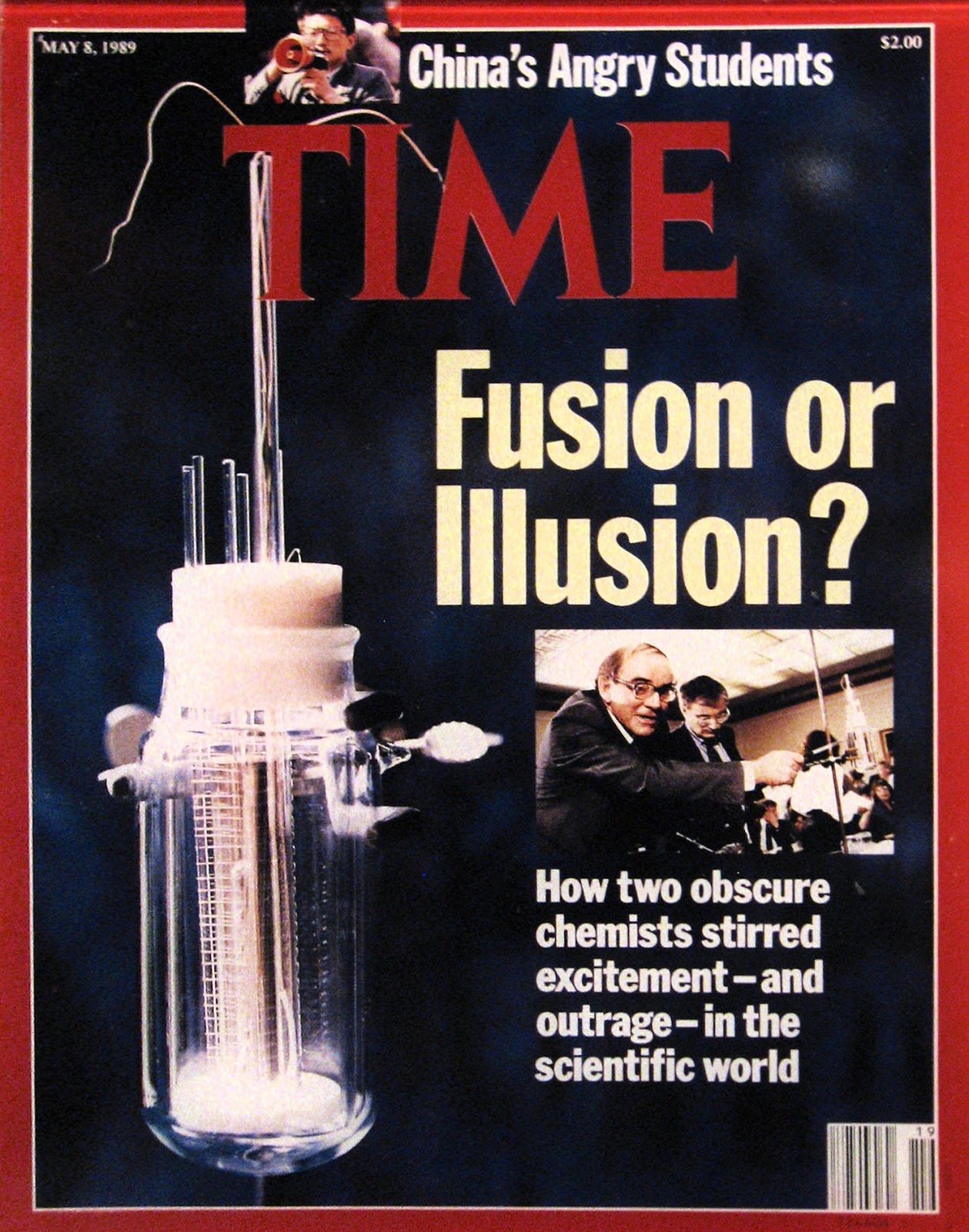
What does not work is Cold Fusion, a flaw that Dogbert has lately re-invented as an energy source.

TIME, the cover of May 8, 1989
I still remember. In the spring of '89, Carlo Rubbia (later Nobel Prize winner and my Director-General) caught me in a hallway at CERN, saying: "Look what Fleischman and Pons do in the States, and we are all sleeping here." I gulped and later provided him and other teams at CERN with neutron counters, so that my Group could hardly fulfill its radiation protection tasks at the Lab. 

Yes, even Cold Fusion, if it works, will create radiation! To make a long story short, a CERN spokesman said that "essentially all" attempts in Western Europe to reproduce the results had failed (Wikipedia). This means that Cold Fusion did not, and I add will not work.
**

Thursday, March 31, 2011

The Follow-up

Smudged election poster
Ministerpräsident (governor) Mappus got the nuke issue right in his face. Last Sunday, Fukushima in distant Japan decided the state elections in Baden-Württemberg with the Greens more than doubling their votes.

Distribution of seats in the state assembly. In percentage: Christian Democrats 39.0%,
Greens 24.2%, Social Democrats 23.1%, and Liberals 5.3%
Look at the new distribution of seats in Baden-Württemberg's state assembly. Not only did many base voters switch to green, but people who had never cast their votes in the past put their ballot paper into the box. The turnout of voters in 2011 was 66.2% compared to 53.4% in 2006. Note that the Liberals, with 5.3%, had nearly missed their entry into the legislature, a fate that happened to the right and left-wing parties, for they missed the minimum quorum of 5% of the votes necessary to be presented in the state assembly.

The intention of the Social Democrats had been to form a coalition with the Greens to oust the present black-yellow government. However, the Greens having more than doubled their seats and gained one more than the Reds, will form a green-red government with their leader becoming the new Ministerpräsident.

Suddenly the existing schedule for phasing out nuclear power in Germany in the coming years without jeopardizing our electrical supply is questioned. Even the past pro-nuke Liberals now try to jump on the "Abandon Nuclear" bandwagon. And there are those for whom Angst transforms into a panic when they demand: Stop all nuclear power stations now!

Will they still be satisfied when Germany has to import "nuclear" electricity from France with prices per kilowatt-hour going up? As long as the Japanese do not come to grips with their reactor disaster, the issue of nuclear power in Germany will overshadow all other problems.
*

Friday, March 25, 2011

Abwählen = recall?

If I understood correctly: it is possible to recall senators in Wisconsin before the end of their term by public vote. When you look at an election poster for next Sunday's state elections in Baden-Württemberg, you read the words: Jetzt abwählen (recall now), and you wonder. 

You can vote alright, but how to recall the Christian Democrats (Conservatives or black) + the Free Democrats (Liberals or yellow)?

What actually is meant is do not vote in Sunday's election for nuclear power. The issue is represented by the present coalition government of black and yellow here in the Ländle, but since Fukushima loaded with German Angst

While it is impossible to recall deputies in Germany, it is possible to refrain from voting for them in the upcoming election.
*

Sunday, March 20, 2011

Color Coding

During my recent visit to Madison, when speaking with protesters around the Capitol, some inquired about coalitions between various political parties in the Old World and how they function. Even the motherland of the one-party majority rule, the UK, is now governed by a coalition of Conservatives and Liberals in Parliament, with the Labor Party in opposition.

The situation is even more colorful in Germany since we have a whole "spectrum" of parties. The Christian Democrats (CDU with the usual 30 to 40% of the votes in elections) are our conservatives. However, people have recently become uneasy about the adjective Christian as some great leaders are divorced, and one has fathered an illegitimate child. 

The other Volkspartei, our GOP*, is the Social Democrats (SPD with 25 to 35% of the votes). They traditionally are the party of the working class. Recently, however, they renewed their pact with the industry that had worked so well under the Schröder administration. The SPD eventually understood that elections are won only when the party appeals to the middle class and follows the rule: thou shalt not kill the cow (industry) that gives the milk (jobs). Such an attitude, however, never pleased the traditional left-wingers. 
*Not ideologically but just what it literally means: the Sozialdemokratische Partei Deutschlands is our Great Old Party, founded in the 19th century and still exists. Due to Germany's industrialization in the 2nd Reich, the number of SPD voters increased steadily. Bismarck attempted to take the wind out of their sails by introducing old-age and health insurance for the working class. When, contrary to his plans, the rollback did not work, Bismarck had the Reichstag (parliament) pass the Socialist Act, which outlawed the Social Democrats. Later, the SPD was admitted again because Emperor Wilhelm II needed the Socialists' votes to pass the war budget in 1914. Following the lost war, the Social Democrats were the party whole-heartily supporting the Weimar Republic. It was the only political formation that voted in parliament against Hitler's Ermächtigungsgesetz (Enabling Act) that eventually assured absolute power to the Nazi regime. Additionally, today, the Social Democrats are one of the pillars of German democracy.

When the German Democratic Republic (GDR) was integrated into the Federal Republic of Germany in 1990, nostalgic Marxists in the East founded the Party of Democratic Socialism (PDS). The PDS, suffering great labor pains, eventually amalgamated with the extreme left of the Social Democrats in the West to form the Left Party (Die Linke), which garnered 5% of the votes in the West and 20% of the votes in the Eastern parts of Germany.

Returning to the party spectrum, the Christian Democrats are traditionally associated with the color black, as they originated from the Zentrum, the Catholic Party in the Weimar Republic. You guessed it: the Social Democrats wear red. Since there is no redder than red, the post-communist PDS is presented by magenta in pie charts. 

Green for the Green Party (10 to 20% of the votes) is obvious, and the Liberals (5 to 10%) are painted yellow. New parties have to take what is left over in the spectrum. The recently formed Pirate Party, which demanded free internet access for everyone in its program, chose orange.

Now, let us form coalitions. The hard part is to find a compromised common governmental platform allowing the survival of a whole legislature with a usual small majority in a coalition government against solid opposition. The easy part is the colors. In the past, traffic light (Ampel) coalitions of Red, Yellow, and Green were quite popular. 

When in some of our State governments (Länder), the Social Democrats are replaced by the Christian Democrats, a Jamaica coalition may form, which is my favorite only in terms of the combination of colors: Green, Yellow, and Black.

More common than three-party coalitions, two parties form a government, as seen in the Black-Yellow coalition, which is our present Federal Government in Berlin. The other proven working combination is Red-Green. There have been successful cases of Red-Black coalitions, too. These are called grand coalitions because of their large and comfortable parliamentary majorities for the two parties concerned. In such a combination, the Social Democrat Party generally is the junior partner and usually suffers a setback in the next election. On the other hand, an experiment of a Black-Green coalition in the State of Hamburg ended in an electoral disaster for the Christian Democrats.

If you have been wondering about some recent erratic reactions and decisions by our Federal government*, you should know that there are upcoming elections in three of our Federal States. Since their outcome is vital for the majority in our Senate (Bundesrat), the government avoids any unpopular decisions that could deter voters from choosing Black-Yellow.
*The hectic dealings with the minister of defense, Guttenberg's copy-and-paste thesis, the sudden about-face in support of nuclear power following the Fukushima disaster, and the negative vote in the UN Security Council about the Libyan no-fly zone

Today is Election Day in the State of Thuringia. Will there be a new edition of a grand coalition, or will we see the formation of a Red-Magenta government?

Next weekend, Germany is looking forward to a Super Sunday. I shall vote in the election for the State Parliament of Baden-Württemberg. At the same time, people elect their State parliament in the Land of Hessen. For the latter, it is practically sure that Hessen will be governed by a Red-Green coalition.

However, for my Ländle, the election result is a thriller: will the incumbent Black-Yellow government survive, or will a Green-Red coalition take over? You read correctly: Green-Red means that a green Ministerpräsident (Governor) would form a coalition State government for the first time in German history. Stay tuned for a possible political earthquake in Germany's South-West. 
**

Monday, March 14, 2011

Nuclear Power And No End?

In writing this, I do not mean electrical power from nuclear fission that will surely come to an end. Given the present catastrophe in Japan, I mean the renewed discussion in Germany on nuclear power. The apocalyptic scenario we watch with great sympathy for the Japanese people, in fact, furnishes no new arguments in the debate about the safety of nuclear power reactors.

The explosion (©AP)
Let me say this clearly: Present power reactors are safe as long as a team of incompetent technicians does not mess around with the cooling system (Three Mile Island), an overambitious engineer does not play with the control rods (Tchernobyl), or a magnitude 8.9 earthquake followed by a tsunami wave of 10 meters height does not hit a nuclear power plant. 

While the last scenario can be excluded in Germany, nobody is safe against human foolishness. This and the unresolved nuclear waste storage are the main reasons Germany has an established timetable for phasing out its nuclear power reactors. Let us face it: Presently, there is no alternative to "cheap" energy, as nuclear fusion is still only in the stars (in both senses).

The industry is propagating a new generation of power reactors that will be more compact and work at higher temperatures, hence being more efficient than those we presently operate. Do not believe the people telling you this new line of power reactors is safer than the old one. 

Due to the higher energy density and the higher neutron flux density inside the nuclear core, the materials used for the reactor vessels will rapidly become brittle and fail much earlier than in present-day reactors. Mother Nature presents us with marvelous elements that we melt into alloys, showing properties our ancestors only dreamt of. We have, however, approached the technological limit of stability of metal alloys as far as the combined influence of neutron bombardment and temperature is concerned.

So please, we want no new nuclear fission reactors and let the old existing ones eventually come to their well-deserved rest. 

What makes me nervous is that most people today are unaware that energy is too cheap. They moan if prices for petrol, gas, and electricity steadily increase. However, the increasing stress on their purses and wallets will hopefully trigger their consciousness of an economical use of our limited resources.
*

Monday, March 7, 2011

Fabulous Fred

With Wisconsin's 14 Democrat Senators having fled their State, Republican Governor Scott Walker's contested budget repair bill cannot be passed. The Republicans have a majority in Wisconsin's upper house alright, but the quorum is needed to pass a bill touching on financial matters. With the Democrat Senators absent, the upper chamber falls short of the number required by just one vote.

Among those 14 expatriated Democrats, Fred Risser is an outstanding person. Senator Risser has served Wisconsin for 55 years in the legislature and is the longest-serving state legislator in American political history. When in 2009, the Freiburg-Madison Gesellschaft had organized a trip to Madison, Senator Risser - then 81 years old - showed us his workplace place in the Capitol and explained the working of the two-chamber legislature on the State and Federal level. Nobody could foresee that this personality now "hides" in Illinois out of the range of Wisconsin troopers who received an order to "escort" at least one Democrat Senator back into Wisconsin's Senate Chamber.

State Senator Fred Risser, primary democratic rock, addresses us, visitors, at Madison's Capitol in 2009,
ending a tour of the building arranged by the Mayor's wife, Dianne, right to him.

This picture from a local newspaper shows Risser at the end of February 2011, together with State Senator Robert Rauch changing hotels in Illinois (frequently) to avoid harassment by Tea Party activists. Fred wears a red cap, but my American friends keep telling me this has no political significance.
*