Thursday, August 13, 2020

750

Dear friends, this is the 750th blog. I will dedicate it to my last hometown, Freiburg.


My dear and unforgotten wife, Elisabeth, is buried here. There is still enough space left for me.

Hase's self-portrait in 1860
This Freiburg blog features yesteryear photos by Gottlieb Theodor Hase that are presently on display at the graphics cabinet of the Augustinermuseum. Hase, born in 1818, started as a painter and daguerreotypist at Bayreuth in 1845, announcing in the local newspaper on August 14: "I paint portraits in oil, watercolor, pastel, miniature on ivory, and make chalk and pencil drawings in any format. Furthermore, I make daguerreotypes of all kinds, enlarging them into a larger scale."

When Hase moved to Freiburg in 1852, he gave up painting, earning money with portrait photography, and taking pictures of his new hometown. He was known and well-liked at Freiburg, where he joined the local artist circle, Ponte Molle.


Ponte Molle's heraldic shield shows G. Th. "Hare," sitting somewhat glumly on his camera, having broken his brush handle.

Hase 1860
One of Hase's first and most famous photos of his new hometown shows the Kaiserstraße, with the Bertoldsbrunnen in front and St. Martin's Gate in the back.

August 12, 2020
The 2020 view shows a different Betoldsbrunnen and the raised St. Martin's Gate. Note that the facade of the first house on the left has been set back a few meters, while the subsequent buildings now have archways.


This is Karl von Rotteck's Memorial in its original location on Franziskanerplatz - nowadays, Rathausplatz - in May 1850. However, the liberal von Rotteck became a persona non grata when the Revolution of 1848/49 failed.

 Bertold-Schwarz-Brunnen, Hase 1860
The city removed Rotteck's bust in a Nacht und Nebel Aktion (dawn raid) from June 22 to 23, 1851, and replaced it with the current Bertold-Schwarz-Brunnen one year later.

Hase 1862
Here is Hase's Bildreportage (photo report) about the second inauguration of Rotteck's Memorial, now placed in front of his former home.

Hase 1865
Here are people visiting the Memorial at its new site.

Hase 1865
Freiburg's Festhalle (art and festival hall) was destroyed during the air raid on November 27, 1944. In the photo on the left, the young man is Hase's son Fritz, who took over the trade following his father's death in 1888.

Hase 1865
The entrance to the city by the Schwabentor in 1865 ...


... and today's view. Only the steeple of the Minster Church in the back and the yellow house on the left are still in their place.


Already early in his career, Gottlieb Theodor Hase won distinguished prizes.

Hase 1880
One of the most photographed scenes in Freiburg is Oberlinden. Entering the town through the Schwabentor, you see the linden tree in front of the bifurcation of  Salzstraße and Herrenstraße.


The black-and-white photo was taken in the 1920s.

An evening scene on July 1, 2020

December 7, 2010.
And who does not remember Professor James Steakley's famous photo taken in December 2010, following the FMG Christmas dinner at the Greiffenegg-Schlössle? Admire the linden tree decorated by Herrenhut stars.

Otto Kokoschka 1984
And still, another famous person loved Oberlinden so much: Oskar Kokoschka. Note the green linden tree and the steeple of the Minster Church cut.

In 1964, Kokoschka offered his oil painting to the city of Freiburg for 100,000 Deutschmarks (50,000 euros). It was a bargain - but the city refused because "nothing typical" was depicted; besides, the cathedral tower was cut off.

In 1966, after almost two years of unsuccessful negotiations, Kokoschka eventually withdrew his offer. A private collector acquired the painting and, in a win-win situation, lent it to Freiburg's Museum of Contemporary Art.

Hase 1870
Another frequently photographed scene is St. Martin's Gate, viewed from the south.


The scene in the 1930s photo looks ...


... the same in 2020.

Hase 1886
The Minster Church as seen from Schlossberg.


In 1860, the photographic technique was already well-advanced. Physics professor Johannes Müller at Freiburg University describes the detailed process in the first volume of his textbook, Physik und Meteorologie, 5th edition of 1856. Here is the translation:

"The Frenchman Niepce went quite far in the art of fixing photographs; only Daguerre, after many laborious attempts, found a method which is almost unbelievable."

The first page of Johannes Müller's textbook.
"The material on which Daguerre's photographs are recorded is a plated copper plate, i.e., a copper plate covered with a thin layer of silver. After being properly cleaned, it is placed on a square porcelain dish containing an aqueous solution of chlorine iodide. The plate is exposed to iodine vapor until a golden-yellow or violet layer of iodine silver forms. The plate is then protected from external light and inserted into the camera obscura, exactly where a sharp image of the object is formed. After some time, the duration of which depends on various circumstances, the plate is removed from the camera obscura. At this point, no trace of an image is visible, but it will soon appear if the plate is exposed to mercury vapor. As soon as the image is sufficiently distinct, the plate is placed in a sodium bicarbonate solution, which dissolves the coating of iodine silver, making it impossible for the light to interact further."

Colored print of 1856 of the solar spectrum in Müller's textbook
Later in 1859, Hase worked with Müller, taking photographs of the absorption lines in the solar spectrum known as the Fraunhofer lines. Their experiments were hindered by the problem that blue light is more effective on photo emulsions than red light. Unfortunately, they left no notes about their findings.

Following Gottlieb Theodor Hases's death in 1888, his son Fritz continued the photographic atelier.


Here is the corner of Rathausgasse and Franziskanerplatz with the Haus zum Rechen (House of the Rake, left) and the Haus zum Phoenix (House of the Phoenix, right) photographed in 1895 by Fritz Hase. The two buildings are connected by a wall with a gate leading to a courtyard.

This had been the building of the Old University since 1595. On its upper floor, Father Hase made the solar spectral photographs for Professor Müller in 1859.


In 1896, the city bought the building and transformed it into the New Town Hall by adding a decorative middle part. Here is a colored postcard from the beginning of the 20th century.

At the start of the Corona pandemic on March 19, 2020.
**

Sunday, August 2, 2020

Freiburg Splinters 3

As you know, the festivities for Freiburg's 900th anniversary have come to a halt. Nevertheless, some events couldn't be stopped, such as:


Aircraft Christening


©BZ
At the beginning of July, the last Airbus A350 that Lufthansa had accepted from the aircraft manufacturer was christened "Freiburg." This is a small consolation because, in the anniversary year, many events had to be postponed on canceled due to Corona.

The airline, hard hit by the pandemic, has a total of 360 aircraft. The new Airbus A350 will be the 17th of this model in the Lufthansa fleet. Presently, the airline plans to sell 100 jets (to whom?) of its modern fleet. Until October, the Lufthansa Group aims to regain 50% of its air traffic levels before the Corona crisis. Good luck!


The Coin

©BVA/Hans-Joachim Wuthenow
The 900th anniversary of the city of Freiburg requires 18 tons of silver to mint one million 20-euro commemorative coins that are legal tender in Germany.

The actual one was selected among the many designs because "the citizenship of Freiburg is placed in the center of attention in front of the city's coat of arms." Besides, "the striking historical buildings are shown on the right-hand side and the nature-loving elements of the ecological city on the left-hand side. The view opens up to the Schlossberg tower, and below, it focuses on Freiburg's brooklets". Note the Historic Kaufhaus on the bottom left, the houses with solar cells, and the grapes on the right.

A remark coined by Freiburg's second founder, Otto Winterer, is written in capital letters on the coin's edge. His maxim is found above the entrance to Freiburg's town hall, "The citizen's welfare is the highest law."


The Stamp


The commemorative 80-cent stamp shows St. Martin's Gate upside down, the historical Kaufhaus on Minster Square, the Freiburg minster church, and the new university library in lateral positions. The design was much criticized by the citizens of Freiburg. Red Baron just wondered why the yellow color was omitted.


Killing Two Birds with One Stone


When Red Baron went to his EDEKA supermarket the other day, he noticed a stroke of genius.

To protect the shop assistants working behind the counter, the manager had simply placed crates of beer in front of the counter, ensuring the necessary distance and promoting barley juice. Who doesn't like a beer together with the sausage he just bought?


Pre-Lunch Jazz and Drink


Last Sunday, Toni Schlegel invited me to pre-lunch jazz and drink at the Kastanien-Biergarten above the Greiffenegg-Schlössle. Mouth-nose covers were worn while walking and when getting food and drink.


Distance rules were observed, but mouth-nose-covers were taken off, and a cold beer was enjoyed.


The overjoyed Red House Hot Six (they were actually seven) performed at their best. After four months of starvation, playing again in front of grateful listeners was overwhelming.


Cabaret


These days, artists try their best to perform in front of a paying audience. The city of Freiburg made the inner court of the Basler Hof available to soloists and small groups.

The entrance to the Basler Hof on Kaiser-Josef-Straße.
A blue Poseidon at the inner court near the stage


Red Baron went to a musical cabaret presentation.

© Michael Dignal
 An educated concert pianist, Anna Folger, turned her other talent, that of a cabaret performer, to the outside. It was an enjoyable evening.


Dry Dreisam


©BZ
Last time I reported that due to the lack of rain in the Black Forest, the water level of the Dreisam River was extremely low.

The latest photo shows that the Dreisam has dried up a few kilometers downstream of Freiburg. Although the weather people announce rain from time to time, keeping the farmers quiet but not happy, only a few drops fall onto hot and dry surfaces, evaporating instantly.


Bach Forever


St. Jean at the end of the street
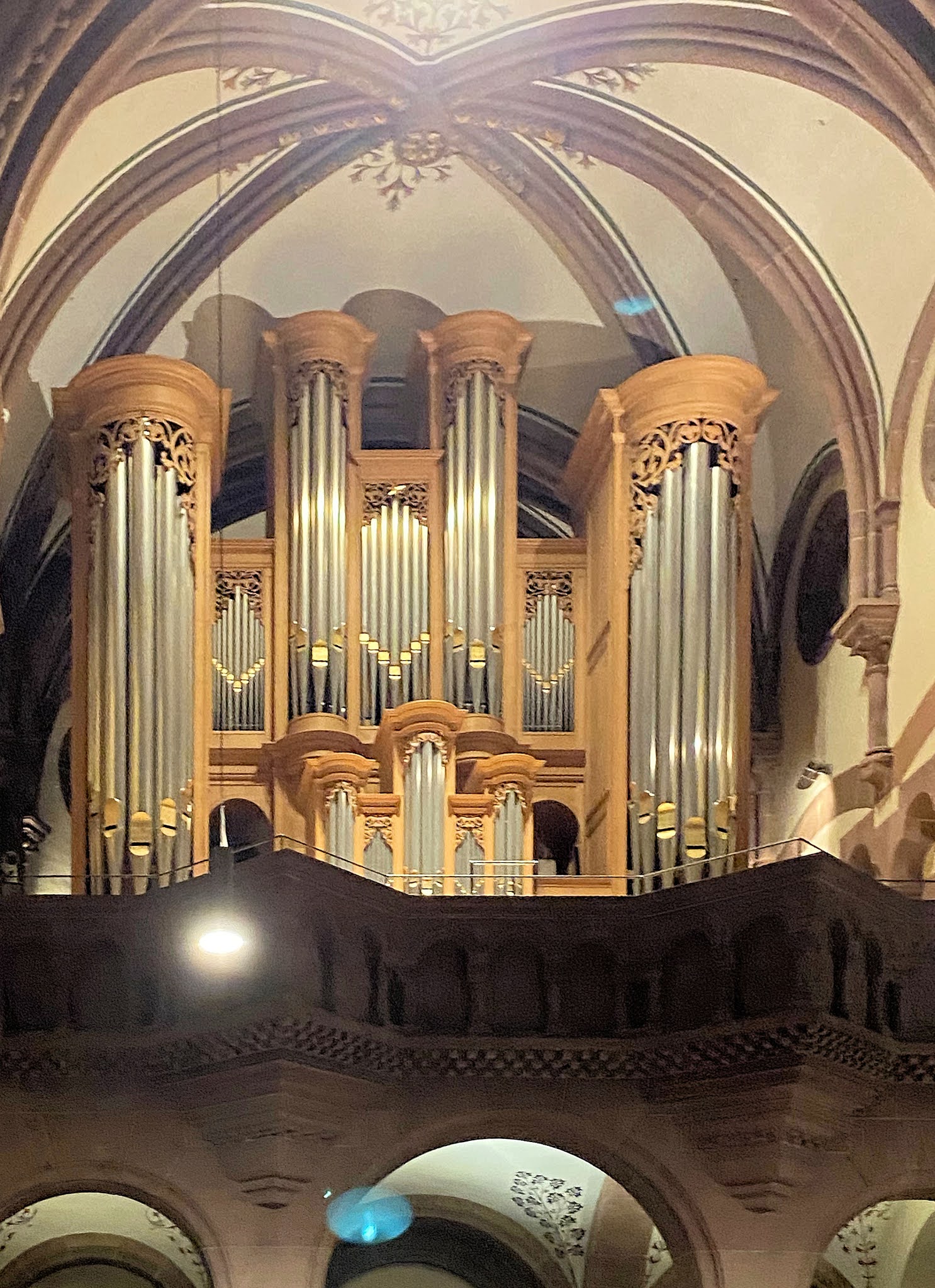
To commemorate Johann Sebastian Bach's 270th date of death, an organ recital occurred at the nearby St. Jean's Church.

St. Jean's main organ
Although knowing the master's great works quite well, Red Baron was surprised by the music he had not heard before. That is what one of my washed-out T-shirts suggests:


Freiburg Archeology


The House to the Beautiful Corner. In the back, the historical Kaufhaus.
Saturday morning, Red Baron had a guided tour of an exhibition called Freiburg Archeology at the Museum of City History. The museum is in the Haus zum schönen Eck (House at the Beautiful Corner) on Minster Square, built by Johann Christian Wentzinger.

The exhibition wasn't dat Jelbe vom Ei (the greatest thing since sliced bread).


Here is what I later had at Toni's place to console me, watching the vivid market life and looking at the Minster church.

**

Sunday, July 19, 2020

Gotha

The name rings a bell. Wasn't there something called House of Saxe-Coburg and Gotha?
Coburg and Gotha are two cities in Germany. The first is located in Franconia, and the second is in Thuringia. Red Baron visited Gotha twice, but only passing through, so when I was in Erfurt, the city was just a 20-minute train ride away. I decided to spend one day in Gotha while keeping my residence in Erfurt.

The Dukes of Saxe-Coburg are a branch of the Wettiner, and their history is somewhat complicated. To make a long story short, the first Duke of Saxe-Coburg and Gotha was Ernest I, who reigned from 1826 to 1844.

In the meantime, the marriage policy of the House turned out to be as efficient as that of the Habsburgs. As Wikipedia knows, Ernest's younger brother Léopold became King of the Belgians in 1831, and his descendants continue to serve as Belgian monarchs. Léopold's only daughter, Princess Charlotte of Belgium, was the consort of Maximilian I of Mexico, and she was known as Empress Carlota of Mexico in the 1860s. Ernest I's second son, Prince Albert (1819–1861), married Queen Victoria in 1840 and is the progenitor of the United Kingdom's royal family.

The actual founder of the British line Saxe-Coburg and Gotha is King Edward VII (1901–1910), the eldest son of Albert and Victoria. In 1917, Edward's son, George V (1910–1936), renamed the royal line the House of Windsor while Britain was fighting Germany in the First World War.

The streetcar took me from the station (lower right)
to the Bertha-von-Suttner-Platz (upper right) from where
I followed the red line to the Hauptmarkt (primary market). 
One arrives at Gotha by train at a station outside the city center. While the first railway stations in big cities were - and some are still - railhead termini, fast train connections require through stations. The result is that these modern stations are primarily located outside city centers. Examples in Germany are Braunschweig, Heidelberg, Karlsruhe, and Gotha.

Gotha's Townhall and the Castle uphill
I arrived at the entrance to the old town on foot. When facing the Rathaus (town hall), you look upwards at the Friedenstein Castle. Sadly, the whole area was a construction site.


Walking up to Gotha Castle, I saw two city archaeologists at work.


Further uphill, I passed the Gothaer Wasserkunst, an artificial brooklet that was dry due to repairs.


When I looked back at the Hauptmarkt, I noted the red tower of Gotha's town hall. The house in the sun on the right is the Lucas Cranach Haus, now a museum. Lucas Cranach the Elder (1472-1563) lived most of his life in Wittenberg but owned this house in Gotha.


Further up the hill, I approached the ducal castle from the left side, following the red line on the city plan. Schloss Friedenstein was built from 1643 to 1654; the name was chosen allegorically to honor the end of the Thirty Years' War and the Peace of Westphalia.


Above the main entrance, the House of Saxe-Coburg and Gotha coat of arms greets the visitor. Schloss Friedenstein and its exhibitions were still closed to the public, so I walked through the gate hall and entered the vast courtyard.


I noticed how impressive the building was when I looked back into the courtyard.


I followed the red line on the plan, walked over the hill, and descended to the Ducal Museum, which was built from 1864 to 1879.


Wearing mouth-nose covers was mandatory in the museum. The statue of the founder, Duke Ernest II, in the entrance rotunda was decorated accordingly.

Ernst II was the only German prince who took the March Revolution of 1848 seriously. In 1849, he decreed that Saxe-Coburg and Gotha had the most progressive constitution in the German territories.

The quality of the paintings was not up to the impressive building, although some original works of Lucas Cranach the Elder should be mentioned.

Portrait of an Old Man is attributed to Rembrandt van Rijn's workshop or the master himself.
A comment reads: Future art-historical analysis may provide a conclusive attribution
  and the identification of the person portrayed.

Abraham van Dyck (1635-1672): Old Woman with Book.
Van Dyck was a Rembrandt pupil.

From the workshop of Lucas Cranach, the Elder:
Portraits of Martin Luther and his wife, Katharina von Bora

Damnation and Salvation by Lucas Cranach, the Elder
The explanation reads as follows: The painting illustrates Luther's teaching on the justification of every person before God alone. The tree of life and death divides the image into two halves: on the left, the sinful person who has acted against the law is driven into hell by death and the devil. On the right, the guilt-laden person, accompanied by John the Baptist, is discovering the grace of God through Christ's suffering and death.

I walked through the ducal park to the station and took a train back to Erfurt in the early afternoon.
**