Sunday, February 28, 2021

Waldsterben 2.0

Several times, I wrote about the German Wald (forest), a soul topic for most of my compatriots. Waldsterben, their ultimate sorrow, had already found its way into the English language by the 1980s.

For Germans Waldsterben equals Götterdämmerung, “Erst stirbt der Wald, dann stirbt der Mensch (When forests die, men/women will follow)."

In 2015, I wrote cautiously optimistic: There is good news concerning oak trees. While in 2012, 50% of their tree-tops were sick, the figure dropped to 36% in 2014. Germany's agricultural minister commented on the positive trend: "Es ist schön, sagen zu können: Viel Laub auf Deutschlands Eichen (It is nice to be able to say: Much foliage on Germany's oaks)."


In the meantime, the situation has undergone a dramatic change. The new emotive word is Kronenverlichtung (crown defoliation). The Waldsterben is back.

For several reasons, "The storms, the drought, the massive bark beetle infestation, and the increased forest fires in the past three years are the apocalyptic horsemen of climate change."

A bark beetle looking for a maiden spruce tree
Up to 10,000 bark beetles can infest one spruce tree. They are to blame for the mass death of the trees, which have no chance of survival. The animals found ideal conditions last year because 2020 was the third consecutive year with a dry summer, following 2018 and 2019.

Insects are the leading cause of tree damage.
 Due to the lack of water, the beetles could easily invade spruce trees that later had to be felled en masse. In some federal states, even soldiers arrived to deal with dead trees. 245,000 hectares of trees were destroyed, and the supply of spruce wood has increased massively. 

Two-thirds of the timber in Germany is from damaged trees
The result was a rapid decline in prices, by around 35 percent in three years.

35% of the trees in Germany show a significant crown defoliation
The beech trees are even worse than the spruce, for only one in ten remains intact. Although fewer of these deciduous trees have been dying for more than ten years, up to 60 percent of them have been showing Kronenverlichtung, i.e., beech trees, are missing 25 percent or more of their average leaf mass. In 2020, more than half of all trees were in such poor condition.

What about the oak tree, the symbol of the German love of freedom, pride, power, and strength? It was balm to the Teutonic soul that the condition of the oak trees improved somewhat last year. The Forest Condition Survey Report notes, "The oak is thus showing the first signs of regeneration but remains at a high level of damage."
**

Friday, February 19, 2021

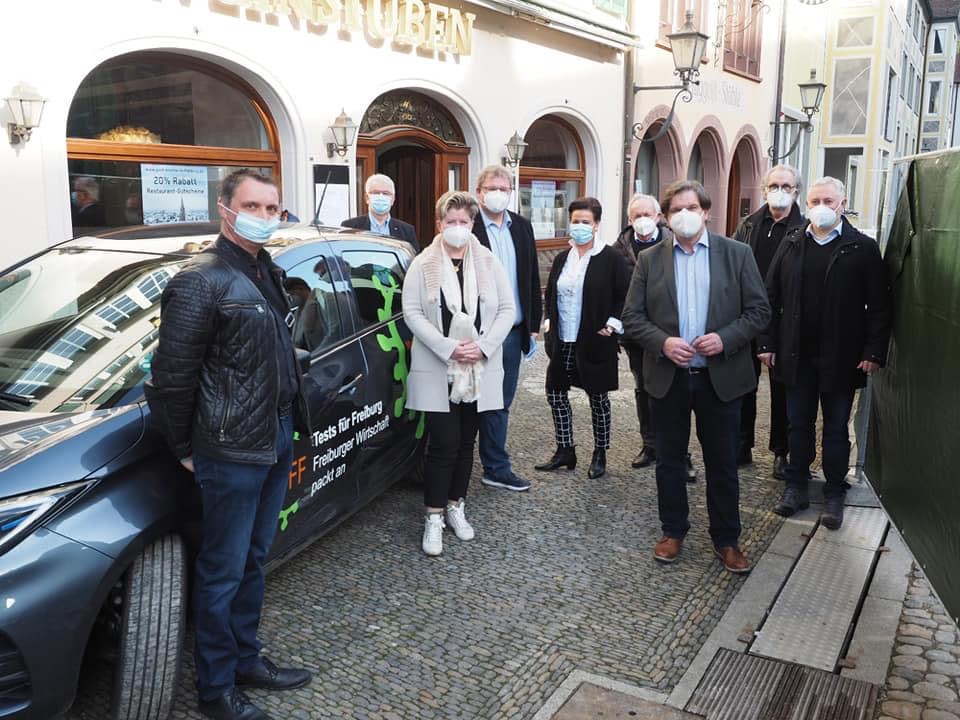
Tests für Freiburg

 According to our Minister of Health, Jens Spahn, corona quick tests shall be freely available in Germany at the beginning of March. They will be performed by family doctors and qualified people, e.g., in pharmacies. Another of Spahn’s announcements concerns self-test kits for laypeople that will be simultaneously available in supermarkets, drugstores, and pharmacies.

In Freiburg, many entrepreneurs did not want to wait another two weeks and started a program.

Dear doers,

Last Sunday evening, some entrepreneurs from Freiburg and the VBU (Baden Business Association) decided to jointly launch the initiative.

Tests for Freiburg
Starting next week, 1000 quick tests will be made available to educators, teachers, and senior citizens free of charge and financed by donations.
 
With this initiative, we want to shake up the ponderous government and administration to - finally - actively take up the vital testing topic. The more testing is done, the more infection chains can be broken.


The voluntary initiative is funded by donations and sponsors.


The president of the Freiburg-Madison-Gesellschaft, Toni Schlegel, is one of the doers. He offered the test premises at his Hotel Rappen on Münsterplatz.

Corona quick tests are touted as an effective tool to fight the virus. Infected people are detected and will go into quarantine. The positive result is reported to the local Gesundheitsamt (health authorities), which will subsequently start the tracing, thus breaking the chain of infection.

I have my doubts regarding the self-tests bought and performed by laypeople. How many false-negative results will there be, and how safe does the tested person feel after a negative test?

A negative test is nothing else than a snapshot of the present personal COVID situation. It should never lull the person into a sense of security, leading to disregarding the AHAL rules.

If a positive self-test results, will the person inform the health authorities and voluntarily undergo a ten-day quarantine? I doubt it.
*

Wednesday, February 17, 2021

Gender Madness

While politically correct people struggle with the natural and grammatical gender of nouns (NG and GG) in German-speaking countries, gender developments are becoming insane in the UK.

Like Latin, as you may know, German has three grammatical genders, much to foreign learners' chagrin. Simple sets like cutlery come in three GGsder Löffel (masculine, the spoon), die Gabel (feminine, the fork), and das Messer (neuter, the knife).

Already Mark Twain complained: To continue with the German genders: a tree is male, its buds are female, its leaves are neuter; horses are sexless, dogs are male, cats are female -- tomcats included, of course; a person's mouth, neck, bosom, elbows, fingers, nails, feet, and body are of the male sex, and his head is male or neuter according to the word selected to signify it, and not according to the sex of the individual who wears it -- for in Germany all the women, either male heads or sexless ones; a person's nose, lips, shoulders, breast, hands, and toes are of the female sex; and his hair, ears, eyes, chin, legs, knees, heart, and conscience haven't any sex at all. The inventor of the language probably got what he knew about a conscience from hearsay.

Then Twain drives the difference between GG and NG ad absurdum in a conversation about die Steckrübe (the turnip) and das Mädchen* (the girl):
*All words in German ending in the diminutives -chen or -lein are neuter.

Gretchen: Wilhelm, where is the turnip?
Wilhelm: She has gone to the kitchen.
Gretchen: Where is the accomplished and beautiful English maiden?
Wilhelm: It has gone to the opera.


During my time at the university, we were Studenten (students), and it was understood that the word comprised both male and female students. The problem arose because "die Studenten" is the plural form of "der Student". So feminists argue that female students are not included in the "male" plural form.

Well, you could use the feminine form Studentin and address a crowd of students as Liebe Studenten, liebe Studentinnen, but never say "Liebe Studenten". The German federal justice ministry now emphasizes that all state bodies should stick to "gender-neutral" formulations in their paperwork.

In the case of Studenten, a dreadful form based on the present participle, Liebe Studierende (Dear those who study), is officially used as "gender-neutral" throughout. The American AYF students in Freiburg got a special treat. They are affectionately called Studies.

In my days at the University of Tübingen in 1955, we frequently had our lunches not at the students' canteen but at the Schlatterhaus on Österberg. The Evangelische Studentengemeinde (Lutheran Students' Community) ran the Haus. It not only had better food but also many female students. Girls visiting the community house did not mind being called Studenten.


How different the situation is today. In Freiburg, the Lutheran Regional Church proudly presents the word monster Evangelische Studierenden-Gemeinde.

There are other proposals to remedy discrimination against women in "male words." Red Baron already reported that on the non-discriminatory form of Student*innen comprising all students. Other suggestions are the Binnen-I (within-I), i.e., StudentInnen, or the gender gap, which is written as Student_innen.

In the meantime, radical feminists supported by the University of Leipzig simply demand the total Frauisierung (womanizing) of the language, i.e., the female form Studentinnen is used throughout, making male Studenten look bad. Others argue that Studentinnen will comprise transgender people, too.

Proposed gender-appropriate traffic signs of crosswalks in Hamburg (©Elbvertiefung)
The German word for the crosswalk is Fußgängerüberweg. This already heavy construct becomes a gender-appropriate monster: Weg für die Zu-Fuß-Gehenden (path for those who go on foot).

Spoken language is important, too. In fact, anchor "people" on German television have started
replacing die Demonstrierenden in Myanmar with die Demonstrant'innen, marking a hiatus behind the "t." What a mess!

This could have been avoided had Luther used the Low German dialects when translating the Bible from Greek. Lower German knows only one article, "de," instead of "der, die, das." So, we Germans call anglophone speakers lucky. With their "the," they avoid any gender madness. Really?

The Guardian recently reported that the Brighton and Sussex University Hospital (BSUH) is the first in the UK to formally implement a gender-inclusive language policy for its maternity services department — now known as "perinatal services."

BSUH follows in its approach the British Medical Association, which said pregnant women should not be called "expectant mothers" but "pregnant people" as it could offend intersex and transgender men.

The BSUH Staff have been told to avoid using the word "mothers" on their own. They have been given a list of alternative terms to use when addressing patients, including "mothers or birthing parents," "breast/chestfeeding," and "maternal and parental."

Instead of saying "breastmilk," they can choose from "human milk," "breast/chest milk," or "milk from the feeding mother or parent."

Don't they have any other worries?
**

Wednesday, February 10, 2021

Out of Time?

Lately, Red Baron has learned that wokeness is a powerful way of enforcing political correctness.

In the States, one recent example of wokeness is the renaming of schools in San Francisco. Among those were the George Washington and Abraham Lincoln High Schools. Both men were "engaged in the subjugation and enslavement of human beings. "

The trend to look into the sexism and racism of famous people long gone is not only en vogue in the States. Are those current efforts on dead people not falling out of time?

We in Freiburg slave (?) away on Karl von Rotteck, Professor at the University; he was, as Wikipedia knows, a political activist, historian, politician, and political scientist. He was a prominent advocate of freedom of the press and the abolition of compulsory labor.

Still, in 1821, as a deputy in Baden's state parliament, he was the spokesman for complete Jewish emancipation in the State of Baden under well-defined conditions only, i.e., the postponement of the Sabbath, the abolition of the dietary laws, the renunciation of Hebrew, and the purification of the Talmud from "anti-state tendencies." In other words, Jews shall earn their civil rights through increased integration.

And in Rotteck's Freiburg constituency, the resistance against the settling of Jews was fierce. For fear of competition, the merchants wanted to retain the prohibition of Jews, a ban that had existed since 1424, and the city council had once more confirmed it in 1809. A petition addressed to the Baden parliament stated, "Wir werden zum Judennest (We shall become a Jewish nest.”)

In 2010, in response to antisemitism by its famous citizen, Freiburg's municipal council abolished the Karl-von-Rotteck-Medal. Still, it kept as a compromise the name of the city's main boulevard, Karl-von-Rotteck-Ring. The medal had been attributed as a distinction to people who had rendered outstanding service to Freiburg.

Charles Darwin's sexism has been known for a long time, but has now been brought back to light.


The essay in the New York Times was written by Michael Sims. Immediately, Darwin's unconditional admirer Jerry Coyne went to the barricades. How dare you knock my icon off its pedestal? Jerry writes in his impeccable English.

You could take nearly any male Briton from the mid-19th century and, if you could suss out his views, discover that he was a sexist and a racist. That makes Darwin simply one of many. But it's good clickbait to indict Darwin because he's the most famous scientist of his time—perhaps of any time. And it's no surprise that the New York Times, mired as it is in identity politics and ideological purity, decided it needed the clicks of calling out Darwin for sexism.

But let me quote from Sims's essay.

Despite many respectful and admiring interactions with female writers and thinkers, as well as with his intelligent and well-read sisters, wife, cousins, and colleagues' wives, Darwin comprehensively dismissed women's intellectual potential. "The chief distinction in the intellectual powers of the two sexes, "he stated in "The Descent of Man and Selection in Relation to Sex "(1871), "is shewn by man's attaining to a higher eminence, in whatever he takes up, than can woman — whether requiring deep thought, reason or imagination or merely the use of the senses and hands. "

Later in 1881, Darwin confirmed, "I certainly think that women, though generally superior to men [in] moral qualities, are inferior intellectually."

He conceded that there was "some reason to believe that aboriginally (& to the present day in the case of Savages)" men and women demonstrated comparable intelligence, thus implying the possibility of regaining such equality in the modern world. "But to do this, as I believe," he added, "women must become as regular 'bread-winners' as are men; & we may suspect that the early education of our children, not to mention the happiness of our homes, would in this case greatly suffer."

What would have been Darwin's reaction to the multitasking emancipated superwomen of today? Excelling in their professions, they educate their children, look after the households, and keep their men's* backs free.
*Nowadays, "husbands" are a sub-category
**

Tuesday, February 9, 2021

Trumpet Language

Trompetensprache is a New German word that one of my favorite columnists, Florian Harms, propagated. According to him, this language is used if something uncommonly changes our everyday life profoundly.

Yesterday, Monday, was a highlight of the trumpet language. The onset of winter was hyped up as a "snow catastrophe," having the whole of Germany "firmly in its grip."

The whole of Germany? Looking from my balcony into our small park.


Germany was again divided but not into East and West. 


This time the weather cut the country into North and South. A cold front from the Pole met with warm dust from the Sahara over Germany, causing lots of precipitation as freezing rain or snow.

Looking like nickel-and-dime stuff
to my blizzard-accustomed friends in New York and Wisconsin
The trumpet sounded on. "Cities sank deeply into the snow," mutated in some places even to the "blood snow." The "cold claws" were invented, and the "crisp-cold winter."


There was "chaos on the highways," "chaos in train traffic," and possibly also chaos in the heads of some reporters when they headlined "Snow! Snow! Snow!" followed by a disappointing trumpeting "... so far only fender benders and car body damage".

Given the media excitement surrounding the weather, one might think we were the first bipeds to have a few flakes fall on our heads. Wasn't there such a thing as snow ten, twenty, or thirty years ago? As one experienced journalist said, "We should report in detail on the weather situation, but keep our language moderate. "

"Grandpa, were there past weather disasters with snow and ice and icy roads? "
 "We called it winter. "©Mario Lars


Note: A trumpet is most beautiful when it falls silent.
*

Sunday, February 7, 2021

Postal Ballots

Postal ballots = fraud was Donald Trump‘s mantra before, during, and after the recent presidential elections in the States.

In Germany, voting by mail was an exception in the good old days. You had to have convincing arguments, e.g., being absent from your place of voting on Election Day. Sundays were chosen as voting days to ensure a high turnout at the polls because people having travel jobs make it a point to be home for the weekend.

On the other hand, left-leaning parties argued that Catholics had chosen Sunday as Election Day during the Weimar Republic so that the pastor had the last chance to remind his sheep from the pulpit to vote for the Catholic party (Zentrumspartei) when leaving the mess for the polling station.

In Germany, absentee ballots have dramatically increased over the years. Today every citizen has the right to choose freely between going to the polls or voting by mail. During the pandemic, a record number of postal ballots is expected.

Here is the point. In 2021, Germany faces a super-election year.

March 14, state elections in Baden-Württemberg and Rhineland-Palatinate.

June 6, a state election in Saxony-Anhalt

September 26, Super Sunday, state elections in Mecklenburg-Western Pomerania, Berlin, Thuringia, and the Federal election of the Bundestag (House of Representatives).


On March 14, Red Baron is called upon to vote in Baden-Württemberg’s state election.
I’ll walk to my polling station at the Walter-Eucken-Gymnasium (a high school and not a sports hall) and will place my ballot into the box.
*

Saturday, February 6, 2021

Privileged?

As you know, Red Baron has been vaccinated against Covid-19. Due to his age, he belongs to the 1% of Germans inoculated up to now. Although in its vaccination rate Germany is behind many other countries, e.g., the United States, recently a discussion picked up speed about privileges for vaccinated people compared to nonvaccinated citizens.

The mere one percent vaccination coverage is an obvious argument that discussions about privileges are premature. However, this attitude is offending the German trait to solve all problems fundamentally.

Enter the German Ethics Council, an independent body of the medical, church, political, and philosophical sages advising the Federal Government in questions of abortion, active euthanasia, etc.

Now the Ethics Council had to decide whether the government should (and perhaps even must) give more freedom to vaccinated than nonvaccinated citizens.

The Council advised against lifting contact restrictions and other anti-corona measures for vaccinated persons. It cited two arguments in particular:

- up to now, no proof that vaccinated people can no longer carry the virus exists and

- as long as every citizen has not got the opportunity to be vaccinated, these "privileges are likely to be perceived as unfair."

Indeed, a majority of 68% of Germans oppose lifting Corona restrictions on vaccinated people.

Professor Alena Buyx at the Bundespressekonferenz (Federal Press Conference) ©dpa
When asked whether one should speak of "privileges," the Ethics Council's chairwoman, Professor Alena Buyx, said, "I would be happy if people stopped using the term. The word "privilege" is imprecise and causes an unnecessary aggravation of the public debate."

Chancellor Angela Merkel added, "Privileges in this context are nothing else than fundamental rights that everyone has in non-Corona times." Left-wing leader Katja Kipping said, "If you introduce two forms of citizen status via the detour of vaccination, fundamental rights become privileges."

The Ethics Council emphasized:  A distinction must be made between government measures and private companies requirements. If, after a general reopening of concert halls, an organizer decides to allow only vaccinated people to enter, this would be possible.

Let us put it the other way, freedom will return when everyone has the chance to be immunized as promised by our chancellor by the end of summer, i.e., September 21.

When herd immunity is not reached by that date, it is quite possible that the debate will turn into the complete opposite. If today's discussion is about fewer restrictions for vaccinated people, it could be about: More restrictions for people who don't want to be vaccinated.

Is this a mandatory vaccination coming through the back door?
*

Thursday, January 28, 2021

Ich bin hindurch

Martin Luther said those words when he was through with the hearings by Johann von Ecken*, Dr. jur. utr., i.e., doctor of both secular and ecclesiastical laws at the Imperial Diet at Worms on April 18, 1517.
*Not to be confused with Johann Eck, Luther's other theological opponent


Red Baron got his first Pfizer/BioNTech jab on January 7 at 8:30 a.m. Exactly three weeks later* on January 28, at 8:30 a.m., he was invited to the second and decisive shot against Covid-19.
*German precision?

January 28 is a historical date for on this day in 1517, the above-mentioned Imperial diet began at Worms.

It is my Saint's day, i.e., instead Blessed Manfred's day.

The name Manfred means "man of peace." This is derived from the Alemannic "man" for man and "fridu"' (Frieden) for peace.

As far as the "blessing "is concerned, we read in the German Wikipedia (translated), "Manfredo Settala, Blessed Manfred of Riva or Beato Manfredo (born 12th century Milan; † January 28, 1217, in Riva San Vitale on Lake Lugano, according to other sources 1450) was a priest and hermit."

Finally, January 28 is a historic Covid-19 date for Germany. In 2020, a brief press release from the Bavarian State Ministry of Health and Care read, "A man from the district of Starnberg has been infected with the novel coronavirus," adding that he is "clinically in good condition" and "The risk for the population in Bavaria to become infected with the novel coronavirus" is "currently considered low."

©dpa
On January 27, 2020, the German patient zero was a 33-year-old employee of automotive supplier Webasto near Munich who had been infected during a business trip to China. Eventually, the virus spread from Wuhan's Chinese megacity's fish and wildlife market to Germany.


The Covid-19 chronology went as follows:

December 2019: The first infections became known in Wuhan, China.

January 5, 2020: The World Health Organization (WHO) emails the German Joint Federal and State Reporting and Situation Center warning of a "cluster of pneumonia" in Wuhan.

January 9: Experts identify a new coronavirus as the causative agent.

January 11: China's authorities report the first death and seven patients in critical condition.

January 14: The new coronavirus is detected abroad for the first time in Thailand.

January 20: Chinese experts report that the coronavirus is transmissible from person to person. There are now 200 confirmed infections and three deaths in China.

January 25: The coronavirus reaches Europe, with three cases reported in France.

January 26: Germany's Robert Koch Institute, the R.K.I., classifies the Chinese province of Hubei as a risk area. More than 43 million people in China will soon be largely isolated from the outside world. Evidence shows the virus has now reached the U.S., Japan, South Korea, Vietnam, Nepal, Singapore, Taiwan, and Australia.

January 27: When the first German case at Webasto is confirmed, the global death toll is already at 80, with 2,744 cases in China and about 50 more in the rest of the world.

February 11: The disease gets a name: WHO calls it Covid-19,

February 12: Germany's Health Minister Jens Spahn said it is "currently not yet foreseeable whether a regionally limited epidemic in China will develop into a worldwide pandemic or not."

March 11: The WHO officially declares a global pandemic.


How did my second vaccination go?


Today, more people than on January 7, queuing in a double line, counting both first and second jab customers.


More booths for vaccination were open, with people waiting for about five minutes.


Finally, I arrived at the Ausgang to enter the Ruhezone (rest area) for a stay of 15 minutes.


The Ruhezone was more occupied than three weeks ago. The gentleman in front of me is not Bernie with mittens but Bernhard mit Schirm auf dem Schoß.


While waiting, I took my usual (?) espresso. The patron of the kiosk was interviewed by the Badische Zeitung the other day, stating that most old gentlemen are looking for espressi following their jabs. Q.E.D. and Amen.

©Pfizer/BioNTech
As the above graphic suggests, I hope I am now protected against the coronavirus.
*

Tuesday, January 26, 2021

Little Pipe


This is the English translation of the name of my favorite baker. He has several outlets in town and a stand at the Munster Market.


This bread is generally known as Wurzelbrot (root bread) - due to its outer appearance, i.e., contorted by the baker's hand like a tree root - that Pfeifle branded Freiburger Bengele (a rascal from Fribourg?). Indeed, you buy the most original Wurzelbrot in Switzerland, although not only in Fribourg but also in Basel.

Pfeifle writes about the Wurzelbrot: "Our wheat bar bread with barley malt. Made according to a secret recipe with 'poolish' (soft wheat pre-dough) and 'Levain Naturel' (natural wheat sourdough). We spend plenty of time on the dough for full flavor and high digestibility. Formed by the baker's hand. Baked in a stone oven. Extra crispy on the outside. Silky soft inside. Unmistakable: the rustic taste. Simply to fall in love with," which I did.


The Oberlindenhörnle is a house specialty, with people from far and wide buying them by the dozen to fill their freezers. The pastry is not formed like a "croissant" but is shaped individually. It is named after the Upper Linden Quarter, situated at the Schwabentor (Swabian Gate), where Pfeifle's original bakery is located.


Oberlinden is famous among my friends from Madison since Professor James Steakley shot the ultimate photo of the linden tree decorated for Christmas in 2010.


Here is a recent and sad Corona photo of the site.

Pfeifle describes the Oberlindenhörnle as follows: "A successful liaison of short pastry and puff pastry with fine marzipan. Baked with brand butter. Finished with delicate coconut flakes. Particularly finely chopped due to the elaborate touring of the dough-butter layers."


A Quarkballen is a Berliner (doughnut) made from yeast dough, adding white cheese and cinnamon, a pastry prepared during the Carnival season. The quark makes this fritter fluffier than the original Berliner.

You all know President Kennedy's struggle with the meaning of the word "Berliner." People from Berlin call the spherical fritter made from yeast dough Pfannkuchen, so 'pancake' is the wrong translation. In Northern and Western Germany, the pastry is called Berliner Ballen or simply Berliner.

What do the Berliners call their pancakes? They call them Eierkuchen, which translates to 'egg cakes'.
**

Saturday, January 23, 2021

Maskgate

While Germany's somehow successful fight against the pandemic is praised by many countries, we still started it badly. I am talking about the wearing of face masks.

Although in Asiatic countries, face masks are standard and proven effective in preventing airborne infections, people wearing a mouth-nose-coverage in western countries were rarely seen at the beginning of 2020.

When the first wave of the pandemic swept through Europe, the Robert-Koch Institute (RKI) president, Lothar Wieler, said at the end of February on the subject of masks in everyday life, "There is no evidence whatsoever that this is helpful in any way."

On March 11, our Minister for Health, Jens Spahn, said that surgical mouthguards or medical masks provide "only manageable protection, to put it that way."

These statements by the federal government and the RKI on wearing face masks were not driven by facts: The aim was to prevent a run on masks so that the scarce commodity stayed reserved for those who needed it most urgently, the medical staff.

At that time, face masks were known to protect efficiently against aerosols contaminated with the Coronavirus. On March 22, a study in the medical journal, The Lancet stated, "Universal use of face masks should be considered. "This was not communicated: we, the people of Germany, we're screwed!

It was perfectly clear that wearing an Alltagsmaske (everyday mask, mostly homemade) could at least protect other people to a certain extent. Germany's Fauci, Christian Drosten, acknowledged this fact for the first time in his famous radio podcast on March 23, adding that FFP2 masks could even protect oneself from being infected by others.

Red Baron proudly wearing an Alltagsmaske on a streetcar on April 10.
This "elegant" everyday mask was produced by a Turkish tailor in my quarter.
Only at the beginning of April did the RKI change its strategy and recommend "everyday masks." On April 17, Saxony became the first German state to make masks mandatory with some success regarding the Coronavirus spread.

Above: Medical or surgical mask
Below: FFP2 mask certified in the European Economic Area (CE)
So by now, it is common knowledge that wearing appropriate masks reduces the risk of infection with Corona. Last Tuesday, in a video conference with all 16 state governors, our federal government took this into account. It imposed wearing medical or FFP2 masks in public places, i.e., public transport, hospitals, administrative buildings, and supermarkets. 
 
There were nine months between the beginning of April when the RKI came around to recommend masks. This leads to the crucial question: How can it be that Germany has not managed to provide the population with the cheapest, demonstrably effective means of containing the pandemic in more than nine months? How many lives could have been saved by wearing masks?

There is always at least one governor marching to a different drummer. Bavarian Markus Söder declared an obligation for an FFP2 mask in all public places where people cannot observe a sufficient distance.

Here is a defeatist remark by the president of the RKI, "FFP2 masks are masks used for medical, occupational safety. They have high efficiency if they're worn correctly and if the people who wear them are well educated about how to wear them."
*

Thursday, January 7, 2021

Vaccinated

On Sunday night, December 27, I read an article in the daily Badische Zeitung (BZ) on my iPad titled: Questions and answers concerning Freiburg's Central Vaccination Center. This article appeared in its paper edition only the following Monday.

One paragraph headed "How can I register?" found my full attention:

Registration is possible online via a central web platform that can be accessed at http://www.impfterminservice.de. Appointments for the vaccination center in Freiburg can be booked there. However, only for those over 80 years of age, people in need of care, and those working in care. Entitlement will then be rechecked in detail on-site at the vaccination center.

Note the date and time of the email.
I immediately started to look for an appointment when the trouble started. After a long hour of frustration on the computer, I suddenly received a twelve-digit code and was assigned an appointment for February 7 at 8:30 a.m. Then, the system asked me to reserve the date for the second shot of the Biontech/Pfizer vaccine too, but there I failed.

Some friends aged above 80 but mostly younger than me tried in vain the following morning to reserve a date at the Impfzentrum.


Freiburg's Central Vaccination Center is located at the Messehalle (Hall for Fairs and Exhibitions on Madison Allee

Waiting at a distance outside
This morning I arrived 20 minutes early at the Impfzentrum. A few people were in front of me, so I had to wait in line. The reception was as described in the BZ article:

The code and any certificates will be checked before entry to the exhibition hall. Inside, registration takes place at set-up counters, where the health insurance card is scanned. The vaccination center may only be entered wearing medical mouth-nose protection, which everyone should bring. If someone does not have such protection, it will be provided by the center. All employees will wear FFP2 masks. A fever measurement will be taken at the entrance. Anyone with a body temperature above 37.5 degrees centigrade will not be allowed into the hall.

My vaccination booth.
The waste bin is marked Data Protection Garbage.
Following all this, I have been vaccinated against SARS-CoV-19 once and shall receive an invitation for my second shot.

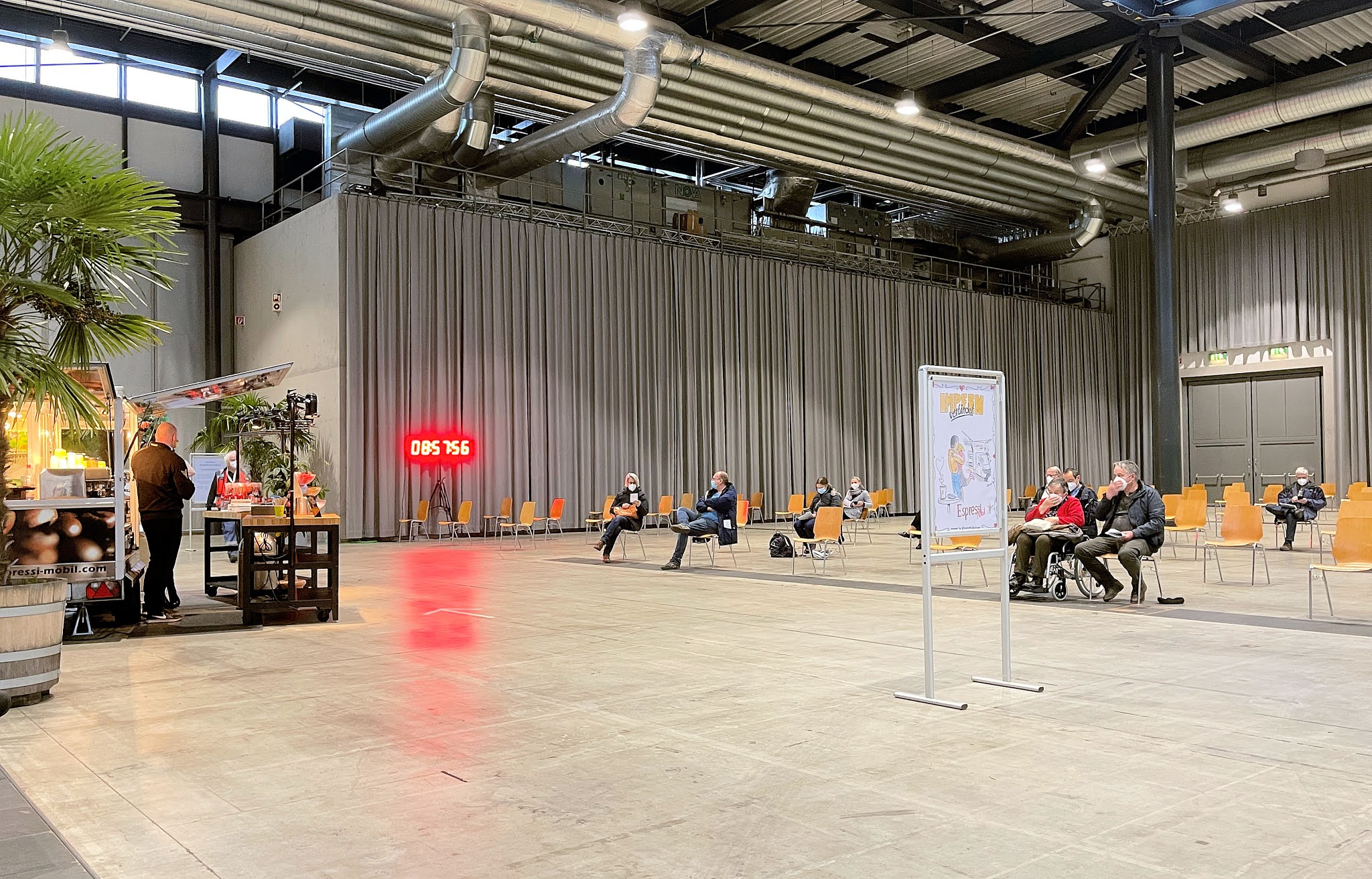
Recovery space and coffee bar at 8:57 a.m.
Before we inoculated persons were allowed to leave the hall, we had to sit on chairs at appropriate distances. So I helped myself to a well-deserved espresso served at a small kiosk near the exit.

©BZ
I was positively impressed by the staff's diligence, competence, and friendliness. The center could easily inoculate 2000 persons a day but is limited by the quantity of the vaccine delivered so far. In the meantime, they discovered that instead of five, they could squeeze out six (!) doses from a flacon.
*

Monday, January 4, 2021

Renaming

Let me start by wishing you all a healthy 2021.

The topic of my first blog in the new year is "renaming." Red Baron has written about the renaming of streets in Freiburg and Berlin. This time, two small towns carrying names that no longer seem acceptable are presented.

For safer traffic.
Please, don't drive too fast! (©Kurier/Österreich)
The first village, named initially Fucking, is located in the so-called Innviertel (Inn quarter), an area that has belonged to Bavaria for centuries. In 1779, the territory became Austrian in the Treaty of Teschen. This is why Hitler, born in Braunau am Inn, had Austrian citizenship. For more information, read the appendix.

Wikipedia knows: The village's name was particularly popular with British tourists; as a local tour guide explained, "The Germans all want to see Mozart's house in Salzburg; the Americans want to see where The Sound of Music was filmed; the Japanese want Hitler's birthplace in Braunau; but for the British, it's all about Fucking." Augustina Lindlbauer, the manager of an area guesthouse, added, "The area has lakes, forests, and vistas worth visiting, but there is an obsession with Fucking." She once told a British tourist, "There are no Fucking postcards."

Place-name signs were frequently stolen. So in August 2005, all eight signs at the four entrances to the village were secured against theft by setting them in concrete and riveting and welding them.

The settlement Fucking is believed to have been founded in the 6th century AD by Focko, a Bavarian nobleman. Initially, in 1070, the village's name was documented as Vucchingen; in 1303 as Fukching; in 1532 as Fugkhing; and it received its modern spelling in the 18th century. The -ing ending is an old Germanic suffix meaning "the people belonging to the place of Fuck," i.e., Fuck's people. In German, the vowel "u" in Fucking sounds like "book" in English.

The name was frequently used in German with an English connotation. A brewery fermented a Fucking pale lager beer and sold it as Fucking Hell. An effort to make Fucking into a spa (bath) ended badly with Bad Fucking.

Men at work (©Reddit)
On November 17, 2020, the municipal council decided to rename the village Fugging, effective January 1, 2021.

(©Sauerland Kurier)
The other village, still to be renamed (?), is an idyllic spot in the Sauerland region, close to the popular Biggesee, with hiking trails in the greenery. The place called Neger is located in the valley of the river Neger and is divided into Unterneger, Mittelneger, and Oberneger. The names are several centuries old. No one accuses the 400 inhabitants of racist tendencies. However, in the face of everyday racism and increasing linguistic sensitivity, the village's name causes confusion.

Where does the name come from? It has been documented for 700 years. The disturbing word is formed from a stem "Nag-." Nothing exact can be said about the origin and original meaning of Neger except that there is no derivation from the Latin word "niger," which means black or dark.

Other place names could be controversial, such as Mohrkirch and Negernbötel in Schleswig-Holstein, or Groß Mohrdorf in Mecklenburg-Pomerania. These places are small and little known. Although place names should be treated as proper names, some linguists claim that their origins play a less important role than their current meanings.

The place name Neger existed when its racist, personal designation in German was not yet known. The present-day meaning, however, is unambiguous.

A proposition goes like this: If the name can be derived historically from "Nag-," then why not "Nager"?* Then one could possibly say at some point: "Welcome to the Nager Valley!"
*Nager in German are rodents


Appendix:

Hitler (right) and his Bavarian comrades in France (©SZ)
Hitler, having renounced his Austrian citizenship in 1925 after serving during the First World War as a private first class and Meldegänger (reporting officer) in the German army in a Bavarian infantry regiment, became a stateless person living in Germany.

In 1932, he was eventually made a German in the Free State of Brunswick with the help of his right-wing friends, being employed as a Regierungsrat (state council) at the Landeskultur- und Vermessungsamt (state cultural and surveying department). He was supposed to be on duty as a clerk at the Brunswick state representation in Berlin, an appointment he never held.

The new state servant was sworn in on February 26, 1932, and at the same time received "citizenship in the Free State of Braunschweig," thereby becoming a "citizen of the Reich" under state law.

The "fascinating" story of Hitler's struggle for German citizenship is well documented.
**

Sunday, December 20, 2020

The Philosophy Is to Stay at Home

Angela Merkel said this wise phrase on December 13 when she and the 16 German governors decided on a hard shutdown for the country, given the rising number of Corona infections.

And then, I came across the following statement: Studies show that female leadership during the COVID-19 pandemic led to more evidence-based, sustainable, inclusive, and effective outcomes; see, e.g., Denmark, New Zealand.

While the Covid-19 infection rates remained low in Germany during the summer holidays, the pandemic picked up the pace with the cold days arriving.


The number of infections started to climb during October, so after lengthy deliberations, our government installed a "breaker" for the second pandemic wave, which some people called a lockdown light. The measures starting on November 2 and supposed to last until the end of the month, included the shutdown of all restaurants, but retail stores, daycare centers, and schools remained open.

By mid-November, the number of daily infections had stabilized, although at a high level. When at the beginning of December, the curve started rising again; governors and the chancellor agreed during a video conference on December 13 to step up the country's lockdown measures valid from December 16 to January 10. The complete lockdown should stop the exponential rise in Corona cases.


In spring, states in Germany's east had been spared during the initial Covid-19 outbreak. They have now become the nation's hotspots. The purple color was introduced to mark infection rates of greater than 500 per week and 100,000 people on the above map in the case of Saxony.

Germany has closed most stores and all schools to further limit social contact. With the previous lockdown light, the number of contacts was reduced by only 40%. However, a reduction of 70% would have been needed to reach the magic figure of 50 new infections averaged over a week per 100,000 inhabitants in a district.

The number of people requiring intensive care is rising rapidly.
About half of them need ventilators.
High infection rates will lead to a collapse of intensive care. While there are still enough beds and ventilators, qualified medical personnel is missing. 

By the way and what had been predicted: the initial measures of contact limitation combined with the AHAL rules have reduced the usual number of severe influenza infections by a factor of eight.

Red Baron lived through all these developments in the splendid isolation at the Reha. I was released on Sunday, the 13, and took a taxi home.

Following 8 weeks of growing, my only worry was to get a haircut before the total shutdown on Wednesday, the 16. In despair, I called my hairdresser on Monday, and he gave me a "cutting slot" on Tuesday 15 at 6 p.m. I already made a reservation for January 27, not knowing whether the hairdressers will reopen by then.

Last Thursday, December 16, Red Baron went downtown to his pharmacy looking for a body shower lotion I had left behind at the hospital. Limping on crutches into their premises, I benefitted from the free distribution of three FFP2 masks. They are paid for by the federal government and are handed out in pharmacies to people over 60. I simply call them Volksmasken.

Supported by my two crutches, I could not take any photos in town. Here are some impressions of deserted Freiburg borrowed from David Lohmüller's© Corona Fotoblog:

Obligation to wear a mask within the inner city
Rathausplatz and Bertold Schwarz monument
Konviktstraße and Herrenhuter stars
Here is an authentic German Christmas story to finish my last 2020 blog. The director of the Institute for Medical Microbiology at the University Hospital in Halle estimated, "If everyone in a church has masks on and there is a maximum of one person per five square meters in the room, church services at Christmas are acceptable. But only if there is no singing! Otherwise, we have too many aerosols."

Mass 2019 in Freiburg's Minster Church (©Patrick Seeger/dpa)
Two other eminent German virologists were vexed and wanted to have their finger in the pie too. So one virologist refined, "Even the common creed or the 'Our Father' must be silent - at most, the 'Amen' at the end is okay." The other expert demanded that every churchgoer must not only wear a mask but at least an FFP2 type. These masks could be financed through a collection. Isn't it all well organized in my country?

Dear friends, I wish you all a Merry Christmas, stay healthy, and I expect 2021 to be a better year than 2020. The city of Freiburg looks forward to 2021, provided:

We celebrate best by keeping our distance.
PS: Oh no, I just learned that there is a British Mutation of the Wuhan Virus. Brexit now is real if it wasn't for the trade, with most EU countries cutting all flights from and to the UK.
*