
|
| Blechkuchen and Prasselkuchen |

I checked into the Augustinum monastery for three nights, where I had asked to be booked in Martin Luther's cell.

|
| The entry to my cell |

|
| The spartan interior of my cell. Note the sandals. |

|
| My look into the monastery garden |

I took my frugal Luther-like breakfast - except for the coffee I can't live without - bread, cheese, yogurt, and scrambled eggs in the Renaissance Court.

|
|
The Renaissance Court in the morning sun. The entrance to the monastery garden is located on the left, just below my cell. On the right is the door to the refectorium (refectory), now Luthersaal, where breakfast is usually served. |

Here are two plans of the vast monastery complex.


|
| The cloisters |

|
| The monastery's flowery western frontage |

|
| Luther Rose in the courtyard of his birthplace at Eisleben in the Eichsfeld. |


My First Walk

Heading for Krämerbrücke (Grocer Bridge), I passed Him on Am Anger, the former common green now a large square in the middle of Erfurt. The church in the back is Kaufmannskirche St. Gregor (Merchant's Church St. Gregory), a 14th-century Gothic parish church.

|
| Note my mouth-nose-cover on the table. |

...with old Bach watching me from a window vis-à-vis.

Walking toward the cathedral square, I met Bernd das Brot. Erfurt is the home of KiKa (Kinderkanal, i.e., Children's Channel). With Sesame Street being such a success on German television, they created a German version starring Bernd the Bread instead of grumbling Bert.
Zum Güldenen Rade

On the recommendation of a good friend, I had dinner at the restaurant To the Golden Wheel, reminiscing about the red Wheel of Mainz. Note: The straw in the hole above the entrance is a good sign, meaning the fresh beer is on draft.

I was thirsty, so I had an alcohol-free wheat beer brewed by Benedictines as an appetizer. Old man, get your water balance right!

Red Baron chose a local specialty for dinner called Thüringer Klöße gefüllt mit Rot- und Leberwurst auf Sauerkraut an Zwiebel und Meerrettichsauce (Thuringian dumplings filled with red and liver sausage on sauerkraut with onion and horseradish sauce). I drank the Köstritzer to the health of Kenneth, a friend in Madison.
At the Market
The following morning, I went to the market on Domplatz (cathedral square). Here I had my real Thüringer Bratwurst, remembering the good old times in Weimar.

It is always the same. You ask the person taking the picture to close in on the wurst, but they don't follow the advice.

I became thirsty and went to the nearby beer garden at the foot of the cathedral hill, watching the market people from a distance. Regrettably, they served the beer in plastic cups.
An offer caught my eye as I passed the market on my way to the guided tour appointment.

Air-dried Stracke from the Eichsfeld. This is what I call Luther's sausage. Although I gave up consuming sausages - I eat them on special occasions (see above) - I could not resist and bought a small Stracke.

Here is the thin object of desire. I read the following: "The Eichsfelder sausage gets its unmistakable character mainly from the warm meat processing. It is made mainly from cuts of pork from the region, with a longer fattening period. Traditional natural spices and the artisan skill of Eichsfeld sausage makers give this firm raw sausage an extraordinary taste. The Eichsfelder Stracke receives its perfection through several months of climate ripening."
A Guided City Walk
The guided tour started at 11 a.m. and was the first one allowed in Erfurt during the still-waning Corona pandemic. Red Baron had actually booked two tours: one on foot in the morning and one by streetcar in the late afternoon.
Our guide reminded the smaller group of the distance rule. Mouth-nose covers weren't required because our group avoided indoor sightseeing.

|
| The fish market is surrounded by richly decorated Renaissance-style patrician houses. |
|
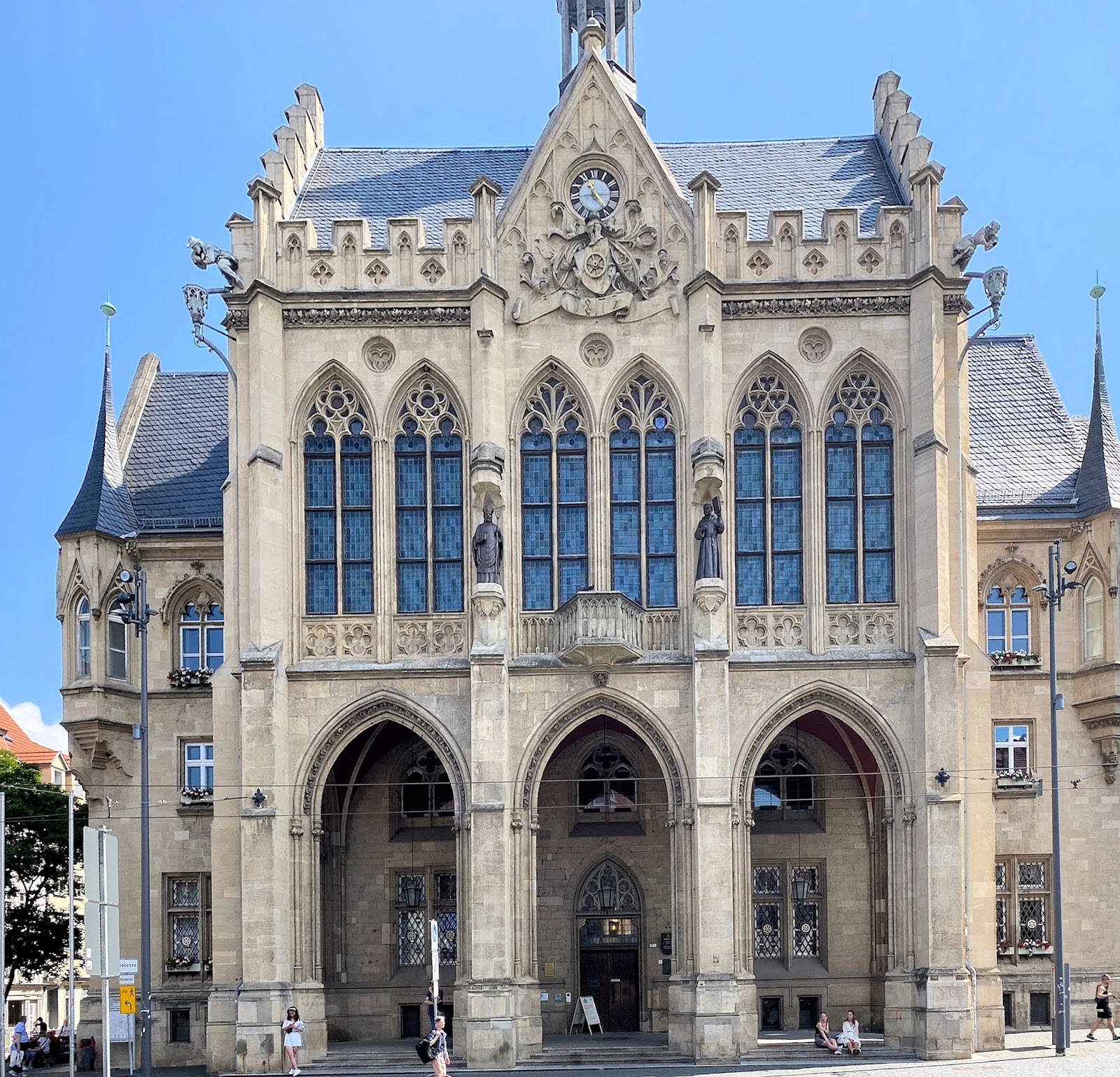
| The impressive Rathaus (town hall) was built in the neo-Gothic style. |

|
| The Haus zum Roten Ochsen transformed into Erfurt's art gallery. |

|
| The narrowest house in Erfurt |

|
| Beautiful: Zum Sonnenborn (Sun-Spring) |

|
| The old woad storage, now used as a theater. |

|
| Semen donor? No, woad seeds. |

It was hot in Erfurt on Saturday. I rested with a fresh Erdinger wheat beer and watched tourists entering Krämerbrücke through a tunnel under Aegidienkirche.

The producer of unusual ice cream on Krämerbrücke served a long line of customers. The gentleman in the center still can't decide which ice cream flavor he wants.
A Streetcar Sightseeing Tour
This was not a city tour, but we used Erfurt's extended streetcar network to pass by several sights in the suburbs and on the periphery.

|
| Mouth and nose covers are in place, and we maintain social distancing. |

|
| Note the Wheel of Mainz |
**

No comments:
Post a Comment