Friday, August 30, 2024

The Biography of a Free Thinker

Desiderius Erasmus Roterodamus, the prince of scholars, was a genius far ahead of his time.

Toward the end of his life, marked by countless recriminations and accusations, he turned into a Stinkstiefel (grouch, grumbler) while living in exile in Freiburg.

Red Baron has collected all the information about Erasmus's stay in Freiburg from 1517 to 1521 on his history page and has already written one blog post. Here is another titled Erasmus in Freiburg.

Langereis' book cover shows a painting by ©Neel Korteweg,
Amsterdam 2012. Erasmus in a poppy shirt. Acrylic on linen 100/85 cm
In 2021, the Dutch historian Sandra Langereis published Erasmus's ultimate 1200-page biography, which Bärbel Jänicke translated into German in 2023. I read this opus magnum as an e-book.

My readers may remember my blog about Wieland's biography. Red Baron is fascinated by the lives of prominent figures from the past, particularly when they met other prominent contemporaries. The descriptions of those encounters bring back the past.

So it was with Erasmus, who gave a welcoming speech for Philip the Fair in Brussels, met Kings Henry VII and VIII of England, and wrote letters to popes such as Leo X.

As the illegitimate child of a priest, Erasmus was not destined for such a future. He was not entitled to receive ecclesiastical ordination. The flaw of his damnable birth runs like a red thread through his life.

In a Compendium*, Erasmus euphemistically reports disguising his origin by stating that his father, Gerard, was destined by his parents to lead a consecrated life. Still, he fell in love with Margareta, the daughter of a doctor. When Gerard's parents refused to consent to the intended marriage, the son ran away, leaving behind a farewell letter adorned with the symbol of the marital handshake, "Farewell, never to be seen again."
*A brief description of his childhood

Gerard went to Italy to study law without a degree. He earned his living as an excellent copyist with manuscripts of essential authors. He received a letter from his parents while he was in Italy with the news that his lover, Margareta, had died. Grief-stricken, he became a priest. From then on, he dedicated his life, body, and soul to the faith. When Gerard later returned home, he found Margaret alive and well. She had given birth to his child: Erasmus. Priest Gerard" never touched Margareta again." 

And Gerard did not abandon his child. On the contrary, he gave his son a good education.

However, new research has revealed that Erasmus was only conceived long after Gerard had returned from his Italian study trip to Holland. Erasmus was, therefore, the son of a priest. Worse still, Gerard and Margareta lived in concubinage, and Erasmus had a brother, Pieter, who was three years older.

Erasmus was about 13 years old when his mother died of the plague, and his father followed shortly after. His guardian placed the boy in a boarding school. His relatives then forced him into a monastery run by the Augustinian canons. As a canon, Erasmus was ordained a priest in 1492. He secretly legalized this ordination in 1516 following correspondence with Pope Leo X.


As a schoolboy, Erasmus decided to become a writer and, while studying in Paris, wrote the proverbial dictionary Adagia, which became a bestseller.


Another famous work is the satire Moriae encomium, "Praise of Folly," where not he but the personified Folly denounces ecclesiastical and secular grievances. To learn more, consult my blog about the opera titled The Folly.


Above all, Erasmus's works, the Novum Instrumentum, stand out. It is an entirely new Latin translation of the New Testament from the original Greek sources. Red Baron once attended a lecture and wrote a blog about the Novum Instrumentum, but there is more to report in another blog.

The young, culture-loving Medici Pope Leo X was delighted when the world-famous author dedicated this famous Novum Instrumentum to him. In return, Erasmus asked Leo for a favor, which the pope delivered when Erasmus was in London.

On Good Friday 1516, Leo's special representative Andrea Ammonio absolved his friend Erasmus in a strictly closed ceremony in his private chapel and granted the Dutch humanist a triple papal dispensation. Erasmus' unholy origins were thus finally a thing of the past.

Henry VIII and Cardinal Thomas Wolsey then granted him an audience. Erasmus was told that they had in mind an annual income for him from a benefit yet to be determined
.

Fiddlesticks, because the second common thread running through Erasmus' life is his lack of money. In a letter to his friend Guillaume Budé in Paris in 1501, he wrote, "I am married to Mrs. Poverty, and unfortunately, she is so infatuated with me that I simply cannot drive her away, no matter how nasty I am with this woman."

His friend wrote back that Erasmus should cherish his wife, Poverty, because there would be no literature without her love. Budé also knew this woman, but he lovingly referred to her as his muse rather than his curse.

Budé's answer is still practiced at universities where professors' assistants sometimes work for starvation wages. When asked about this, one professor said, "Hungry birds sing beautifully."

Erasmus's financial situation changed dramatically when he settled in Basel in 1521 to work for his favorite printer, Johann Froben. He labored tirelessly as an author, editor, and canvasser for five, six, and, when the Frankfurt book fairs were back on the doorstep, seven printing presses at the same time, single-handedly delivering manuscripts. Erasmus ensured that Froben could print around twenty new and old editions of his bestselling titles each year. Froben earned a fortune.

In December 1521, Froben bought Erasmus a house and "remunerated"* him with 200 gold pieces a year.
*Royalties were unknown, but pirate printing was standard at the time

Now, Erasmus supported young talents even more and remained in correspondence with many of them. "It is really clever to move into a room with a barber if you want to learn the local language," Erasmus wrote with amusement to one of his former students in Paris, who had reported that he wanted to work on his French. "But it would be even smarter to look for a sweetheart because a French girl would be better for his French than thirty teachers," added the Nestor in Basel very humanely.

This reminds me of the saying, "The best way to learn a foreign language is with a long-haired dictionary."

To Erasmus' great gratitude, the jovial publisher provided a further two hundred Rhenish gold pieces in 1526 to buy a city garden, which the star author had longed for for years.

But at the beginning of 1529, this good life ended. On February 9, the day before Ash Wednesday, when the Great Lent was to begin, a devastating iconoclasm took place in Basel with the approval of a reformist council majority and under the protection of an armed militia that occupied the market square with rows of cannons.

Erasmus recalls as an eyewitness: "Nothing of the statues was left intact, neither in the churches, nor in the vestibules, nor in the cloisters, nor in the monasteries. What there was of painted pictures was covered with a whitewash of lime; what was inflammable was thrown on the pyre; what was not was smashed piece by piece. Neither value nor art convinced them to spare anything. On Ash Wednesday, the iconoclasts set fire to a pyre of destroyed works of art on Münsterplatz."

As the riots against the followers of the Old Faith intensified, Erasmus fled Basel in April 1529 to the Catholic city of Freiburg. He lived there until 1535, when he returned to Basel, where he died on July 12, 1536.

After Erasmus's death, his considerable legacy became known for an efficient international scholarship system for gifted students. They flocked to Basel from far-flung corners to enroll at the university.

Today's European Erasmus Foundation builds on this.
**

Saturday, August 24, 2024

Bunbury

Yesterday night, Red Baron went to the theater and saw Oscar Wilde’s comedy Bunbury, or The Importance of Being Earnest, in an open-air performance on a warm summer evening. My faithful readers may recall my recent visit to the Theater der Immoralisten.


Wikipedia knows, “This farcical comedy depicts the tangled affairs of two young men about town who lead double lives to evade unwanted social obligations, both assuming the name Ernest while wooing the two young women of their affections.” 

I first encountered Oscar Wilde as a schoolboy when we saw Lady Windermere's Fan at the Hamburg Kammerspiele. It was my first visit to the theater to see a socially critical comedy. 

My second contact with Oscar Wilde was through my mother-in-law, who raved about The Picture of Dorian Gray. She read the novel as a young girl, and she teasingly alluded to Oscar Wilde's homoerotic tendencies. 

The Freiburg performance could not resist this allusion either. After all, all the scenes in the play took place in a men's restroom, which in retrospect need not even be seen as an alienating gag. 

And, of course, it is an allusion to Wilde's homosexuality when one of the protagonists, Algernon Moncrieff, comes covetously close to his friend John Worthing and strokes his cheeks. 

Lady Bracknell, who does not want to marry off her daughter, Gwendolen Fairfax, to the foundling John Worthing, is played so wonderfully by a man. Shortly after her first appearance, she naturally empties her bladder in a urinal. 

The governess, Miss Prism, watching over Worthing's ward, Cecily Cardew, is also played by a man and occasionally gets a slap on the butt from the gay Reverend Canon Chasuble. 

Oscar Wilde called his last comedy A Trivial Comedy for Serious People. Although there is a happy ending for the comedy's bisexual protagonists, Wilde was accused of homosexual acts shortly after the premiere in 1895. In the course of a public trial, he was sentenced to two years in prison with forced labor. Ruined in health, financially, and socially, Wilde died in Paris in 1900 at the age of 46. 

A running gag is a play on words, earnest and Ernest. Both Gwendolen and Cecily have the idea of marrying a man named Ernest. So, for the two, it is important to be earnest (Ernest?). 

Gwendolen places her entire faith in this forename, declaring in Act I, “The only really safe name is Ernest.” Cecily shares her opinion in Act II, “I pity any poor married woman whose husband is not called Ernest.” Luckily, this world play works as well in German, with Ernst being a name and ernst meaning serious(ly).

A blustering applause. From left to right:
Reverend Canon Chasuble, Gwendolen Fairfax, Lady Bracknell,
Algernon Moncrieff, Cecily Cardew, Miss Prism, John Worthing
My gentle readers may forgive me for not explaining the complicated plot of the comedy. Here is a link to Wikipedia instead. 

I admit that I was positively distracted elsewhere during the play.
**

Sunday, August 11, 2024

No Soul Comforter

Yesterday, I read an article in Der Spiegel that shocked me, and no, it wasn't the infant mortality rate in the Middle Ages, around 30%.

At that time, people were deeply religious. For many, the salvation of their soul was more important than life in this world. So, for parents, it was essential that their babies be baptized soon after birth to cleanse them of their original sin.

In many cases, however, the child died before receiving the sacrament of baptism. This was a horror for the parents because it meant that the souls of these little beings fell victim to eternal damnation. Their corpses were not allowed to be buried in the consecrated earth of a cemetery.

The dead children were tainted with the stain of original sin*, and the medieval Church was no Seelentröster (soul comforter) for the parents.
*Here is a blog about a lecture on original sin  

Church Father Augustine (©Ercole De Roberti/Mondadori Portfolio/Getty Images)
The strict rule that unbaptized children will go to hell comes from Church Father Augustine, who is still regarded by many Catholics as the second St. Paul in the interpretation of the faith.
 
So, it became custom, albeit forbidden, to bury the little bodies near the church wall so that they would be sprinkled with rainwater from the church roofs. This water was considered sacred and, therefore, expected to have a healing effect. Although the sacrament of baptism may only be administered to the living, a Traufkind perhaps would become a Taufkind?*
*A play on words in German. Traufen, i.e., eaves catch water: A child buried below the eaves will become a baptized child.

A skeleton of a Traufkind afflicted with the stain of original sin
from excavations near the Church of Eggolsheim (©IN TERRA VERITAS Bamberg)
People's lack of understanding about the fate of innocent children ultimately led towards the end of the 18th century to the idea that unbaptized children endure a Vorhölle (limbo puerorum). Still, the idea of unbaptized children ending up in hell remained part of Christian heritage and in everyday life for much longer.

It was not until 2007 that the Vatican decreed that unbaptized children could at least hope for the "blissful vision" of God. Nowadays, those Sternkinder (star children) are also entitled to a church funeral.
**

Thursday, August 8, 2024

Radioactive Waste in the Summer Hole

In German, there is a word for the uneventful summer season called Sommerloch (summer hole), which can be translated as silly season or summer slump. Mind you, the Olympics are still on, Ukrainian troops are invading Russian territory, the world is waiting for the Iranian retaliation against Israel, and Kamala chose her running mate. Still, Red Baron is sitting in the summer hole, waiting for a worthwhile subject to write a blog about.

Yesterday, the Freiburg Institute for Applied Ecology made the national news with nuclear waste, a topic on which I have written several blogs.

©Sebastian Kahnert (dpa)
In most of those blogs, I castigated the various governments' obfuscation tactics. Their message is always the same: They will take care of nuclear waste, but for lack of a solution, they are putting the problem off until the Sankt Nimmerleinstag (doomsday or the day the cows come home), still keeping us citizens in the dark.

In my June 2011 blog, I criticized the complacent phrases: 
- The unsolved global problem of the permanent disposal of radioactive waste must be solved, and 
- The permanent disposal of radioactive waste must not be left to future generations.

My second blog of June 2013 summarized: High-level radioactive waste is a poisonous legacy for future generations. Considering all the costs nuclear energy will incur for our descendants, it is not a source of cheap electricity. We would be well-advised not to make their burden too heavy.

In my third blog of April 2014, I discussed the situation in neighboring Switzerland. They plan an underground site for nuclear storage near the German-Swiss border. If everything works out and the Swiss people vote yes in a national referendum around 2028, the final storage facility will start operating in Switzerland by 2060.

In my fourth blog of October 2014, I reported on a symposium: Where Shall We Store Our Radioactive Waste? The next day, a well-balanced article in the Rhein-Main Presse did not refrain from an attention-grabbing headline: Where to place the radioactive poison?

In my fifth blog of May 2015, I questioned whether the nuclear power plant operators had not bamboozled our government's lay(wo)men, who apparently do not know the difference between provisions and reserve allocations. 

I thought I had written enough on the topic, but yesterday, Red Baron learned that in a paper commissioned by the Federal Office for the Safety of Nuclear Waste Management (BASE) and now published by the Freiburg Institute for Applied Ecology, the search for a final repository for highly radioactive nuclear waste in Germany could take more than 40 years longer than initially planned. 

Already in November 2022, the ministry announced that the original timeline of 2031 could not be met. Shortly afterward, documents from the Federal Company for Final Disposal (BGE) became public, according to which the search could extend until 2046 or, in another scenario, even until 2068.

The latest report suggests that, under ideal conditions, a decision on the location of a final repository for highly active nuclear waste could be expected as early as 2074.

The Federal Minister for the Environment, Nature Conservation, Nuclear Safety, and Consumer Protection, Steffi Lemke, of the Green Party hurried to say, "It has been known for some time that the finding process for a final storage site cannot be completed by 2031. However it is a "science-based, transparent and learning process, the requirements of which are geared towards finding the site that guarantees the best possible safety for a period of one million years."

Steffi continued, "The recent report does not reflect the latest progress. This study has not been able to incorporate all the latest information and facts because we have seen dynamic developments in recent months. For me, the demand remains that we must find a final repository as quickly as possible that is as safe as possible - for us and future generations."

Another load of empty phrases. What does Steffi mean by dynamic developments in recent months? 

The summer hole is not a black hole. So, the radioactive waste will not simply disappear.
**

Saturday, August 3, 2024

Statusangst

While writing the blog about status angst,  I came across a book by Alain de Botton with the same title. He defines status angst as "We are afraid of failing to meet the criteria for success set by society and consequently losing prestige and respect."

Red Baron was rather inspired by an article by Christine Holthoff on t-online titled Angst vor dem Abstieg. She writes that Germans have angst about losing their socio-economic status. Only we Germans?

©DW
German sociologist Hartmut Rosa explains, "The future today is nothing but a defensive struggle on a downward slope. Against the Russians. Against climate change. Against economic decline. Against the AfD. Against migration. That creates hopelessness and anger, and it will add voters to right- and left-wing populist parties.

Germans fear the loss. Whereas my parents rightly believed that their children would be better off than themselves one day, today, parents fear the loss and feel it the other way around: their children will be worse off.

This phenomenon is called status angst, the worry that one's own economic situation is at risk and that social decline is permanent. Those who fear that they could lose something become skeptical of democracy and move toward the political fringes. This explains why more and more middle-class citizens and young people are voting for the AfD and Sarah Wagenknecht's party. It also explains why those parties are strong in East Germany, where the people have already experienced a downward spiral in their lives.

Most of my country fellows are dissatisfied but are not doing so badly. Sociologist Rosa explains the strange discrepancy, "Our perception of whether we are living in good or bad times depends less on what we have and more on what we are moving towards."

And here, communication comes in. "Bad" things should be seen from Angela Merkel's 2015 angle: "Wir schaffen das (We'll make it)."

Is the future all renunciation, bans, and war?

We must reflect on our abilities and resources with which future challenges could be met. The more confident we are to overcome a crisis, the less threatening it becomes.

Instead of focusing on renunciation and bans to fight the climate crisis, it would be more helpful to emphasize what is gained when fewer combustion engines pollute the air, when cities become greener, or what individuals save when they use heat pumps instead of gas heating.

Instead of creating the impression that migration is bad and a burden, we should consider that without an imported workforce, branches like the nursing professions would collapse. At the same time, the statutory pension insurance scheme will have more contributors thanks to immigration from abroad.

Facing Russian aggression, terms such as "war capability (Kriegsfähigkeit)" and "new military service (neuer Militärdienst)" will make look the future consisting of war and rearmament. Instead, it should be emphasized that this is necessary for our long-term goal: A more peaceful world.

Our government should give people the feeling that, yes, although there are a lot of problems, we'll manage them because, firstly, we know where we want to go and, secondly, by what means.

Germany, the nation of poets and thinkers, is brooding and worried. It was never a country of ease and is permanently darkened by its Nazi history, its dense forests, and gruesome fairytales. We lack the savoir vivre of our southern neighbors.

The cheerful summer of soccer in 2006 showed that, at times, we can be like that, too. In the summer of 2024, Germany lost against Spain in the European championship. No cheering, but realizing that our southern neighbors play better soccer, too.
*

Monday, July 29, 2024

Where to Take Our Books?


A few weeks ago, Professor Sabine Wienker-Piepho, the Vice President of the Freiburg Museumsgesellschaft, gave an enchanting keynote speech on book ownership today.

The term "bibliocide" was only partly appropriate, but it was apparent how concerned she was about the future of printed books. Here are some of her slides.


The Encyclopædia Britannica is no longer available in print but is available online. Unlike the free encyclopedia Wikipedia, you have to subscribe. Some people only trust the EB and are suspicious of Wikipedia.

As an IM (informal contributor) to the German version of Wikipedia, I would like to emphasize the ongoing topicality of its information and its completeness through swarm knowledge. At the same time, I stress that some of my Wikipedia colleagues are in a frenzy about making corrections. On the other hand, the style and grammar of WP articles often need improvement.

The existence of a 14-volume Fairy Tale Encyclopedia was new to me.


This is not a work of art, but are unsold copies of the "best-selling" The Fifth Shade of Gray arranged in some fancy way in a bookshop in the UK. Books may seem to be selling less and less, but in the States, every guest on Stephen Colbert's Late Show, whether actor, sportsman, or politician, presents his/her newest book.


"Intellectual" Boris in front of a half-empty bookshelf in 10 Downing Street? On the top left is the book Sabine described as the dystopia of book ownership: Fahrenheit 451 by Ray Bradbury, published in 1955. Red Baron still remembers the movie in which government agents hunt down books with flamethrowers.

The Church and governments have always tried to eliminate unpleasant views by burning books. Luther's writings were burned; in 1817, students consigned reactionary books to the fire at Wartburg Castle, and the book burning by the Nazis in 1933 was the high point so far.

There were attempts to burn books not only in Berlin but also in Freiburg.

The Documentation Center in Munich displays some of the books' titles consigned to the fire during the 3rd Reich in its vestibule.

Red Baron loves books, but he also suffers from the accumulated crowd.

Click to enlarge
Here is the main shelf in my study, which holds physics, history, language, and literature books.


In my study, there is also a cupboard with special editions such as the works and the complete scientific edition of Christoph Lichtenberg, my Hans Küng collection, Karlheinz Deschner's complete Criminal History of Christianity, Annegarn's World History of 1899, Gottfried Keller's works, Theodor Fontane's works, Jean Paul's works, a three-volume Meyers Lexicon from 1931 to 1934 with an addendum on the Nazi seizure of power in volume 3, and art volumes.


My bedroom has a shelf full of literature about Freiburg and DVDs ...


... and a second one with travel literature and comics. Since starting my job at CERN, I've collected a complete French edition of all the Asterix comics and much secondary literature on the subject. Queezed in a corner is a charger with multiple outlets for my various iDevices.


In the living room, I keep the German classics that Elisabeth once inherited from her aunt Kathi. Goethe, Schiller, Heine, Lessing, Kleist, and even Shakespeare were once a must in every German bourgeois household. A French literary history and many unique individual books are on the lower shelves.

Where do I take my books?

When I moved from Geneva to Freiburg in 2001, I offered most of my math and physics books to the university library. I had kept them in Geneva for 32 years, as German textbooks are not in demand in a French-speaking environment. The university library showed interest and asked me to bring the books over. That was too much because they were in two small boxes. Eventually, they sent a van.

Four years ago, I offered my Freiburg books to the city archive posthumously. Yes, they already had an extensive collection and would like well-preserved individual copies. I assume that interest has since died out completely.


Sabine's last slide is giving me a headache: Do books have their fates?

In the Middle Ages, every handwritten book was a treasure, and even after the invention of printing, books were initially expensive. During the Thirty Years' War, entire libraries were plundered and taken away, from Heidelberg to Rome, from Prague to Upsala.

Today, many publications are not worth the paper they were printed on.

In the discussion, many people anecdotally shared their experiences with too many books, but had no solutions for their own floods.

Red Baron also has no solution for where to take his many books. He has started reading e-books and sees the advantages, not only in saving paper, but that's another story.
**

Tuesday, July 23, 2024

Democracy and International Organizations

This was the last Saturday lecture in the Studium generale on democracy in all its facets: Democracy - Foundations and Challenges.


It was a refreshing end to the series, as Professor Paulina Starski gave her talk in a charming, spirited, and convincing manner.


Abraham Lincoln gave the best definition of democracy. My American friends will rejoice.


The normative bases of democracy are constitutional law and international law. The right to democracy is in Article 21 of our Grundgesetz (Basic Law) and in the Universal Declaration of Human Rights.


But Paulina wanted to present the structure of democracy in a legally clean way. She showed the audience that, in a democracy, there are structural principles such as a federal state, a republic, democracy, and the rule of law. 

State objectives such as the welfare state, environmental protection, and animal welfare are distinguished from these structural principles.


Furthermore, in a democracy, there are objects of legitimacy, such as state authority, and subjects of legitimacy, such as the people.


Red Baron learned that the Peace of Westphalia, which was concluded in Münster and Osnabrück, is regarded as the birth of international law. Read more.


States, peoples, and individual groups, such as Non-Governmental Organizations and International Organizations (IOs), are important subjects of international law.


International Organizations deal with cross-border problems. Thus, some competences of individual states are assigned to IOs. When states cede sovereign rights to IOs, these bodies will have a de facto and legal impact on domestic issues.


Article 23(1) of the German GG (Basic Law) stipulates that the federal government may transfer sovereign rights to IOs by law, with the approval of the Bundesrat (German Senate).

Click to enlarge
Here is an overview of the United Nations' individual organizations.


Prof. Starski spent the rest of her presentation on the relationship between individual states and the European Union (EU). The institutions are listed as:

European Parliament

The European Council is a collegiate body that defines the overall political direction and priorities of the European Union.

Council of the European Union, also known as the Council of Ministers, is the second legislative body. Together with the European Parliament, it amends and approves or vetoes the European Commission's proposals.

European Commission

European Court of Justice

European Central Bank

European Court of Auditors.


The institutional structure of the EU is complex.


On the democratic legitimacy of the EU, Paulina showed a couple of densely labeled slides that were difficult to read and digest during the presentation. I reproduce two of them here.


Prof. Starski concluded that the European Parliament has only limited democratic legitimacy.


Paulina transferred Willy Brandt's famous call on her last slide: We should "dare more democracy" in the context of International Organizations.

I want to answer Paulina's call with a quote about democracy in the United Kingdom that I have never forgotten since my school days: "Our government system isn't one hundred percent democratic, but it works." My English teacher attributed the quote to Winston Churchill.

Churchill's statement, "Democracy is the worst form of Government except for all those other forms that have been tried from time to time," is better known and documented.
**

Sunday, July 21, 2024

Science, Society, and Politics


This was the final seminar in the series, "Which Truths Can We Build Upon?" Physics and Theology in Discourse, held entirely in English. In the final discussion, it turned out that language was an issue. I'll come back to it later.

The seminar's organizer, Prof. Buchleitner, gives some ultimate instructions
to students Jayadevan and Sakhibov.
This scene reminds me of the recent European Football Championship
 when a coach talks to players before they enter the field. 
On previous occasions, up to five students had organized a seminar, but in this case, only two addressed the topics of science, society, and politics.


Their second slide, which showed two of my favorite physicists, Sabine Hassenfelder and Neil deGrasse Tyson, already left me wanting more.


In my home country, everything has to be orderly and defined, so the students showed us two formulations of science.

Immanuel Kant wrote: "Every doctrine, if it is to be a system, i.e., a whole of knowledge organized according to principles, is called science.

The Federal Administrative Court (Bundesverwaltungsgericht) defined science as everything that, in terms of content and form, is regarded as a serious attempt to ascertain truth.

The subtitle of this seminar was Critique of Scientism. Here is a definition:


The students presented additional subdivisions of scientism but concluded that scientific methods are not the only reliable avenues for acquiring knowledge.

As far as society is concerned, it sometimes has problems with science:


To contradict such a statement opens a new can of worms and goes beyond the scope of this blog.

In the States, some Evangelical parents keep their children out of certain science classes, afraid that scientific education will lead them to doubt and ultimately reject their faith.


On the other hand, Neil deGrasse Tyson has a strong opinion on science education. But what really shocked me was when Karthik showed the following headline:


Will there no longer be contributions to physics from outstanding scientists from India? Who hasn't heard of Raman scattering and the Bose-Einstein statistics?


In the seminar discussion, somebody raised the question of whether there is ethics in science. I stood up and declared categorically: Physics has no moral, but physicists should have one!  

Remember Heisenberg's visit to Copenhagen, where he attempted to convince Niels Bohr to talk to the Allies about not building the bomb. The meeting ended in a complete misunderstanding. 

In the movie Oppenheimer, the pricks of conscience of the bomb builders are apparent.

The discussion on ethics in science reminded me of a statement by Richelieu on the morality of states.

Following the energetic intervention of Catholic France on behalf of the Protestants in 1635 during the Thirty Years' War, the cardinal was reminded of the Christian virtues of forgiveness and charity. Richelieu responded with the following astonishing argument: "The interests of a state and religion are entirely different. The state must pursue Christian goals, but it is a political collective without an immortal soul and can advocate things not permitted to an individual Christian. The salvation of man, on the other hand, is finally realized in the hereafter, so it is not surprising that God wants the individual to leave vengeance to Him ... But the states have no continuance after this world; their salvation is now or not at all, i.e., the Bourbon king fights the Habsburg emperor.

Here is another statement by Neil deGrasse Tyson:


I do not share Neil's opinion, as this seminar posed a question that physicists can't answer, but theologians do. My Catholic school catechism from the elementary school in Hövelhof had the answer to, "What are we on earth for?" To love God, to serve him, and thereby go to heaven.

Astrophysicist deGrasse Tyson is an atheist. So the following statement is in line with his "belief" and research: I want [upon death] to be buried, just like in the old days, where I decompose by the action of microorganisms, and I am dined upon by any form of creeping animal or root system that sees fit to do so.… I will have recycled at least some of the energy that I have taken from it back to the universe.

Many foreign students study at German universities; English is their lingua franca. Holding this course in both languages was only partly successful. In the general discussion about the seminar, English-speaking students complained about the sometimes complicated German contexts. Nobody likes to reveal information beforehand, but I proposed that the slides to be presented be made available on the university's ILIAS platform for study before the lecture.
**

Tuesday, July 16, 2024

World Heritage of the Middle Ages

... is the title of an exhibition at the Archäologischen Landesmuseum Konstanz. This year, the Museumsgesellschaft Freiburg made its summer trip to Constance and Reichenau Island, commemorating the monastery's founding 1300 years ago. Professor Thomas Zotz, an expert on medieval history, guided our group.

St. Pirmin, reading his
Dicta Abbatis Pirminii, de Singulis Libris Canonicis Scarapsus?
(Words of Abbot Pirminius, extracts from the Single Canonical Books)
It all started in 724 when the peregrinating monk and missionary Pirmin founded a monastery on Reichenau Island. Benedictine monks preferred islands to settle.


The founding document of Reichenau was forged in the 12th century on a predecessor that had been scraped off and supports the legend of Reichenau. According to this, the monastery was founded in 724 on the orders of Charles Martel, who was Mayor of the palace (Hausmeier) of the Frankish Empire from 718-741.

Here is a statue of Benedict of Nursia
Benedict must have known the Psalms well, for he based one rule of the order on Psalm 116, verse 62: At midnight I will rise to give thanks to You. Because of your righteous judgments, Benedict continued invoking verse 164: Seven times a day, I praise you for your righteous rules.

The rules
The motto of the Benedictines was ora et labora. 

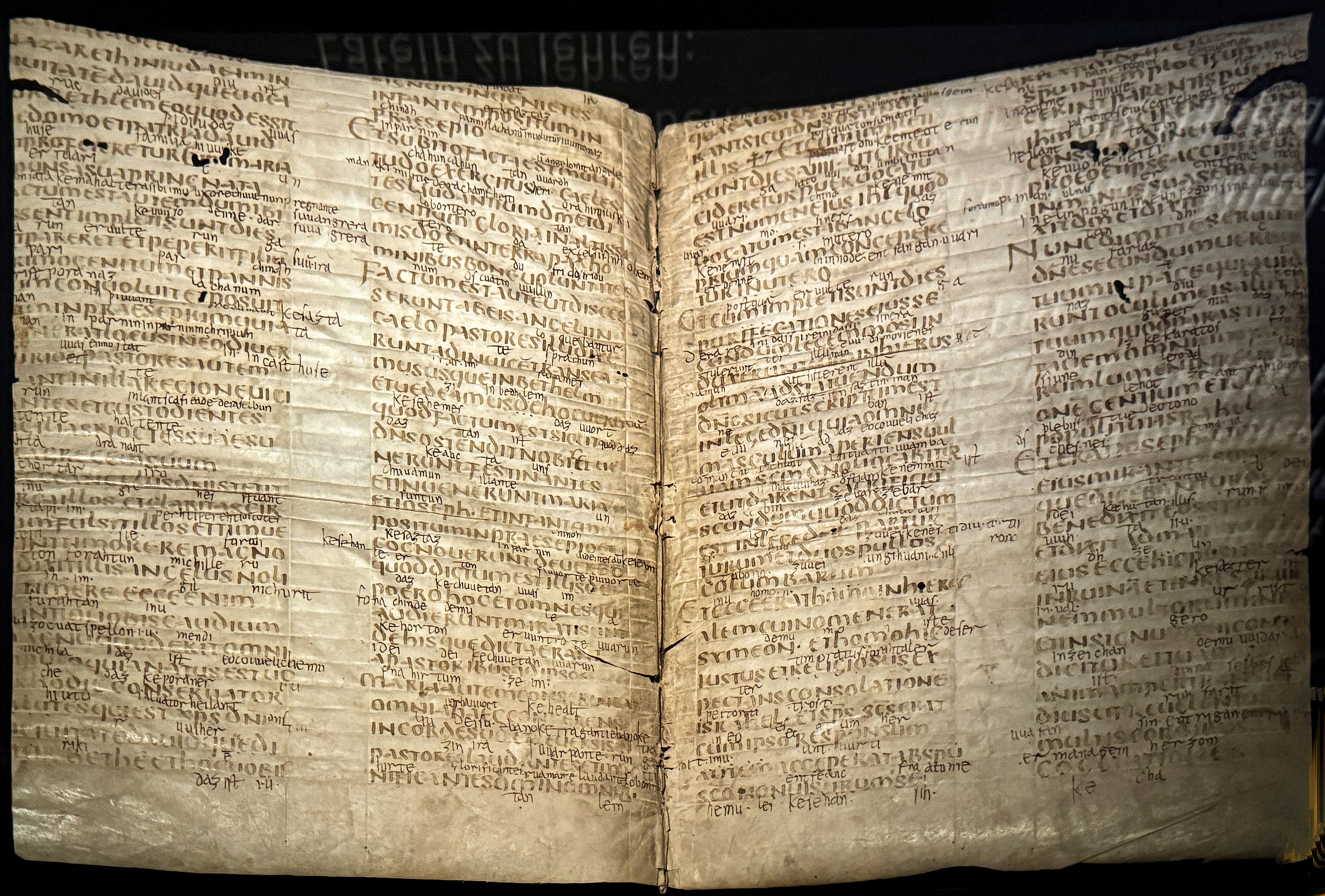
The monks used glosses to help them better understand the Latin texts.
They sometimes wrote these reading aids in Old High German directly into the original texts,
as in the case above in the Gospel of Luke.
These annotations are among the oldest treasures of the German language. (click to enlarge)
However, they not only labored on the most extensive estates of their abbeys but also inside the monastery walls, learning biblical texts.
 
The hierarchy

The region on the High Rhine and Lake Constance is characterized by the founding of many monasteries. 

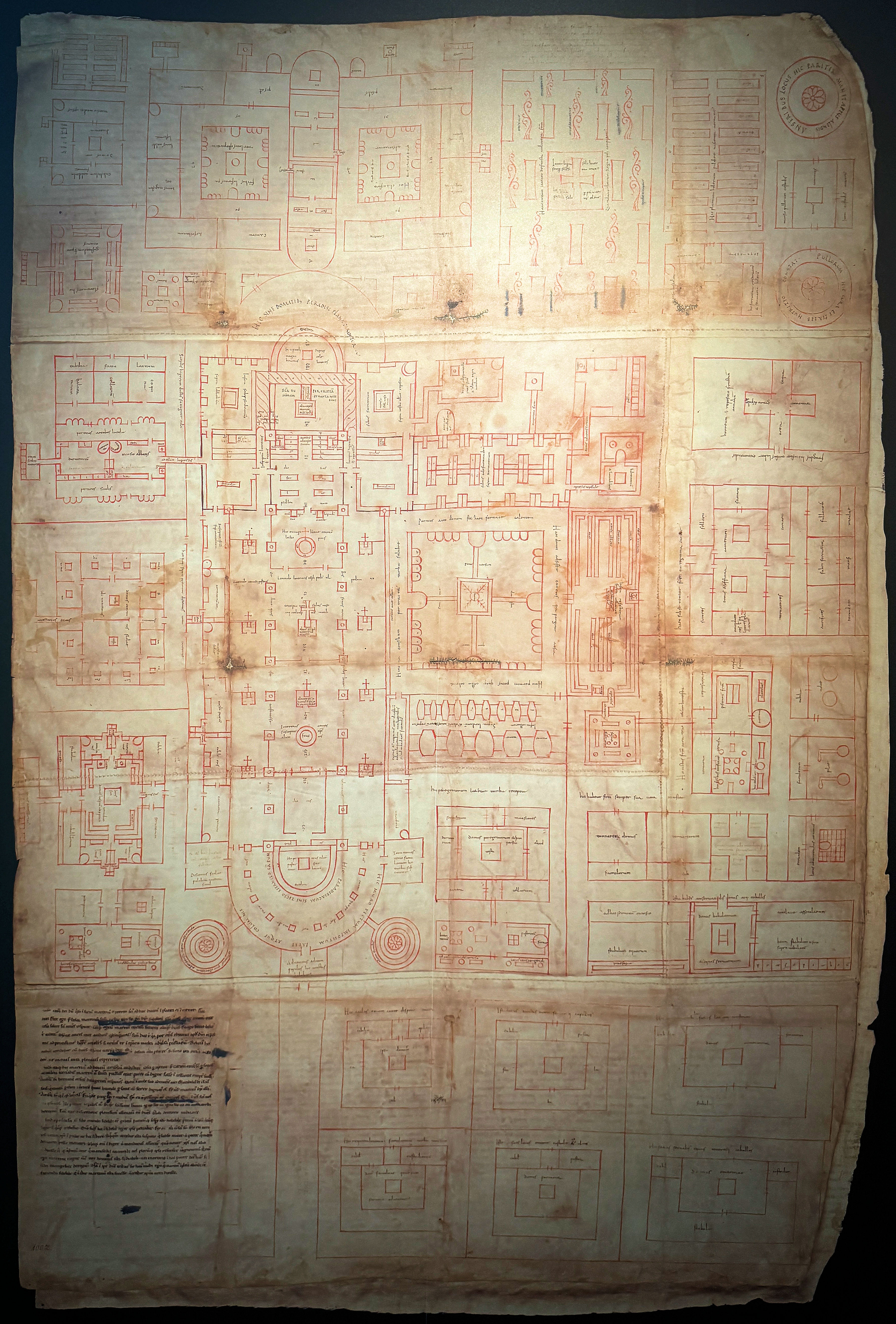
Click to enlarge
One of the exhibition's highlights is the Plan of Saint Gall, a medieval architectural drawing dating back to 820–830. It depicts an entire Benedictine monastic compound.

According to the latest investigations, the plan is an original drawing from Reichenau Abbey. Librarian Reginbert and the young monk Walafrid Strabo drew the plan and inscribed it with Latin verses. According to the inscription, it was intended to inspire Prior Gozbert at the St. Gall monastery.

St. Gallus
In the 820s, Gozbert planned to build a new abbey church to house the relics of the monastery's founder and namesake, the hermit Saint Gallus. Construction of the Basilica of Gall (Gallusbasilika) began in 830, and the church was sanctified after 835.

Reichenau Abbey was famous for its scribes and book illuminators.

The health problems of a scribe: A person who does not know how to write
does not believe it is work. O, how hard writing is: it dulls the eyes,
squeezes the kidneys, and simultaneously brings agony to all the limbs.
Three fingers write the whole body suffers ...

(Vita Harlinis et Reinilae around 850-880).
The dedicatory poem on the left reads:
This book, O Egbert, is full of divine teachings. Take it as a farewell greeting and rejoice for a long time.
In your honor, the blessed Au
(Reichenau) offers it to you, Bishop.
On the right, Reichenau monks Keralt and Heribert hand manuscripts to Archbishop Egbert of Trier.
The Codex Egberti is one of the highlights of Ottonian book illumination. The Evangelistary was made at the Reichenau and dedicated to the Archbishop of Trier, Egbert (977-993). The codex contains 51 scenes from the life of Christ, making it the oldest and most comprehensive series of images on this subject in the Middle Ages.

The statue of St. Mark in front of the Minster is dedicated to St. Mary and him
The next day of the summer trip, the group was taken to the Reichenau. The first stop was an extensive visit to St. Mary and St. Mark's Minster.


Abbot Haito had a Carolingian basilica built in a cruciform, parts of which are still preserved in the crossing and the east transept. It was consecrated on 16 August 816 in honor of the Virgin Mary. 

St. Marc's shrine is garnished with written intercessions
In 830, Verona Bishop Randolt transferred St. Mark the Evangelist's relics to the cathedral.

The nave of the basilica with a view of the altar
In April 2024, on the occasion of the cathedral's 1,300th anniversary, Pope Francis elevated it to the status of basilica minor.

An oversized Pirmin in a boat approaches the already built-up Reichenau
On the way to the church choir, we passed a painting depicting the monastery's origins.

Our guide is standing on the tomb slab of Duke Gerold,
a Prefect of Bavaria. He died in 799 (©hj)
Our guide was talkative and told us many stories, Dönekes, as they say in the Westphalian dialect. Indeed, he had my mother's accent. I told him outright that he was from Westphalia, to which he replied affirmatively.

On the right wall of the choir is Mary with the child, the Minster's patron saint.
View into the choir
The festive flag of the Catholic Church, based on the Vatican flag, is white for Christ, light, and resurrection. A dull yellow replaces gold, a surrogate that Germans know so well.

And there are plenty of celebrations in this church. In addition to the regular Catholic holidays, the people of Reichenau celebrate their island holidays. On the Feast of St. Mark on April 25, the Feast of the Holy Blood on the Monday after Trinity Sunday, and the Feast of the Assumption on August 15, all work stops, stores are closed, and children are off school. This is when the island people take the reliquaries from the cathedral treasury and carry them in processions across the Reichenau.

Painting in the choir: A list of the owners, patrons,
and benefactors of the Holy Blood of Jesus Christ here in Reichenau.
Another relic kept in St. Mary and St. Mark's Minster is the holy blood of Christ.


In the church's treasury, I saw a stained-glass window from 1510 depicting the Annunciation of Mary, flanked by Saints Pirmin and Benedict. The lower part shows the nativity scene with the three wise men from the East, identified here as kings in the early tradition.


On the way to the monastery garden, I passed a Pieta.


The exit from the church to the monastery garden was low and narrow.


Some participants sank to their knees before the splendor of the flowers in the center.


The impressive church building from the perspective of garden visitors.


One last look at the choir as we left for lunch at the restaurant "mein Inselglück" (My Island Bliss).

©MS (Click to enlarge)
After the meal, we reposed blissfully on the restaurant's terrasse, dozing or contemplating the "sweet" landscape.

Look into the western apsis
with a door through which our guide was supposed to arrive.
In the afternoon, our first stop was the church of St. George, built in the late 9th century to house the relic of the Saint's head. 


The Reichenau Abbot Hatto, who in 891 also became Archbishop of Mainz and thus Archchancellor of the East Frankish Empire, received a reliquary of the skull of St. George from Pope Formosus in Rome in 896. Our guide showed us a photo.

Our guide was devoted to her job.
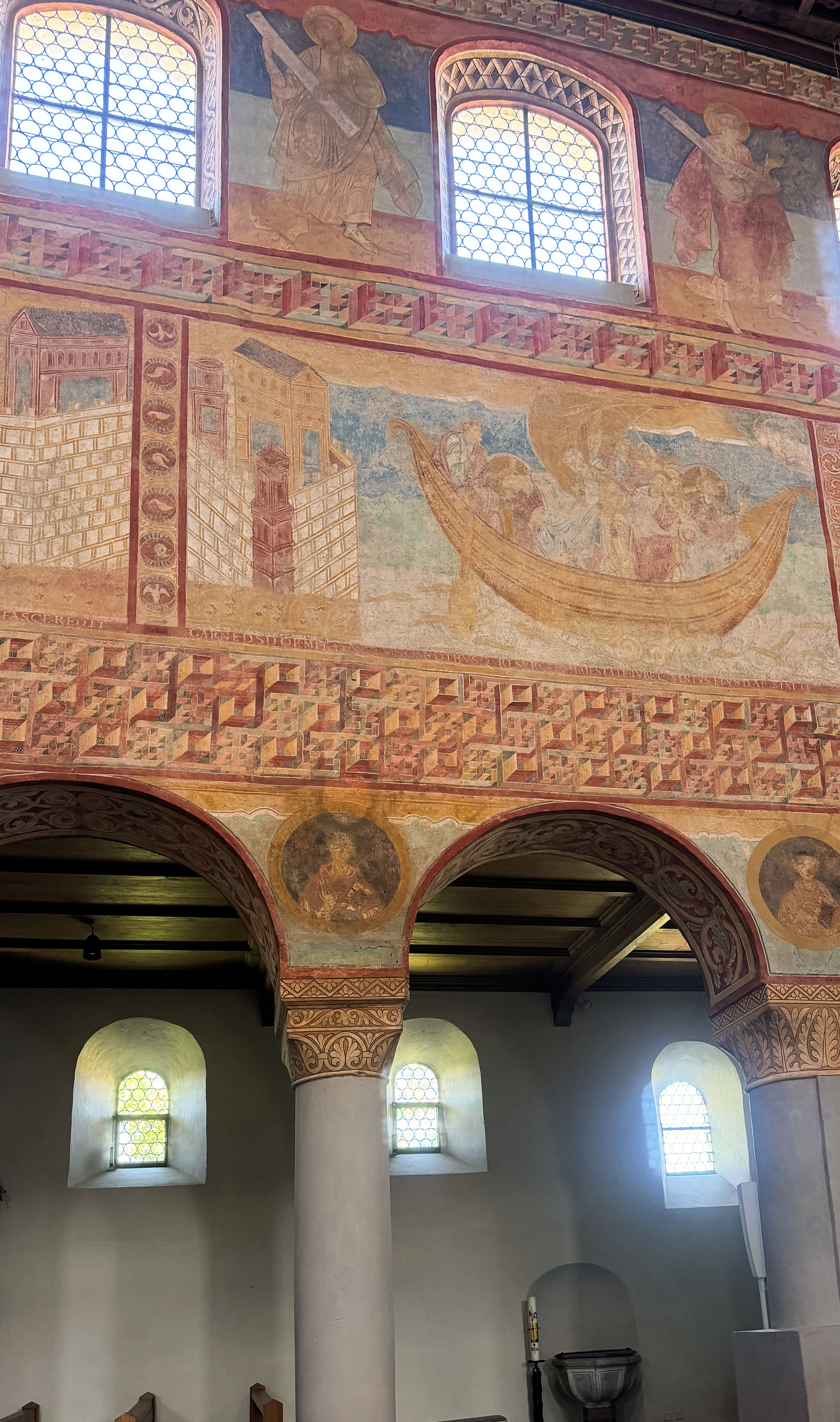
St. George is world-famous for its mural paintings dating back to the 10th century. These are often referred to as frescoes in English descriptions. The “correct” English description is fresco secco. I have changed the Wikipedia article on the Church of Saint George (Reichenau) accordingly.


This well-known story happened on Lake Genezaret near Capernaum: Then Jesus got into the boat, and his disciples followed him. Suddenly, a furious storm came up on the lake, so the waves swept over the boat. But Jesus was sleeping. The disciples went and woke him, saying, "Lord, save us! We're going to drown!" He replied, "You of little faith, why are you so afraid?" Then he got up and rebuked the winds and the waves, and it was completely calm. (Matthew 8:23-28).

The fresco-secco paintings on the other side.

The German expression Es geht auf keine Kuhhaut is translated into English as "It's going too far," or "It beggars description," and today, it means just that. But where does the strange expression come from? Here is the famous mural of a cow's skin at St. George. A devil writes on it, "I want to write here about the stupid women; the blah-blah spoken here all week will be remembered when it comes before the judge."

The inscription is aimed at female churchgoers who gossip and spread lies and fake news. In the Middle Ages, people believed the devil recorded all sins on parchment. The predecessor of today's paper was made from goatskin or cowhide. As parchment was expensive, only the essential things were written down. For the devil, these were sins. When there were too many, they would no longer fit on a cow's skin.

Prof. Zotz is waiting for a few latecomers
to begin his lecture on the church's history.
Our last stop on this remarkable Museumsreise was a visit to the Romanesque Basilica, St. Peter and Paul. Bishop Egino of Verona built the first church on this site in 799. After his resignation and Abbot Waldo's permission, Egino withdrew to his richly furnished cella on the western tip of Reichenau, where he died in 802. 

 Thank you, Thomas. You immersed the group deeply into the medieval history of Reichenau Island. Thanks to Gertraud, too, for the perfect organization of this trip.
**