Many friends know I spent eight years of secondary education in Hamburg.
Therefore,
I long to visit the city whenever possible. In fact, my former class holds reunions annually, so I am in Hamburg at least
once a year. Since remembering dates becomes challenging with age, those still
alive meet on the third weekend in September. Here is
the link to picture galleries
of those class reunions dating from 2002 to 2019.
In January 2017, I was in Hamburg to listen to a
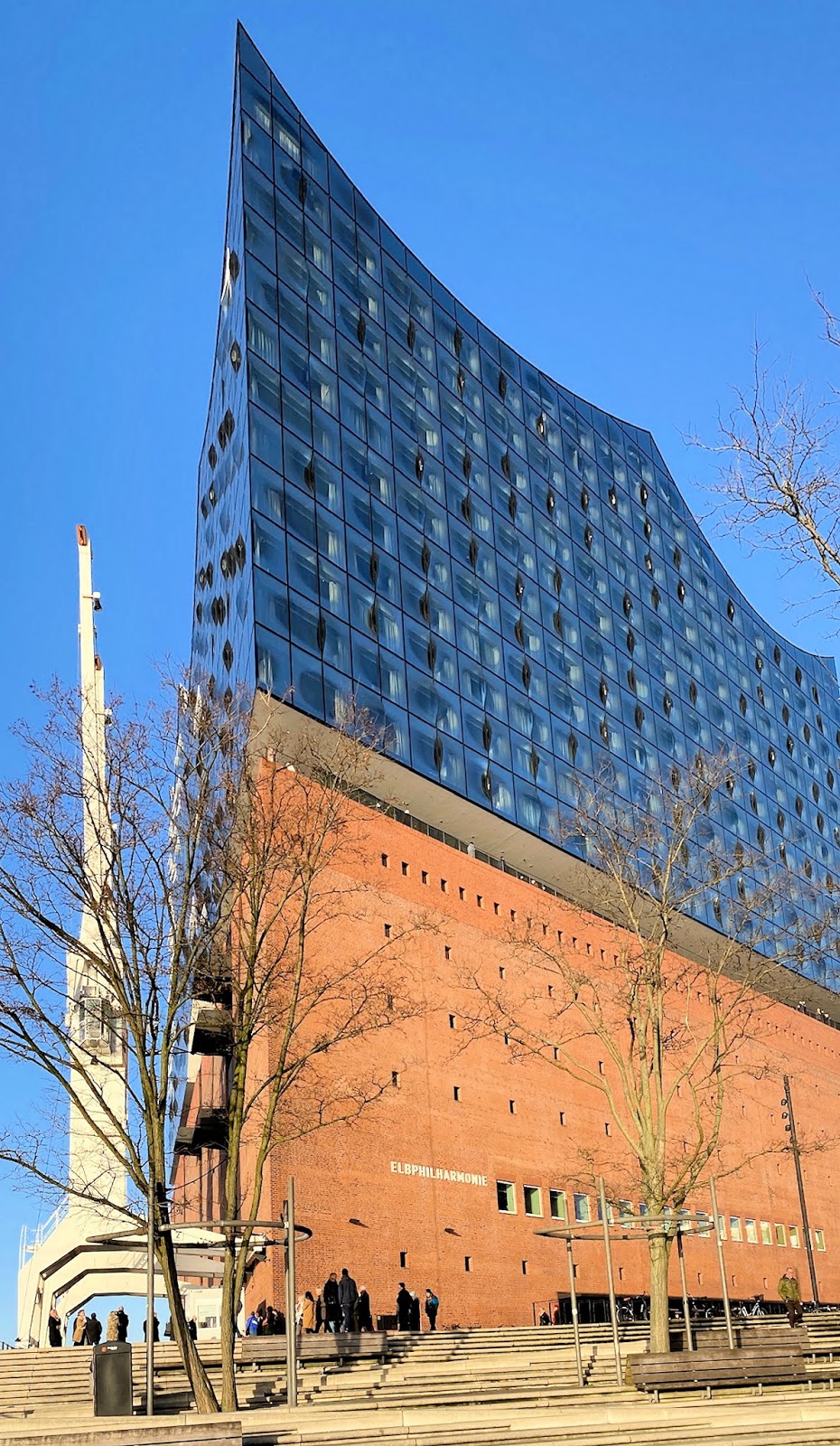
concert at the Elbphilharmonie
(Elphi). This new landmark had been inaugurated just the week before. The
resulting trilogy of blogs further
described some highlights of Hamburg and focused on
the famous Miniatur Wunderland.
Last year, I was in Hamburg for my class reunion in September, then in November,
and later, I celebrated the turn of the year on a boat on the Elbe River.
My visit in November had a double purpose.
The
Fachverband für Strahlenschutz (FFS), the German-Swiss Radiation
Protection Society, hosted a two-day seminar on the new German Radiation
Protection Act at DESY (
Deutsches Elektronen-Synchrotron), the high-energy physics laboratory located in Hamburg.
Retired members of the Fachverband paid a well-reduced conference fee, including
a guided tour of DESY. That made me curious to learn about new developments in
my old trade.
The other reason for my trip was to determine whether the visitors' tour of DESY
would be worth an excursion to Hamburg in 2020 as part of the "
Museumsreisen."
You may know that Red Baron is a member of Freiburg's oldest citizens' society, founded in 1807, called
Museumsgesellschaft. Last year, our society visited
the city of Schwäbisch Hall and its surroundings. I published some
stray observations in a blog as splinters during that trip.
On November 17, Red Baron boarded the ICE train from Freiburg to Hamburg. The
ride took six and a half hours, but I like soft traveling, although I no longer
enjoy
Butterkuchen
(with time," the quality of the cake was strained"). I would rather have a pot
of coffee served on the train with a slightly salty and crusty
Laugen croissant bought at Freiburg's train station.
I stayed at the Hotel Harbor Hamburg near the S-Bahn station
Landungsbrücken (jetty facilities).

|
|
View of the Landungsbrücken at the waterfront. The display on
the tower to the left shows the tide mark.
|
I had a splendid view of the port and the
Elbe River from my hotel.
On the waterfront at
Landungsbrücken in the evening, I had one of the
best
Finkenwerder Speckscholle (a plaice baked in finely diced bacon) in
my life, crowned by a
Hamburger Rote Grütt (red berry groats with
vanilla ice cream instead of the original vanilla custard).
The hotel featured a tower with a bar that offered fantastic views of the city and
harbor.

|
Looking upstream:
In the back, in the middle, the dark silhouette of the
Elbphilharmonie
|

|
Looking downstream:
The dome of the Elbtunnel in the middle, near the waterfront, and
illuminated dry docks in the background
|
FFS
What did I learn at the seminar
on radiation protection, having been out of business for nineteen years? Twenty years ago, the annual dose limit to the body of persons
exposed to ionizing radiation in the course of their profession was lowered from 50 to 20 mSv, and radiation protection abandoned the notion of critical organs that had to be specially protected.
Now, the "lens of the eye" rears its head again as a "critical organ" with an annual dose limit of 20 mSv. In fact, there may be radiation situations
where special efforts must be made to protect the lens from beta radiation.
This is not true for flying personnel exposed to high-energy radiation during
flights. Their individual doses are not measured but calculated and attributed
to the route flown. Nowadays, pilots and cabin crews are among the most exposed
people.
DESY
During the introduction to DESY and before the guided tour, I learned that the
institute is now part of the Helmholtz Community, a network of German research
institutes.

|
In the interactions of high-energy electrons with high-energy protons,
the electrons explore the structure of protons by deep inelastic
scattering.
|
The HERA tunnel and accelerator (in orange) run deep below the city of Hamburg
and cross under the famous
Volkspark soccer stadium, home of the
frustrating HSV (
Hamburger Sportverein).

|
Inside the HERA tunnel. Dismantling the accelerator is too
expensive.
Abandoned and partially cannibalized, it is showcased as a highlight for
visitors.
|

|
Starting at DESY and heading over 3.4 kilometers
northwest into the
neighboring State of Schleswig-Holstein.
|
DESY's newest tool is the European XFEL (X-Ray Free-Electron Laser Facility)
commissioned
in 2017. The machine
is constructed such that the electrons produce X-ray light in
synchronization, resulting in high-intensity X-ray pulses with the properties
of laser light and at intensities much brighter than those produced by
conventional synchrotron light sources (Wikipedia).
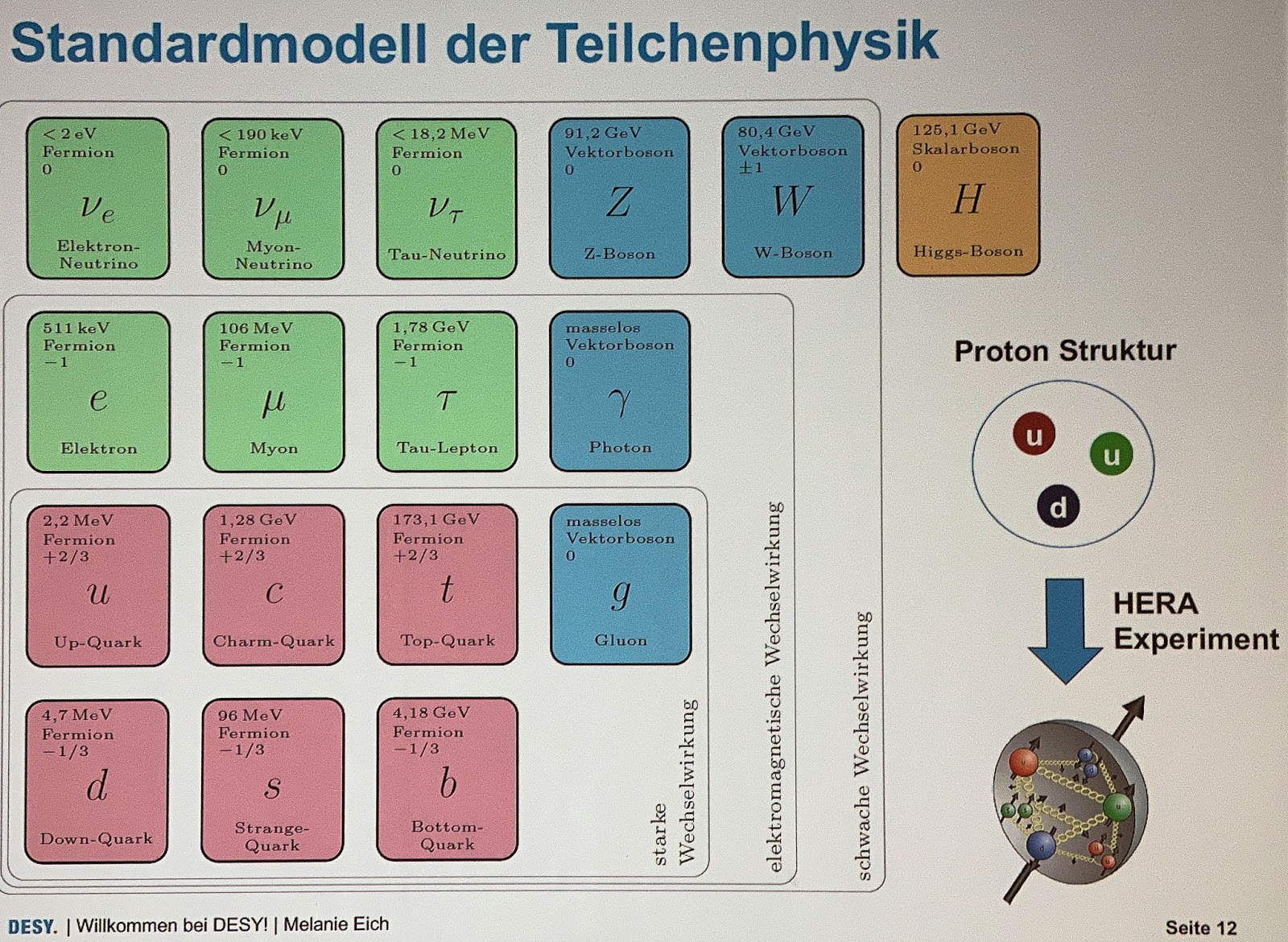
|
|
Showing the basic building blocks of matter.
|
The Standard Model of particle physics is elegant, but physicists look further. No sign of New Physics exists even with the highest energies at CERN. Frustration becomes more pronounced as the years pass. Here is a glimpse of
hope, a possible crack in the Standard Model:
The latest LHCb result is the first test of lepton universality made using
the decays of beauty baryons – three-quark particles containing at least one
beauty quark. Sifting through proton-proton collision data at energies of 7,
8, and 13 TeV, the LHCb researchers identified beauty baryons called Λb0 and
counted how often they decayed to a proton, a charged kaon, and either a muon
and antimuon or an electron and antielectron.
The team then took the ratio between these two decay rates. If lepton
universality holds, this ratio should be close to 1. A deviation from this
prediction could, therefore, signal a violation of lepton universality. Such a
violation could be caused by the presence in the decay of a
never-before-spotted particle not predicted by the Standard Model.
The team obtained a ratio slightly below 1, with statistical significance of
approximately 1 standard deviation, well below the 5 standard deviations required to
claim a real difference in the decay rates. The researchers say that the
result aligns with other findings, which have observed
hints that decays to a muon–antimuon pair occur less frequently than those to an
electron–antielectron pair. Still, they also stress that much more data is needed
to determine whether this oddity in lepton behavior is here to stay.
Read
the full article here.
There are many open questions in physics, particularly about dark matter and
energy. And here is a "wanted" poster with fancy "names" to illustrate what we
still do not know but would like to learn.
DESY can no longer fly on the one wing of high-energy physics. The Federal
Republic and the Hamburg Senate will transform the DESY complex into a
multidisciplinary Science City, aiming for synergistic effects in the years to come.
The taste of Hamburg or Franzbrötchen is just delicious.

|
|
A unique outlet at Hamburg's Central Station.
|
Finding food in Hamburg to take on the train is straightforward. The
underdeveloped culture of
the Laugen croissant in northern Germany is quickly
forgotten when you opt for
Franzbrötchen, a small, sweet pastry baked
with butter and cinnamon.

|
|
franz & friends offer the standard variety, as well as fancy new
creations of Franzbrötchen.
|

|
In 1812, the French Empire swallowed up the Habsburg and the Protestant
Netherlands.
(Département des bouches du Rhin) as well as northern Germany (Département des bouches de l'Elbe)
including the cities of Hamburg and Lübeck.
They say that Napoleon intended to build a canal on French territory
connecting
the Seine River with the Baltic Sea
|
The pastry's name dates back to the French occupation, when, in 1812, Hamburg was part of France under Napoleon's Grand Empire. Even then, the French
occupiers ate better than the Germans. Instead of the
petits pains, the
former preferred the sugared version that the people from Hamburg reverently
called
französische Brötchen. The name and recipe stuck.
**